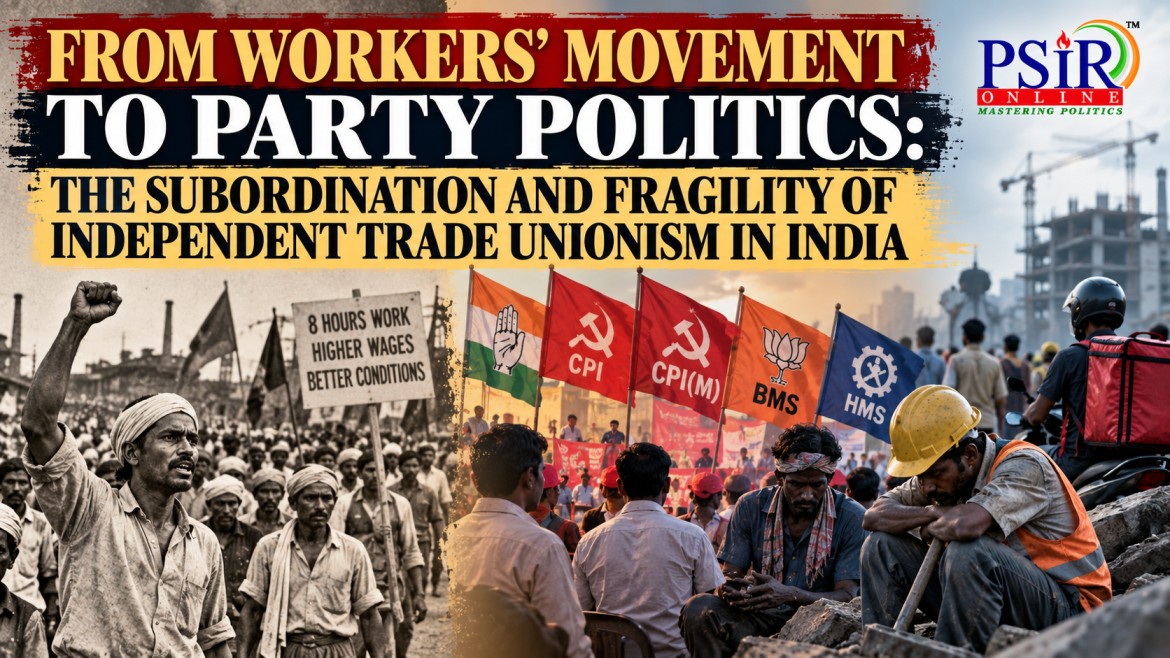
India’s labour history represents a century-long struggle for collective bargaining, fair wages, occupational safety, and industrial democracy. From early organizing in Bombay's textile mills, the railways, and colonial plantations, the formal establishment of the All India Trade Union Congress (AITUC) in 1920 anchored organized labour as a national political force. However, this movement was never insulated from partisan crosscurrents. Over successive decades, trade union federations developed not as autonomous worker-run platforms, but as institutional arms and organized mass fronts of major political formations: the Indian National Congress (INTUC), the Communist Party of India (AITUC), the CPI(M) (CITU), socialist currents (HMS), and the RSS/BJP ideological spectrum (BMS).
While partisan affiliation once offered organized labour legislative leverage and political visibility, it produced a debilitating structural trade-off: the subordination of workers' material autonomy to external party interests, organizational fragmentation along ideological lines, and a growing disconnect from India's vast informal and contractual workforce.
The Evolution of Federations: Ideological Pluralism or Partisan Fragmentation?
The post-independence trajectory of Indian unionism reflects the ideological cleavages of the broader party system rather than the natural economic aggregation of workers' interests:
· All India Trade Union Congress (AITUC, 1920): Formed to unify anti-colonial labour demands, it became closely tethered to the undivided Communist Party of India (CPI), operating as an instrument of class-conscious political mobilization.
· Indian National Trade Union Congress (INTUC, 1947): Founded on the eve of independence by Congress leaders, INTUC embraced Gandhian notions of arbitration, class conciliation, and industrial peace, explicitly intended to counter communist militancy in strategic industrial hubs.
· Hind Mazdoor Sabha (HMS, 1948): Established by socialist pioneers resisting both Congress paternalism and communist centralism, carving out a non-communist democratic socialist front.
· Bharatiya Mazdoor Sangh (BMS, 1955): Emerging out of the Rashtriya Swayamsevak Sangh (RSS) milieu, BMS rejected Marxist concepts of class conflict in favor of organic national integration and non-adversarial labour relations.
· Centre of Indian Trade Unions (CITU, 1970): Born directly out of the ideological schisms that split the communist movement and created the CPI(M), solidifying ideological competition within organized shop floors.
This proliferation institutionalized a structural anomaly: workers facing identical workplace exploitation, wage caps, and hazardous working conditions within the same factory or public utility found themselves splintered into competing unions owing allegiance to rival political bosses.
THE STRUCTURAL COST OF POLITICAL SUBORDINATION
Partisan sponsorship provided access to state dispute-resolution machinery, legislative lobbies, and tri-partite boards. Yet, it introduced severe organizational liabilities that eroded the independence of the trade union movement:
THE VICIOUS CYCLE OF PARTISAN LABOUR UNIONISM
Political Party Dominance & Cadre Integration
▼
Union Priorities Subordinated to Electoral Strategy / Governance
▼
Inter-Union Rivalry & Organizational Fragmentation on Shop Floors
▼
Periodic Strike Mobilisation Replaces Everyday Plant Representation
▼
Worker Disillusionment & Flight to Enterprise / Informal Collectives
1. Accountability Inversion (Party Interest vs. Worker Mandate): When an allied political party holds governmental office, affiliated unions face systemic pressure to temper strike notices, accept concessions, or avoid challenging state disinvestment and austerity policies. Conversely, the same union is mobilized aggressively when its patron party is in opposition, turning shop-floor action into a tool for electoral disruption rather than member-led negotiation.
2. Fractionalization of Collective Bargaining: Multiple party-backed unions operating within the same industrial unit engage in cut-throat rivalry for recognized status. Instead of forming a united bargaining front against management, unions expend their resources undercutting competitors, enabling employers to divide workforces and suppress wage growth.
3. Electoral Mobilization Over Continuous Service: Politically tethered federations frequently prioritize national general strikes, symbolic rallies, and voter-turnout drives during election cycles. They often neglect the tedious, everyday casework required by workers: individual grievance redressal, arbitrary contractual dismissals, occupational health hazards, and PF disputes.
4. Atrophy of Independent Internal Leadership: Key leadership echelons are frequently staffed by external party functionaries, career politicians, or designated ideologues rather than workers rising organically from the shop floor. This institutional arrangement insulates union leadership from direct membership accountability.
THE CONTEMPORARY CRISIS: A FRAGMENTED WORLD OF WORK
The traditional architecture of party-run federations was engineered for concentrated, public-sector enterprises, mines, ports, and large manufacturing plants with identifiable single employers and stable, permanent payrolls. The post-1991 economic transformation has dismantled that baseline, pushing conventional political unionism into structural irrelevance:
· Pervasive Informalisation: Over 90% of India's labour force is engaged in informal employment, small retail, brick kilns, gig work, domestic labor, and seasonal agriculture. Party federations, rooted in formal collective bargaining laws, lack the institutional agility to organize unorganized workers across fragmented worksites.
· Contractualisation and Outsourcing: Even inside formal industrial belts, permanent workers have been replaced by multi-tier contract laborers, trainees, and platform workers. Traditional unions have historically protected the privileges of shrinking permanent cohorts, leaving contract workers marginalized and unrepresented.
· Worker Cynicism and the Search for Autonomy: When workers realize that their union leaders are executing party directives or colluding with regional political patrons, collective subscription collapses. Disenchantment has led to wildcat strikes, autonomous enterprise-level worker committees, and localized mutual-aid groupings that intentionally bar politicians from their executive boards.
HAS INDEPENDENT UNIONISM DISAPPEARED?
The claim that independent trade unions have completely vanished from the Indian landscape oversimplifies a complex reality. While politically affiliated federations maintain institutional dominance over formal tripartite policy boards and parliamentary consultations, autonomous worker-led models persist at the margins:
|
Parameter |
Politically Dependent Model (INTUC, CITU, BMS, etc.) |
Worker-Centred Autonomous Model |
|
Primary Accountability |
Subordinated to party high-command and electoral calculations. |
Accountable to rank-and-file workers through internal secret-ballot votes. |
|
Bargaining Mandate |
Mediated by party alignments with the ruling or opposition regime. |
Exclusively anchored to workplace grievances, wage parity, and safety. |
|
Leadership Origin |
Often external political appointees or party cadres. |
Organic shop-floor workers elected from within the establishment. |
|
Approach to Politics |
Partisan alignment; mobilizing cadre as electoral vote banks. |
Non-partisan; engaging with parties issue-by-issue based on worker welfare. |
|
Workforce Inclusivity |
Skewed toward permanent, formal, and public-sector workers. |
More adaptable to contract workers, gig laborers, and informal collectives. |
Independent unionism survives through enterprise-level unions in manufacturing corridors, independent transport bodies, tea garden worker collectives, and organizations like the Self-Employed Women’s Association (SEWA). However, these formations face intense structural constraints: administrative delays in statutory registration under the Trade Unions Act, employer hostility, and marginalization by established party federations during national tripartite negotiations.
RECLAIMING THE MOVEMENT: THE TRANSITION TO MEMBERSHIP-CENTRED UNIONISM
The International Labour Organization (ILO) has argued that Indian political unionism requires a decisive paradigm shift. Revitalizing trade unionism does not require workers to become apolitical—labour rights are inherently political questions regarding the distribution of national wealth, industrial authority, and social security. Instead, it requires de-linking worker representation from partisan subservience.
A sustainable model of contemporary trade unionism requires:
· Enforcing Internal Democracy: Establishing regular, secret-ballot elections, open financial disclosures, and limits on external non-working leadership within executive boards.
· Bridging the Regular-Contract Divide: Structuring collective bargaining demands around equal pay for equal work, non-negotiable health safety for contract labor, and regularized benefits across outsourcing chains.
· Service-Oriented Advocacy: Building legal aid desks, wage-claim grievance machinery, and emergency mutual assistance funds to provide direct, tangible value to workers beyond political demonstrations.
· Cross-Ideological Issue Coalitions: Fostering functional issue-based solidarity among diverse federations on common regulatory challenges—such as changes to industrial disputes law and social security frameworks—while resisting the impulse to reduce union platforms into electoral appendages.
The legitimacy of organized labour rests on its capacity to defend workers' everyday dignity and material well-being. When party discipline supplants democratic accountability to the shop floor, the trade union ceases to function as a vehicle for worker liberation, becoming just another instrument of political management.
PSIR DIMENSION: THEORETICAL CONCEPTS & EXAMINATION LINKAGES
|
PSIR Theoretical Dimension & Concepts |
How It Connects to Examination Answers (PSIR Paper 1 / Paper 2) |
|
Corporatism vs. Pluralist Interest Intermediation (Philippe Schmitter; Alan Cawson) |
State-Sponsored Labour Subordination: Contrasts autonomous pluralist collective bargaining with state/party corporatism. Explains how post-independence Indian federations (INTUC, CITU, BMS) were co-opted as transmission belts of political parties, subordinating independent shop-floor militancy to electoral discipline and state industrial targets. |
|
"Business Unionism" vs. "Political Unionism" (Robert Hoxie; Selig Perlman) |
The Representational Dilemma: Hoxie distinguished between purely economic/service-oriented bargaining ("business unionism") and revolutionary/ideological mobilizations ("political unionism"). Frames the crisis of Indian trade unions as an over-extension of partisan political mobilization at the cost of continuous workplace representation. |
|
Working-Class Fragmentation & Hegemony (Antonio Gramsci; E.P. Thompson) |
Fractured Class Consciousness: Applies Gramsci’s concept of political fragmentation preventing the formation of a unified counter-hegemony. Shows how partisan unionization split workers in identical industrial sectors along party/caste lines, weakening collective bargaining against capital and the state. |
|
Informal Economy & "Politics of the Governed" (Partha Chatterjee; Jan Breman – Footloose Labour) |
The "Insider-Outsider" Divide in Labour: Contrasts the protected, unionized formal-sector workforce (civil society) with the expanding informal, contractual, and gig workforce (political society). Explains why traditional trade unions struggle to organize informal workers, who negotiate survival through ad-hoc welfare patronage rather than statutory collective bargaining. |
|
Accumulation by Dispossession & Neo-Liberal Deregulation (David Harvey; Prabhat Patnaik) |
Post-1991 Economic Restructuring: Analyzes how liberalisation, contractualisation, and the consolidation of the four Labour Codes dismantled permanent industrial shop floors, eroding the structural foundations upon which traditional union federations historically operated. |
|
Autonomous Labour Assertion & Wildcat Unionism (Rosa Luxemburg – The Mass Strike; Dipesh Chakrabarty) |
The Flight from Party-Tethered Federations: Explains the emergence of autonomous enterprise-level unions and wildcat actions (e.g., in automotive manufacturing corridors like Manesar/Sriperumbudur) as a direct rebellion against bureaucratic party federations co-opted by management and state machinery. |
CONCLUSION
The transformation of Indian trade unionism—from an anti-colonial movement of mass emancipation into party-affiliated federations—reveals the central structural dilemma of organized labour in India: the conflict between political patronage and class autonomy. While political affiliation historically granted unions institutional access, legislative influence, and tripartite representation, it extracted a severe price: ideological fragmentation on the shop floor, subordination to electoral calculations, and an entrenched leadership insulated from rank-and-file workers. In the contemporary political economy, defined by aggressive informalisation, contractualisation, and the consolidation of the new Labour Codes, this party-centred model has reached an institutional impasse.
Reclaiming the vitality of the labour movement does not necessitate becoming apolitical, as the defense of labour rights is an intrinsically political contestation over economic distribution and constitutional dignity. Rather, as emphasized in the International Labour Organization's call for a paradigm shift, trade unionism must transition toward democratic, service-oriented, and membership-driven models. The future relevance of collective bargaining in India depends on whether unions can organize beyond the shrinking enclave of permanent formal labour, bridge the chasm with contractual and gig workers, and restore sovereign deliberative control to the working class.
RELATED READING & ANALYTICAL ANGLES
· The Political Economy of Labour Deregulation:
o Core Focus: The transition from the colonial-era Trade Unions Act, 1926, and the Industrial Disputes Act, 1947, to the modern consolidation under the Industrial Relations Code, 2020.
o Key Angles: The statutory thresholds for union recognition, severe restrictions imposed on the right to strike (mandatory 14-day notice across all industrial establishments), and the rise of fixed-term employment.
· The Informalisation and Contractualisation Dilemma:
o Core Focus: The structural divide between the dwindling permanent workforce and the growing mass of precarious contract, platform, and informal labor.
o Key Formulations: Jan Breman, Footloose Labour: Working in India's Informal Economy; Pong-Sul Ahn (ILO Report), The Growth and Decline of Political Unionism in India: The Need for a Paradigm Shift.
· The Historical Sociology of Indian Labour:
o Core Focus: The organic links between the freedom struggle, ideological splits in the socialist/communist movements, and the emergence of rival national federations (AITUC, INTUC, HMS, BMS, CITU).
o Key Texts: Bipan Chandra et al., India's Struggle for Independence (chapters on the working-class movement); Sukomal Sen, Working Class of India: History of Emergence and Movement 1830–2010.
· Autonomous Worker Movements & New Labour Formations:
o Core Focus: Grassroots alternatives to party-affiliated federations—enterprise-level bargaining, women-led informal unions (e.g., SEWA), and new gig-worker associations (e.g., app-based transport and delivery unions).
o Key Angles: How horizontal worker collectives deploy digital networks and public-interest litigation instead of formal political party patronage.
PRACTICE QUESTIONS FOR PSIR
