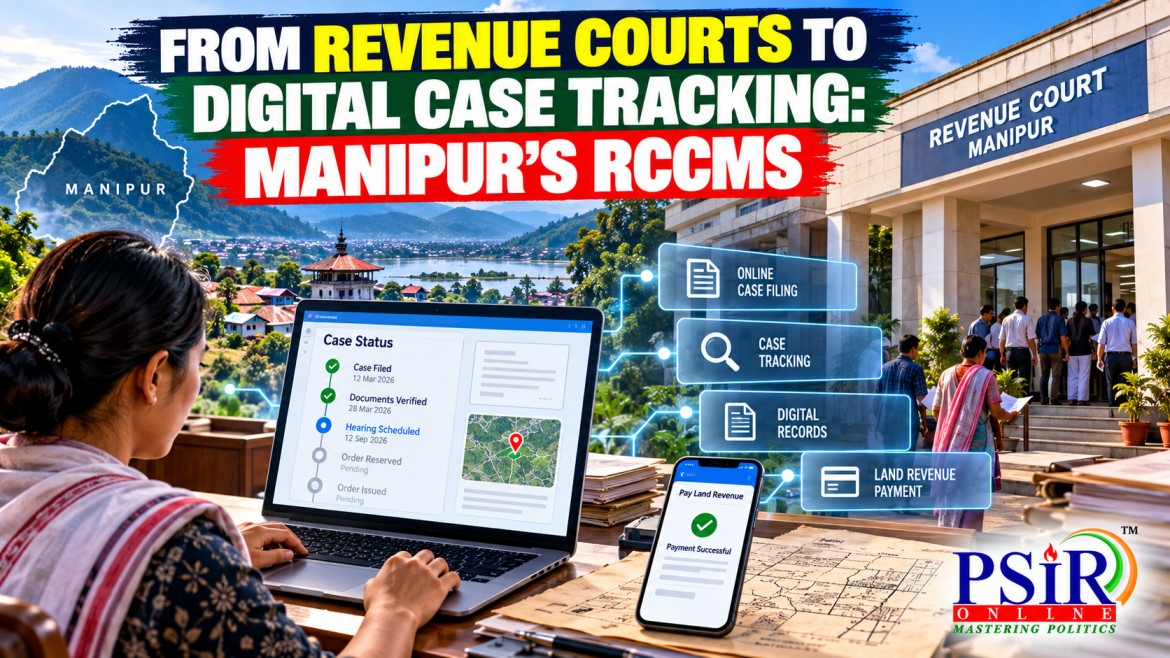
Land administration is closely connected with livelihoods, property rights, agricultural activity and local development. Disputes over land records, ownership, boundaries, transfers and revenue assessments can require citizens to approach revenue officials and administrative courts. When case information is difficult to access or records are maintained through fragmented procedures, citizens may face repeated visits, uncertainty about hearing dates and delays in obtaining decisions.
To modernise these processes, the Government of Manipur launched the Revenue Courts Case Management System (RCCMS) on 7 August 2026, alongside online land-revenue payment facilities and other digital services of the Land Resources Department. The launch was reported by the National Informatics Centre (NIC), which contributed to the development of the digital services.
RCCMS forms part of a wider effort to digitise land administration in the state. Its importance lies in the possibility of making revenue-court proceedings easier to track, improving the management of case records and reducing avoidable administrative friction.
However, digital case tracking is not the same as faster adjudication. The effectiveness of the system will depend on reliable land records, trained personnel, functional connectivity and the ability of revenue authorities to resolve disputes fairly and within reasonable timeframes.
WHAT IS RCCMS AND WHY DOES IT MATTER?
The Revenue Courts Case Management System is designed to support the digital management of revenue-court proceedings. At the national level, the Department of Land Resources identifies the computerisation of revenue courts and their integration with land records as components of the Digital India Land Records Modernization Programme (DILRMP).
The Department's RCCMS framework envisages a centralised digital platform supporting case filing, document storage, case tracking, scheduling, notifications, reporting and access to case decisions. It also envisages links with land-record databases and a monitoring dashboard covering pending cases and other indicators. Individual states may customise the system to their administrative requirements.
In Manipur, the system was launched as part of a broader digital land-administration initiative. Contemporary reporting describes features for online filing and tracking of revenue-court cases, including hearing dates, case status and orders. The state's integrated Land Resources Department gateway also lists RCCMS among its services.
The initiative matters because revenue-court administration involves both legal and administrative processes. Citizens need to know whether a case has been registered, when it will be heard, what documents are required and whether an order has been issued. Officials, in turn, need reliable records to manage their caseloads and identify pending matters.
A digital system can make these processes more visible. Whether it reduces delays in practice will depend on implementation, record quality and the capacity of the relevant institutions.
HOW DIGITAL CASE TRACKING CAN IMPROVE REVENUE ADMINISTRATION
A case-management platform can support revenue-court administration in several ways.
Case registration and document management: Digitally organised applications and supporting documents can make it easier for officials to retrieve case files and maintain procedural records. Where digitisation is complete and reliable, it may reduce dependence on repeated manual searches through physical files.
Hearing schedules and case status: Access to hearing dates and case progress can help citizens and their representatives prepare for proceedings. Timely updates may also reduce unnecessary visits to revenue offices merely to obtain routine information.
Access to orders: Digital availability of orders can make it easier for parties to obtain records of decisions and determine what administrative steps may follow. Users must still verify the authenticity of documents and comply with applicable procedural requirements.
Monitoring pending cases: Digital reports can help supervisory officials identify backlogs, examine the age of pending matters and assess whether particular stages are causing delays.
These functions are consistent with the broader objectives of the Department of Land Resources' RCCMS framework.
Consider a landholder who has filed a revenue-related dispute. A functioning case-management system could allow the person to check the hearing date and case status without repeatedly travelling to the relevant office. The official handling the matter could access the available documents and monitor the procedural history.
Such benefits are conditional. They depend on accurate data entry, regular updates and the extent to which the relevant court's proceedings have actually been digitised. A portal that displays outdated information may create additional uncertainty rather than reduce it.
ONLINE LAND-REVENUE PAYMENTS AND INTEGRATED DIGITAL SERVICES
The August 2026 launch also included online payment of land revenue. This is a related but distinct service: RCCMS focuses on revenue-court proceedings, whereas online payment facilities support the financial transactions associated with land revenue.
Manipur's existing Loucha Pathap portal provides digital land-tax payment options, payment verification and transaction-history facilities. Its official website states that online payment is available for computerised Land Resources villages where the facility has been activated.
The state's wider digital land-administration gateway brings together services including land registration permissions, change of land use, land allotment, land-record access and revenue-court case management. This offers a common entry point for different services while retaining distinct procedures for each.
The potential governance benefits include:
· Convenience: eligible users can pay land revenue digitally rather than relying exclusively on in-person transactions.
· Payment traceability: digital receipts and transaction histories can help users verify payments and resolve discrepancies.
· Reduced administrative friction: integrated access can make it easier to discover the appropriate service.
· Improved record management: linking relevant services may support better coordination between payment records and land-administration processes, where the underlying systems are interoperable.
However, payment digitisation does not resolve every land-record problem. A successful tax payment does not, by itself, establish ownership, settle a boundary dispute or correct an inaccurate land record. The legal significance of each record and transaction must be assessed under the applicable laws and procedures.
RCCMS, DILRMP AND THE WIDER DIGITAL LAND-GOVERNANCE FRAMEWORK
RCCMS should be understood as part of the wider effort to modernise land administration rather than as a standalone case-tracking application.
The Digital India Land Records Modernization Programme (DILRMP) seeks to improve land-record management through computerisation and related reforms. The Department of Land Resources identifies the computerisation of revenue courts and their integration with land records as a component of this programme.
The relationship between case-management and land-record systems is important. A revenue dispute may involve information from land registers, maps, mutation records, administrative orders and other documents. If relevant records can be accessed reliably, officials may find it easier to assemble the material needed for proceedings.
Interoperability can also help supervisory authorities understand patterns in disputes and identify recurring administrative problems. For example, repeated cases involving inconsistent entries or delayed updates may point to weaknesses in record-maintenance procedures.
Yet integration must be handled carefully. Different systems may use different identifiers, formats and verification procedures. Incorrectly linked records could create confusion, while sensitive personal or property information requires appropriate access controls and security safeguards.
The broader objective should therefore be reliable and legally meaningful integration, not simply the connection of multiple databases. Digital systems must preserve the distinction between recorded information, contested claims and decisions made by competent authorities.
IMPLEMENTATION CHALLENGES AND CITIZEN ACCESS
Digitisation can improve the administration of revenue cases, but several underlying constraints require attention.
Incomplete or inaccurate land records: A digital platform cannot automatically correct errors in historical records, disputed boundaries or inconsistent entries. Data verification and established procedures for correction remain essential.
Staffing and institutional capacity: Case tracking can reveal backlogs, but it cannot independently provide additional officers, legal expertise or hearing time. If the workload exceeds institutional capacity, pending cases may remain unresolved despite improved information systems.
Digital exclusion: Citizens with limited internet access, low digital literacy, disabilities or language barriers may find online procedures difficult to use. Assisted access through local offices and clear public guidance remain important.
Data security and privacy: Case files and land records may contain sensitive personal and property-related information. Authentication, access controls, secure storage and procedures for correcting errors are necessary to protect citizens.
Procedural fairness: Digital systems should support, rather than replace, lawful notice, opportunities to present evidence, reasoned decisions and available appeal or review procedures. Citizens must be able to challenge inaccurate information and obtain clarification from the responsible authority.
Monitoring outcomes: The government should distinguish between the number of cases entered into the system and the number actually resolved. Useful indicators include the age of pending cases, time between procedural stages, frequency of data updates, accessibility of orders and user experience.
The system's impact should ultimately be assessed through evidence about administrative performance and citizen experience, rather than the launch of the portal alone.
UPSC ANGLES
|
Dimension |
Relevance for UPSC |
|
Land administration |
Digital case management can improve the organisation of revenue proceedings and access to land-related records. |
|
Administrative justice |
Case-status information and access to orders can make administrative proceedings more transparent and predictable. |
|
E-governance |
RCCMS illustrates the use of information technology in case management, record retrieval and administrative monitoring. |
|
Public service delivery |
Online land-revenue payments and integrated service portals can reduce some routine administrative burdens. |
|
Digital India |
RCCMS forms part of the wider modernisation of land records under DILRMP. |
|
Accountability |
Digital records and dashboards can help supervisory authorities monitor pendency and procedural progress. |
|
Inclusion and accessibility |
Assisted digital services are necessary for citizens who face connectivity, literacy or accessibility barriers. |
|
Institutional capacity |
Staffing, training, record quality and timely hearings remain essential to reducing delays. |
|
Rule of law and fairness |
Digitisation must preserve due process, access to relevant records and the ability to challenge errors. |
|
Outcome evaluation |
Case disposal, pendency, procedural timeliness and citizen experience are more meaningful measures than the number of digital records alone. |
CONCLUSION
Manipur's RCCMS, launched on 7 August 2026 alongside online land-revenue payment services, represents an effort to make land administration more accessible and digitally organised. Case tracking, digital document management and access to orders can help citizens follow proceedings while enabling officials to monitor administrative workloads.
Nevertheless, digital case management cannot substitute for accurate land records, adequate staffing, timely hearings and fair adjudication. Its success will depend on whether the information is reliable, the system is regularly updated and officials have the capacity to act on what it reveals.
The wider lesson is that digitising administrative justice can make procedures more visible, but resolving disputes requires capable institutions, reliable records and meaningful access to remedies.
OFFICIAL REFERENCES AND FURTHER READING
GS2 MAINS PRACTICE QUESTIONS
10 marks | 150 words
15 marks | 250 words
