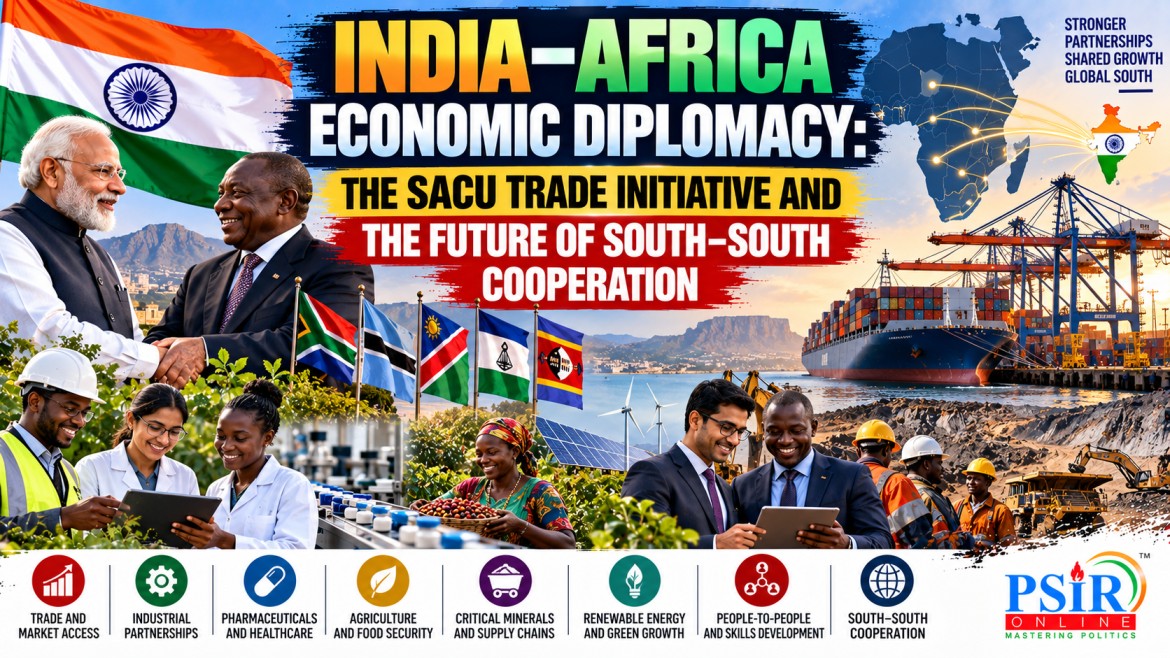
India’s engagement with Africa is increasingly shaped by the search for diversified markets, secure supply chains, development partnerships and a stronger voice for the Global South. The signing of the Terms of Reference (ToR) between India and the Southern African Customs Union (SACU) on 12 August 2026 marks an important step towards a preferential trade agreement between India and five southern African countries. The initiative reflects an effort to deepen economic relations through regional integration rather than relying exclusively on bilateral arrangements. Its significance, however, will depend on whether negotiations produce reciprocal market access, stronger industrial linkages and tangible development benefits.
THE SACU INITIATIVE: FROM NEGOTIATIONS TO A TRADE FRAMEWORK
SACU comprises South Africa, Botswana, Namibia, Lesotho and Eswatini. Established in its present institutional form in 1910, it is one of the world’s oldest functioning customs unions. Its members apply a common external tariff and negotiate certain external trade arrangements collectively, making bloc-level engagement different from separate bilateral negotiations.
On 12 August 2026, India and SACU signed the ToR in New Delhi to formally guide negotiations towards a Preferential Trade Agreement (PTA). The agreed negotiating framework covers eight chapters, including trade in goods, market access, rules of origin, customs procedures, sanitary and phytosanitary measures, technical barriers to trade, trade remedies and dispute settlement. The framework establishes the scope of negotiations; it does not itself reduce tariffs or constitute a concluded trade agreement.
The initiative revives negotiations that began in the early 2000s but did not reach completion. Their renewed momentum reflects the shared interest in diversifying export markets and strengthening economic ties. For India, engagement with SACU offers access to a regional market and opportunities to expand exports, while SACU members can seek more predictable access to one of the world’s major economies.
ECONOMIC COMPLEMENTARITY AND THE TRADE POTENTIAL
India and SACU possess complementary economic capabilities. India has established strengths in pharmaceuticals, automobiles and components, engineering goods, textiles, information technology and selected manufactured products. Southern Africa offers mineral resources, agricultural products, industrial inputs and access to regional production and distribution networks.
The existing trade relationship also reveals the need for diversification. According to trade figures reported in August 2026, India exported approximately US$7.55 billion in goods to SACU during 2025–26, while imports from the bloc were reported at approximately US$9.2 billion. Petroleum products and automotive components feature among Indian exports, while South Africa is an important source of mineral and other commodity imports. These figures indicate substantial commercial engagement but also underline the importance of examining the composition, concentration and value addition of trade.
|
Area of cooperation |
Potential opportunities |
|
Pharmaceuticals and healthcare |
Affordable medicines, pharmaceutical manufacturing and health-sector cooperation |
|
Automobiles and engineering |
Vehicle components, machinery, industrial equipment and manufacturing partnerships |
|
Critical minerals |
Supply-chain cooperation involving platinum-group metals, manganese and other industrial minerals |
|
Agriculture and food processing |
Agricultural products, processing technologies and value-added exports |
|
Digital economy |
Information technology services, digital public infrastructure and skills development |
|
Renewable energy |
Solar technologies, clean-energy equipment and related industrial investment |
The objective should not be merely to increase the volume of trade. A durable partnership would encourage local value addition, technology transfer, investment and employment creation. Otherwise, the relationship could remain concentrated in the exchange of manufactured exports for primary commodities, limiting its developmental impact.
SOUTH–SOUTH COOPERATION: BEYOND MARKET ACCESS
The SACU initiative reflects a broader transformation in South–South cooperation. Historically, cooperation among developing countries emphasised political solidarity, decolonisation and demands for a more equitable international economic order. Contemporary cooperation increasingly includes trade agreements, industrial partnerships, digital technology, infrastructure and critical-mineral supply chains.
India’s engagement with SACU can support this transition by connecting Indian manufacturing capabilities with southern African industrial priorities. Indian firms could explore partnerships in pharmaceuticals, automotive components, renewable energy and information technology, while SACU countries could use improved market access to expand exports and attract investment.
The initiative also fits into the wider context of African regional integration. The African Continental Free Trade Area (AfCFTA) seeks to expand intra-African trade and build a more integrated continental market. An India–SACU agreement would operate alongside this process rather than replace it. Its design should therefore complement African industrialisation and regional value chains instead of encouraging competition among neighbouring African economies.
The developmental test is whether both sides can move from transactional trade towards productive cooperation. Joint ventures, vocational training, research collaboration and partnerships with small and medium-sized enterprises could distribute the benefits more widely than tariff reductions alone.
STRATEGIC SIGNIFICANCE FOR INDIA’S AFRICA POLICY
Africa occupies an important place in India’s wider foreign-policy objectives. The continent offers expanding markets, diplomatic partnerships, natural resources and opportunities for cooperation in international institutions. Stronger economic relations can also support India’s efforts to diversify its external trade and reduce excessive dependence on a limited number of markets or suppliers.
The SACU initiative is significant because it engages a regional economic bloc, requiring India to negotiate with multiple countries through a coordinated framework. This can create a more predictable commercial environment while giving the five SACU members a collective negotiating platform.
However, regional trade diplomacy also involves complexities. Different levels of industrial development, domestic sensitivities and trade priorities can make consensus difficult. South Africa’s industrial base and economic weight differ from those of the smaller SACU members. An agreement that primarily benefits larger exporters or concentrates investment in a few locations could produce uneven gains within the bloc.
India must therefore combine commercial objectives with diplomatic sensitivity. Development cooperation, market access and industrial partnerships should respond to the different capacities and priorities of all five members. The agreement’s credibility will depend on reciprocity, transparency and inclusive economic benefits, rather than on the headline value of trade alone.
NEGOTIATING CHALLENGES AND IMPLEMENTATION RISKS
The signing of the ToR is an opening step, not the completion of a trade pact. Several issues will shape the eventual agreement.
First, tariff liberalisation must balance export opportunities with the protection of genuinely sensitive sectors. Excessively broad exclusions could reduce the agreement’s commercial value, while rapid liberalisation without adjustment measures could place pressure on vulnerable producers.
Second, rules of origin will be essential to ensure that preferential treatment benefits producers in India and SACU rather than goods merely routed through either side. Customs procedures, product standards and sanitary and phytosanitary requirements will also determine whether formal market access translates into actual trade.
Third, the agreement should address the distribution of benefits. Smaller SACU economies may require technical assistance, trade facilitation and support for productive capacity to participate effectively. Indian small and medium-sized enterprises could also face barriers involving logistics, regulatory compliance, finance and market information.
Finally, the agreement must be assessed in the context of existing African and international trade arrangements. Its provisions should remain compatible with applicable trade rules and avoid creating unnecessary obstacles for regional integration.
A successful PTA would therefore require effective implementation mechanisms, reliable dispute settlement, business engagement and periodic review. Without these elements, preferential access could remain a diplomatic achievement with limited impact on production and employment.
A PRACTICAL ROADMAP FOR A DEVELOPMENT-ORIENTED PTA
India and SACU can strengthen the initiative by connecting negotiations to a clear programme of economic cooperation.
|
Policy priority |
Practical direction |
|
Balanced market access |
Identify products where tariff reductions can expand mutually beneficial trade while addressing sensitive sectors. |
|
Industrial partnerships |
Promote joint ventures in pharmaceuticals, automotive components, machinery and clean-energy technologies. |
|
Critical-mineral cooperation |
Explore transparent, sustainable supply arrangements alongside local processing and skills development. |
|
Support for smaller firms |
Improve access to market information, customs guidance, trade finance and business-to-business platforms. |
|
Regional integration |
Align cooperation, where appropriate, with AfCFTA priorities and regional value chains. |
|
Monitoring and review |
Track trade diversification, investment, employment, local value addition and participation by smaller businesses. |
These measures would help prevent the PTA from becoming solely a tariff-reduction exercise. They would also strengthen the connection between India’s commercial diplomacy and the wider objective of development-oriented South–South cooperation.
THEORETICAL ANGLES
|
Theory or concept |
Application to India–SACU economic diplomacy |
|
South–South Cooperation |
Explains cooperation among developing countries to strengthen trade, development capabilities and bargaining power in the international economic system. |
|
Complex Interdependence |
Highlights how trade, investment, technology and supply chains create multiple channels of cooperation beyond traditional security relations. |
|
Liberal Institutionalism |
Explains how negotiated rules, trade frameworks and dispute-settlement mechanisms can reduce uncertainty and facilitate sustained economic cooperation. |
|
Realism and Economic Statecraft |
Draws attention to how states use trade agreements to diversify markets, secure strategic resources and strengthen their relative economic position. |
|
Dependency Theory |
Raises questions about whether trade reproduces unequal exchanges between manufactured goods and primary commodities or enables industrial upgrading and local value addition. |
|
Regionalism |
Explains the significance of negotiating with SACU as a bloc and the relationship between external trade agreements and African regional integration. |
CONCLUSION
The India–SACU initiative represents an opportunity to deepen India’s economic engagement with southern Africa through a regional trade framework. Its wider significance lies in the possibility of linking market access with industrial development, technology cooperation and more diversified supply chains. Yet the signing of the Terms of Reference on 12 August 2026 is only the beginning of negotiations. The agreement’s ultimate value will depend on balanced concessions, effective implementation and benefits shared across the participating economies. For India, the central challenge is to translate Global South solidarity into a practical partnership that supports trade, productive capacity and sustainable development on both sides.
RELATED READING
PRACTISE QUESTIONS FOR GS2 MAINS
PRACTISE QUESTIONS FOR PSIR
