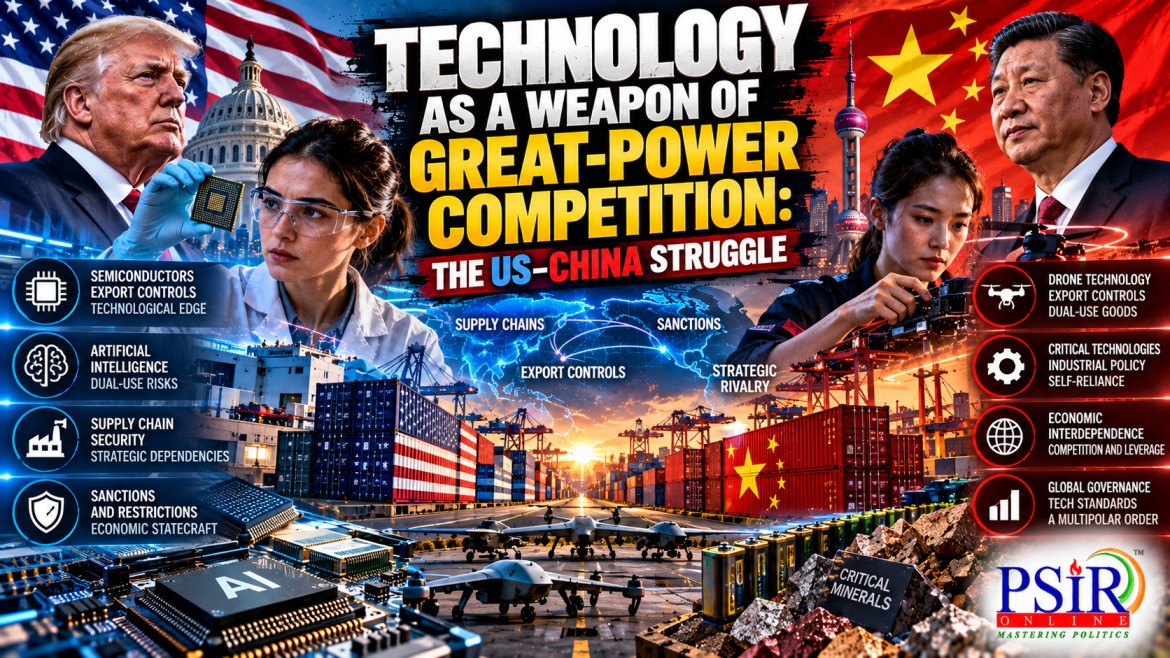
Technology has become one of the principal arenas of strategic competition between the United States and China. Semiconductors, artificial intelligence, telecommunications, drones, quantum computing and advanced manufacturing influence not only economic productivity but also military capabilities, intelligence collection and national security. Control over these technologies increasingly shapes the distribution of power in the international system.
On 5 August 2026, China announced countermeasures against American restrictions, including tighter export controls on drone-related dual-use items destined for the United States and restrictions on dealings with selected American entities. The measures followed US actions involving telecommunications and testing equipment, Chinese entities associated with alleged forced-labour concerns, and other technology-related restrictions. The episode illustrated how technology policy, trade controls and sanctions have become interconnected instruments of statecraft.
The US–China relationship reveals a central paradox of contemporary international political economy: the two powers compete to reduce strategic dependence while continuing to rely on interconnected markets, production networks and technological ecosystems. Technology has become a source of both economic interdependence and geopolitical leverage.
FROM TECHNOLOGICAL COMPETITION TO TECHNOLOGICAL CONTAINMENT
For decades, international technology trade was largely justified through efficiency, innovation, investment and access to global markets. The expansion of US–China economic relations reflected the expectation that commercial interdependence could generate mutual gains. However, growing strategic rivalry has altered the way both governments assess technological exchange.
Washington has increasingly restricted Chinese access to selected advanced technologies on national-security grounds, particularly where semiconductors and advanced computing could contribute to military modernisation. Beijing has responded through industrial self-reliance policies, export controls and measures intended to protect its own technological and economic interests.
The distinction between civilian and military technology has become increasingly difficult to maintain. Artificial intelligence can support commercial services and military targeting; drones can be used for agriculture, logistics and surveillance; and semiconductor manufacturing equipment can serve civilian industries as well as advanced defence systems. These are dual-use technologies, making the regulation of exports a strategic question.
The competition is therefore no longer limited to which country produces more technological innovations. It also concerns access to advanced equipment, software, manufacturing capacity, specialised materials, research networks and international standards.
EXPORT CONTROLS, SANCTIONS AND THE STRATEGIC USE OF TECHNOLOGY
Export controls regulate the transfer of specified goods, software and technology to particular destinations, end users or end uses. Sanctions and restrictions on commercial dealings can impose additional costs on designated firms and individuals. Although these instruments may overlap, they are not identical: an export-licensing restriction is not automatically a sanction, and the legal basis and scope of each measure matter.
The United States has used export controls to restrict Chinese access to selected advanced semiconductors and semiconductor-manufacturing capabilities. In January 2026, the US Department of Commerce revised its licensing policy for certain advanced computing chips, including Nvidia H200 and AMD MI325X products, allowing case-by-case review subject to specified security conditions.
China's 5 August 2026 response demonstrated that technological leverage is not confined to Washington. Beijing announced restrictions on dealings with selected US entities and tighter case-by-case review of exports of drones, key components and related dual-use technologies to the United States.
|
Instrument |
Strategic purpose |
Potential consequence |
|
Export controls |
Restrict access to specified technologies, equipment or end uses |
Delays, higher compliance costs or reduced access to advanced inputs |
|
Entity-based restrictions |
Limit dealings with designated firms or organisations |
Disruption to commercial relationships and technology partnerships |
|
Domestic industrial support |
Expand national production and technological capabilities |
Greater resilience, but possible duplication and higher costs |
|
Investment screening |
Assess foreign investment in sensitive sectors |
Reduced exposure to selected security risks, alongside possible investment uncertainty |
|
Export controls on critical inputs |
Use control over selected goods or components as leverage |
Pressure on foreign manufacturers that depend on those supplies |
The effectiveness of these measures depends on technological capabilities, the availability of substitutes, enforcement and the cooperation of third countries. Restrictions may slow access to particular technologies, but they can also encourage domestic innovation, alternative supply chains and retaliatory measures.
Consequently, technological restrictions can produce strategic leverage without necessarily delivering permanent technological superiority. Their long-term effects depend on how competitors respond and whether restrictions are coordinated with wider industrial and diplomatic policies.
SEMICONDUCTORS, ARTIFICIAL INTELLIGENCE AND THE STRUGGLE FOR TECHNOLOGICAL POWER
Semiconductors are foundational to contemporary computing, telecommunications, advanced manufacturing and military systems. Advanced chips support high-performance computing and artificial intelligence, while semiconductor-manufacturing equipment and specialised software determine the ability to produce increasingly sophisticated integrated circuits.
The United States retains important advantages in semiconductor design, specialised software, advanced computing and research. China possesses substantial manufacturing capacity, a large domestic market and considerable state-supported investment in technological development. Neither country controls every stage of the semiconductor value chain.
This division creates opportunities for cooperation but also vulnerabilities. A country may be strong in chip design while depending on foreign manufacturing, specialised equipment or materials. Restricting one stage of the chain can affect production across several industries.
Artificial intelligence intensifies the competition. Advanced computing chips, data centres, algorithms, energy infrastructure and skilled researchers all contribute to AI capabilities. Governments consequently regard access to computing resources as an economic and security issue.
|
Technological area |
Strategic significance |
Principal policy tension |
|
Advanced semiconductors |
AI computing, advanced electronics and military applications |
Restricting access while preserving commercial incentives and technological leadership |
|
Semiconductor manufacturing equipment |
Enables the production of advanced chips |
Dependence on specialised suppliers and restrictions on technology transfers |
|
Artificial intelligence |
Productivity, intelligence analysis, automation and military applications |
Balancing innovation, security, access and governance |
|
Drones and autonomous systems |
Logistics, surveillance, industrial applications and defence |
Managing dual-use exports and concentrated supply chains |
|
Quantum and advanced computing |
Potential applications in communications, sensing and computing |
Protecting sensitive research without unnecessarily obstructing scientific collaboration |
The strategic challenge is not simply to prevent the rival from acquiring technology. It is also to maintain domestic innovation, attract investment, develop skilled labour and preserve access to critical inputs.
Overly broad restrictions can raise costs for domestic firms and reduce incentives for international research. Conversely, unrestricted transfers may create security risks when technologies have sensitive military applications. The policy problem is to define restrictions narrowly enough to address identifiable risks while avoiding unnecessary disruption to legitimate trade.
DRONES AND CRITICAL SUPPLY CHAINS: CHINA'S COUNTER-LEVERAGE
Drones illustrate how technological interdependence can become a source of strategic pressure. Their production depends on several interconnected components, including motors, batteries, sensors, cameras, flight-control systems, communication modules and specialised software.
China has a significant position in global drone manufacturing and related component supply chains. This industrial capacity creates commercial advantages but can also provide leverage when access to products or components becomes subject to export restrictions.
The Chinese measures announced on 5 August 2026 placed exports of specified drones, key components and related dual-use technologies destined for the United States under stricter case-by-case review. The measures followed US restrictions involving telecommunications and testing equipment, among other actions.
The episode illustrates a pattern of reciprocal technological statecraft. One government restricts selected products or entities on security or other stated grounds; the other responds by using its own regulatory powers and supply-chain position.
However, export controls do not necessarily amount to a complete embargo. Their actual impact depends on the items covered, licensing decisions, available alternatives and the degree of dependence among producers and users.
The broader lesson is that strategic leverage can arise from control over manufacturing scale, specialised components or regulatory access—not merely from inventing the most advanced technology. A country that dominates a particular production stage may influence the options available to its competitors even when it does not control the entire technological ecosystem.
THE DATA: INTERDEPENDENCE PERSISTS DESPITE STRATEGIC RIVALRY
The economic relationship between the United States and China remains substantial, even as governments seek to reduce selected dependencies. Official US trade figures demonstrate that the relationship has changed in scale and composition rather than simply disappeared.
|
US trade with China |
2024 |
2025 |
|
Goods and services trade, total |
Approximately US$660.3 billion |
Approximately US$494.6 billion |
|
Goods exports |
US$143.3 billion |
US$106.0 billion |
|
Goods imports |
US$440.1 billion |
US$308.7 billion |
|
Goods trade deficit |
US$296.8 billion |
US$202.7 billion |
Source: Office of the United States Trade Representative, China Trade Summary. Figures are nominal US-dollar values; goods-and-services totals are estimates, and individual figures may not sum exactly because of rounding.
The figures show a significant decline in recorded bilateral trade between 2024 and 2025. They do not, by themselves, establish that every reduction resulted from technology restrictions or that all trade shifted to other countries. Tariffs, demand, inventory decisions, changes in sourcing and other economic conditions can also influence trade flows.
Nevertheless, the continued scale of the relationship demonstrates why complete technological separation would be difficult and costly. Firms depend on international markets, suppliers, research networks and production systems that cannot always be replaced quickly.
A further distinction is necessary between decoupling and de-risking. Decoupling implies a broad reduction or separation of economic ties, while de-risking seeks to reduce specific vulnerabilities without ending interdependence altogether. Governments may seek to diversify critical supplies and restrict selected sensitive technologies while maintaining trade in less sensitive goods and services.
This selective approach is more consistent with the complexity of modern production networks. It also creates uncertainty for businesses, which must continually assess changing regulations, compliance obligations and the possibility of further restrictions.
CONSEQUENCES FOR GLOBAL GOVERNANCE AND THE INTERNATIONAL SYSTEM
The US–China technology contest affects more than the two principal powers. Other countries face pressure to adjust export controls, investment policies, technology standards and supply-chain strategies. States that possess important manufacturing capabilities or critical materials may gain bargaining power, while countries dependent on imported technology may face higher costs and reduced policy flexibility.
The competition also complicates multilateral governance. Existing international institutions provide frameworks for trade, intellectual property, investment and security cooperation, but national-security exceptions and unilateral restrictions can create disputes over transparency, proportionality and consistency with international obligations.
Third countries must navigate competing commercial and strategic relationships. They may seek access to US technologies, Chinese manufacturing networks and alternative suppliers simultaneously. This can encourage diversification and investment, but it can also produce fragmented standards and competing technological ecosystems.
The contest raises three major governance questions. First, how can legitimate security concerns be distinguished from protectionist restrictions? Second, how can states reduce dangerous dependencies without disrupting essential civilian supply chains? Third, what forms of cooperation remain possible in areas such as AI safety, cybersecurity, research integrity and the governance of autonomous systems?
The challenge is not to eliminate all competition. It is to prevent technological rivalry from undermining every channel of economic cooperation and international rule-making. Strategic competition and selective cooperation can coexist, but their relationship requires transparent rules, effective communication and carefully defined security objectives.
THEORETICAL ANGLES
|
Theory or concept |
Application to the US–China technology struggle |
|
Neorealism |
States seek relative gains and strategic advantages in capabilities that affect their security. Export controls and technological self-reliance can be understood as efforts to prevent rivals from acquiring strategically important capabilities. |
|
Geoeconomics |
Economic instruments—including sanctions, export controls, industrial subsidies and access to critical inputs—are used to pursue geopolitical objectives. Technology policy becomes an instrument of state power. |
|
Complex Interdependence |
The two economies remain connected through trade, investment and supply chains, creating mutual vulnerabilities. Interdependence does not eliminate rivalry; it can provide leverage to actors controlling strategically important nodes. |
|
Hegemonic Competition |
Competition over semiconductors, AI and technological standards reflects a wider contest over leadership, innovation and rule-setting in the international system. |
|
Liberal Institutionalism |
International institutions and negotiated rules can reduce uncertainty and facilitate cooperation. Unilateral restrictions and retaliatory controls demonstrate the limits of institutional cooperation when national-security concerns dominate. |
|
Strategic Autonomy |
Governments seek the capacity to make independent choices in critical technologies without excessive reliance on external suppliers. The pursuit of autonomy can improve resilience but may also generate costly duplication and competing blocs. |
CONCLUSION
The US–China technology struggle demonstrates how economic power, national security and technological innovation have become closely intertwined. Export controls, sanctions, industrial policies and restrictions on critical components are increasingly used to shape the strategic options available to competitors.
Yet neither power can easily eliminate the benefits or vulnerabilities of economic interdependence. Semiconductor production, AI development and drone manufacturing rely on complex international networks that make complete separation difficult. The resulting contest is therefore likely to involve selective restrictions, competing industrial strategies and continuing commercial interaction.
The central challenge is to balance legitimate security concerns with the benefits of open innovation and predictable economic relations. Technological leadership is not determined by restrictions alone; it also depends on research, skilled labour, industrial capacity, international partnerships and the ability to sustain innovation over time.
The US–China struggle thus reflects a broader transformation of international politics in which technology is simultaneously a source of prosperity, a strategic capability and an instrument of geopolitical influence.
RELATED READING
PRACTICE QUESTIONS FOR GS2 MAINS
PRACTICE QUESTIONS FOR PSIR
