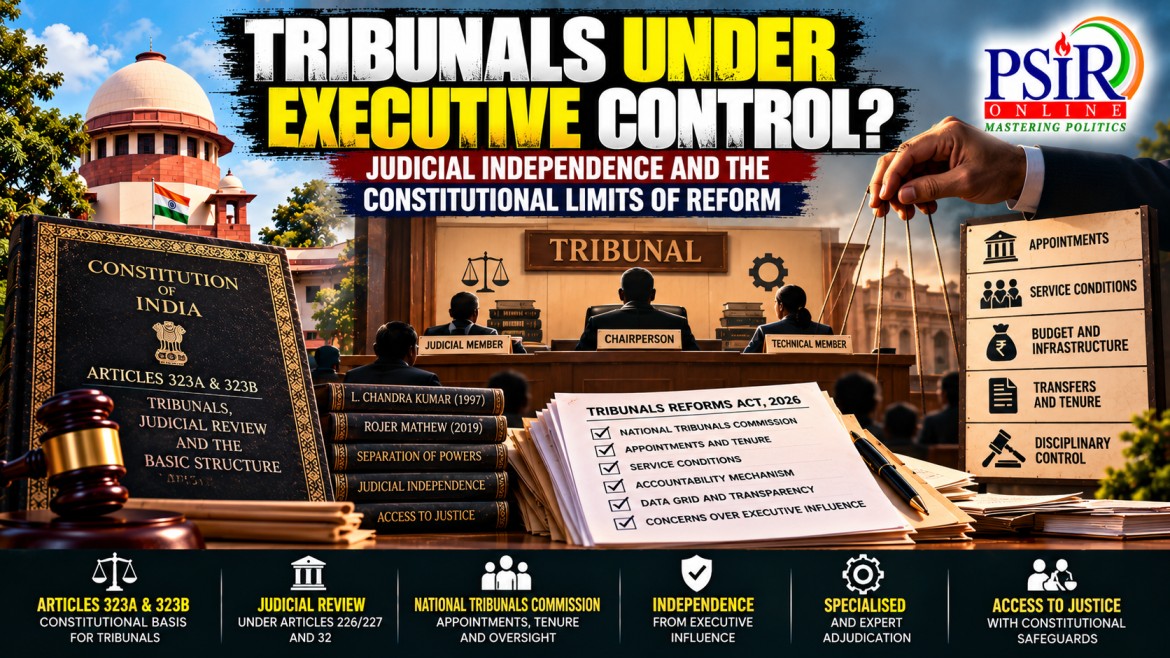
Tribunals occupy a distinctive position in India’s justice system. Established to resolve specialised disputes involving taxation, company law, administrative decisions and other technical matters, they seek to combine expertise, procedural efficiency and accessible adjudication. However, their effectiveness depends on more than reducing judicial delays: tribunals must remain independent of the executive authorities whose decisions they may be required to review.
The Tribunals Reforms Act, 2026, which received presidential assent on 13 August 2026 and came into force on 25 August 2026, establishes a National Tribunals Commission (NTC) and replaces the 2021 framework. The legislation follows a prolonged constitutional contest over appointments, tenure and executive influence in tribunal administration. Although the new framework responds to important judicial concerns, the degree of autonomy retained by the executive remains central to assessing whether reform can secure independent and impartial adjudication.
WHY TRIBUNAL INDEPENDENCE MATTERS
Tribunals were developed partly to reduce the burden on ordinary courts and provide specialised adjudication. Their members may possess judicial, administrative, financial or technical expertise, enabling them to determine complex disputes in areas such as taxation, company affairs, telecommunications and public service.
Yet an institutional conflict arises when a ministry that formulates or implements a policy also exercises substantial control over the tribunal deciding disputes concerning that policy. Control over appointments, tenure, remuneration, transfers, infrastructure and removal can create actual dependence or a reasonable perception of dependence.
The constitutional concern is not that the executive must have no administrative role whatsoever. Rather, administrative convenience cannot override adjudicative independence. A tribunal must be sufficiently insulated from external pressure to decide cases according to law and evidence, regardless of the identity of the litigating authority.
CONSTITUTIONAL FOUNDATIONS: ARTICLES 323A AND 323B
Articles 323A and 323B were inserted by the 42nd Constitutional Amendment Act, 1976. Article 323A authorises Parliament to provide for administrative tribunals dealing with recruitment and service conditions of public servants. Article 323B enables the appropriate legislature to establish tribunals for specified subjects, including taxation, industrial and labour disputes, land reforms and certain other matters.
These provisions facilitate specialised adjudication but do not create constitutionally isolated institutions beyond judicial scrutiny. Parliament’s power to establish tribunals must operate within the broader constitutional framework, including the basic structure doctrine, separation of powers and judicial review.
The Supreme Court has repeatedly clarified that tribunals may supplement the judicial system but cannot replace the constitutional role of High Courts and the Supreme Court. Their legitimacy therefore rests on two connected requirements: functional competence and institutional independence.
THE JUDICIAL EVOLUTION OF TRIBUNAL REFORM
Three landmark developments explain the constitutional trajectory.
|
Judgment |
Constitutional significance |
|
S.P. Sampath Kumar v. Union of India (1987) |
Considered administrative tribunals as an alternative institutional mechanism for service-related adjudication, subject to constitutional safeguards. |
|
L. Chandra Kumar v. Union of India (1997) |
Held that judicial review under Articles 226/227 and 32 forms part of the basic structure. Tribunal decisions remain subject to scrutiny by constitutional courts. |
|
Rojer Mathew v. South Indian Bank Ltd. (2019) |
Examined the tribunal rules introduced through the Finance Act framework and emphasised the need for independence in appointments and service conditions; the judgment called for a more appropriate institutional arrangement for tribunal administration. |
The significance of L. Chandra Kumar extends beyond the jurisdiction of individual tribunals. It establishes that constitutional courts retain the final supervisory role in protecting fundamental rights and ensuring legality. Tribunals cannot be treated as substitutes for the constitutional judiciary in a manner that removes meaningful judicial review.
In Rojer Mathew, the Court scrutinised the executive’s role in determining tribunal appointments and service conditions. The subsequent litigation, including the Madras Bar Association proceedings, continued to challenge provisions that were considered inconsistent with judicial independence. The 2026 legislation emerged against this background of repeated judicial intervention and legislative response.
THE TRIBUNALS REFORMS ACT, 2026: WHAT HAS CHANGED?
Parliament passed the Tribunals Reforms Bill, 2026, in August. Following presidential assent on 13 August, the Act came into force on 25 August 2026. It repeals the Tribunals Reforms Act, 2021, and creates a statutory framework for a National Tribunals Commission.
|
Feature |
Position under the 2026 framework |
|
National Tribunals Commission |
Establishes a central institution for tribunal selection and oversight. |
|
Composition |
A chairperson who has been a Supreme Court judge or High Court Chief Justice, two judicial members and two technical members. |
|
Appointments to the Commission |
Made by the Central Government, with consultation with the Chief Justice of India for the chairperson and judicial members. |
|
Tribunal selection |
A search-cum-selection committee mechanism operates under the new statutory framework. |
|
Tenure |
Provides a five-year term for tribunal members, subject to the applicable statutory conditions. |
|
Administration and oversight |
Includes functions relating to performance, complaints and the National Tribunals Data Grid. |
The establishment of the NTC is an important institutional development because tribunal administration is no longer conceived solely as a function of the ministries associated with individual tribunals. A common framework can improve uniformity, professional administration and transparency.
However, the Commission’s composition does not automatically establish complete independence. Since the Central Government appoints its members and retains important administrative responsibilities, the practical question is whether the Commission can exercise its statutory functions without inappropriate executive influence. The law’s operation, subordinate rules, appointment practices and financial arrangements will be critical to answering that question.
THE LIMITS OF REFORM: INDEPENDENCE, ACCOUNTABILITY AND EXECUTIVE DISCRETION
The 2026 framework must be evaluated on the basis of its institutional safeguards rather than its stated objectives alone. The following concerns remain important.
First, appointment autonomy: Consultation with the Chief Justice of India for certain Commission appointments is a safeguard, but its effectiveness depends on the actual selection process and the degree of executive discretion that remains.
Second, rule-making powers: The relationship between the Act and subsequent executive rules matters. If essential qualifications, selection standards or service conditions are left to broad discretionary rule-making, statutory reform may not fully eliminate the concerns that prompted judicial intervention.
Third, complaint handling: Complaints against tribunal members require a process that is fair, independent and transparent. Administrative screening should not become a mechanism through which a ministry can obstruct scrutiny or influence adjudicators.
Fourth, financial and administrative autonomy: A tribunal system cannot be fully independent if its resources, staffing or operational requirements are subject to arbitrary interference by authorities whose decisions it reviews.
At the same time, independence cannot mean freedom from accountability. Transparent selection, published performance information, reasoned disciplinary procedures and timely disposal of cases are legitimate objectives. The constitutional challenge is to ensure that accountability mechanisms do not become instruments of control.
The distinction is therefore between legitimate executive participation in the administration of justice and executive dominance over adjudication. The former may be necessary; the latter undermines the institutional credibility of tribunals.
THE WAY FORWARD: BUILDING AN INDEPENDENT TRIBUNAL SYSTEM
Effective reform requires safeguards that are operational, not merely declaratory.
· Transparent appointments: Selection criteria, vacancy notices, timelines and recommendations should be governed by clear and publicly accessible procedures.
· Secure tenure: Removal, disciplinary action and changes to service conditions should follow legally defined procedures that protect members from arbitrary pressure.
· Independent administration: The NTC should possess adequate institutional capacity, predictable funding and professional staff to discharge its functions effectively.
· Accountable complaint mechanisms: Complaints should be assessed through impartial procedures, with safeguards against both executive interference and unaccountable conduct by tribunal members.
· Stronger judicial oversight: High Courts must retain meaningful review under Articles 226 and 227, consistent with L. Chandra Kumar.
· Performance transparency: The National Tribunals Data Grid can improve public understanding of vacancies, pendency and disposal rates, provided that data collection respects procedural fairness and institutional independence.
The success of the 2026 framework will ultimately depend on whether these safeguards translate into independent decision-making, timely justice and public confidence. Creating a commission is an institutional starting point; ensuring that it can function independently is the more demanding constitutional task.
UPSC DIMENSION
|
Constitutional provision or concept |
Relevance to tribunal reform |
|
Articles 323A and 323B |
Establish the constitutional basis for administrative and subject-specific tribunals. |
|
Articles 226 and 227 |
Preserve High Court judicial review and supervision over tribunal decisions. |
|
Article 32 |
Enables Supreme Court enforcement of fundamental rights. |
|
Basic structure doctrine |
Protects judicial review and core constitutional principles against impermissible legislative interference. |
|
Separation of powers |
Requires adjudicative functions to be protected from inappropriate executive influence. |
|
Rule of law |
Requires tribunal decisions to follow law, evidence and fair procedure rather than administrative preference. |
|
Natural justice |
Demands impartial adjudicators, fair hearings and reasoned decisions. |
|
Institutional accountability |
Supports transparent appointments, fair disciplinary procedures and performance reporting without compromising independence. |
CONCLUSION
The Tribunals Reforms Act, 2026 marks a significant change in India’s approach to tribunal administration by establishing a National Tribunals Commission and replacing the 2021 framework. Its constitutional value, however, will depend on the substantive autonomy available to the Commission and the tribunals under its oversight.
The central issue is not whether the executive should participate in institutional administration, but whether such participation is limited by effective safeguards. A tribunal system that combines independence, expertise, transparency and accountability can strengthen access to justice. Without these safeguards, institutional reform risks changing the administrative structure without fully resolving the constitutional problem.
RELATED READING
PRACTISE QUESTIONS FOR GS2 MAINS
PRACTISE QUESTIONS FOR PSIR
