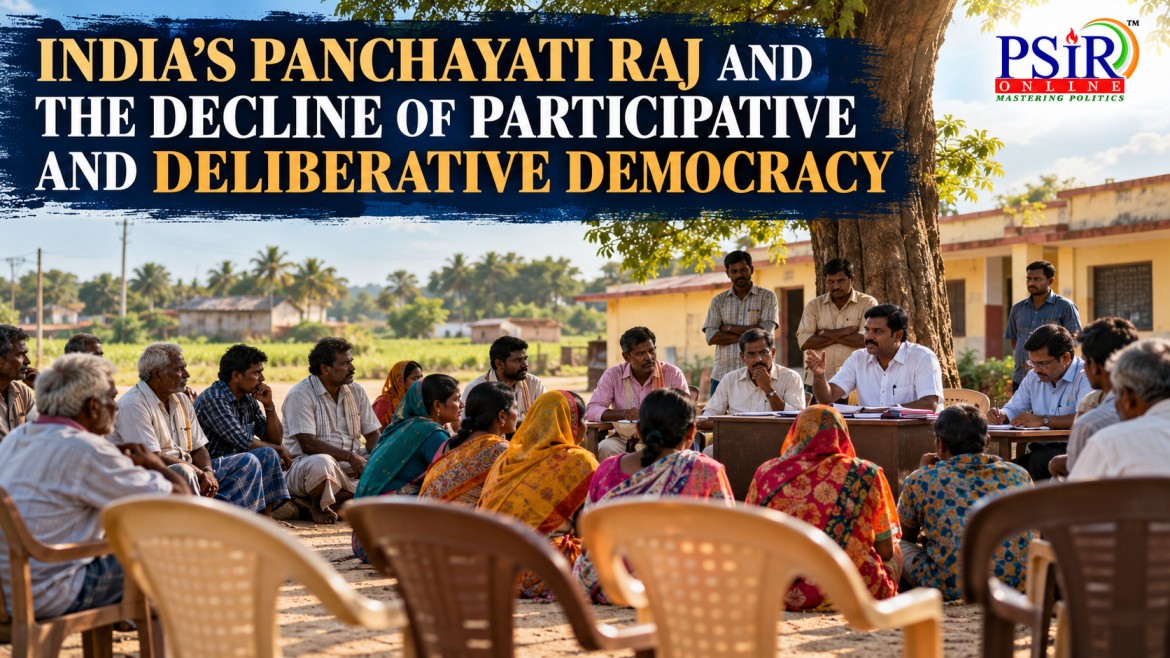
The 73rd Constitutional Amendment Act, 1992, constitutionally entrenched Panchayati Raj Institutions (PRIs) to transform rural citizens from passive recipients of centralized patronage into active architects of their own local development. By recognizing the Gram Sabha as a constitutional body under Article 243A, the reform aimed to build an institutional platform for direct, face-to-face democracy. Yet, decades into its institutional operation, a systemic paradox defines grassroots governance in India: local democratic bodies have expanded quantitatively in administrative presence, but contracted qualitatively in deliberative and participative substance.
Across vast swathes of rural India, local governance has settled into procedural compliance. Gram Sabhas are frequently convened merely to fulfill statutory minimums, pass pre-drafted resolutions, or sign off on beneficiary lists rubber-stamped elsewhere. Rather than acting as dynamic public spheres where development priorities are debated and executive actions scrutinized, rural local bodies increasingly operate as subordinate delivery nodes for higher levels of government.
CONCEPTUAL FOUNDATIONS: PARTICIPATIVE VS. DELIBERATIVE DEMOCRACY
Evaluating the trajectory of Panchayati Raj requires distinguishing between the foundational concepts of participative, deliberative, and representative democracy:
|
Democratic Conception |
Theoretical Essence |
Operational Expression in Panchayati Raj |
|
Representative Democracy |
Citizens elect proxies at periodic intervals to exercise sovereign public power on their behalf. |
Electing Ward Members, Gram Pradhans/Sarpanches, Panchayat Samiti, and Zilla Parishad representatives. |
|
Participative Democracy |
Direct, continuous involvement of non-elected citizens in decision-making beyond voting. |
Villagers attending assemblies, framing Gram Panchayat Development Plans (GPDPs), monitoring expenditure, and participating in social audits. |
|
Deliberative Democracy |
Collective decisions emerge through informed public discussion, reciprocal reason-giving, and the reconciliation of conflicting claims. |
Villagers debating trade-offs (e.g., spending limited funds on canal desilting versus drinking water filtration) through reasoned argumentation. |
|
Democratic Accountability |
Public officials and elected proxies explain decisions, justify spending, and answer to institutional scrutiny. |
Gram Panchayats presenting accounts, contractor records, and beneficiary selections for open public examination. |
As political theorist Carole Pateman argued in Participation and Democratic Theory (1970), direct participation possesses a vital educative function: active involvement fosters a sense of political competence and public efficacy. Jürgen Habermas grounded democratic legitimacy in communicative rationality, positing that decisions are just only when forged through uncoerced public deliberation among free and equal participants. Similarly, Benjamin Barber’s model of "Strong Democracy" (1984) and Robert Dahl’s criteria of "effective participation" emphasize that democracy hollows out when citizens are reduced to spectator-voters. In the Indian intellectual tradition, Mahatma Gandhi’s vision of Gram Swaraj viewed the autonomous, self-reliant village republic as the moral and political foundation of genuine self-rule.
PANCHAYATI RAJ AS THE HISTORIC ENGINE OF DELIBERATION AND PARTICIPATION
The constitutional architecture envisioned the Gram Sabha not as a subordinate tier, but as the foundational democratic forum:
· Direct Democracy at the Grassroots: Article 243(b) identifies the Gram Sabha as all persons registered on the electoral rolls of a village, while Article 243A empowers it to function as a direct popular assembly. Unlike state assemblies or parliament, where citizens delegate power to distant representatives, the Gram Sabha was designed to bring power directly to the people.
· Participatory Planning (GPDP): Under decentralized planning mandates, the Gram Panchayat Development Plan (GPDP) was meant to be framed from below. Deliberation allowed local communities to allocate village funds based on lived geographic, climatic, and social realities rather than distant bureaucratic priorities.
· Descriptive Inclusion of Historically Marginalized Groups: Through Article 243D, mandatory reservations for Scheduled Castes, Scheduled Tribes, and women (frequently expanded by state laws to 50%) widened formal political access. It broke the traditional, upper-caste, patriarchal monopoly over formal local decision-making.
· Social Accountability: Platforms like social audits under MGNREGA and open register verifications empowered ordinary citizens to question public expenditure, verify muster rolls, and inspect local infrastructure.
THE CONTEMPORARY EROSION: HOW GRASSROOTS DELIBERATION LOST ITS CHARACTER
Despite its constitutional guarantees, the deliberative and participative engine of Panchayati Raj has experienced widespread institutional decay:
1. Infrequent Assemblies and Procedural Formalism
Gram Sabhas are increasingly reduced to an annual or bi-annual calendar requirement. Meetings are held on mandatory public holidays (such as 15 August, 2 October, or 26 January) primarily to complete administrative checklists. Quorum requirements are routinely met by collecting signatures or thumbprints door-to-door without convening an assembly, turning substantive deliberation into an administrative exercise.
2. Centralisation and Top-Down Hegemony by MLAs and Ministers
Instead of functioning as an autonomous third tier of federal governance, Panchayats are systematically circumscribed by higher-level political actors. Members of Legislative Assemblies (MLAs), Members of Parliament (MPs), and state ministers maintain extensive clientelistic networks, exercising discretionary control over local infrastructure projects, scheme sanctions, and contract allocations. Local development funds—such as MLA-LADS and tied state grants—are routed through political loyalists, reducing elected Sarpanches to subordinate canvassers and marginalizing the Gram Sabha’s allocative authority.
3. Bureaucratic Dominance and the Line-Department Nexus
Local administration is severely distorted by an asymmetric power balance between elected representatives and district bureaucracies. Field-level bureaucrats—such as the Panchayat Secretary, Block Development Officer (BDO), and junior departmental engineers—retain financial authorization, technical sanction, and administrative approval over Panchayat resolutions. This structural dependence creates an entrenched bureaucratic-political nexus where priorities are aligned to state targets and administrative convenience rather than Gram Sabha resolutions.
4. The Structural Incompletion of the Three Fs (Functions, Funds, Functionaries)
Decentralization cannot operate without substantive devolution:
· Functions: Several subjects listed under the Eleventh Schedule remain un-devolved or overlapped by parallel state parastatals and departmental bodies.
· Funds: Local bodies generate negligible internal revenue and remain dependent on conditional, tied central and state grants. Tied grants dictate line-item spending, leaving Gram Sabhas zero fiscal room to deliberate on localized priorities.
· Functionaries: Panchayats lack an independent, accountable civil service cadre. Gram Panchayats cannot hire, discipline, or direct the ground-level staff tasked with essential service delivery.
5. Declining Public Interest and the Problem of Political Inefficacy
Widespread voter disengagement in Gram Sabha meetings is often misdiagnosed as civic apathy, but it is fundamentally a rational reaction to institutional non-responsiveness. When villagers attend meetings, submit petitions, and identify local infrastructure failures only to see their inputs ignored by block offices, their sense of political efficacy collapses. The transactional cost of attending a day-long assembly—foregoing daily agricultural or informal labor wages—outweighs any perceived return.
6. Social Hierarchies, Caste Asymmetries, and Elite Capture
The village is rarely an egalitarian public sphere. Entrenched social hierarchies along caste, class, and gender lines continue to mediate who can speak, where meetings are hosted, and whose demands are prioritized. In many rural areas, marginalized communities face social intimidation, spatial segregation, and exclusion during village deliberations. Similarly, while female representation has increased numerically, patriarchal practices such as the Sarpanch Pati phenomenon undermine the substantive agency of elected women.
7. Digital Technocracy Without Participative Deepening
Digital interventions such as e-GramSwaraj, Panchayat NIRNAY, and geographic tracking systems have enhanced reporting and central visibility. However, digitizing paperwork is not equivalent to democratizing governance. Digital portals often center accountability upward toward state capitals and central ministries rather than downward toward village residents, creating a technocratic reporting layer that non-literate and low-connectivity citizens cannot inspect or challenge.
STRUCTURAL DRIVERS OF THE DEMOCRATIC DECLINE
THE VICIOUS CYCLE OF LOCAL DEMOCRATIC EROSION
Top-Down Control & Incomplete Devolution (Tied Funds, No Autonomy)
▼
Bureaucratic Dominance & Pre-Determined Administrative Approvals
▼
Gram Sabha Reduced to Symbolic Formalism (Resolutions Ignored)
▼
Low Political Efficacy & Public Disengagement (Falling Quorums)
▼
Deepening Elite Capture & Discretionary Control by MLAs/Bureaucracy
The underlying causes of this institutional erosion can be summarized across three interrelated structural drivers:
· Incentive Structures of Higher-Tier Politicians: State legislators routinely resist the emergence of independent, constitutionally empowered local leaders who might challenge their electoral machines, patronage monopolies, and gatekeeping over state resources.
· Bureaucratic Paternalism: The inherited colonial administrative framework prioritizes upward hierarchical reporting, compliance, and procedural risk-aversion over downward democratic accountability to village assemblies.
· Material and Social Disparities: The daily struggle for informal wages, combined with local caste asymmetries, makes unorganized citizens vulnerable to elite co-optation, preventing the emergence of an autonomous rural counter-public.
The consequence is a shift from democratic decentralisation to administrative deconcentration. Local institutional structures exist, but the power to deliberate, allocate resources, and direct policy remains centralized.
REVITALISING GRASSROOTS DELIBERATION
Restoring the participative and deliberative promise of Panchayati Raj requires institutional reforms aimed at making participation consequential:
· Statutory Quorums and Predictable Calendars: Gram Sabha schedules must be fixed, widely publicized, and accompanied by agenda packets and budget statements circulated in advance. Ward Sabhas (sub-village assemblies) should be institutionalized to ensure smaller, accessible spaces for inclusive deliberation.
· Un-Tied Fiscal Devolution: State Finance Commissions must enforce the devolution of predictable, un-tied grants, granting Panchayats discretionary fiscal space to implement development priorities determined by their assemblies.
· Mandatory Action-Taken Reports (ATRs): To break the cycle of civic disengagement, bureaucracies and Gram Panchayats must be legally bound to present public ATRs on resolutions passed in previous assemblies, closing the grievance-redressal loop.
· Administrative Subordination of Line Staff: Ground-level functionaries across irrigation, primary health, and schools must be placed under the functional control and operational review of the Gram Panchayat.
· Independent Social Audit Directorates: Social audits must be institutionalized across all state and central development initiatives, supported by an autonomous audit apparatus insulated from block and district officials.
The long-term vitality of Indian democracy depends on whether the Gram Sabha can function as a genuine forum for collective reasoning rather than a ceremonial appendage to the administrative state. True decentralization is measured not by whether government schemes reach the village gate, but by whether the village community retains the sovereign authority to determine its own path of development.
PSIR THEORETICAL DIMENSION & EXAMINATION LINKAGES
|
PSIR Theoretical Dimension & Thinkers |
How It Connects to Examination Answers (PSIR Paper 1 / Paper 2) |
|
Deliberative Democracy & the Public Sphere (Jürgen Habermas) |
Gram Sabha as the Rural Public Sphere: Conceptualizes the Gram Sabha as an institutionalized communicative space. Connects low attendance, administrative scriptedness, and bureaucratic dominance to the distortion of the public sphere, where reciprocal public reasoning is replaced by technocratic fiat. |
|
Participative Democracy & Political Efficacy (Carole Pateman; Benjamin Barber) |
The Educative Value of Participation: Applies Pateman's thesis that political efficacy develops through direct involvement. Demonstrates that when villagers realize meetings yield no tangible policy change, low participation emerges not as cultural apathy, but as a structural collapse of perceived efficacy. |
|
Substantive Democracy vs. Procedural Formalism (Amartya Sen; C.B. Macpherson) |
Evaluating Decentralisation Beyond Elections: Critically distinguishes between formal institutional compliance (holding periodic Panchayat elections, reaching quorum through proxy signatures) and substantive democratization (citizen control over public goods, funds, and planning). |
|
Gram Swaraj & Oceanic Circles of Power (Mahatma Gandhi) |
Decentralist Alternative to the Centralised Leviathan: Contrasts the top-down, bureaucratic model of development delivery with Gandhi's vision of autonomous village republics exercising collective self-rule and moral-economic self-reliance. |
|
Democratic Decentralisation vs. Administrative Deconcentration (James Manor; Brian Smith) |
Evaluating the 'Three Fs': Provides the analytical lens to explain how the non-devolution of Functions, Funds, and Functionaries preserves the centralized bureaucratic state beneath a facade of local self-government. |
|
Elite Capture & Social Stratification (Gunnar Myrdal; Pranab Bardhan) |
The Unequal Village Republic: Analyzes how traditional rural power dynamics (caste, class, gender, and landownership) enable local elites to capture Panchayat resources and monopolize discussions, neutralizing the emancipatory intent of reservations. |
CONCLUSION
The enduring paradox of India’s Panchayati Raj is that it has successfully decentralised political institutions without substantively decentralising democratic power. While the 73rd Constitutional Amendment Act, 1992, institutionalised representative democracy across rural India, it has increasingly faltered in sustaining its participative and deliberative core. The formal survival of local bodies—characterized by periodic elections, digital portal compliances, and administrative resolutions—often conceals a landscape of elite capture, bureaucratic dominance, and executive centralisation by higher-tier politicians. Consequently, the widespread decline in citizen engagement is not merely an expression of public apathy, but a rational democratic withdrawal in the face of eroded political efficacy.
Realizing the promise of genuine grassroots self-rule demands moving beyond administrative deconcentration toward substantive devolution of functions, funds, and functionaries. Gram Sabhas cannot remain ornamental gathering points convened solely to satisfy procedural quotas or rubber-stamp centrally designed welfare rosters. In the spirit of Gandhi’s Gram Swaraj, local bodies must be reclaimed as vibrant public spheres where community members exercise sovereign deliberative authority over their own development priorities. The ultimate test of Indian decentralisation lies not in how efficiently state-sponsored schemes are delivered to the village gate, but in whether ordinary citizens possess the autonomous democratic power to decide what those schemes ought to be.
RELATED READING & ANALYTICAL ANGLES
· Constitutional Architecture & Statutory Provisions:
o Article 243A to 243O (Part IX of the Indian Constitution): The constitutional framework governing Panchayats, with specific reference to Article 243A (Gram Sabha powers), 243D (reservations for SCs, STs, and women), 243G (powers, authority, and responsibilities), and 243I/Y (State Finance Commissions).
o The Eleventh Schedule (Articles 243G): The 29 functional domains meant to be devolved to Panchayati Raj Institutions.
o Panchayats (Extension to Scheduled Areas) Act, 1996 (PESA): The statutory model of radical village-level direct democracy and customary self-rule in Fifth Schedule tribal areas.
· Institutional Reports & Policy Benchmarks:
o Second Administrative Reforms Commission (6th Report - Local Governance): Landmark recommendations on deepening fiscal autonomy, establishing a distinct rural municipal cadre, and institutionalizing social audits.
o Parliamentary Standing Committee on Rural Development and Panchayati Raj (2025): Critical findings on incomplete devolution of the three Fs, tied financial allocations, and weak local capacity.
o Ministry of Panchayati Raj Devolution Index (2024) & National Gram Sabha Study (2026): Empirical data detailing state-wise disparities in devolution, low Gram Sabha attendance, and communication bottlenecks.
· Core Political Economy Texts for Advanced Study:
o Pateman, Carole (1970). Participation and Democratic Theory. Cambridge University Press.
o Barber, Benjamin (1984). Strong Democracy: Participatory Politics for a New Age. University of California Press.
o Habermas, Jürgen (1996). Between Facts and Norms: Contributions to a Discourse Theory of Law and Democracy. MIT Press.
o Bardhan, Pranab & Mookherjee, Dilip (2006). Decentralisation and Local Governance in Developing Countries: A Comparative Perspective. MIT Press.
PRACTICE QUESTIONS FOR PSIR
