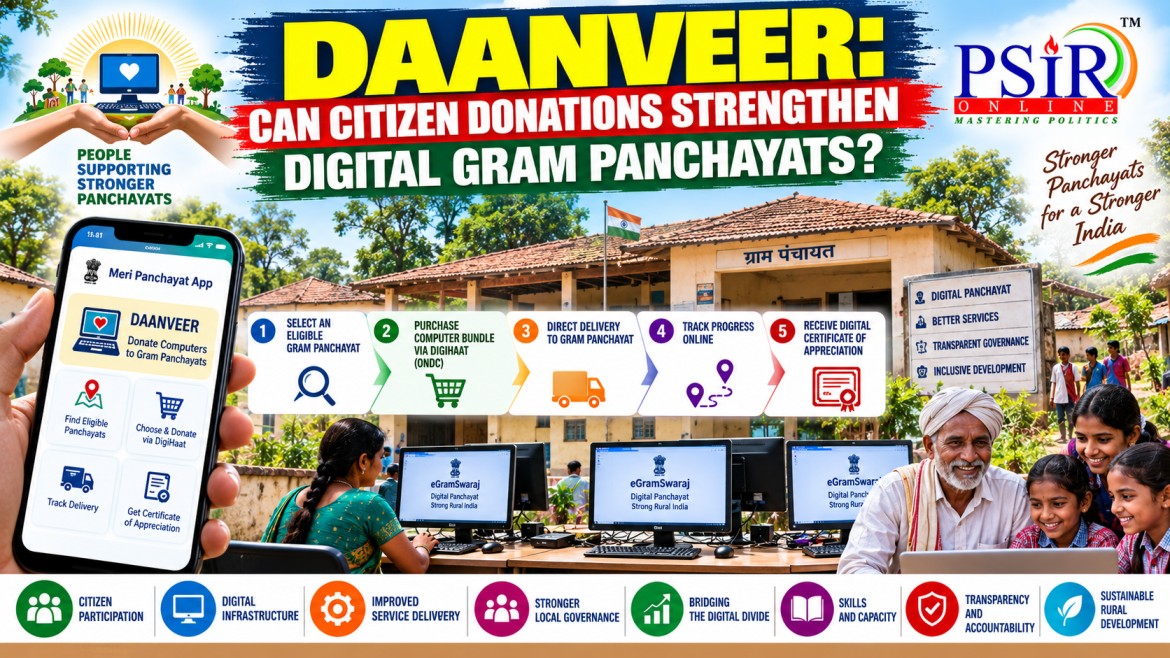
Gram Panchayats increasingly depend on digital systems for development planning, financial management, record-keeping and the delivery of public services. Platforms such as eGramSwaraj and Meri Panchayat support different aspects of Panchayat administration, but their effective use requires adequate hardware, connectivity, trained personnel and reliable technical support.
To address one part of this infrastructure requirement, the Ministry of Panchayati Raj launched DAANVEER on 29 July 2026. The initiative enables individuals and organisations to donate computers directly to eligible Gram Panchayats through the Meri Panchayat App. The Ministry presented it as a voluntary, citizen-participation model intended to complement government programmes supporting rural digital infrastructure.
The initiative offers an opportunity to examine whether voluntary contributions can strengthen local self-government institutions. Its significance, however, extends beyond donating computers. The larger question is whether community participation can help Panchayats build sustainable digital capacity without shifting the government's responsibility for providing essential public infrastructure onto citizens.
WHAT IS DAANVEER AND HOW DOES IT WORK?
DAANVEER is a computer-crowdsourcing initiative of the Ministry of Panchayati Raj. It allows individuals and organisations to support eligible Gram Panchayats whose requirements for desktop computers have been verified by the respective State Governments.
The initiative follows a digital process designed to reduce paperwork and make the donation journey traceable.
The process broadly involves the following steps:
1. Identify a Panchayat: Donors use the Meri Panchayat App to view eligible Gram Panchayats requiring computers.
2. Select a contribution: The donor chooses a Panchayat, which may be the donor's own village or another eligible Panchayat.
3. Purchase through DigiHaat: Selecting the donation option redirects the donor to DigiHaat, an ONDC-enabled digital marketplace. The donor can select from standardised computer bundles aligned with prescribed technical specifications.
4. Track delivery: The digital process enables tracking from order confirmation and dispatch to delivery and acknowledgement.
5. Receive acknowledgement: After the Gram Panchayat Secretary acknowledges receipt, the donor receives a digitally generated Certificate of Appreciation.
The platform is intended to make institutional needs visible and provide a verifiable process for voluntary contributions. The verification of Panchayat requirements and the standardisation of equipment are important because they help connect donations to identified needs rather than leaving recipients and donors to arrange equipment independently.
However, a completed donation is an input, not proof of improved governance. The computer must be installed, maintained and used for relevant administrative work before it can contribute to better service delivery.
WHY DIGITAL INFRASTRUCTURE MATTERS AT THE PANCHAYAT LEVEL
Gram Panchayats perform important functions in local planning, financial administration, public-service coordination and development implementation. Digital platforms can support these responsibilities, but access to software alone does not guarantee effective use.
A Panchayat needs functional equipment and the capacity to use it. Inadequate hardware can make it difficult for staff to maintain records, prepare reports, access online systems and complete routine administrative transactions. Where computers are shared across several employees or are unreliable, digital work may be delayed or shifted to external service providers.
A donated computer could help a Panchayat perform tasks such as:
· Maintaining digital records and administrative documents.
· Accessing eGramSwaraj for relevant planning, accounting and monitoring functions.
· Using online government portals and communication systems.
· Preparing reports and maintaining development-related information.
· Facilitating the use of digital tools for citizen-facing administrative services.
These are potential uses rather than guaranteed outcomes for every recipient. The practical benefit will depend on the Panchayat's existing equipment, workload, connectivity, staffing and administrative needs.
The Ministry reported that 75 donations had been made by 27 August 2026. This establishes an early implementation milestone, but it does not by itself reveal how many computers had been installed and put to sustained use, how many Panchayats had benefited or whether service delivery had improved.
CITIZEN PARTICIPATION AND COMMUNITY OWNERSHIP
DAANVEER introduces a model in which citizens can contribute directly to the digital infrastructure of local institutions. It may be particularly relevant to people who live away from their native villages, members of the Indian diaspora, philanthropic organisations and corporate social responsibility partners.
Its potential governance contributions include:
Strengthening community participation: Citizens can contribute to a practical local need rather than participating only through consultations or financial donations to general causes.
Connecting migrants with their villages: People living in cities or abroad can support eligible Panchayats in their home regions through a digital process.
Improving transparency: Standardised computer bundles, direct delivery and digital tracking can make the contribution process easier to verify.
Complementing public programmes: Voluntary donations may help address specific equipment gaps alongside government-supported digital infrastructure initiatives, including the Rashtriya Gram Swaraj Abhiyan (RGSA).
Nevertheless, community participation should not be confused with the transfer of public responsibility to private donors. Gram Panchayats are institutions of local self-government under the constitutional framework of Part IX. Their ability to function effectively requires sustained public investment, administrative support and adequate institutional capacity.
Voluntary contributions can supplement these arrangements, but they should not determine which Panchayats receive essential public infrastructure or create dependence on the fundraising capacity of individual communities.
THE LIMITS OF HARDWARE-FIRST DIGITAL GOVERNANCE
A computer is only one component of digital infrastructure. Its contribution may remain limited if other essential conditions are absent.
|
Requirement |
Why it matters |
|
Reliable electricity |
Equipment cannot be used consistently without a dependable power supply. |
|
Internet connectivity |
Online portals and digital services require a stable connection. |
|
Trained personnel |
Staff need the skills to operate systems, maintain records and resolve routine technical problems. |
|
Maintenance and repairs |
Hardware requires servicing, security updates and eventual replacement. |
|
Appropriate software and security |
Systems need suitable applications, secure access and responsible handling of official information. |
|
Recurring funding |
Connectivity, repairs, peripherals and replacement equipment create continuing costs. |
These requirements reveal a central limitation of equipment-donation models: the cost of a computer is only the initial cost of digital capacity.
A donated desktop could remain underused if a Panchayat lacks a suitable workspace, trained personnel or internet access. Similarly, a computer that becomes unusable after a hardware failure may not deliver lasting value if repair arrangements are unavailable.
The initiative therefore needs to be considered alongside the wider digital Panchayat ecosystem. The Ministry's e-Panchayat Mission Mode Project and platforms such as eGramSwaraj address broader dimensions of digital governance, while programmes such as RGSA support capacity-building and the strengthening of Panchayati Raj Institutions.
DAANVEER can help fill a hardware gap, but it cannot independently resolve every institutional and infrastructural constraint affecting digital governance.
ACCOUNTABILITY, EQUITY AND SUSTAINABILITY
For DAANVEER to produce durable benefits, the donation process must be complemented by transparent allocation, effective installation and long-term maintenance.
First, needs-based distribution is important. The verification of eligible Panchayats by State Governments provides a basis for identifying requirements. Periodic reassessment can help ensure that listed needs remain accurate and that donations reach Panchayats with genuine equipment gaps.
Second, receipt should be followed by installation and use. Acknowledgement of delivery confirms that equipment has reached the institution, but further monitoring is needed to establish whether it is functional and being used for administrative purposes.
Third, maintenance responsibility must be clear. Panchayats need arrangements for technical support, repairs, software updates, connectivity and eventual replacement. These responsibilities should not be left dependent on repeated voluntary donations.
Fourth, digital equity requires attention. Panchayats differ in their existing infrastructure, staffing and capacity to maintain equipment. A donation-led model could unintentionally favour areas with stronger networks of alumni, philanthropists or diaspora contributors unless public authorities continue to address unequal needs.
Fifth, performance should be evaluated through outcomes. Useful indicators include the number of computers delivered and installed, the proportion remaining functional, usage of relevant digital platforms, staff training completed and improvements in the timeliness of administrative work. Where feasible, these measures should be compared with baseline conditions.
The initiative would also benefit from clear reporting on donations, delivery acknowledgements and the status of donated equipment. Such information would help citizens assess whether their contributions have translated into lasting institutional capacity.
UPSC ANGLES
|
Dimension |
Relevance for UPSC |
|
Constitutional governance |
Part IX of the Constitution provides the framework for Panchayati Raj Institutions and grassroots self-government. |
|
Decentralisation |
Functional digital infrastructure can support the administrative capacity of local governments. |
|
Participatory governance |
DAANVEER provides a mechanism for voluntary citizen participation in strengthening local institutions. |
|
E-governance |
Computers can support digital planning, financial management, record-keeping and service delivery when accompanied by connectivity and skills. |
|
Public finance |
Donations can complement government expenditure, but should not replace predictable public funding for essential infrastructure. |
|
Digital divide |
Unequal connectivity, electricity, equipment and skills can produce unequal access to digital governance. |
|
Accountability |
Digital tracking, delivery acknowledgement and reporting can improve the traceability of contributions. |
|
Capacity-building |
Staff training, technical support and maintenance are necessary to convert equipment into usable administrative capacity. |
|
Outcome evaluation |
Functional equipment, regular use and improved service delivery are more meaningful indicators than donation counts alone. |
CONCLUSION
DAANVEER introduces a practical route for citizens and organisations to contribute computers to eligible Gram Panchayats through the Meri Panchayat App. Its standardised purchasing process, digital tracking and direct delivery model can help connect voluntary contributions with identified infrastructure needs.
However, the initiative's long-term value will depend on whether donated computers remain functional and support routine Panchayat work. Electricity, connectivity, staff training, maintenance and institutional accountability are essential complements to hardware.
The wider lesson is that citizen participation can strengthen local institutions when it complements, rather than substitutes for, public responsibility. DAANVEER should therefore be assessed not simply by the number of computers donated, but by whether those computers help Gram Panchayats perform their functions more effectively and serve citizens better.
OFFICIAL REFERENCES AND FURTHER READING
GS2 MAINS PRACTICE QUESTIONS
10 marks | 150 words
15 marks | 250 words
