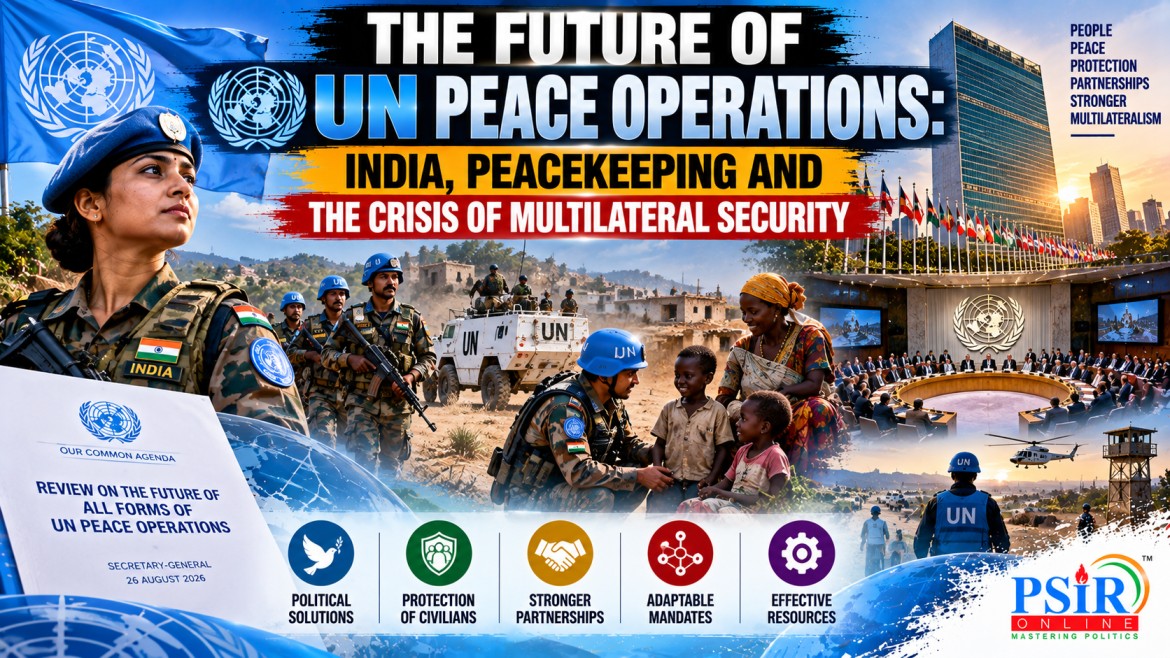
United Nations peace operations are entering a period of strategic uncertainty. Intensifying conflicts, geopolitical divisions, financial constraints and increasingly complex threats have exposed the limitations of traditional peacekeeping. On 26 August 2026, UN Secretary-General António Guterres presented a comprehensive review of the future of all forms of UN peace operations to the General Assembly. It called for a renewed emphasis on peacemaking, stronger partnerships with host states, focused and adaptable mandates, and more agile operations. For India, a longstanding contributor to UN peacekeeping, the review raises a fundamental question: how can multilateral security remain effective when political consensus is weakening?
THE AUGUST REVIEW: REIMAGINING UN PEACE OPERATIONS
The review, prepared under the framework of the Pact for the Future, examines both traditional peacekeeping operations and special political missions. It proposes a more flexible approach in which the choice of instrument depends on the political and security conditions of each conflict.
Three priorities stand out:
· Political solutions over indefinite deployments: Peace operations cannot substitute for negotiations, political settlements or the willingness of conflict parties to pursue peace.
· Adaptable mandates: Missions need clearly defined political objectives and the ability to respond when conditions change.
· Stronger partnerships: The UN should deepen consultations with host states, regional organisations, troop- and police-contributing countries, and other relevant actors.
The review also reflects the need for greater operational efficiency, technological readiness and accountability. However, flexibility must not become a justification for weakening civilian protection or abandoning populations in conflict zones.
INDIA’S PEACEKEEPING LEGACY AND STRATEGIC INTERESTS
India has contributed to UN peacekeeping since its early years. According to India’s Permanent Mission to the UN, the country has contributed nearly 300,000 personnel across more than 53 missions, cumulatively among the largest contributions by any country. Indian personnel have served in demanding environments involving civilian protection, medical assistance, stabilisation and support for political transitions.
India’s contribution is not simply a matter of military deployment. Peacekeeping provides an avenue for supporting multilateral security, strengthening diplomatic engagement with developing countries and demonstrating the operational role of the Global South in international institutions.
India has also highlighted a structural problem: expanding mandates without adequate resources can place peacekeepers in increasingly dangerous situations. Its stated position favours realistic mandates, effective resource allocation and stronger host-state capacity, rather than expecting peacekeepers to compensate indefinitely for unresolved political conflicts.
THE CRISIS OF MULTILATERAL SECURITY
The difficulties facing peace operations reflect a broader crisis in collective security. The UN Security Council’s permanent members frequently disagree over conflicts, sanctions, intervention and political settlements. Such divisions can produce delayed decisions, limited mandates or an inability to exert sustained pressure on parties to a conflict.
At the operational level, peacekeepers may face armed groups, disinformation, criminal networks, drones and other advanced technologies. Yet peacekeeping remains dependent on member states for troops, police, equipment and financing. The result is a persistent gap between international expectations and the capabilities provided to missions.
A further challenge concerns host-state consent. Cooperation with national authorities is essential, but governments may have limited capacity or may contest aspects of a mission’s mandate. The UN must therefore balance national ownership with impartiality, human rights and the protection of civilians.
INDIA’S POLICY PRIORITIES: FROM TROOP CONTRIBUTIONS TO INSTITUTIONAL REFORM
India can use the review to press for reforms that connect operational effectiveness with a more representative multilateral order.
|
Priority |
Policy direction |
|
Mandate–resource alignment |
Ensure that Security Council mandates are matched by personnel, equipment and financing. |
|
Host-state capacity |
Support training and institution-building so national authorities can assume sustainable security responsibilities. |
|
Troop-contributor consultation |
Strengthen the role of troop- and police-contributing countries in mandate design and operational decisions. |
|
Technology and protection |
Improve medical evacuation, surveillance, cyber resilience and protection against emerging battlefield threats. |
|
UN reform |
Link peacekeeping reform with wider demands for a more representative and accountable Security Council. |
India’s diplomatic challenge is to move beyond being a major provider of personnel and contribute more substantially to mandate formation, strategic planning and institutional decision-making. Greater consultation with troop contributors would help align responsibility with influence, although final authority over Security Council mandates would remain with the Council.
LIMITS AND THE WAY FORWARD
India’s approach must also recognise that troop contributions alone cannot resolve the political causes of conflict. Peacekeeping is most effective when it supports a viable political process, enjoys sufficient international backing and operates within a realistic mandate.
The UN review offers an opportunity to improve coordination between peacekeeping, special political missions and regional organisations. India can support this transition while insisting that efficiency should not mean indiscriminate withdrawals, underfunded missions or reduced protection for civilians.
A durable framework requires political commitment, adequate resources, accountability and meaningful local participation. Women’s participation in peace processes, respect for international humanitarian law and engagement with local civil society are also important to the legitimacy and sustainability of peace operations.
THEORETICAL ANGLES
|
Theory or concept |
Application to UN peace operations |
|
Collective Security |
Explains the UN’s responsibility to respond collectively to threats to international peace, while exposing the constraints created by Security Council divisions. |
|
Liberal Institutionalism |
Highlights how international institutions facilitate cooperation, coordinate resources and manage conflicts despite differences among states. |
|
Realism |
Explains how great-power rivalry, national interests and veto politics constrain multilateral responses to conflict. |
|
Constructivism |
Examines how norms of civilian protection, impartiality and peacebuilding shape the legitimacy and practice of UN missions. |
|
Global South perspectives |
Draws attention to the contribution of developing countries to peacekeeping and their demands for greater representation in international security decisions. |
CONCLUSION
The August 2026 review recognises that UN peace operations must adapt to a more fragmented and technologically complex security environment. For India, the challenge is to combine its longstanding peacekeeping contribution with greater influence over the design and reform of multilateral security. The future of peace operations will depend not merely on more agile missions, but on whether member states can provide political consensus, credible mandates and the resources required to protect civilians and sustain peace.
RELATED READING
PRACTISE QUESTIONS FOR GS2 MAINS
PRACTISE QUESTIONS FOR PSIR
