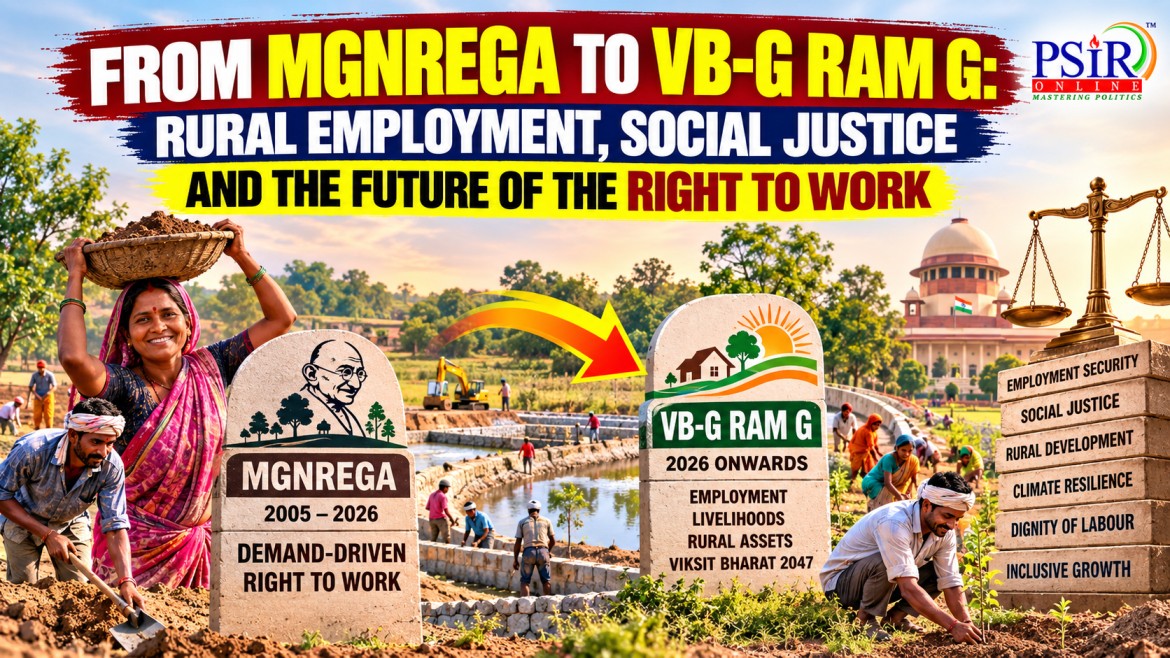
For nearly two decades, MGNREGA represented one of India's strongest statutory instruments of rural social protection. It created a legal entitlement to demand unskilled wage employment and provided a fallback for rural households facing unemployment, agricultural distress and economic shocks.
From 1 July 2026, MGNREGA was replaced by the Viksit Bharat–Guarantee for Rozgar and Ajeevika Mission (Gramin) Act, 2025 (VB-G RAM G). The new law increases the statutory employment guarantee from 100 to 125 days, while simultaneously changing the financing, planning and implementation architecture of rural employment.
THE SCHEME
The VB-G RAM G Bill was introduced in the Lok Sabha on 16 December 2025 and passed by both Houses on 18 December. The Act subsequently received Presidential assent and replaced MGNREGA from 1 July 2026.
The new law provides 125 days of statutory wage employment per rural household per financial year to households whose adult members volunteer to undertake unskilled manual work. It also retains the provision for unemployment allowance when work is not provided within the prescribed period. For 2026–27, the Union Government has provided a Central share of ₹95,692.31 crore; including the estimated State contribution, the total programme outlay is expected to exceed ₹1.51 lakh crore.
The government also states that the new framework seeks to combine employment security with durable rural assets, livelihood infrastructure, water security and climate resilience.
WHY THE CHANGE?
The government's rationale is that rural employment policy should move beyond short-term wage employment towards productive assets, sustainable livelihoods and rural infrastructure.
The new framework therefore seeks to:
· increase the employment guarantee from 100 to 125 days;
· create durable and productive rural assets;
· improve water security and climate resilience;
· integrate village planning with PM Gati Shakti;
· strengthen transparency through digital monitoring;
· use AI and geospatial technologies for planning, auditing and fraud-risk mitigation; and
· improve the timeliness of wage payments.
The government also argues that MGNREGA needs to be aligned with the changing requirements of rural India and the broader objective of Viksit Bharat @2047.
WHAT ACTUALLY CHANGED?
The increase from 100 to 125 days is important, but the more consequential changes concern funding, planning and the relationship between employment demand and government allocation.
|
Dimension |
MGNREGA → VB-G RAM G |
|
Employment guarantee |
Increased from 100 to 125 days per rural household per financial year. |
|
Wage payment |
Wages are to be paid weekly or, in any case, within 15 days of work. |
|
Unemployment allowance |
Retained when employment is not provided within the prescribed period. |
|
Works |
Greater focus on water security, core rural infrastructure, livelihood infrastructure and extreme-weather/climate-resilience works. |
|
Village planning |
Works are planned through Viksit Gram Panchayat Plans, approved through the local planning process and aggregated upwards. |
|
Agricultural season |
States can notify an aggregate 60-day period during peak sowing/harvesting seasons when scheme works will not operate. |
|
Funding |
The programme becomes a Centrally Sponsored Scheme, with 60:40 Centre–State sharing for most states and 90:10 for North-Eastern and Himalayan states and specified UTs. |
|
Normative allocation |
The Centre determines state-wise normative allocations using prescribed objective parameters. Expenditure beyond the normative allocation is borne by the State. |
|
Technology |
Greater use of biometric authentication, GPS/mobile monitoring, real-time MIS and AI-based planning/auditing. |
|
Administrative expenditure |
The administrative expenditure ceiling rises from 6% to 9%. |
THE BIGGEST CHANGE: FROM FUNDING DEMAND TO NORMATIVE ALLOCATION
This is arguably the most important structural difference. MGNREGA had an annual budget allocation, but the Centre's financial commitment was not rigidly capped at that initial Budget Estimate. Because it was a demand-driven statutory employment programme, additional funds could be sought and allocated when demand and expenditure requirements increased. But, Under VB-G RAM G, the Centre determines a state-wise normative allocation. Expenditure beyond that normative allocation becomes the State's responsibility.
This creates two competing interpretations.
|
Government's rationale |
Social-justice concern |
|
Normative allocation creates greater predictability in public expenditure and encourages planned rural development. |
A predetermined allocation may become a constraint if actual demand for employment rises sharply during drought, agricultural distress or economic shocks. |
|
Cost-sharing gives States greater ownership of implementation. |
Poorer States may find it difficult to finance their share, particularly when demand for employment is high. |
|
Planned expenditure can be aligned with durable assets and long-term rural transformation. |
If States hesitate to incur expenditure beyond the normative allocation, the practical availability of employment may become weaker than the statutory entitlement. |
|
The government maintains that the programme remains demand-driven and retains the unemployment-allowance provision. |
Critics argue that the combination of normative allocations and increased State financial responsibility could weaken the open-ended character of the earlier employment guarantee. |
WHY DOES IT MATTER FOR SOCIAL JUSTICE?
Rural employment programmes are not simply employment schemes. They provide a fallback income source for households with limited access to formal employment, agricultural income or social security.
MGNREGA historically became particularly important for women and vulnerable rural households. Government data shows that women's participation in MGNREGA has remained above 50% in recent years. The social-justice significance of employment guarantee can therefore be understood through the following dimensions:
|
Social Justice Dimension |
Significance of Rural Employment Guarantee |
|
Right to work |
Provides a statutory mechanism through which rural households can demand wage employment. |
|
Income security |
Creates a fallback source of income during periods of unemployment or agricultural distress. |
|
Gender justice |
Rural public employment can provide women with independent wage income and greater participation in the labour market. |
|
Caste and social inclusion |
Public employment provides an institutional mechanism through which historically disadvantaged rural communities can access wage work. |
|
Poverty reduction |
Wage employment can smooth household consumption during periods of economic stress. |
|
Social mobility |
Stable income can reduce dependence on informal borrowing and distress migration. |
|
Dignity of labour |
A statutory employment guarantee recognises wage employment as a component of livelihood security rather than discretionary relief. |
|
Climate justice |
Water conservation, drought-proofing and climate-resilient assets can protect vulnerable rural communities from environmental shocks. |
|
Local development |
Panchayat-level planning can connect employment generation with community infrastructure and local needs. |
THE 60-DAY AGRICULTURAL PAUSE: EFFICIENCY OR EXCLUSION?
One distinctive feature of VB-G RAM G is the provision allowing States to notify an aggregate 60-day period during peak agricultural seasons, including sowing and harvesting, when scheme works will not be undertaken. The stated objective is to ensure adequate labour availability for agriculture. The policy creates a genuine social-policy trade-off. During peak agricultural seasons, farmers may require additional labour. At the same time, landless agricultural workers may depend on public employment precisely because they do not own land.
Therefore:
Farmer labour availability → agricultural productivity
but also
Landless worker access to employment → livelihood security
The success of the provision will depend on whether the agricultural pause is implemented in a way that balances farm-sector labour demand with the livelihood needs of landless workers.
THE TECHNOLOGY DIMENSION
VB-G RAM G introduces a significantly stronger technology component into rural employment governance. The framework envisages:
· biometric authentication;
· GPS/mobile-based worksite monitoring;
· real-time MIS dashboards;
· geospatial planning;
· proactive public disclosure; and
· AI for planning, audits and fraud-risk mitigation.
The government is also extending the BhuPRAHARI platform, which uses satellite and ground-based data with AI-driven analytics to monitor rural assets.
Technology can therefore improve:
Transparency → monitoring → asset quality → fraud detection → accountability
However, social justice requires that technology remain an enabler rather than become a new barrier to accessing employment. Biometric authentication, digital records and online monitoring must therefore be accompanied by effective grievance redressal and offline assistance.
WHAT DO THE EARLY NUMBERS SHOW?
The government reported that between 1 and 22 July 2026, more than 99.5% of workers who demanded employment were offered work, with 5.20 crore person-days generated across 8.46 lakh worksites. However, later official dashboard data reported by The Indian Express showed 7.67 crore person-days in July 2026, compared with 15.33 crore under MGNREGA in July 2025—a decline of nearly 50%. But as we know, one month's data cannot by itself establish whether the new system is stronger or weaker than MGNREGA.
The more meaningful indicators will be:
· person-days generated over a full financial year;
· average days of employment per household;
· percentage of households reaching 100 and 125 days;
· unemployment allowance actually paid;
· wage-payment delays;
· State utilisation of funds;
· employment generated in poorer districts; and
· participation of women and vulnerable social groups.
THE CENTRAL SOCIAL-JUSTICE QUESTION
The debate is therefore not simply: MGNREGA vs. VB-G RAM G. It is about the underlying philosophy of social protection.
|
MGNREGA Rights-based employment security |
VB-G RAM G Development-oriented employment security |
|
Employment is primarily a statutory entitlement responding to household demand. |
Employment is combined with planned asset creation and rural transformation. |
|
Fiscal expenditure expands when demand rises. |
Normative allocations provide greater expenditure predictability. |
|
Priority is livelihood protection. |
Priority is livelihood protection + productive assets + infrastructure. |
|
The State acts as an employer of last resort. |
The programme seeks to integrate employment with broader rural development. |
|
Social protection is the primary lens. |
Social protection is combined with productivity and development objectives. |
The challenge is to ensure that the second approach does not weaken the first. A rural employment programme can create productive assets and still remain a strong social-security instrument. The crucial question is whether the employment guarantee remains practically accessible when vulnerable households need it most.
CHALLENGES
|
Challenge |
Why it matters for social justice |
|
Normative allocation |
If actual demand exceeds the allocation, States may face pressure to finance additional expenditure themselves. |
|
Higher State contribution |
The 60:40 funding pattern can place greater pressure on fiscally constrained States. |
|
Agricultural pause |
Landless workers may lose access to public employment during periods when private agricultural employment is not sufficient. |
|
Digital dependence |
Biometric and technology-based systems can create exclusion if authentication or connectivity fails. |
|
Unemployment allowance |
The existence of a legal entitlement is meaningful only when the allowance is actually paid when work is not provided. |
|
Women workers |
Any reduction in employment availability could disproportionately affect women who depend on public works for accessible local employment. |
|
Demand during crises |
Droughts, floods, crop failures or rural economic shocks can suddenly increase employment demand. |
|
Centre–State tensions |
A centrally determined allocation combined with State financial responsibility can create federal tensions. |
|
Implementation capacity |
Panchayats require adequate administrative capacity to prepare plans, execute works and maintain transparency. |
|
Asset versus employment trade-off |
Excessive emphasis on asset quality should not reduce the availability of timely wage employment for vulnerable households. |
PRS notes that unemployment allowance under MGNREGA was itself poorly realised: between 2019–20 and 2025–26, only about 8% of the amount due was actually paid, highlighting that statutory rights require strong implementation mechanisms.
UPSC DIMENSION
|
UPSC Dimension |
How VB-G RAM G connects with it |
|
Social justice |
VB-G RAM G strengthens livelihood security by providing a statutory employment guarantee to rural households, particularly benefiting workers with limited access to stable employment. |
|
Right to work |
The statutory guarantee transforms employment from a purely market-dependent opportunity into a legally recognised form of livelihood protection. |
|
Equality of opportunity |
By providing wage employment to rural households irrespective of their access to land, capital or formal employment, the programme creates a minimum institutional floor for economic opportunity. |
|
Gender justice |
Rural employment programmes can strengthen women's economic participation by providing locally available wage employment and independent earnings. |
|
Poverty and vulnerability |
Wage employment provides consumption support during periods of unemployment, agricultural distress and economic shocks. |
|
Fiscal federalism |
The shift to a 60:40 Centre–State funding structure increases the financial role of States and raises questions about fiscal capacity and cooperative federalism. |
|
Demand-driven welfare vs budgetary planning |
The shift towards normative allocations creates an important policy debate between an open-ended rights-based entitlement and predictable budgetary planning. |
|
Decentralisation |
Viksit Gram Panchayat Plans and Gram Sabha participation place local planning at the centre of rural asset creation. |
|
Digital governance |
Biometric authentication, GPS monitoring, real-time dashboards and AI-based audits bring technology into welfare delivery and accountability. |
|
Climate justice |
Water conservation and extreme-weather mitigation works connect employment generation with protection of vulnerable rural communities from climate risks. |
|
Agricultural labour market |
The 60-day agricultural pause attempts to balance rural employment guarantees with the seasonal labour requirements of agriculture. |
|
Inclusive growth |
The programme combines income support with rural infrastructure, livelihood assets and local economic development. |
|
Centre–State relations |
Central determination of normative allocations alongside State financial contributions makes the scheme an important case study in intergovernmental governance. |
WAY FORWARD
|
Priority |
Way Forward |
|
Protect the employment guarantee |
Ensure that normative allocations do not become a practical barrier when genuine demand for work rises sharply. |
|
Strengthen fiscal support |
The Centre should provide additional support to fiscally weaker States during droughts, disasters and severe rural distress. |
|
Ensure unemployment allowance |
Make payment of unemployment allowance automatic, transparent and time-bound wherever the statutory conditions are met. |
|
Protect women and vulnerable workers |
Monitor employment access for women, SCs, STs and landless households separately. |
|
Digital inclusion |
Maintain effective offline alternatives and grievance mechanisms wherever biometric or digital systems fail. |
|
Strengthen Panchayats |
Build technical and administrative capacity for participatory planning and quality asset creation. |
|
Measure real outcomes |
Evaluate the programme through person-days, average employment per household, wage-payment timeliness and livelihood outcomes—not merely expenditure or number of worksites. |
|
Balance agriculture and labour welfare |
Use the 60-day agricultural pause carefully so that farm labour availability is protected without creating a livelihood gap for landless workers. |
|
Strengthen Centre–State cooperation |
Normative allocation and cost-sharing should be implemented through transparent consultation and predictable fiscal arrangements. |
|
Integrate employment with livelihoods |
Employment works should create durable assets that strengthen irrigation, water security, agriculture, storage, connectivity and rural livelihoods. |
CONCLUSION
The transition from MGNREGA to VB-G RAM G represents a major restructuring of India's rural employment policy. The new framework offers a larger statutory employment entitlement of 125 days, higher notified wage rates, greater emphasis on durable assets, climate resilience and technology-enabled governance.
At the same time, the move to a Centrally Sponsored Scheme with normative State-wise allocations and greater State financial responsibility changes the fiscal foundation of the employment guarantee. This is why the central social-justice question remains unresolved by the increase from 100 to 125 days.
The government's early data suggests that recorded demand has been substantially met, while subsequent person-day data shows a sharp decline compared with the corresponding month under MGNREGA. Both indicators need to be followed over a longer period before drawing firm conclusions.
Ultimately, rural employment guarantee is not only about creating work or assets; it is about ensuring that a poor household has a dependable institutional fallback when the market fails to provide livelihood opportunities.
The success of VB-G RAM G will therefore depend not merely on whether it creates more assets or promises more days, but on whether the poorest rural household can actually exercise its right to work when it needs it most.
RELATED READING
For comprehensive UPSC preparation, students should connect VB-G RAM G with:
· MGNREGA and the rights-based approach to welfare
· Article 21 and livelihood security
· Directive Principles and social-economic justice
· Decentralisation and Gram Sabha
· Centre–State fiscal relations
· Centrally Sponsored Schemes
· Rural poverty and informal employment
· Women’s participation in the rural labour force
· Social protection and employment guarantees
· Climate-resilient rural development
· Digital governance and welfare delivery
· Agricultural labour and seasonal migration
· Inclusive growth and rural infrastructure
· MGNREGA as a counter-cyclical safety net
PRACTICE QUESTIONS – GS PAPER II
1. “Rural employment guarantee is not merely a poverty-alleviation measure but an instrument of social justice.” Discuss in the context of VB-G RAM G. (10 Marks, 150 Words)
2. The shift from MGNREGA to VB-G RAM G represents a transition from employment-centric welfare to employment-linked rural transformation. Examine. (10 Marks, 150 Words)
3. “A statutory employment guarantee is meaningful only when its fiscal architecture enables the State to respond to actual demand for work.” Critically analyse the VB-G RAM G framework. (15 Marks, 250 Words)
4. VB-G RAM G seeks to balance livelihood security, agricultural labour availability, rural infrastructure and fiscal sustainability. Examine the challenges in achieving this balance while ensuring social justice. (15 Marks, 250 Words)
