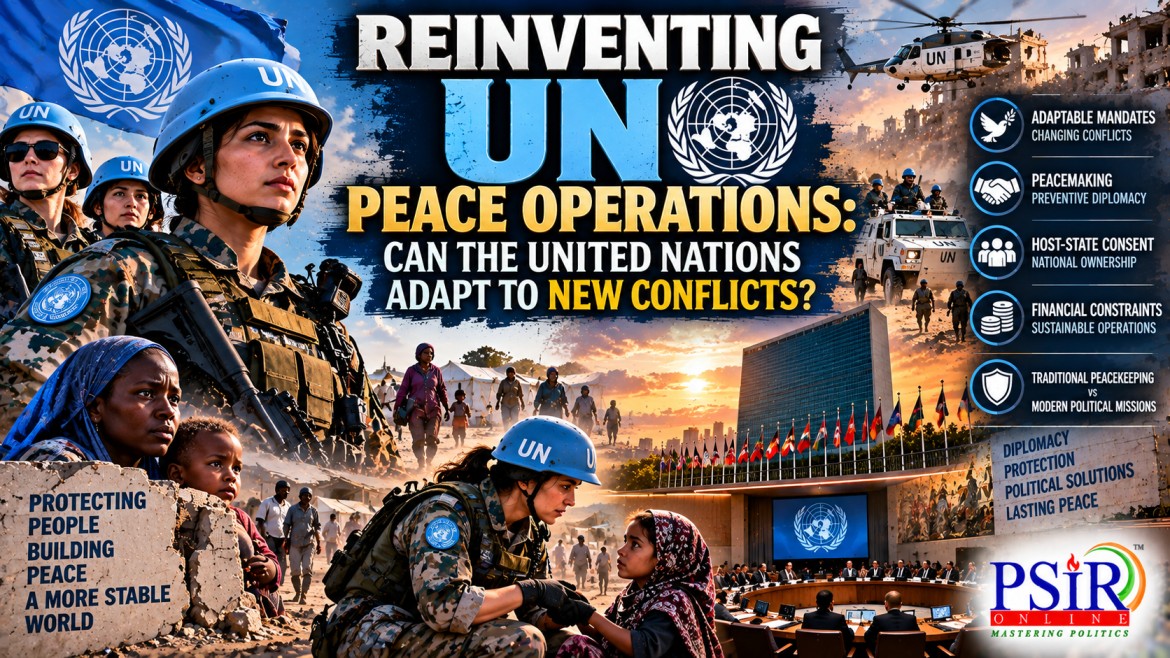
United Nations peace operations remain among the most visible instruments of multilateral action in international security. Since the establishment of the first UN peace operation in 1948, these missions have supported ceasefires, monitored peace agreements, protected civilians, facilitated political transitions and assisted post-conflict reconstruction. However, the character of contemporary conflicts has changed significantly. Interstate rivalries, fragmented armed groups, transnational criminal networks, drone warfare and prolonged conflicts without comprehensive peace agreements have complicated the environment in which UN missions operate.
On 26 August 2026, the UN Secretary-General presented a review of the future of all forms of UN peace operations to the General Assembly. Submitted to the General Assembly and Security Council on 20 August as document A/80/798–S/2026/600, the report proposed a strategic reset in the way peace operations are designed, deployed and evaluated. It contained 47 recommendations and commitments across eight areas, ranging from preventive diplomacy and adaptable mandates to financing and partnerships with regional organisations.
The review reflects a central challenge of contemporary global governance: peace operations must adapt to changing conflicts without abandoning the principles of the UN Charter. Their effectiveness depends not only on military capabilities but also on political agreement, host-state cooperation, institutional legitimacy and sustained financial support.
WHY TRADITIONAL PEACEKEEPING IS UNDER PRESSURE
Traditional UN peacekeeping developed around the monitoring of ceasefires and the separation of opposing forces, often following agreements accepted by the parties. Its effectiveness depended on consent, impartiality and the limited use of force except in self-defence and defence of the mandate.
Many contemporary conflicts do not fit this model. Armed groups may be fragmented, ceasefires temporary, political authority contested and external actors involved in sustaining hostilities. Some missions are deployed where no comprehensive peace agreement exists or where the parties have little incentive to negotiate one.
Technological developments add further complexity. Drones, digital surveillance, disinformation and increasingly accessible weapons can alter the risks faced by civilians and peacekeepers. Missions may also be expected to operate across large territories with inadequate infrastructure, restricted movement and limited resources.
The Secretary-General’s review therefore calls for a more flexible approach to peace operations, with missions designed around specific political and security objectives rather than a standard template.
This does not make traditional peacekeeping obsolete. Monitoring ceasefires, supporting electoral processes and assisting the implementation of negotiated settlements remain important functions. The challenge is to determine which instrument is appropriate for each political and security environment.
PEACEKEEPING AND SPECIAL POLITICAL MISSIONS: DIFFERENT TOOLS, COMPLEMENTARY PURPOSES
The 2026 review considers the entire spectrum of UN peace operations, bringing peacekeeping operations and special political missions into a common strategic framework. These instruments have different functions and should not be treated as interchangeable.
|
Dimension |
UN peacekeeping operations |
Special political missions |
|
Principal character |
Often involve uniformed military and police personnel alongside civilian components |
Primarily political, diplomatic and civilian in character |
|
Main functions |
Monitoring ceasefires, supporting peace agreements, protecting civilians where mandated and assisting stabilisation |
Mediation, preventive diplomacy, political facilitation, good offices and support for political transitions |
|
Typical operating environment |
Often deployed where a Security Council mandate and an appropriate operational framework exist for a field presence |
Can operate through political engagement, advisory support, regional offices or special envoys |
|
Core requirements |
Personnel, logistics, equipment, security arrangements and a feasible mandate |
Diplomatic access, political engagement, adequate staffing and cooperation from relevant actors |
|
Principal limitation |
Security threats, insufficient capabilities, weak consent or the absence of a viable political process |
Limited leverage where parties reject dialogue or powerful external actors obstruct negotiations |
The distinction is important because a military deployment cannot independently resolve the political causes of a conflict. Conversely, diplomacy may be insufficient where civilians face immediate threats and a properly authorised protection presence is necessary.
The review encourages a continuum of peace operations, in which preventive diplomacy, political missions, peacekeeping and peacebuilding can complement one another. The appropriate combination depends on the conflict, the political objectives and the capacities available.
The UN’s experience with the Cameroon–Nigeria border dispute illustrates this relationship. UN good offices helped the parties work towards implementing the International Court of Justice ruling, while a subsequent special political mission supported boundary demarcation. The case demonstrates how political engagement can contribute to resolving disputes without relying on a large peacekeeping deployment.
ADAPTABLE MANDATES AND HOST-STATE CONSENT
A peace operation’s mandate defines its authority, responsibilities and objectives. When mandates are too broad, insufficiently prioritised or disconnected from conditions on the ground, missions may be expected to achieve outcomes beyond their capabilities.
The 2026 review calls for focused and adaptable mandates linked to clear political end states agreed through the Security Council. Objectives should be realistic, measurable where possible and reviewed when conflict dynamics change substantially.
Adaptability, however, does not mean unlimited discretion. Missions must remain within their mandates, respect international law and maintain accountability. Changes in objectives must be authorised through the appropriate UN decision-making processes.
Host-state consent is equally important. National ownership can improve legitimacy, facilitate access and connect international assistance with domestic political processes. Yet cooperation may weaken when governments view a mission as threatening their authority or when political actors disagree about its role.
Consent also presents a difficult question when state authorities are implicated in abuses or obstruct civilian protection. Respect for sovereignty cannot be interpreted as removing a mission’s obligations under its mandate or eliminating the wider responsibilities of the international community.
The review therefore emphasises stronger partnerships with host states while reaffirming the importance of the UN Charter, international law and the impartiality of the Secretariat. Effective peace operations require negotiation with national authorities, but cooperation must be connected to clear political objectives and credible protection arrangements.
PEACEMAKING, PREVENTIVE DIPLOMACY AND POLITICAL SOLUTIONS
One of the review’s central priorities is to place peacemaking and prevention more firmly at the centre of UN action. Peacekeeping can create space for political negotiations, but it cannot substitute for the willingness of conflict parties to reach and implement settlements.
Preventive diplomacy seeks to address tensions before they escalate into violence. Good offices, mediation, special envoys, regional engagement and early-warning mechanisms can help identify opportunities for negotiation and reduce the risk of escalation.
The review also reflects the difficulty of operating in conflicts where comprehensive peace agreements are increasingly rare or fragile. In such circumstances, missions may be required to contain violence, preserve humanitarian access or maintain channels of communication without having a realistic route to a final settlement.
This makes political strategy essential. Each operation needs a clear understanding of the outcome it is expected to support, the actors capable of delivering it and the conditions under which its mandate should be adjusted.
Regional organisations can contribute local knowledge, diplomatic access and political influence. The African Union, European Union and regional organisations in other parts of the world may complement UN engagement, although coordination, resources and differences in political priorities can complicate joint action.
The broader principle is that peace operations are instruments for supporting political solutions, not substitutes for them. Military presence can help create conditions for peace, but sustainable outcomes depend on political processes, institutional arrangements and local participation.
FINANCIAL CONSTRAINTS, CAPABILITIES AND ACCOUNTABILITY
Peace operations require predictable financing, trained personnel, equipment, logistics and the political backing of member states. When funding is uncertain, missions may experience operational gaps, delayed reimbursements, reduced mobility and difficulties retaining essential capabilities.
The UN’s wider financial pressures have increased the urgency of reviewing how peace operations are planned and funded. At the same time, the costs of maintaining large missions must be considered alongside the potential human and political costs of unmanaged conflict.
The Secretary-General’s review emphasises agile operations, cost-efficiency and accountability. This includes assessing whether a mission’s size, mandate and capabilities remain appropriate as circumstances evolve.
|
Challenge |
Reform priority |
|
Unclear or excessively broad mandates |
Establish prioritised objectives and realistic political end states |
|
Unpredictable financing |
Improve financial planning and align resources with authorised responsibilities |
|
Inadequate operational capabilities |
Match personnel, equipment and technology to actual mission requirements |
|
Limited evaluation of outcomes |
Strengthen reporting, independent assessment and performance review |
|
Uncoordinated international action |
Improve cooperation among the UN, host states, troop- and police-contributing countries and regional organisations |
Cost-efficiency should not be reduced to cutting expenditure regardless of consequences. An inadequately resourced mission may be unable to carry out its mandate, exposing civilians and peacekeepers to greater risks. Equally, maintaining a mission without a credible political purpose can consume resources without producing sustainable progress.
The central objective is responsible resource allocation linked to political outcomes. Decisions about expansion, reconfiguration, transition or withdrawal should be based on the situation on the ground, the mission’s performance and the prospects for a sustainable political process.
THE ROAD AHEAD: IMPLEMENTING THE 2026 REVIEW
The review offers a framework for improving the flexibility and coherence of UN peace operations, but its recommendations require political support from member states. The Security Council and General Assembly remain central to decisions concerning mandates, financing and the broader direction of UN peace and security policy.
Implementation faces several constraints. Permanent members of the Security Council may disagree over the objectives and scope of particular missions. Host states may have different expectations from those of the UN Secretariat or contributing countries. Regional organisations may lack sufficient resources, while financial pressures can limit the ability to respond quickly to emerging crises.
The review also raises the question of institutional division of labour. Peace operations cannot independently deliver every aspect of post-conflict recovery. Humanitarian assistance, development, human rights, governance and peacebuilding require coordination across the UN system and with national institutions.
A practical reform agenda would therefore prioritise clear mandates, structured consultation with host states and contributing countries, stronger regional partnerships, realistic financing and regular assessment of political progress. It should also ensure that protection of civilians remains central wherever the mandate requires it.
Reform cannot eliminate the political divisions that constrain the UN. It can, however, improve the use of available instruments and clarify the relationship between political objectives, operational capabilities and financial commitments.
THEORETICAL ANGLES
|
Theory or concept |
Application to UN peace operations and exam use |
|
Liberal Institutionalism |
The UN provides rules, procedures and forums through which states can coordinate responses to conflict. The review illustrates both the value of multilateral institutions and their dependence on member-state cooperation. |
|
Collective Security |
UN peace operations contribute to international peace and security through collectively authorised action. Their limitations become visible when Security Council divisions prevent agreement on mandates or political objectives. |
|
Sovereignty and Non-Intervention |
Host-state consent and national ownership are central to legitimate engagement, but they must be considered alongside the UN Charter, international law and authorised protection responsibilities. |
|
Constructivism |
Peace operations reflect evolving international norms concerning civilian protection, peacebuilding and legitimate international action. Changes in mandates can be understood through shifts in expectations about the UN’s role. |
|
Realism |
Great-power rivalry and national interests shape Security Council decisions, mission mandates and resource commitments. This helps explain why institutional reform may remain constrained despite recognised operational needs. |
|
Peacebuilding and Conflict Transformation |
Sustainable peace requires more than containing violence. Political inclusion, institutional recovery, reconciliation and local ownership are essential to reducing the risk of renewed conflict. |
CONCLUSION
The 2026 review of UN peace operations recognises that the changing nature of conflict requires more flexible, politically focused and financially sustainable approaches. Traditional peacekeeping remains valuable where its principles and operating conditions are present, while special political missions and preventive diplomacy offer complementary instruments for addressing disputes and supporting political transitions.
The effectiveness of reform will depend on whether member states translate recommendations into clear mandates, adequate resources and sustained political engagement. Adaptability must be accompanied by legitimacy, accountability and realistic objectives. Without these conditions, institutional restructuring alone cannot overcome the political obstacles that constrain international peace efforts.
The future of UN peace operations therefore depends on aligning political strategy, operational capacity and international cooperation. The central challenge is not simply to redesign missions, but to ensure that the UN’s available instruments remain capable of supporting credible pathways from conflict towards sustainable peace.
RELATED READING
PRACTICE QUESTIONS FOR GS2 MAINS
PRACTICE QUESTIONS FOR PSIR
