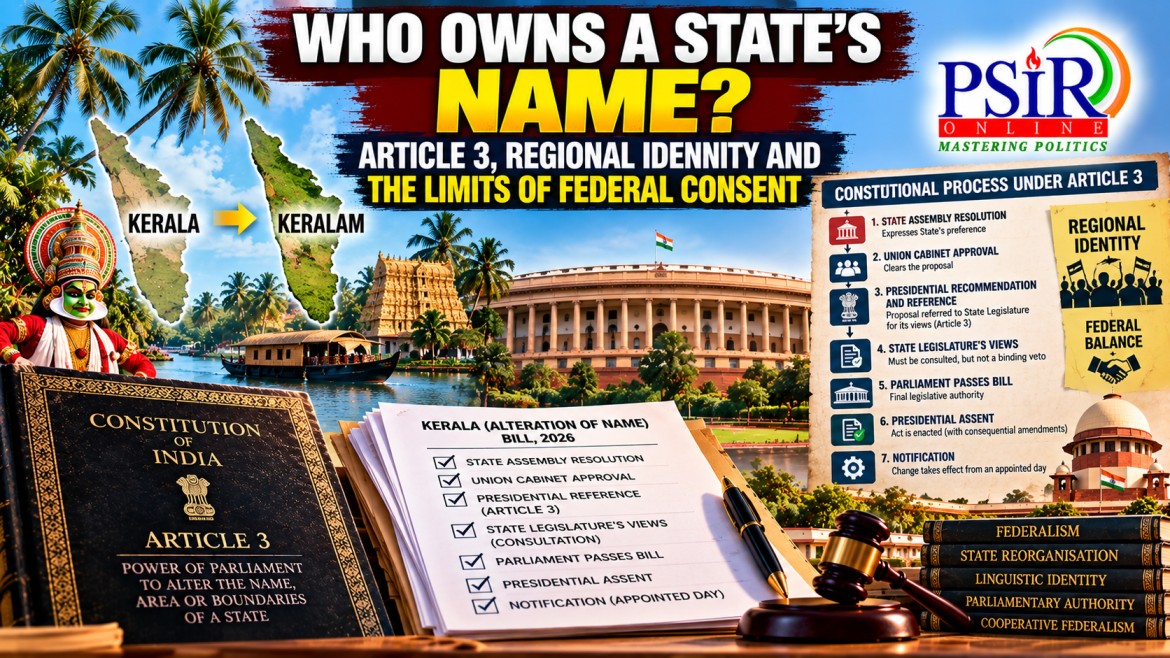
A State's name is more than a geographical label. It reflects language, history, collective memory and the political identity of its people. Kerala's proposal to adopt the name Keralam, the name used in Malayalam, illustrates how regional identity interacts with India's constitutional structure. The Kerala Legislative Assembly first adopted a unanimous resolution on 24 June 2024 requesting the Union Government to change the State's name. The Union Cabinet approved the proposal on 24 February 2026, and the Assembly subsequently endorsed the proposed legislation in July 2026 after the President referred it for its views under Article 3. Parliament later passed the Kerala (Alteration of Name) Bill, 2026, and the President gave assent on 14 August 2026. The resulting Act provides for the change to Keralam from an appointed day to be notified by the Central Government.
This sequence raises a fundamental question about Indian federalism: if a State's name expresses the identity of its people, why does the Constitution give Parliament the final legislative authority rather than requiring the State's consent?
KERALA TO KERALAM: FROM REGIONAL ASPIRATION TO CONSTITUTIONAL CHANGE
The demand to rename Kerala as Keralam reflects the linguistic history of the State. Malayalam speakers have long used Keralam as the name of their homeland, while the Constitution and the English-language administrative framework have used Kerala. The State was formed on 1 November 1956 during the linguistic reorganisation of Indian States, bringing together Malayalam-speaking regions. The 2024 resolution argued that the constitutional name should reflect the name used in the Malayalam language and the historical demand for a unified Malayalam-speaking State.
The proposal proceeded through several institutional stages. The State Assembly first expressed its preference through a unanimous resolution. The Union Cabinet approved the proposal in February 2026, after which the President referred the draft legislation to the Kerala Legislative Assembly under the proviso to Article 3. In July, the Assembly unanimously endorsed the draft provisions. Parliament subsequently enacted the Kerala (Alteration of Name) Act, 2026, which received presidential assent on 14 August 2026.
The sequence demonstrates that a State's political demand and the legal alteration of its name are separate stages. The Assembly's resolution expressed the State's preference; the presidential reference enabled constitutional consultation; and parliamentary legislation supplied the legal authority for the change. The eventual statutory change did not arise from the Assembly's resolution alone.
ARTICLE 3: PARLIAMENT'S AUTHORITY AND THE STATE'S RIGHT TO BE CONSULTED
Article 3 of the Constitution empowers Parliament to form new States and alter the areas, boundaries or names of existing States. A Bill proposing such a change can be introduced in Parliament only on the recommendation of the President. Where the proposal affects a State's area, boundaries or name, the President must refer it to the legislature of the affected State for expressing its views within a specified period, or within any further period allowed by the President.
The crucial constitutional distinction is that consultation is mandatory, but State consent is not a legal veto. The State Legislature must receive an opportunity to express its views, but Parliament retains the authority to decide whether to enact the proposed change. The Constitution does not require the State Legislature to approve the proposal as a precondition to parliamentary legislation. Nor does Article 3 require the State's political preference to determine the final outcome.
This arrangement reflects the character of Indian federalism. States possess constitutionally protected institutions and substantial responsibilities, but the Union retains an important role in the territorial and structural organisation of the federation. The procedure seeks to ensure that the affected State is heard without making every alteration dependent on a binding agreement between the Union and the State. Article 3 institutionalises consultation while preserving parliamentary supremacy over the legislative decision, subject to the Constitution's procedural requirements.
THE CONSTITUTIONAL PROCESS: WHAT EACH INSTITUTION DOES
|
Stage |
Constitutional or institutional role |
|
State Assembly resolution |
Expresses the State's political preference and requests action from the Union Government. It does not by itself alter the constitutional name. |
|
Union Cabinet consideration |
Examines the proposal and approves the Union Government's position before the legislative process proceeds. |
|
Presidential recommendation and reference |
The President recommends the introduction of the Bill and refers the proposal affecting the State's name to its Legislature for its views under Article 3. |
|
State Legislature's views |
The State Legislature considers the proposal within the specified period. Its views must be sought, but they are not binding on Parliament. |
|
Parliamentary legislation |
Parliament debates and passes the Bill through the constitutionally prescribed legislative process. |
|
Presidential assent and commencement |
Assent completes the enactment process. Where the Act provides for commencement on an appointed day, the change takes effect in accordance with the relevant commencement provision and notification. |
The Kerala case illustrates why these stages must not be conflated. The State's unanimous support was politically significant, but it did not make parliamentary legislation unnecessary. Conversely, Parliament's final authority does not make consultation meaningless. The referral gives the State Legislature a formal constitutional opportunity to place its historical, linguistic and administrative considerations before the Union and Parliament.
The process also shows that constitutional authority and political legitimacy are related but distinct. Parliament may possess the legal power to enact a name change, while the State's endorsement strengthens its political legitimacy. A constitutionally valid procedure can therefore incorporate regional participation without transferring the final legislative decision to the State.
REGIONAL IDENTITY AND THE LIMITS OF FEDERAL CONSENT
A State's name can be deeply connected to its linguistic identity, cultural heritage and historical experience. Recognising that identity can strengthen public confidence in federal institutions and acknowledge the role of linguistic movements in the formation of modern Indian States. The Keralam proposal is therefore not merely a change in spelling; it is an effort to align the official name with the linguistic expression used by the State's people.
Yet constitutional federalism does not necessarily require every question involving regional identity to be decided exclusively by the affected State. Article 3 places the decision within a national constitutional framework because the organisation of States is also a matter concerning the Union and the federation as a whole. The constitutional design permits regional preferences to be formally expressed while preserving the ability of Parliament to legislate.
This creates an important distinction between political consent and constitutional consent. Political consent can confer legitimacy and demonstrate public or legislative support. Constitutional consent, by contrast, would mean that a State's approval is legally indispensable. Article 3 requires consultation, not such a binding consent requirement. Kerala's unanimous endorsement meant that the State's preference and the Union's proposal were aligned, making the process politically smoother. It did not change the constitutional rule applicable to other States or future disputes.
The deeper question is whether the current balance provides sufficient protection for regional identity when the Union and a State disagree. Article 3 gives the State a voice, but not a veto. The strength of the arrangement consequently depends on meaningful consultation, transparent reasoning and political respect for the views expressed by the affected legislature. A non-binding consultation should not be reduced to a ceremonial exercise merely because Parliament holds the final authority.
ADMINISTRATIVE CONSEQUENCES AND THE WAY FORWARD
Changing a State's name has implications beyond official maps and public signage. Government departments, courts, educational institutions, statutory records, contracts, databases and administrative correspondence may contain references to the former name. A legal change therefore requires coordinated adaptation to avoid confusion about the identity of the State, the continuity of public institutions and the validity of existing legal arrangements.
The Kerala (Alteration of Name) Act, 2026, provides a statutory framework for the change and associated consequential amendments. Implementation must follow the Act's commencement provisions and applicable notifications. Authorities must ensure that the transition is reflected consistently in relevant official records and administrative systems. The name change does not, by itself, create a new State or alter Kerala's territorial boundaries, constitutional status or representation in Parliament.
Future proposals under Article 3 would benefit from a transparent consultation process that explains the reasons for the proposed change, records the State Legislature's views and clarifies how those views were considered. Where the State and Union disagree, reasoned engagement can reduce the perception that constitutional power is being exercised without regard to regional identity. The legal power to decide should be accompanied by an institutional responsibility to listen.
Ultimately, the Kerala case shows that federal accommodation need not depend entirely on a binding veto. A constitutional process can preserve Parliament's final legislative authority while respecting the affected State's historical and linguistic claims. Its legitimacy depends on whether consultation is treated as a substantive constitutional step rather than a procedural formality.
UPSC DIMENSION
|
Constitutional provision or polity concept |
Relevance to State-name alteration |
|
Article 3 |
Empowers Parliament to alter the name, area or boundaries of an existing State, subject to the prescribed procedure. |
|
Article 4 |
Permits laws under Articles 2 and 3 to make consequential amendments to the First and Fourth Schedules and provides that such laws are not treated as constitutional amendments under Article 368. |
|
Article 1 and the First Schedule |
Establish the Union of States and list the names and territories of States. A change in a State's official name requires the corresponding statutory and constitutional adjustments. |
|
Presidential recommendation |
A Bill under Article 3 cannot be introduced in Parliament without the President's recommendation. |
|
Consultation with the State Legislature |
Ensures that the affected State has a formal opportunity to express its views, without granting it a binding veto. |
|
Parliamentary sovereignty within the Constitution |
Demonstrates Parliament's decisive legislative role while remaining subject to constitutional requirements and judicial review. |
|
Federalism |
Illustrates the balance between regional political identity and the Union's authority over the organisation of States. |
|
Linguistic reorganisation |
Connects the Keralam proposal to the historical role of language in the formation and recognition of Indian States. |
|
Cooperative federalism |
Highlights the value of consultation and intergovernmental coordination even where the State's views are not legally binding. |
|
Constitutional morality and democratic legitimacy |
Distinguish the legal validity of a decision from the importance of respecting regional identity and representative institutions. |
|
Administrative continuity |
Requires consistent updates to official records, statutory references, databases and public-facing systems following a name change. |
|
Article 368 and constitutional amendment |
Article 4 distinguishes legislation under Article 3 from the special amendment procedure under Article 368, even where consequential changes to the Schedules are involved. |
CONCLUSION
The transition from Kerala to Keralam illustrates the relationship between regional identity and constitutional authority in India's federal system. The State Assembly's unanimous endorsement expressed a clear linguistic and political preference. The Union's consideration, the presidential reference, parliamentary legislation and presidential assent converted that preference into a statutory process for changing the State's official name.
Article 3 does not make the State's consent legally indispensable. It requires the State Legislature to be consulted while leaving the final legislative decision to Parliament. This arrangement reflects India's distinctive federal structure, in which regional institutions participate in decisions affecting their identity without possessing an absolute veto over the Union's constitutional authority.
The constitutional lesson is not that State preferences are irrelevant, nor that Parliament's power is unlimited. It is that legal authority, regional identity and democratic legitimacy must operate together within the constitutional framework. A robust federal system respects the State's right to be heard, preserves Parliament's lawful decision-making authority and ensures that consultation is meaningful even when it is not binding.
RELATED READING
PRACTISE QUESTIONS FOR GS2 MAINS
PRACTISE QUESTIONS FOR PSIR
