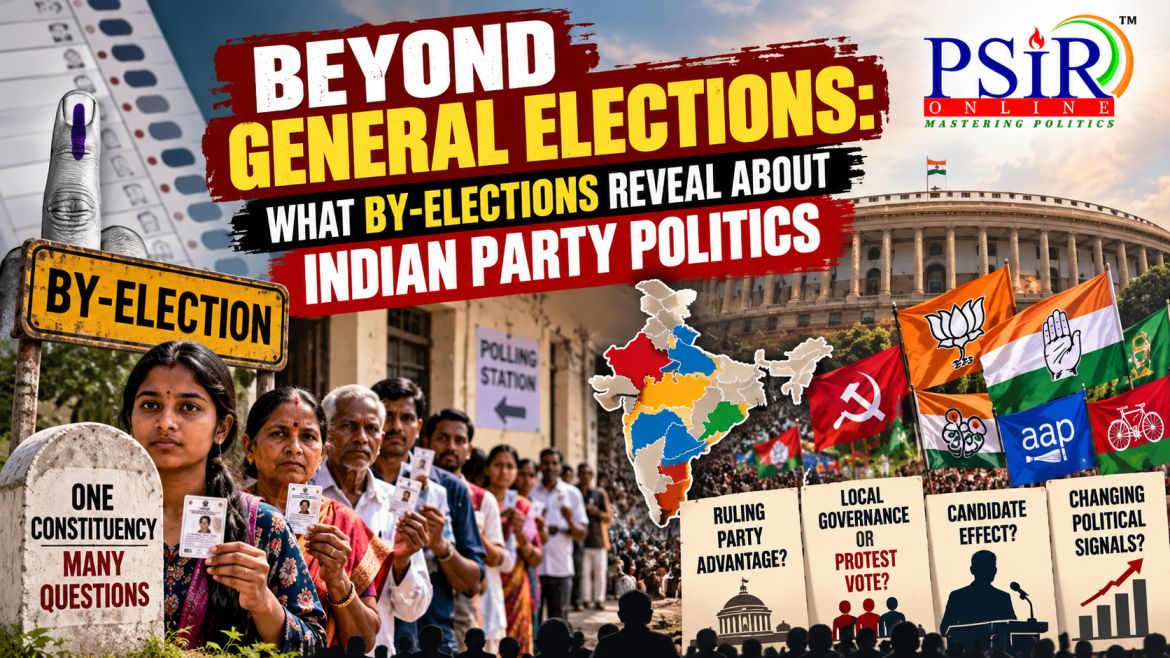
A by-election is formally a procedural exercise: a vacant legislative seat must be filled. Politically, however, a by-election compresses the complex dynamics of representative democracy into a single constituency. Unlike a general election, where voters assess competing statewide or national governing visions, by-election voters evaluate a singular representative under distinct local circumstances, balancing party loyalty, local development demands, government performance, and the catalyst behind the vacancy itself.
This dynamic makes Assembly by-elections a revealing window into political representation, party organization, and electoral behavior in India. It also highlights a central question in electoral politics: Do voters favor the state's ruling party to secure better local governance, or do by-elections function primarily as a tool of political accountability?
GENERAL ELECTIONS VS. BY-ELECTIONS
The strategic calculations in a general election and a by-election diverge substantially:
|
Dimension |
General Assembly Election |
Assembly By-Election |
|
Primary Function |
Determines the government of the state |
Fills a single legislative vacancy |
|
Campaign Agenda |
Statewide and national policy narratives |
Local grievances and constituency development |
|
Key Determinants |
Party leadership, ideology, and manifestos |
Candidate credibility and local patronage networks |
|
Arena of Competition |
Broad, multi-constituency social coalitions |
Concentrated, localized mobilization |
|
Core Voter Question |
"Which party should form the state government?" |
"Which candidate will best deliver for the remaining term?" |
THE RULING-PARTY PUZZLE: INSTRUMENTAL VS. IDEOLOGICAL VOTING
A common hypothesis suggests that voters lean toward the state’s ruling party during by-elections out of practical self-interest:
Ruling-Party MLA → Direct Access to Ministers → Faster Delivery of Funds & Schemes → Local Development
This reflects instrumental voting: the voter may not align ideologically with the ruling party, but calculates that having an MLA aligned with the state executive brings material benefits. This dynamic is especially pronounced in patronage-sensitive, multi-tiered systems where legislators function as intermediaries between citizens and state departments.
Historical data provides some support for this trend. An analysis of over 1,100 Assembly by-elections between 1967 and 2012 (The Indian Express) revealed that when national and state incumbencies differed, the state-level ruling party was significantly more likely to win bypolls than the national incumbent. However, ruling-party alignment is an electoral factor, not an inevitable outcome.
BY-ELECTIONS AS AN ACCOUNTABILITY MECHANISM
The same institutional setup can prompt the opposite voter response:
Discontent with State Government → Low-Risk By-Election → Opposition Vote → Political Warning
Because a single by-election rarely alters the majority of a sitting government, voters can register dissatisfaction without the risk of toppling the administration. The direction of the vote depends on:
· Public evaluation of the state government's performance
· Candidate reputation and accessibility
· Local constituency grievances
· Grassroots party organization
· The circumstances surrounding the vacancy
EMPIRICAL EVIDENCE: MIXED PATTERNS ACROSS STATES
Recent electoral outcomes highlight that ruling-party status does not guarantee victory:
Uttarakhand (July 2024): Defeating the Ruling Party
Despite the BJP governing Uttarakhand and sweeping all five Lok Sabha seats in the state just a month earlier, the Congress won both Assembly bypolls in July 2024:
· Manglaur: Won by Congress's Qazi Mohammad Nizamuddin.
· Badrinath: Won by Congress's Lakhpat Singh Butola, who defeated BJP nominee Rajendra Singh Bhandari. (Note on factual correction: The seat became vacant when Bhandari, the sitting Congress MLA, resigned and defected to the BJP; Congress subsequently retained the seat with a new candidate, demonstrating voter pushback against defection).
Karnataka (2026): Ruling-Party Alignment
In the May 2026 Karnataka bypolls, the ruling Congress retained both contested constituencies:
· Bagalkot: Congress won with 55.41% of the vote against the BJP's 42.90%.
· Davanagere South: Congress secured 43.95% against the BJP's 40.34%.
Gujarat (2025): Intra-State Variance
Even within a strong ruling-party bastion like Gujarat, by-election outcomes can diverge. In 2025, the ruling BJP retained Kadi, but the Aam Aadmi Party (AAP) secured Visavadar, demonstrating that constituency-specific factors can counter statewide incumbency.
Kerala (2025): Local Dynamics Over Incumbency
In the 2025 Nilambur by-election, the opposition Congress defeated the ruling CPI(M)-led Left Democratic Front (LDF), highlighting how local factional dynamics and candidate networks can outweigh executive advantages.
August 2026 Bypolls: Three Distinct Scenarios
The August 2026 bypolls provided a clear comparative snapshot:
· Bankipur (Bihar): Prashant Kishor's Jan Suraaj secured an upset victory in an NDA-governed state, illustrating how bypolls can serve as an entry point for emerging political forces.
· Datia (Madhya Pradesh): The opposition Congress defeated the ruling BJP candidate.
· Manjalpur (Gujarat): The ruling BJP retained the seat.
AGGREGATE DATA: NARROW EDGE, NOT DOMINANCE
Broad empirical analyses confirm that ruling parties possess a slight statistical edge, but bypolls remain highly competitive:
· Long-Term Split (2009–2026): An analysis of 709 Assembly by-elections by Business Standard found that incumbent ruling parties won approximately 53% of contests, while opposition parties claimed 47%.
· Six-Year Contest Rates: A Moneycontrol study similarly showed ruling parties winning just over half of contested bypolls (e.g., BJP winning 36 of 57; Congress winning 39 of 101). Notably, well-entrenched regional parties (such as the Trinamool Congress and BJD) often recorded higher success rates within their core geographic areas, demonstrating the resilience of localized party machinery over national political trends.
|
ASSEMBLY BY-ELECTIONS OVERALL SPLIT (2009–AUG 2026) |
|
|
Incumbent Ruling Parties 53% |
Opposition Parties 47% |
KEY DRIVERS OF BY-ELECTION BEHAVIOR
The Nature of the Vacancy
The catalyst for an election shapes voter sentiment:
· Death of a sitting MLA: Frequently prompts sympathy and continuity voting.
· Defection / Floor-Crossing: Often turns the contest into a referendum on political opportunism.
· Elevation to Parliament: Shifts the focus to local succession and candidate credentials.
· Disqualification: Creates a debate over institutional overreach and legal propriety.
Candidate-Centric Politics
Because the electoral arena is confined to a single seat, local family standing, community ties, accessibility, and personal track records matter more than high-level ideological debates. A striking example was the 2026 Baramati Assembly by-election, where Sunetra Ajit Pawar (NCP) secured an overwhelming 97.81% of the vote.
Testing Organizational Depth
By-elections allow parties to concentrate their entire leadership, booth-level workers, and financial resources on a single constituency. As a result, outcomes often reflect organizational machinery and voter mobilization rather than spontaneous public sentiment.
Multilevel Federal Spillovers
Electoral choices in by-elections reflect cross-tier dynamics. Academic research (such as a 2026 study in JGU Pure analyzing elections from 1994 to 2023) highlights statistically significant spillover effects across electoral tiers: the performance and presence of an incumbent MP or MLA directly influences their party's standing in subsequent elections across tiers.
THE FOUR VOTING LOGICS IN BY-ELECTIONS
Voter behavior in by-elections can be categorized into four primary frameworks:
1. Governance-Access Logic: Supporting the state's ruling party to secure constituency funding, administrative access, and welfare delivery.
2. Continuity Logic: Re-electing the incumbent party or family out of sympathy, legacy, or satisfactory local service.
3. Protest Logic: Backing the opposition to voice dissatisfaction or deliver a low-stakes warning to the governing party.
4. Candidate/Local Network Logic: Prioritizing individual standing, caste/community dynamics, and personal accessibility over party affiliations.
WHY BY-ELECTIONS DO NOT PREDICT GENERAL ELECTIONS
By-elections offer valuable insights into local party health, but treating them as statewide barometers is an analytical mistake. Because bypolls are geographically confined, heavily candidate-dependent, shaped by unique vacancies, and subject to intense, localized campaigning, their outcomes do not reliably predict future general elections.
Historical analyses indicate that the winner of an Assembly by-election has less than a 50% probability of retaining that seat in the subsequent general election (The Indian Express).
Rather than serving as definitive statewide forecasts, by-elections function as political barometers: revealing how voters balance short-term developmental access against broader democratic accountability.
PSIR THEORETICAL DIMENSION & EXAMINATION LINKAGES
|
PSIR Theoretical Dimension & Concepts |
How It Connects to Examination Answers (PSIR Paper 1 / Paper 2) |
|
Rational Choice & Instrumental Voting (Anthony Downs; Samuel Popkin) |
The Governance-Access Calculation: Contrasts expressive/ideological voting in general elections with instrumental voting in by-elections. Explains why a voter might calculate that electing an MLA from the state's ruling party secures direct bureaucratic access, constituency development funds, and faster administrative grievance redressal for the remainder of an assembly term. |
|
Second-Order Election Theory (Karlheinz Reif & Hermann Schmitt) |
Low-Stakes Accountability & Protest Voting: Explains the phenomenon where voters punish the governing party in by-elections because the outcome does not alter the government's survival. This creates an institutional "safety valve" where voters register discontent or issue political warnings without causing systemic executive collapse. |
|
Multi-Level Federalism & Asymmetric Arenas (Paul Brass; Balveer Arora; Yogendra Yadav) |
Decoupling State and National Arenas: Demonstrates that electoral logic is not uniform across levels. An incumbent ruling party nationally can easily lose a local Assembly by-election, illustrating how bypolls compress multi-tiered competition into hyper-localized arenas shaped by vernacular networks and state-level patronage. |
|
The Candidate Effect & Personalization of Power (Hannah Pitkin – Concept of Representation) |
Substantive Presence vs. Party Label: In a single-constituency race, organizational party labels frequently recede behind the personal accessibility, kinship ties, and local track record of the individual candidate. The 2026 Baramati outcome (where Sunetra Pawar won 97.81%) illustrates how dominant political families and personalized networks supersede abstract party manifestos. |
|
Cross-Tier Incumbency Spillovers (Gundimeda et al. / Multi-Tier Electoral Studies) |
Interdependence of Legislative Tiers: Connects the finding that an incumbent MP or MLA significantly influences their party's subsequent electoral fortunes across tiers. Shows that Indian voting behavior cannot be analyzed in water-tight institutional compartments, as federal and assembly outcomes generate mutual momentum or anti-incumbency drag. |
|
The "Pathology of Vacancy" & Political Opportunism (E. Sridharan; Tenth Schedule Jurisprudence) |
Judging Defection and Succession: Analyzes how the catalyst of a vacancy shapes voter response. Defection-induced bypolls (e.g., Uttarakhand’s Badrinath seat in 2024) frequently function as popular referendums on opportunistic party-switching, overriding the institutional advantages normally wielded by the ruling executive. |
|
State Incumbency Advantage vs. Retrospective Voting (Morris Fiorina; Prannoy Roy & Dorab Sopariwala) |
The 53–47 Margin in Indian Bypolls: Explores why the historical incumbent advantage (53% win rate from 2009 to 2026) remains modest rather than guaranteed. Retrospective voter evaluation of sitting government performance continually checks the state's patronage and bureaucratic levers. |
|
Party Machine & Booth-Level Mobilization (Seymour Martin Lipset & Stein Rokkan; Rajni Kothari) |
Organizational Density over Ideological Waves: Explains why well-entrenched regional parties (e.g., TMC, BJD, DMK) demonstrate disproportionately high bypoll retention rates. Because resources can be hyper-concentrated in one seat, deep local cadre penetration matters far more than broad statewide ideological narratives. |
CONCLUSION: MICROCOSMS OF DEMOCRATIC BARGAINING
Assembly by-elections in India are neither miniature general elections nor mere administrative routine. Because they isolate political competition within a single constituency without endangering the state executive's survival, they reveal the dual nature of the Indian electorate: calculating yet accountable.
On one hand, the modest aggregate advantage enjoyed by ruling parties (winning roughly 53% of bypolls since 2009) illustrates the reality of instrumental alignment—where voters pragmatically support the party in power to secure state funds, administrative attention, and patronage for their local representative. On the other hand, recurring defeats of ruling parties across diverse states demonstrate that by-elections serve as vital democratic correction mechanisms: punishing defections, resisting administrative neglect, and providing an entry point for emerging political forces.
Ultimately, the political significance of a by-election lies in its analytical unpredictability. With less than a 50% probability of predicting subsequent general election outcomes, by-elections do not forecast the future of statewide regimes; rather, they illuminate the immediate, transactional, and multi-layered bargaining that defines Indian democracy at the grassroots.
RELATED READING & ANALYTICAL ANGLES
1. Theoretical Concepts & Models
· Second-Order Election Dynamics: Study how European and comparative models (Reif & Schmitt) explain lower turnout, midterm punishment of governing regimes, and tactical voting in localized contests.
· Clientelism, Patronage, and Machine Politics: Connect James C. Scott and Herbert Kitschelt’s theories of patron-client linkages to understand how ruling-party MLAs leverage state infrastructure and discretionary funds during bypoll campaigns.
· The "Economic Voting" vs. "Retrospective Voting" Debate: Examine Morris Fiorina’s model to evaluate whether voters judge governments by past performance or vote prospectively for material constituency gains.
2. Constitutional & Statutory Dimensions
· Section 151A of the Representation of the People Act, 1951: The statutory mandate compelling the Election Commission of India to fill legislative vacancies through by-elections within six months, and the legal caveats surrounding remaining tenure.
· The Anti-Defection Framework (Tenth Schedule): Evaluate how floor-crossing, disqualifications, and subsequent by-election re-contests test the efficacy of the 52nd and 91st Constitutional Amendments.
· Article 174 & Article 324: The constitutional equilibrium between maintaining full representative houses and the plenary scheduling discretion of the Election Commission.
3. Empirical & Comparative Research Angles
· The Non-Predictive Nature of Bypolls: Analyze why assembly bypoll trends fail to translate into general assembly or Lok Sabha results, using post-1990 data on seat retention.
· Cross-Tier Spillover Effects: Explore recent empirical literature tracking how legislative representation at the parliamentary (Lok Sabha) level spills over into assembly constituency choices and vice versa.
· Regional Party Resilience: Assess why cadre-based regional satraps consistently outperform national parties in localized by-elections, connecting this to Paul Brass's thesis on vernacular factional networks.
PRACTICE QUESTIONS FOR PSIR
1. "By-elections in India operate as an arena of instrumental voting rather than ideological contestation." Comment. (10 Marks / 150 Words)
2. Explain the 'Second-Order Election' hypothesis in the context of state assembly by-elections in India. (10 Marks / 150 Words)
3. Examine the role of candidate credibility and local patron-client networks in neutralizing statewide ideological waves during by-elections. (15 Marks / 250 Words)
4. "Defection-induced by-elections convert the electoral arena into a popular tribunal on the Tenth Schedule and political morality." Critically discuss with contemporary examples. (20 Marks / 300 Words)
