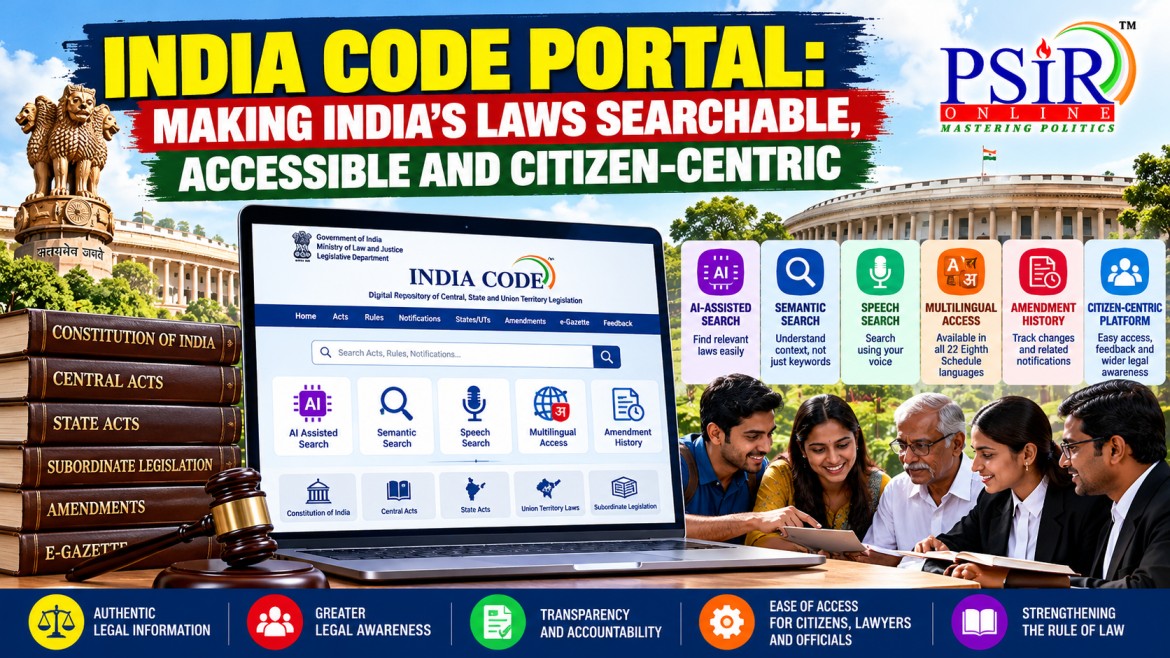
Access to law is an essential component of the rule of law. Citizens need reliable legal information to understand their rights, comply with legal obligations, approach public authorities and seek remedies when their rights are violated. However, the existence of legislation does not automatically make it accessible. Legal documents may be lengthy, difficult to navigate, written in unfamiliar terminology or scattered across different sources.
To address the information-access dimension of this challenge, the Ministry of Law and Justice launched the revamped India Code Portal on 13 August 2026. Developed through the Legislative Department and the National Informatics Centre (NIC), the upgraded portal introduces AI-assisted search, semantic and speech-based search, improved navigation, multilingual access and stronger links between legislative documents
The initiative seeks to move India Code beyond a digital repository towards a more accessible gateway to legislation. Its significance lies not simply in putting laws online, but in helping citizens, lawyers, researchers and public officials locate relevant legal provisions more efficiently.
The central governance question is whether improved digital access can narrow the gap between the formal availability of law and people's practical ability to find, understand and use it.
WHAT IS THE INDIA CODE PORTAL?
India Code is a digital repository of legislative information maintained by the Legislative Department, Ministry of Law and Justice. It provides access to the Constitution, Central Acts and their subordinate legislation, State Acts and subordinate legislation, and Union Territory legislation and regulations.
The portal serves several groups. Citizens may use it to locate legislation relevant to their rights or obligations. Lawyers and researchers can examine statutory provisions and legislative history. Government officials can consult relevant laws while carrying out administrative responsibilities.
The revamped portal seeks to improve how these users discover and navigate legal information. Its features include enhanced search, links between Acts and relevant subordinate legislation, access to amendments and legislative history, integration with the e-Gazette ecosystem, improved document viewing and a structured citizen-feedback mechanism.
These functions matter because legislation rarely operates in isolation. An Act may be supplemented by rules, regulations, notifications or amendments. Locating the principal Act without identifying relevant subordinate legislation may leave the user with an incomplete understanding of the applicable legal framework.
A more interconnected portal can help users follow these relationships. Nevertheless, the reliability of the result depends on the completeness and accuracy of the underlying records and on users checking whether the provisions they consult are applicable to their particular circumstances.
AI-ASSISTED, SEMANTIC AND SPEECH-BASED SEARCH
A major feature of the revamped portal is the use of technology to make legal information easier to discover.
AI-assisted search and interaction can help users navigate legislative material and formulate searches. Instead of relying entirely on exact legal titles or section numbers, users may be able to approach the system through more accessible queries.
Semantic search is intended to improve retrieval by considering the meaning and context of a query rather than relying exclusively on exact keyword matches. For example, a user searching for provisions related to workplace safety may need help locating relevant legislation even without knowing the precise statutory title.
Speech-based search offers another route to legal information. Users can interact through spoken queries rather than typing them, potentially assisting people who are less comfortable with keyboards or who face difficulties using conventional search interfaces.
The portal also includes improved navigation and links between legislative documents. Together, these features can reduce the effort required to locate relevant material and make the legal information system more approachable for non-specialist users.
However, these are capabilities rather than proof of achieved outcomes. Their usefulness should be evaluated through search accuracy, the relevance of retrieved provisions, performance across languages and the ease with which users can verify the original legal text.
AI-assisted discovery must also be distinguished from authoritative legal interpretation. A search tool may identify a relevant provision, but users still need to examine its exact wording, amendments, commencement status and relationship with other applicable laws.
MULTILINGUAL ACCESS AND LEGAL INCLUSION
Language is an important barrier to legal accessibility. Although legislation is available digitally, citizens may struggle to understand it if they are unfamiliar with the language or terminology used in the text.
The revamped India Code Portal seeks to enable AI-assisted multilingual access to laws in all 22 languages listed in the Eighth Schedule to the Constitution. This is intended to widen the range of users who can discover and engage with legislative information.
The potential benefits extend beyond convenience. Multilingual access may help students, local-level officials, community organisations and first-time users identify laws relevant to their concerns. It may also assist legal awareness initiatives by making legislative information easier to locate across linguistic communities.
However, multilingual access raises an important distinction between a translation or AI-generated explanation and an authoritative legal text. Legal terms often have specific meanings, and small translation errors can change how a provision is understood.
The portal's multilingual capabilities should therefore be accompanied by clear indications of the status of translated content, easy access to the underlying authoritative text and appropriate mechanisms for reporting errors. Where users need to rely on a particular legal provision, they should be able to verify its official wording and legal status.
Digital inclusion also requires more than language options. Users need reliable connectivity, accessible interfaces, digital literacy and, where necessary, assistance from legal-aid institutions or trained intermediaries.
LEGISLATIVE HISTORY, AUTHENTICITY AND VERIFICATION
A legal information portal must do more than retrieve a document with a relevant title. It must help users identify the version of the law that applies.
Legislation can change through amendments, repeals, commencement notifications and subordinate legislation. A provision may have been enacted but not yet commenced, or its wording may have changed after the original Act was passed. For some legal questions, the date on which an event occurred is also important in determining the applicable law.
The revamped India Code Portal's links to amendments, legislative history and subordinate legislation, alongside its integration with the e-Gazette ecosystem, can help users trace these relationships.
For example, a citizen researching a statutory entitlement may need to establish whether the relevant provision is currently in force, whether it has been amended and whether rules have been issued to implement it. Finding the original Act alone may not answer these questions.
A reliable digital legal information system should therefore prioritise:
· Authenticity: users should be able to identify the authoritative source of a legal text.
· Currency: amendments, repeals and commencement information should be reflected accurately.
· Traceability: users should be able to follow links between Acts, rules, notifications and relevant legislative history.
· Error correction: feedback should lead to appropriate verification and correction of inaccurate or incomplete records.
These safeguards are especially important when AI-assisted tools are involved. Search results and generated explanations should not be mistaken for a substitute for verifying the underlying legal text.
GOVERNANCE SIGNIFICANCE AND LIMITATIONS
The India Code Portal illustrates how digital public infrastructure can support legal transparency and citizen-centric administration. Its wider significance can be examined through several governance dimensions.
First, access to information. A searchable legislative repository can reduce dependence on scattered sources and make official legal material easier to locate.
Second, administrative efficiency. Public officials, researchers and legal professionals may spend less time locating relevant documents, although the actual time saved requires evaluation.
Third, legal awareness. Easier discovery of legislation may support civic education, legal literacy programmes and informed public participation.
Fourth, institutional accountability. Access to laws and legislative history can help citizens scrutinise the legal basis of government decisions. However, the ability to locate a statute does not by itself establish whether an authority has applied it correctly.
There are also limitations. Digital access may remain difficult for people with poor connectivity, disabilities or limited digital literacy. Search systems may fail to retrieve relevant provisions, while multilingual tools may produce explanations that require careful verification. Users may also struggle to distinguish legislation from commentary or to understand how multiple provisions interact.
Most importantly, access to legal information is not equivalent to access to justice. Citizens may still face the costs of legal representation, delays in dispute resolution, limited awareness of available remedies or difficulties in reaching legal-aid services. A portal can help users discover relevant law, but it cannot by itself resolve these wider barriers.
The initiative should therefore be complemented by legal literacy programmes, accessible public interfaces, reliable feedback and correction processes, and connections to appropriate legal-aid and justice-delivery services.
UPSC ANGLES
|
Dimension |
Relevance for UPSC |
|
Rule of law |
Access to authentic and updated legislation supports awareness of legal rights, duties and limits on public authority. |
|
Constitutional governance |
The initiative relates to legal transparency and the practical accessibility of the constitutional and statutory framework. |
|
E-governance |
AI-assisted search, semantic retrieval and speech-based access illustrate the use of digital technology in public information services. |
|
Digital inclusion |
Multilingual access can widen participation, but connectivity, disability access and digital literacy remain important. |
|
Administrative efficiency |
Easier access to legislation may support officials, researchers and legal professionals in locating applicable provisions. |
|
Transparency and accountability |
Legislative records and amendment histories can help citizens examine the legal basis of government action. |
|
Responsible AI |
Search accuracy, translation quality, traceability and the distinction between information retrieval and legal interpretation require attention. |
|
Access to justice |
Legal information is an important starting point, but it must be complemented by legal aid, accessible institutions and effective remedies. |
|
Outcome evaluation |
Search success, accuracy, usability, language performance and user feedback are useful measures of the portal's practical value. |
CONCLUSION
The revamped India Code Portal represents an effort to make India's legislative information easier to find, navigate and access. AI-assisted search, semantic and speech-based interaction, multilingual capabilities and connections between legislative documents may reduce some of the practical barriers that separate citizens from official legal information.
Its success, however, will depend on the accuracy and currency of the records, the reliability of its search functions, the quality of multilingual access and the ability of users to verify authoritative legal texts. The portal should be evaluated not simply by its technological features or volume of information, but by whether people can find relevant law accurately and use that information meaningfully.
The broader lesson is that digital access can bring law closer to citizens, but legal empowerment requires reliable information, public understanding and effective institutions that enable people to exercise their rights.
OFFICIAL REFERENCES AND FURTHER READING
GS2 MAINS PRACTICE QUESTIONS
10 marks | 150 words
15 marks | 250 words
