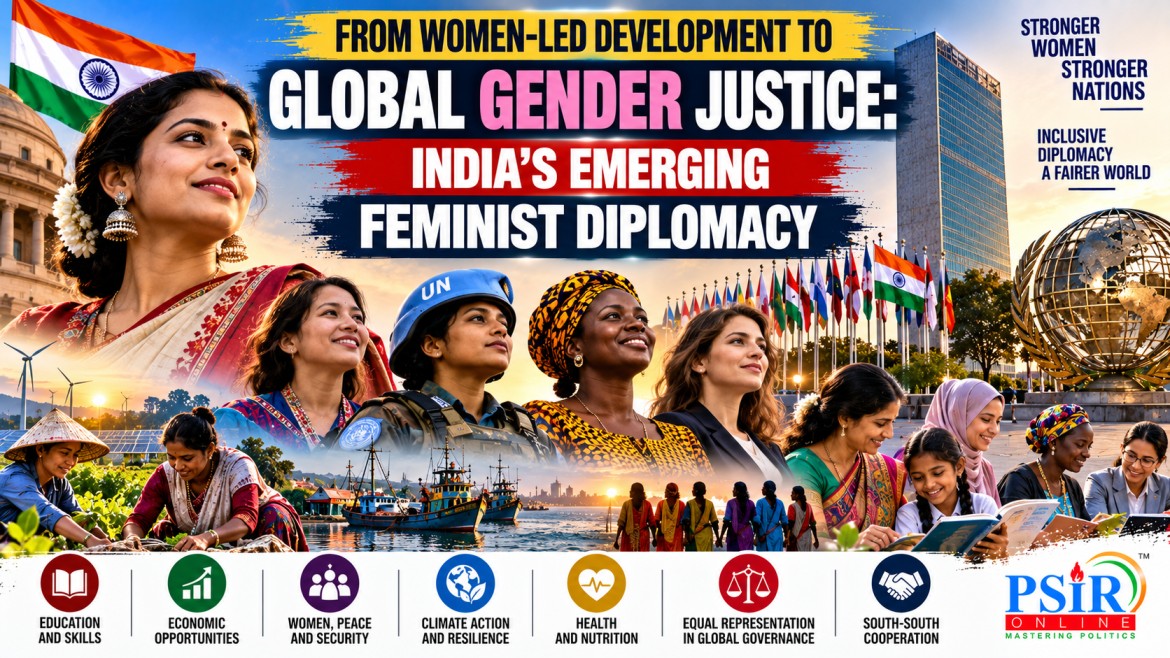
Global gender justice involves more than formal equality: it requires equal access to resources, political representation, legal protection and decision-making power across societies. India’s foreign policy increasingly frames women as agents of development rather than merely beneficiaries of welfare. Through multilateral diplomacy, South–South cooperation and international development partnerships, India seeks to connect women’s empowerment with a more inclusive global order. Yet its credibility depends on translating diplomatic commitments into measurable outcomes.
MULTILATERAL DIPLOMACY: FROM COMMITMENTS TO GLOBAL NORMS
India engages with the United Nations, the Commission on the Status of Women (CSW), the G20 and other multilateral forums to advance gender equality. Its G20 Presidency in 2023 placed women-led development prominently on the global agenda, while the Women’s Empowerment Working Group helped foreground economic participation, education and leadership.
At the 70th session of the Commission on the Status of Women in March 2026, India highlighted women-led development, access to justice and cooperation with the Global South. These engagements connect India’s diplomatic position with the Beijing Declaration and Platform for Action and Sustainable Development Goal 5 on gender equality.
However, global gender justice requires more than declarations. Progress depends on financing, institutional accountability, protection from gender-based violence and the removal of discriminatory barriers.
SOUTH–SOUTH COOPERATION: SHARING SOLUTIONS BEYOND BORDERS
India’s development partnerships offer a practical channel for gender diplomacy. The India–UN Global Capacity-Building Initiative, launched in August 2025, seeks to share Indian development practices and institutional expertise with partner countries according to their priorities. The India–Brazil–South Africa (IBSA) Fund for the Alleviation of Poverty and Hunger also provides a platform for development projects, including initiatives relevant to women and vulnerable communities.
|
Diplomatic instrument |
Potential contribution to gender justice |
|
India–UN Global Capacity-Building Initiative |
Sharing development practices, skills and institutional knowledge |
|
IBSA Fund |
Supporting locally relevant poverty-reduction and community-development projects |
|
Indian Technical and Economic Cooperation (ITEC) |
Building professional and technical capacities through international training |
|
G20 and CSW engagement |
Promoting international commitments on equality, justice and women’s leadership |
The strength of this approach lies in partnership rather than policy imposition. Nevertheless, its impact must be assessed through outcomes such as women’s employment, access to education, financial inclusion and participation in public institutions.
WOMEN, PEACE AND SECURITY: AN UNFINISHED DIPLOMATIC AGENDA
Gender justice is also central to international peace and security. United Nations Security Council Resolution 1325 (2000) calls for greater participation of women in conflict prevention, peace negotiations and post-conflict reconstruction, alongside protection from conflict-related violence.
India’s engagement with UN peacekeeping and multilateral security discussions provides opportunities to strengthen women’s participation and protection. A more ambitious approach would advocate stronger representation of women in mediation, peacebuilding and post-conflict governance, while supporting gender-sensitive humanitarian assistance.
This agenda is particularly important as conflict, displacement and humanitarian emergencies disproportionately expose women and girls to violence, insecurity and the loss of livelihoods.
THE CREDIBILITY GAP: DOMESTIC OUTCOMES AND GLOBAL LEADERSHIP
India’s international advocacy faces a fundamental test: diplomatic leadership must be matched by domestic progress. Gender-based violence, unequal care responsibilities, gaps in labour-force participation and underrepresentation in political institutions remain significant challenges. UN Women’s India data also identifies persistent concerns involving child marriage, violence and women’s representation.
A credible global strategy therefore requires stronger implementation of existing commitments, reliable gender-disaggregated data, adequate development finance and meaningful consultation with women’s organisations. It must also recognise differences of class, caste, disability, geography and economic status rather than treating women as a homogeneous category.
THEORETICAL ANGLES
|
Theoretical approach |
Application to India’s gender diplomacy |
|
Feminist International Relations |
Examines how power hierarchies and gender inequalities shape diplomacy, conflict and international institutions. |
|
Constructivism |
Explains how India uses concepts such as women-led development to shape international norms and diplomatic identity. |
|
Liberal Institutionalism |
Highlights the role of the UN, CSW and G20 in coordinating commitments, cooperation and accountability. |
|
Postcolonialism |
Explores India’s preference for South–South cooperation and locally determined development priorities rather than externally imposed models. |
|
Soft Power |
Considers how development partnerships and gender-focused diplomacy can strengthen India’s international credibility, provided rhetoric is supported by results. |
CONCLUSION
India’s pursuit of global gender justice represents an opportunity to connect women-led development, multilateral reform and Global South solidarity. Its distinctive contribution can lie in combining international norm-building with practical development cooperation. Ultimately, leadership will be measured not by the number of declarations endorsed, but by whether women gain greater security, resources, representation and power in shaping their own futures.
RELATED READING
PRACTISE QUESTIONS FOR GS2 MAINS
PRACTISE QUESTIONS FOR PSIR
