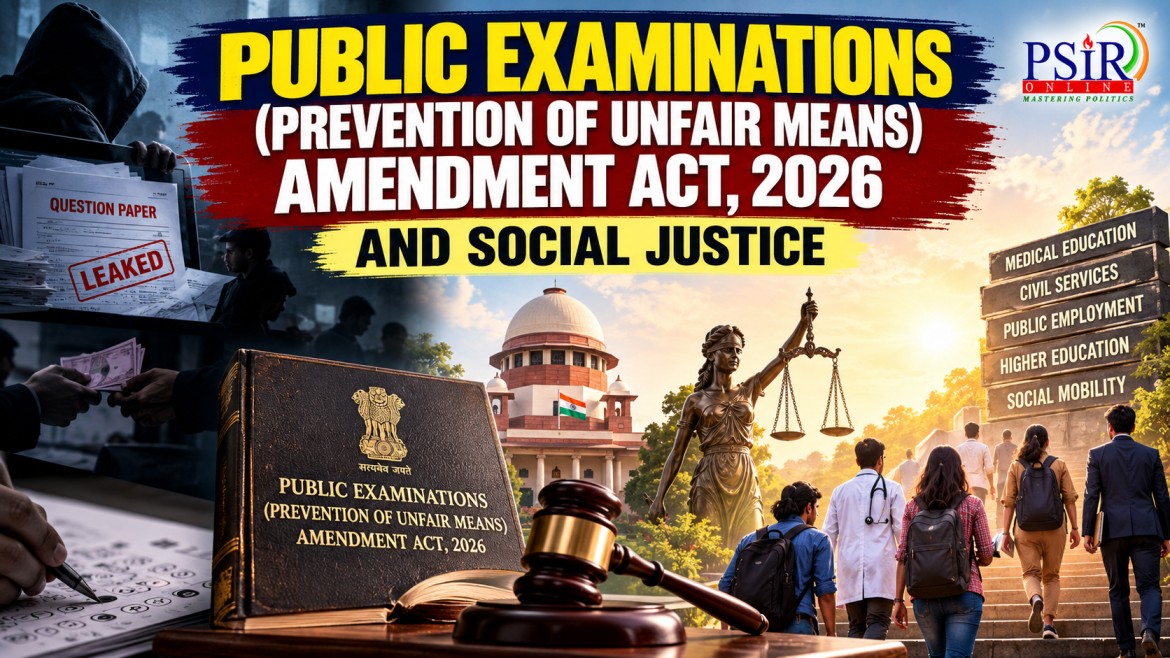
Public examinations are among the most important instruments through which the State attempts to ensure equality of opportunity. A candidate's rank is expected to depend on preparation and performance rather than family wealth, social connections or ability to purchase access.
A paper leak, impersonation, answer-sheet manipulation or organised cheating distorts this principle. The candidate who can purchase unfair access gains an advantage over the candidate who prepares honestly. Thus, examination malpractice is not merely an issue of academic integrity; it directly affects merit, equality of opportunity, public trust and social justice.
The Public Examinations (Prevention of Unfair Means) Amendment Act, 2026 strengthens the legal framework created by the 2024 Act by increasing penalties, introducing time-bound investigation and trial mechanisms, and strengthening institutional mechanisms to deal with organised examination malpractice.
THE PARENT ACT: PUBLIC EXAMINATIONS (PREVENTION OF UNFAIR MEANS) ACT, 2024
The Public Examinations (Prevention of Unfair Means) Act, 2024 was enacted to prevent unfair means in public examinations conducted by specified public examination authorities. These include the UPSC, SSC, Railway Recruitment Boards, IBPS, NTA, Central Government ministries and departments, and other authorities notified by the Central Government.
The Act covers a wide range of malpractice, including:
|
Unfair Practice |
What it means for examination integrity |
|
Question-paper leakage |
Prevents unauthorised access and circulation of examination material. |
|
Answer-sheet manipulation |
Protects the integrity of the candidate's actual performance. |
|
Computer-system tampering |
Covers manipulation of digital examination processes and systems. |
|
Impersonation |
Prevents another person from appearing on behalf of the actual candidate. |
|
Fake websites/admit cards |
Prevents fraud and manipulation of candidates. |
|
Organised unfair means |
Treats examination malpractice as a coordinated and systemic activity rather than merely individual cheating. |
|
Service-provider offences |
Creates responsibility for private entities and persons managing examination-related services. |
The central idea of the 2024 law was therefore to move examination malpractice beyond the narrow category of “student cheating” and recognise organised examination fraud as a threat to the credibility of public examinations.
WHY AN AMENDMENT IN 2026?
The need for stronger enforcement became particularly visible after the NEET-UG 2026 paper-leak case. The CBI registered a case in May 2026 and subsequently arrested persons allegedly involved in accessing and distributing questions before the examination. NTA subsequently conducted a re-examination on 21 June 2026.
The episode demonstrated that merely criminalising unfair means is insufficient when malpractice involves insiders, intermediaries, coaching networks and organised operations.
The Amendment Bill was introduced in the Lok Sabha on 27 July 2026, passed by the Lok Sabha on 29 July and by the Rajya Sabha on 30 July. Presidential assent was given on 31 July 2026, creating the Public Examinations (Prevention of Unfair Means) Amendment Act, 2026.
WHAT DOES THE 2026 AMENDMENT CHANGE?
The amendment primarily strengthens penalties, investigation and trial mechanisms rather than substantially changing the basic scope of unfair means under the parent Act.
|
Area |
2026 Amendment |
|
Individual offender |
Imprisonment increased to 5–10 years and fine increased up to ₹50 lakh. |
|
Service provider |
Maximum fine increased to ₹5 crore and debarment increased from 4 to 8 years. |
|
Persons in charge of service providers |
Minimum imprisonment increased to 5 years, with fine up to ₹5 crore. |
|
Organised examination crime |
Minimum imprisonment increased to 7 years, extendable to 10 years, with fine up to ₹10 crore. |
|
Investigation |
Investigation is required to be completed within 2 months. |
|
Special Fast Track Courts |
States and UTs are required to designate Special Fast Track Courts for offences under the Act. |
|
Trial |
Trial is to be completed within 3 months of filing of the chargesheet, subject to the statutory process. |
|
Special Public Prosecutors |
States and UTs are required to appoint Special Public Prosecutors for these courts. |
|
Special Task Force |
Central Government can constitute a Special Task Force for investigation where necessary. |
|
Appeals |
Appeals lie before a Division Bench of the High Court and are to be filed within 30 days, with limited extension up to 90 days; disposal is to be pursued within 3 months of admission. |
WHY DO THESE CHANGES MATTER?
The amendment addresses two major weaknesses in combating examination malpractice: deterrence and delay.
A paper leak can involve a chain of actors—persons with access to examination material, intermediaries, service providers, organised cheating networks and candidates willing to purchase access. Higher financial penalties and longer debarment therefore attempt to increase the cost of organised malpractice substantially.
The increase in the maximum fine for service providers from ₹1 crore to ₹5 crore, along with an eight-year debarment, is particularly significant because examination integrity often depends on the security and conduct of outsourced examination-related services.
The amendment also recognises that delayed justice can itself harm honest candidates. When an examination is cancelled or re-conducted, students may lose months of preparation, incur additional financial costs and face uncertainty over admissions or recruitment. Time-bound investigation and trial are therefore intended to reduce the gap between wrongdoing and accountability.
However, stricter punishment alone cannot guarantee examination integrity. The 2024 Act already criminalised major forms of unfair means. The effectiveness of the 2026 amendment will depend on secure paper handling, vendor accountability, digital security, professional investigation, functioning Special Fast Track Courts and effective prosecution.
HOW EXAMINATION LEAKS DENY SOCIAL JUSTICE
A public examination is supposed to create a common competitive space in which candidates are evaluated according to the same rules. This is particularly important in India because public examinations provide access to highly valued opportunities such as medical education, higher education, civil services, government employment and other public-sector positions.
Social justice is therefore affected at three levels:
|
Dimension of Social Justice |
How Examination Malpractice Undermines It |
|
Equality of opportunity |
A candidate who purchases leaked questions or receives organised assistance gains an advantage unrelated to ability or preparation. |
|
Merit and fairness |
The ranking system no longer reflects performance under common conditions. |
|
Social mobility |
Students from modest socio-economic backgrounds often depend heavily on competitive examinations to access education and public employment; compromised examinations weaken this pathway. |
|
Economic justice |
Wealth can be converted into examination advantage when access to leaked material or solver networks is commercially organised. |
|
Gender and regional equity |
Candidates who have fewer opportunities to absorb the cost of repeated examinations can face greater consequences when an examination is cancelled. |
|
Trust in public institutions |
Repeated examination controversies can reduce confidence in recruitment agencies and public institutions. |
|
Intergenerational mobility |
For first-generation learners, a fair examination can provide mobility that family wealth or social networks cannot; examination fraud can disrupt this pathway. |
The constitutional significance is particularly important in public employment. Article 16 guarantees equality of opportunity in matters of public employment. Such equality requires not merely formally open recruitment, but also a fair and credible selection process.
Similarly, access to competitive higher education is closely connected with social mobility. When examination integrity is compromised, the harm extends beyond individual candidates to the legitimacy of the entire allocation process.
THE SOCIAL JUSTICE LOGIC
The social-justice significance of the amendment can be understood through a simple chain:
Equal access to examination → Fair examination conditions → Merit-based ranking → Fair allocation of seats/jobs → Social mobility → Equality of opportunity
A paper leak breaks this chain at the fair examination stage. Therefore, examination integrity is not merely an administrative issue. It is a precondition for substantive equality of opportunity. The amendment's focus on organised malpractice is particularly relevant because the threat is not limited to an individual candidate copying an answer. Where examination fraud becomes organised and monetised, economic inequality can be converted directly into competitive advantage.
LIMITATIONS AND CHALLENGES
The effectiveness of the law will ultimately depend on implementation.
|
Challenge |
Why it matters |
|
Prevention is more important than punishment |
Once a paper has leaked, punishment cannot fully restore the lost preparation time and opportunity of honest candidates. |
|
Examination supply-chain security |
Question papers pass through multiple stages involving printing, storage, transportation and examination centres; every stage requires strong safeguards. |
|
Outsourced service providers |
Private vendors involved in examination logistics and technology require stringent accountability and auditing. |
|
Insider threats |
Individuals with legitimate access to examination material can become critical points of vulnerability. |
|
Investigation capacity |
The two-month statutory timeline requires adequately trained and resourced investigative agencies. |
|
Fast-track court capacity |
Time-bound trials require sufficient judicial infrastructure and prosecutors. |
|
Candidate protection |
Honest candidates should not bear disproportionate costs when an examination has to be cancelled and re-conducted. |
|
Technology risks |
Digital examinations and computer systems create new vulnerabilities requiring cybersecurity and audit mechanisms. |
|
Inter-agency coordination |
NTA, investigating agencies, police, examination authorities, vendors and courts must work within a coordinated framework. |
|
Trust deficit |
Repeated leaks can undermine confidence even when subsequent examinations are conducted securely. |
UPSC DIMENSION
|
UPSC Dimension |
How the issue connects with it |
|
Equality of opportunity |
The 2026 Amendment strengthens the integrity of public examinations so that access to education and public employment is determined through a common and fair selection process rather than economic or network-based access to leaked material. |
|
Article 16 |
Fair examination and recruitment procedures give practical meaning to equality of opportunity in public employment under Article 16. |
|
Social justice |
Preventing examination fraud protects candidates who depend on merit-based competitive examinations as pathways to education, employment and social mobility. |
|
Meritocracy |
Examination integrity ensures that rankings reflect performance under common conditions, preserving the credibility of merit-based selection. |
|
Social mobility |
Competitive examinations can provide mobility to students and aspirants who lack inherited economic or social advantages; paper leaks can disrupt this pathway. |
|
Good governance |
Strong examination security, accountability of service providers, transparent procedures and time-bound investigation reflect the principles of accountable and responsive governance. |
|
Rule of law |
The amendment strengthens the legal consequences of organised examination fraud while creating specific investigative and judicial mechanisms for timely enforcement. |
|
Digital governance |
Increasing dependence on digital examination systems makes cybersecurity, data protection, audit trails and technological integrity important components of examination governance. |
|
Public–private partnership |
Since examination authorities often depend on external service providers for logistics, technology and other functions, the Act places greater responsibility on service providers involved in public examinations. |
|
Access to education |
Fair entrance examinations are essential for ensuring that access to competitive educational opportunities is not distorted by purchased information or organised cheating. |
|
Administrative accountability |
The amendment reinforces accountability across the examination chain—from question-paper security and service providers to investigation and prosecution. |
|
Cooperative federalism |
The amendment requires State Governments and UT administrations to designate Special Fast Track Courts and appoint Special Public Prosecutors, creating an important Union–State implementation dimension. |
|
Economic inequality |
Organised paper leaks can transform economic capacity into examination advantage; preventing such practices protects candidates who cannot participate in such markets. |
|
Trust in institutions |
Credible examinations strengthen citizens' confidence in recruitment agencies, educational institutions and the wider public administration. |
WAY FORWARD
The 2026 amendment should therefore be accompanied by a broader examination-integrity architecture.
|
Priority |
Way Forward |
|
Prevention-first approach |
Strengthen paper generation, encryption, storage, transportation and examination-centre security rather than relying mainly on post-offence punishment. |
|
Vendor accountability |
Conduct rigorous background checks, security audits and contractual accountability for private examination service providers. |
|
Insider-risk management |
Use restricted access, encryption, audit trails and continuous monitoring for personnel handling sensitive examination material. |
|
Independent security audits |
Regular third-party audits of examination infrastructure can identify vulnerabilities before they are exploited. |
|
Candidate protection |
Where re-examinations become unavoidable, provide timely communication, minimise financial burdens and protect admission/recruitment timelines. |
|
Strengthen investigation |
Special Task Forces and investigative agencies should receive adequate technical, forensic and cyber-investigation capacity. |
|
Functional fast-track courts |
States and UTs should ensure that designated Special Fast Track Courts have judges, prosecutors and infrastructure sufficient to meet statutory timelines. |
|
Transparent communication |
Examination authorities should provide timely and credible information during suspected malpractice to prevent rumours and uncertainty. |
|
Data-driven monitoring |
Repeated irregularities should be analysed to identify vulnerable centres, vendors and stages of the examination process. |
|
Restore institutional trust |
Examination reform should focus not only on preventing leaks but also on making the entire examination process predictable, transparent and accountable. |
CONCLUSION
The Public Examinations (Prevention of Unfair Means) Amendment Act, 2026 recognises that examination malpractice can undermine much more than the credibility of a particular examination. It can undermine equality of opportunity, merit-based selection and social mobility. The law strengthens the response through harsher penalties, greater accountability for service providers, Special Task Forces and time-bound investigation and trial. Yet, social justice cannot be secured through punishment alone. The real test is whether the State can prevent the conversion of money, networks and access into examination advantage.
A fair examination is not merely a test of merit; it is the State's promise that opportunity will not be sold to the highest bidder.
RELATED READING
For comprehensive UPSC preparation, students should connect this issue with:
· Article 14 and Article 16 – equality and equality of opportunity.
· Social justice and substantive equality – formal equality versus real equality of opportunity.
· Education and social mobility – competitive examinations as pathways to upward mobility.
· Public employment and merit-based recruitment – credibility of recruitment institutions.
· Good governance – transparency, accountability and institutional integrity.
· Digital governance and cybersecurity – protection of digital examination systems.
· Role of NTA and examination reforms – institutional responsibility for secure examinations.
· Centre–State relations – implementation of Special Fast Track Courts and Special Public Prosecutors.
· Private-sector accountability – regulation of outsourced examination service providers.
· Rule of law and deterrence – relationship between punishment, enforcement and institutional credibility.
PRACTICE QUESTIONS – GS PAPER II
1. “Integrity of public examinations is an essential component of equality of opportunity.” Examine the statement in the context of the Public Examinations (Prevention of Unfair Means) Amendment Act, 2026. (10 Marks, 150 Words)
2. Examination paper leaks are not merely instances of academic malpractice but violations of social justice. Discuss. (10 Marks, 150 Words)
3. The Public Examinations (Prevention of Unfair Means) Amendment Act, 2026 strengthens deterrence, but effective prevention requires institutional and technological reforms beyond criminal penalties. Critically examine. (15 Marks, 250 Words)
4. “A credible public examination system is a prerequisite for substantive equality of opportunity in education and public employment.” Analyse with reference to India. (15 Marks, 250 Words)
