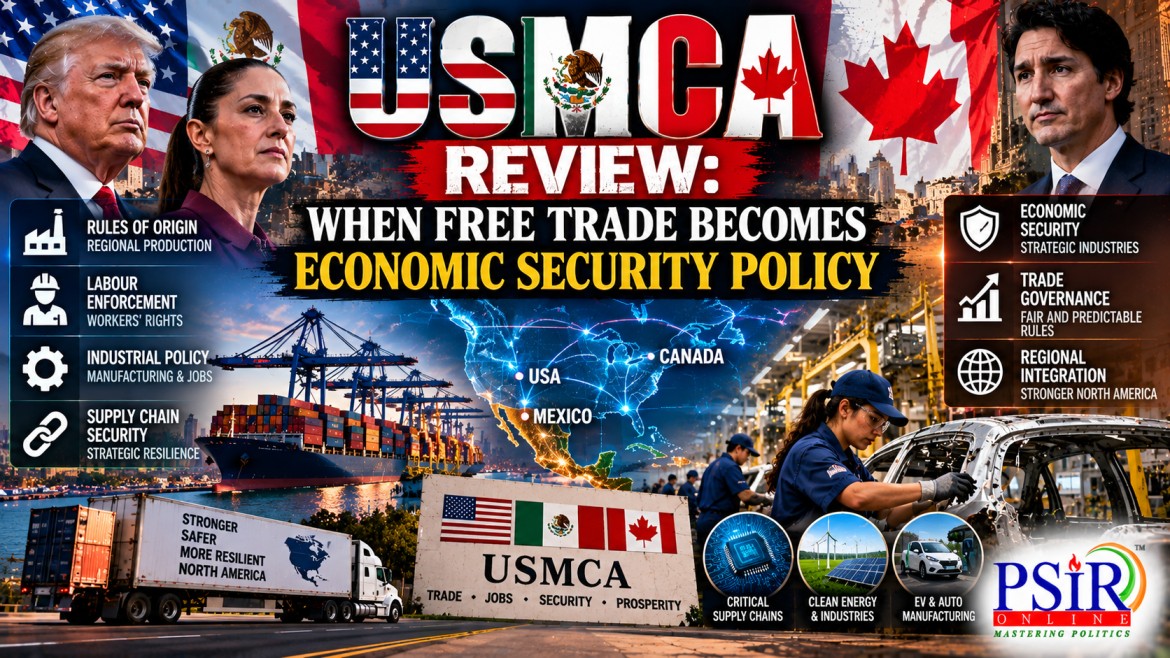
The United States–Mexico–Canada Agreement (USMCA), known as CUSMA in Canada and T-MEC in Mexico, governs economic relations among North America’s three largest economies. It replaced the North American Free Trade Agreement (NAFTA) and entered into force on 1 July 2020. Although it preserves preferential trade among the three countries, the USMCA also places greater emphasis on regional production, labour standards, rules of origin and enforceable trade commitments.
The agreement’s review process has brought a wider transformation in international political economy into focus. Governments increasingly view trade not simply as a means of increasing efficiency and consumer choice, but as an instrument for protecting industrial capacity, securing critical inputs and managing strategic competition with countries outside their trade blocs.
The USMCA is therefore an important case of economic interdependence becoming a matter of economic security. Its review raises questions about how far regional integration can accommodate economic nationalism, whether stronger trade rules can protect workers and producers, and how much uncertainty businesses can absorb when governments renegotiate the conditions of market access.
THE JOINT REVIEW: WHY THE AGREEMENT’S FUTURE MATTERS
Article 34.7 of the USMCA establishes a joint review on the sixth anniversary of the agreement’s entry into force. The three governments were required to consider the agreement’s operation and discuss recommendations. If all three agree to extend it, the agreement receives a new 16-year term, with another joint review scheduled six years later. If they do not agree to extend it, annual reviews follow until the parties agree to extend the agreement or it reaches its scheduled expiry.
The first joint review took place on 1 July 2026. The United States did not agree to renew the agreement in its existing form. This did not terminate the USMCA: it remains in force while the parties continue addressing their differences.
During 2026, US–Mexico discussions covered automotive rules of origin, steel and aluminium, agriculture, labour, economic security and other trade issues. Canada is also a party to the agreement, making the eventual outcome a trilateral question rather than merely a bilateral US–Mexico negotiation.
|
Review issue |
Why it matters |
|
Continuation and predictability |
Businesses need clarity about future access to North American markets |
|
Rules of origin |
Governments want preferential trade benefits to reflect production within the region |
|
Labour enforcement |
Trade benefits are increasingly linked to compliance with workers’ rights |
|
Industrial and supply-chain policy |
Governments seek to reduce strategic dependencies and strengthen domestic production |
|
Trilateral bargaining |
Differences between the three parties can complicate a common regional approach |
The review is significant because it tests whether a regional trade agreement can maintain predictable rules while its members pursue competing national economic priorities. The central issue is not simply whether tariffs remain low, but whether the parties can agree on what constitutes fair, secure and mutually beneficial regional trade.
RULES OF ORIGIN: WHO REALLY PRODUCES NORTH AMERICAN GOODS?
Rules of origin determine whether a product qualifies for preferential tariff treatment under a trade agreement. A product does not automatically qualify merely because it passes through a member country. It must satisfy the applicable requirements concerning its production, materials or regional value content.
The USMCA introduced stricter automotive requirements than those under NAFTA. Passenger vehicles and light trucks must generally meet a regional value content threshold of 75%, alongside requirements covering core parts, steel and aluminium purchases, and labour value content.
|
Automotive provision |
Main requirement and purpose |
|
Regional value content |
Passenger vehicles and light trucks generally require 75% North American content |
|
Core parts |
Specified major components must satisfy regional-origin requirements |
|
Steel and aluminium |
At least 70% of a producer’s steel and aluminium purchases for covered vehicles must originate in North America |
|
Labour value content |
Qualifying vehicles must meet specified high-wage production and related expenditure requirements |
Source: USMCA automotive provisions and US Trade Representative materials. The requirements apply according to the agreement’s detailed definitions, calculation methods and exceptions.
These rules are intended to encourage production within North America and make it more difficult for goods to obtain preferential treatment through limited processing in a member country. They also influence investment decisions: a manufacturer may relocate sourcing or production to meet the regional thresholds.
Yet stricter rules create compliance costs. Firms must trace inputs across complex supply chains, document origin and adjust sourcing where necessary. Smaller suppliers may face particular difficulties meeting administrative requirements. If regional inputs are unavailable or expensive, producers may incur higher costs or lose preferential tariff eligibility.
The broader geopolitical issue is the treatment of third-country dependence, particularly in sectors where governments have concerns about strategic competition, subsidies or supply-chain vulnerabilities. The review can therefore become a mechanism for directing investment and production away from selected external sources.
However, rules of origin cannot automatically guarantee resilience. A region may meet its formal content thresholds while remaining dependent on a narrow set of suppliers, technologies or raw materials. Genuine supply-chain security also requires diversification, infrastructure, skilled labour and cooperation among the three economies.
LABOUR ENFORCEMENT: TRADE RULES AND WORKERS’ RIGHTS
One of the USMCA’s distinctive features is its Rapid Response Labour Mechanism, which provides an expedited process for addressing specified denials of freedom of association and collective bargaining rights at covered facilities in Mexico.
Unlike broad disputes between governments, this mechanism can focus on individual workplaces. Following a request for review, the parties investigate the alleged denial of rights and seek remediation. Where the agreement’s requirements are met, consequences can include suspension of preferential tariff treatment or other specified penalties.
A March 2026 case involving ThyssenKrupp Springs & Stabilizers in San Luis Potosí illustrates how the mechanism operates. The US Trade Representative reported that workers who had been dismissed in retaliation for union activity were reinstated, backpay and benefits were provided, and measures supporting independent union activity were introduced. The United States subsequently resumed the relevant tariff liquidation process.
This illustrates how labour provisions can connect trade access with workplace standards. In principle, enforceable rules can reduce incentives for firms to gain competitive advantages through the denial of workers’ rights. They may also support workers seeking freedom of association and collective bargaining.
However, the mechanism raises broader policy questions. Governments must ensure that enforcement is evidence-based, procedurally fair and consistent with the agreement. Firms need predictable standards, while workers need accessible complaint mechanisms and meaningful remedies. Enforcement should also be distinguished from protectionism: the existence of a labour complaint does not itself establish a violation.
The wider significance is that labour standards have become part of trade governance, rather than remaining solely within domestic employment policy. The USMCA demonstrates both the potential and the complexity of linking market access to enforceable social commitments.
INDUSTRIAL POLICY AND ECONOMIC NATIONALISM
The USMCA review reflects a wider shift in trade policy. Governments increasingly use tariffs, subsidies, procurement rules, investment screening and domestic-production incentives to pursue economic and strategic objectives.
The United States has emphasised manufacturing, supply-chain resilience and the reduction of dependencies outside North America. Mexico seeks investment, industrial development and access to the US market, while Canada has interests in predictable market access, integrated production networks and the protection of key sectors.
These objectives can overlap, but they can also conflict. A policy intended to expand production in one country may divert investment from another. A tariff intended to protect a domestic industry can increase costs for firms that rely on imported intermediate goods. Subsidies can attract new facilities while provoking disputes about whether competition remains fair.
The key distinction is between regional integration and national economic preference. Regional integration seeks to organise production across borders under common rules. Economic nationalism prioritises domestic capacity and national control. The USMCA review tests whether these goals can coexist.
|
Policy approach |
Potential benefit |
Principal tension |
|
Regional production incentives |
Greater investment and manufacturing capacity within North America |
Competition among the three countries for factories and jobs |
|
Stricter origin requirements |
Stronger regional sourcing and reduced dependence on external inputs |
Higher compliance costs and possible input-price increases |
|
Tariffs and trade remedies |
Protection against specified unfair trade practices or import pressures |
Retaliation, uncertainty and higher costs for downstream industries |
|
Labour enforcement |
Greater accountability for specified workplace-rights violations |
Need for consistent evidence, due process and effective remedies |
|
Supply-chain diversification |
Reduced exposure to concentrated sources of critical inputs |
Diversification can be costly and take time |
Industrial policy is not necessarily incompatible with free trade. Governments may support infrastructure, skills, research and strategic production while maintaining open and predictable markets. The difficulty arises when national measures undermine common rules or when economic security becomes a broad justification for discriminatory restrictions.
SUPPLY-CHAIN SECURITY AND THE FUTURE OF NORTH AMERICAN INTEGRATION
Modern manufacturing depends on cross-border networks. A vehicle assembled in one country may contain parts produced in the other two, alongside components and raw materials sourced from outside the region. The same is true of medical products, electronics, machinery and other industrial goods.
This integration creates efficiency and scale, but it can also expose firms to disruptions, export restrictions, transport bottlenecks and geopolitical tensions. Governments increasingly seek to diversify suppliers and expand regional production in selected sectors.
The USMCA review therefore links trade policy to economic security. Discussions about steel and aluminium, automotive production, pharmaceuticals, medical devices and other supply chains reflect the desire to make the region more resilient and reduce dependence on sources considered strategically risky.
Nevertheless, regionalisation is not the same as complete self-sufficiency. Attempting to produce every input within North America could raise costs and reduce access to specialised suppliers. Excessive restrictions could also weaken the competitiveness of the very industries governments want to strengthen.
A sustainable approach would combine targeted risk assessments, diversified sourcing, transparent origin rules, compatible standards and investment in regional infrastructure. The three governments also need predictable consultation and dispute-settlement procedures so that security measures do not become permanent sources of commercial uncertainty.
The wider lesson is that interdependence can generate both mutual benefits and strategic vulnerabilities. The policy challenge is to manage these vulnerabilities without dismantling the economic relationships that make regional integration valuable.
IMPLICATIONS FOR REGIONALISM AND GLOBAL TRADE GOVERNANCE
The USMCA illustrates a broader transformation in international political economy: trade agreements are increasingly expected to address labour rights, industrial capacity, supply-chain resilience and strategic competition alongside tariff reduction.
This may strengthen regional cooperation where members coordinate standards and investments. It may also create difficulties for the multilateral trading system if regional rules become vehicles for discriminatory barriers or if countries increasingly favour exclusive economic blocs.
For the United States, Mexico and Canada, the immediate challenge is to reconcile different national priorities within a common framework. Businesses require clarity about origin requirements and future market access. Workers need credible enforcement of labour commitments. Governments need room to address genuine security risks without undermining their treaty obligations.
The review also raises questions about the distribution of gains from integration. A regional agreement may expand aggregate trade while producing uneven effects across sectors, workers and locations. Adjustment policies, skills development and social protection remain important if the benefits of integration are to be broadly shared.
For international relations, the USMCA is thus more than a trade agreement. It is a case study in how regional institutions mediate the tension between cooperation and competition. Its future will help illustrate whether states can preserve stable economic rules while responding to demands for greater national control over production and strategic resources.
THEORETICAL ANGLES
|
Theory or concept |
Application to the USMCA and exam use |
|
Liberal Institutionalism |
The agreement establishes rules, monitoring and dispute-settlement mechanisms to manage economic relations. Use it to explain how institutions reduce uncertainty, while noting that cooperation remains dependent on political consent. |
|
Economic Nationalism |
Governments use trade rules and industrial policy to protect domestic production, employment and strategic capacity. Use the review to examine how national interests can constrain regional cooperation. |
|
Complex Interdependence |
The three economies are connected through trade, investment and cross-border production networks. Use it to show how interdependence creates mutual gains as well as vulnerability to disruptions and political pressure. |
|
Neorealism |
States seek relative gains and strategic advantages, including control over critical industries and reduced external dependence. Apply this framework to supply-chain security and competition over industrial capacity. |
|
Regionalism |
The USMCA illustrates institutionalised cooperation among geographically connected economies. Use it to discuss the advantages and limitations of regional integration under conditions of national economic rivalry. |
|
Hegemonic Stability and International Political Economy |
The influence of the United States within North American trade highlights the relationship between economic power and rule-making. Examine how power asymmetries shape negotiations without assuming that the smaller partners lack agency. |
CONCLUSION
The USMCA review captures a central dilemma in contemporary international political economy. Governments continue to rely on cross-border trade, but they increasingly demand that trade agreements support domestic employment, strategic industries and secure supply chains.
Stricter rules of origin, labour enforcement and industrial policies can address genuine concerns, yet they can also raise costs and intensify disagreements among partners. The challenge is to ensure that economic security complements, rather than overwhelms, predictable regional cooperation.
USMCA demonstrates that contemporary regionalism is no longer concerned only with tariff reduction. It is also a contest over who produces, under what conditions, with which suppliers and according to whose rules. Its review offers a valuable case study of the continuing tension between economic nationalism and institutionalised interdependence.
RELATED READING
PRACTICE QUESTIONS FOR GS2 MAINS
PRACTICE QUESTIONS FOR PSIR
