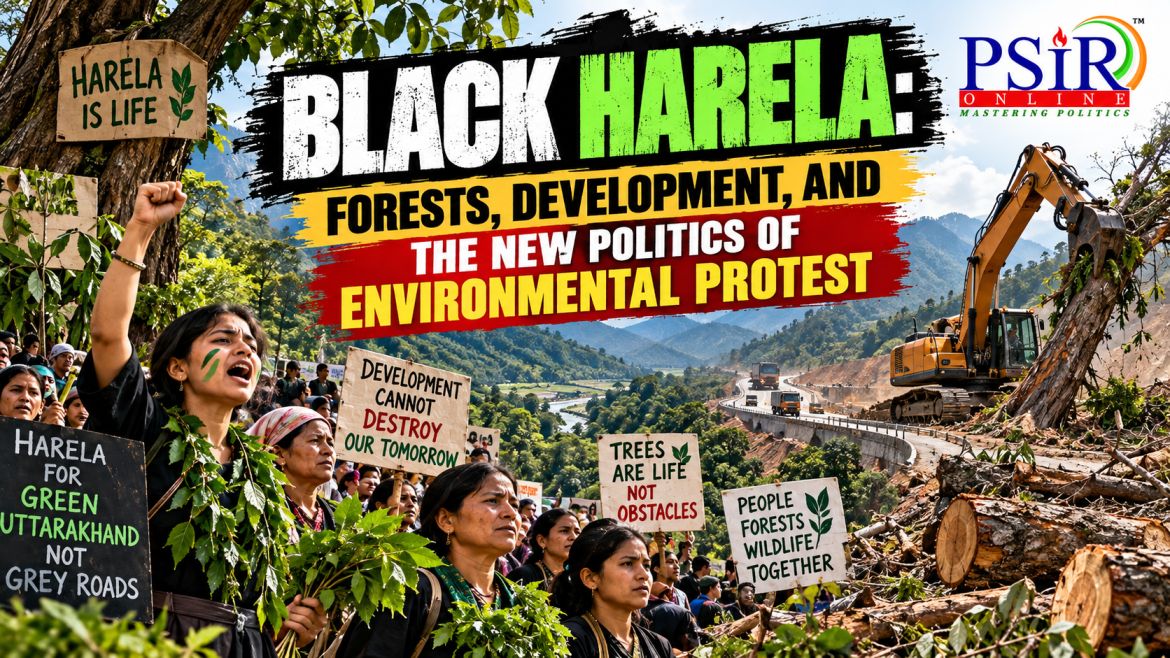
INTRODUCTION: A ROUTINE ROAD SPARKS A BIG MOVEMENT
In July 2026, a highway widening plan in Uttarakhand turned into a major environmental conflict.
The project involved widening the road between Bhaniyawala, Jolly Grant, and Rishikesh. To carry out the expansion, authorities planned to remove 4,369 trees: 3,605 trees were marked to be felled, while 754 were scheduled for transplantation.
The decision triggered immediate opposition from local citizens, students, environmentalists, and civil society groups. As workers began cutting trees, demonstrations intensified, leading to police detentions and arrests.
Soon, the agitation adopted a distinct cultural symbol: “Black Harela.”
Beyond the immediate numbers, the conflict raised a fundamental democratic question: Who gets to decide what constitutes development when roads, forests, wildlife, and community interests collide?
THE PROJECT AT THE CENTER OF THE STORM
The controversy focused on a 19–20 km corridor in Dehradun district passing through the Shivalik forest landscape. The National Highways Authority of India (NHAI) undertook the project to widen the road, ease severe traffic bottlenecks, and improve connectivity between Dehradun, Jolly Grant Airport, and Rishikesh.
NHAI maintained that the highway expansion was essential for regional transportation and included specific ecological and wildlife mitigation measures.
|
Project Detail |
Operational Fact |
|
Total Trees Affected |
4,369 |
|
Trees Marked for Felling |
3,605 |
|
Trees Marked for Transplantation |
754 |
|
Geographic Location |
Shivalik forest belt (Bhaniyawala–Rishikesh stretch) |
|
Executing Agency |
National Highways Authority of India (NHAI) |
|
Primary Ecological Concern |
Habitat fragmentation and canopy loss |
|
Public Response |
Tree-hugging actions, sit-ins, and "Black Harela" protests |
The issue quickly moved past simple road engineering to become a public debate over environmental costs.
WHY THE ISSUE BECAME POLITICALLY SIGNIFICANT
Environmental debates become politically volatile when local residents directly experience the disruption.
Residents and ecologists argued that clearing thousands of trees in the Shivalik belt would directly affect:
· Local climate and rising summer temperatures.
· Natural water absorption and soil stability.
· Wildlife movement corridors and potential human–wildlife conflict.
· The general ecological balance of the Dehradun valley.
The protesters questioned whether a major highway should cut straight through an intact forest belt when planners could have explored alternative alignments or less destructive designs.
The conflict was not an absolute disagreement between "pro-development" and "anti-development" camps. Instead, it centered on what degree of environmental damage is acceptable to achieve an infrastructure goal.
FROM TREE-HUGGING TO POLICE INTERVENTIONS
Tensions peaked in mid-July 2026 as chain-saws moved into the Saat Mod area.
Local citizens and student groups held direct sit-ins and hugged trees marked for removal. Public meetings were organized along the roadside to inform commuters and build solidarity across Dehradun and Rishikesh.
The confrontation soon involved local law enforcement. On July 14, 2026, police registered cases and detained several protesters on charges of disrupting public traffic and obstructing government roadwork.
This turned an environmental disagreement into an active civic dispute involving state policing, civil liberties, and the right to peaceful public assembly.
THE ARRIVAL OF "BLACK HARELA"
The turning point came with Uttarakhand's traditional monsoon festival, Harela. Celebrated across the hill state, Harela marks agricultural renewal, lush greenery, and nature's prosperity. It is traditionally observed by planting saplings and praying for environmental well-being. On July 15, 2026, protesters observed “Black Harela.”
Dressed in black clothing, around 100 demonstrators organized a silent sit-in along the highway. Civil society groups highlighted what they viewed as a clear contradiction: the state celebrating an official festival of greenery while simultaneously felling thousands of mature trees a few miles away.
This gave the protest a distinct cultural voice. The movement was no longer relying only on court petitions, press releases, or political slogans. By turning a community festival into an emblem of ecological dissent, the protesters communicated a simple message: decisions affecting Uttarakhand's forests affect the core cultural and ecological identity of its people.
IS THIS "ANOTHER CHIPKO"?
Because the protest occurred in Uttarakhand and featured people physically protecting trees, observers quickly drew comparisons to the historic Chipko Movement of the 1970s. While Black Harela shares common regional roots with Chipko, their political contexts differ significantly:
· The Historical Chipko Movement: Emerged primarily as a struggle for rural economic survival. Villagers mobilized against outside commercial timber contractors to protect community forest rights, local agricultural tools, and village livelihoods.
· The Black Harela Movement: Emerged in response to modern state-led infrastructure expansion. It questions top-down urban planning, highway engineering, and whether modern environmental clearances adequately account for local ecological security.
The enduring parallel between the two movements lies in a single principle: natural resources are not just administrative assets on an official balance sheet—they are community spaces around which citizens will organize.
THE NUMBERS GAME: CAN OLD FORESTS SIMPLY BE REPLACED?
A central friction in modern highway expansion involves compensatory afforestation and tree transplantation.
In this corridor, 754 trees were scheduled for transplantation, alongside future sapling plantation drives. However, protesters and conservationists pointed out that transplanting a tree is not the same as saving a forest ecosystem.
A mature natural canopy includes:
· Mixed tree species of different ages.
· Well-developed root systems and complex soil biology.
· Established nesting habitats for birds, insects, and small mammals.
· Functional shade and micro-climate moderation.
Saplings planted in distant compensatory patches often experience uncertain survival rates and take decades to reach functional maturity. As a result, public movements increasingly challenge the administrative assumption that cutting an old forest can be resolved through numerical bookkeeping.
POLITICAL ESCALATION AND THE GOVERNMENT’S DECISION
As visual reports of tree-felling and Black Harela demonstrations circulated across national media, mainstream political leaders entered the debate.
On July 18, 2026, the Leader of Opposition in the Lok Sabha, Rahul Gandhi, met representatives of the protest during a visit to Dehradun, promising to raise the matter in Parliament.
Faced with growing public concern, the Uttarakhand state government acted quickly. On July 19, 2026, Chief Minister Pushkar Singh Dhami ordered an immediate, temporary halt to all tree-felling along the highway.
The Chief Minister directed officials to hold fresh consultations with local residents, environmental experts, and public representatives, stating that while modern infrastructure is vital for Uttarakhand, developmental choices must respect public sentiment and ecological protection.
A PAUSE, NOT A CANCELLATION
The Chief Minister’s decision to halt tree felling was an important institutional response to citizen action, but it did not mean the road project was cancelled. Instead, it marked an administrative shift:
Top-down Project Execution → Public Consultation and Reassessment
The administration recognized that executing infrastructure in sensitive mountain ecosystems requires local confidence and scientific review. It shifted the debate from a simple binary—build or don't build—to more practical governance questions:
· Can the road alignment be adjusted to save critical clusters of mature trees?
· Can road medians and shoulders be designed differently to minimize land clearance?
· What specific wildlife-crossing passages need to be incorporated?
THE BROADER LESSON FOR INDIAN ENVIRONMENTAL POLITICS
The Black Harela episode provides useful insights into how civic politics works in modern India:
1. Non-Electoral Actors Shape Real Decisions: Everyday citizens, student volunteers, and independent environmentalists can alter public policy timelines through non-violent mobilization and media visibility without holding political office.
2. Culture Serves as a Political Language: When dry technical debates around highway widths fail to move bureaucracies, tapping into local cultural symbols—like the Harela festival—helps mobilize public empathy and moral support.
3. Balancing Hill Connectivity with Ecology: Mountain states like Uttarakhand face genuine infrastructure challenges, including tourist traffic, pilgrimage routes, difficult terrain, and medical transit needs. Infrastructure expansion cannot simply stop, but it cannot proceed through unexamined forest clearances either.
PSIR DIMENSION: THEORETICAL CONCEPTS & EXAMINATION LINKAGES
|
PSIR Theoretical Dimension & Concepts |
How It Connects to Examination Answers (PSIR Paper 1 / Paper 2) |
|
"Environmentalism of the Poor" (Ramachandra Guha; Joan Martinez-Alier) |
Material and Survival Politics vs. Post-Materialist Lifestyles: Contrasts Western middle-class ecological aesthetics (Inglehart's post-materialism) with Indian environmentalism, where protecting forests, water systems, and hills is an existential defense of rural sustenance, agrarian security, and regional ecological resilience against top-down infrastructure. |
|
Cultural Symbolic Politics & Vernacular Environmentalism (Madhav Gadgil; Amita Baviskar) |
Culture as an Instrument of Resistance: Explains how turning a traditional ecological festival (Harela) into a protest medium (Black Harela) bypasses institutional apathy. Shows how communities appropriate cultural metaphors, sacred memory, and local festivals to build moral legitimacy and cross-ideological solidarity. |
|
Developmental State vs. Ecological Citizenship (James C. Scott – High Modernism; David Harvey) |
Accumulation and Top-Down Technocracy: Analyzes the friction between the high-modernist infrastructure drive of central agencies (NHAI's linear highway corridors) and localized ecological citizenship. Illustrates how peripheral ecosystems bear uncompensated environmental degradation to service national transit and urban tourism. |
|
New Social Movements (NSMs) & Non-Electoral Assertion (Sidney Tarrow; Alberto Melucci) |
Beyond Party Cleavages: Shows how contemporary environmental mobilizations form through horizontal, non-party networks—uniting local residents, students, professional environmentalists, and civil society—forcing executive policy changes without relying on formal electoral party machinery. |
|
Deliberative Democracy & Participatory Governance (Jürgen Habermas; Chhatrapati Singh) |
Democratic Consensus Over Executive Fiat: Connects the Chief Minister’s suspension of tree felling for multi-stakeholder consultations to Habermasian communicative action. Demonstrates that democratic legitimacy requires prior public deliberation and local consent rather than administrative announcements after protests occur. |
|
The Continuous Legacy of Ecofeminism & Chipko (Vandana Shiva; Ramachandra Guha – The Unquiet Woods) |
Genealogy of Himalayan Resistance: Evaluates historical continuities and institutional differences between the 1970s Chipko movement (livelihood defense against commercial timber extraction) and Black Harela (civic resistance against state-led tourism/transit corridors). Emphasizes that Himalayan forests remain contested political spaces. |
|
Environmental Justice & Substantive Due Process (Article 21; Supreme Court of India) |
Judicial and Ecological Constitutionalism: Links the controversy to the expanding interpretation of Article 21 (Right to a Clean and Healthy Environment). Highlights the administrative inadequacy of mechanical compensatory tree counting versus preserving living biodiversity and wildlife corridors. |
CONCLUSION: THE SHIFT TOWARD PARTICIPATORY GOVERNANCE
Black Harela was about more than 4,369 trees along the Bhaniyawala–Rishikesh highway. It showed that environmental action in India is moving beyond reactive protests toward demands for participatory governance.
The primary lesson of the agitation is straightforward: development projects gain lasting legitimacy only when planning includes the people who live alongside the landscape.
Moving forward, durable infrastructure planning in fragile Himalayan zones will require genuine environmental impact assessments, realistic evaluations of alternative routes, and active community consultation before chainsaws arrive on site.
RELATED READING & ANALYTICAL ANGLES
1. Constitutional Provisions & Statutory Frameworks
· Article 21: The fundamental right to life, interpreted by the Supreme Court to encompass the right to a clean, wholesome, and ecologically balanced environment.
· Article 48A & Article 51A(g): Directive Principle obligating the state to protect and improve the environment and safeguard forests and wildlife, mirrored by the fundamental duty of every citizen to protect and preserve natural commons.
· Environment (Protection) Act, 1986 & EIA Notification, 2006 (with subsequent amendments): The legal architecture governing Environmental Impact Assessments, statutory public hearings, and compliance standards for highway expansions and linear infrastructure projects.
· Forest (Conservation) Act, 1980 / Forest (Conservation) Amendment Act, 2023: Statutory rules regulating the diversion of forest lands for non-forest infrastructure purposes, including the contested exemptions granted to strategic linear transit projects.
· Compensatory Afforestation Fund Act, 2016 (CAMPA): The regulatory mechanism governing compensatory sapling plantation and fund utilization, often challenged over poor real-world sapling survival rates and ecosystem non-equivalence.
2. Key Conceptual & Analytical Angles for Examination Prep
· The Ecological Fragility of Himalayan High-Modernism: Evaluating the cumulative hazards of wide highway corridors, slope cutting, tunneling, and soil destabilization in the Shivalik and Central Himalayan belts (e.g., recurring landslides, land subsidence in Joshimath, and altered drainage patterns).
· Ecological Equivalence vs. Numerical Bookkeeping: Why cutting down thousands of mature, multi-layered trees cannot be ecologically balanced by planting saplings elsewhere, and the legal/ecological limitations of mechanical transplantation.
· The Transition from Direct Resistance to Participatory Planning: How grassroots mobilizations push state authorities to switch from unilateral implementation toward institutionalizing alternative routes, wildlife underpasses, and multi-stakeholder consultations.
· Himalayan Eco-Politics: The analytical balance between strategic defense and tourism infrastructure on one side, and regional climate resilience, wildlife migration corridors, and disaster prevention on the other.
PRACTICE QUESTIONS FOR PSIR
