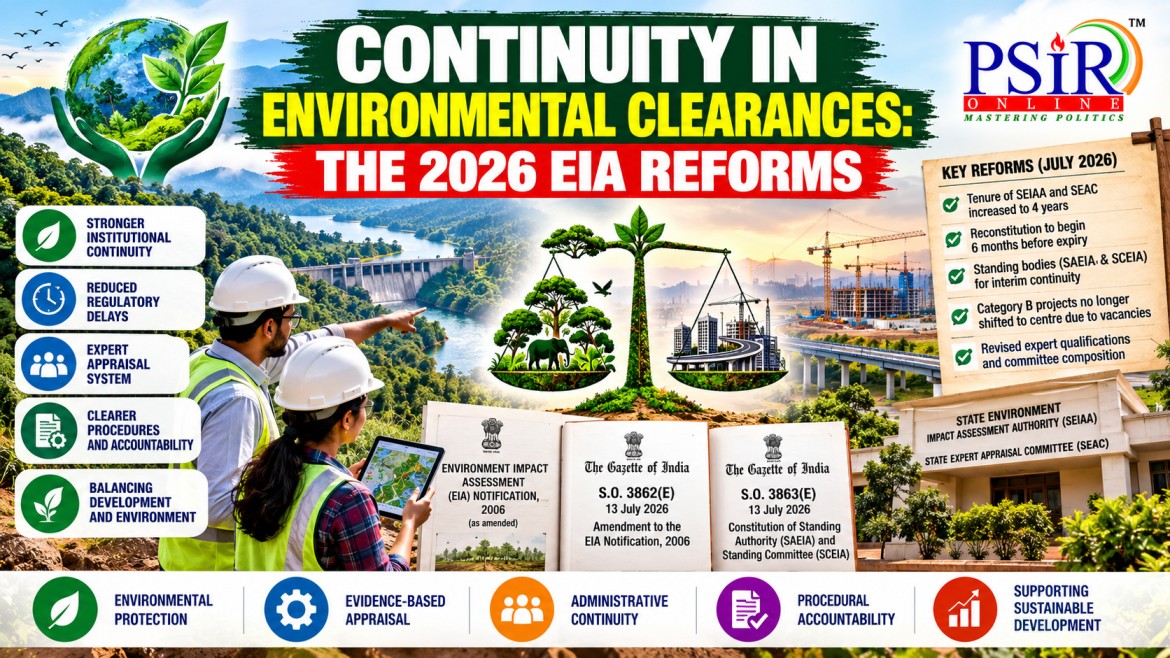
Environmental clearance is an important regulatory instrument for assessing the potential environmental consequences of specified development projects before they proceed. In India, the Environment Impact Assessment (EIA) Notification, 2006, provides the framework for prior environmental clearance for projects covered under its Schedule. The system relies on expert appraisal, regulatory authorities and prescribed procedures to evaluate proposals.
However, environmental appraisal can face administrative delays when State-level authorities and expert committees cease to function because their terms expire or their reconstitution is delayed. Such interruptions can leave proposals pending and create uncertainty for project proponents, regulators and affected communities.
To address this problem, the Ministry of Environment, Forest and Climate Change notified amendments to the EIA framework in July 2026. S.O. 3862(E), dated 13 July 2026, amended the EIA Notification, 2006, while S.O. 3863(E) constituted standing bodies intended to maintain continuity when the regular State-level appraisal institutions are non-functional. The notifications were published in the Gazette of India on 14 July 2026.
The reform raises an important governance question: how can administrative continuity be ensured without compromising expert scrutiny, environmental safeguards and procedural accountability?
WHY CONTINUITY IN ENVIRONMENTAL APPRAISAL MATTERS
The environmental clearance system operates through different institutional arrangements depending on a project's category. Category A projects are appraised at the central level, while Category B projects are generally handled through State or Union Territory-level arrangements involving the State Environment Impact Assessment Authority (SEIAA) and the State Expert Appraisal Committee (SEAC).
The SEAC provides expert appraisal, while the SEIAA performs the regulatory authority's functions, including decisions on environmental clearance. These bodies help bring environmental decision-making closer to the geographical and administrative context of projects under their jurisdiction.
Their functioning depends on the timely constitution and reconstitution of the relevant authorities and committees. When terms expire and replacement arrangements are delayed, the appraisal process can be disrupted. In its July 2026 notification, the Ministry identified delays in reconstituting these institutions as a cause of interruptions in State-level clearance processing and the transfer of pending proposals to the central level.
Continuity is therefore an administrative concern as well as a regulatory one. Prolonged vacancies can affect the processing of proposals, the availability of expert scrutiny and the ability of public authorities to meet prescribed timelines.
At the same time, environmental clearance is not merely a file-processing exercise. It involves examining potential impacts, assessing mitigation measures and applying relevant environmental requirements. The objective must therefore be to prevent institutional vacancies from interrupting appraisal without treating faster processing as a substitute for substantive scrutiny.
WHAT THE 2026 EIA AMENDMENTS CHANGE
The July 2026 amendments introduce several changes to the institutional framework under the EIA Notification, 2006. The principal provisions are set out in S.O. 3862(E), read alongside the separate notification constituting the standing bodies.
|
Provision |
Change introduced |
|
Tenure of SEIAA and SEAC |
The prescribed tenure is increased from three years to four years. |
|
Reconstitution process |
State Governments are required to initiate reconstitution six months before expiry. |
|
Interim continuity |
A Standing Authority on Environment Impact Assessment (SAEIA) and a Standing Committee on Environment Impact Appraisal (SCEIA) are established for each State or Union Territory. |
|
Interim period |
The standing bodies may discharge the relevant functions for an initial period of up to six months, extendable by a further period of up to six months. |
|
Appraisal arrangements |
The earlier provision directing Category B projects to be considered at the central level when a duly constituted SEIAA or SEAC was absent is omitted. |
|
Expert eligibility and composition |
Appendix VI is replaced with revised qualifications, experience and membership provisions for appraisal committees and authorities. |
The amendments also revise the composition and eligibility provisions in Appendix VI. These include specified educational qualifications and relevant professional experience, a maximum of 15 members for an EAC or SEAC including the Member Secretary, and a maximum of two four-year terms in total for members of the specified committees and authorities, subject to the prescribed age conditions. The rules also address removal before expiry of tenure on proven charges affecting proper and fair functioning, including specified delays in processing environmental clearance proposals.
These changes seek to make institutional appointments more predictable while establishing an alternative arrangement for periods when regular bodies are unavailable. They do not, by themselves, demonstrate that processing delays have already declined or that environmental outcomes have improved.
SAEIA AND SCEIA: THE NEW CONTINUITY MECHANISM
The most significant institutional change is the constitution of two standing bodies under S.O. 3863(E):
· Standing Authority on Environment Impact Assessment (SAEIA): intended to discharge the functions of the SEIAA when the regular authority is non-functional or has not been constituted, subject to the notification's conditions and time limits.
· Standing Committee on Environment Impact Appraisal (SCEIA): intended to discharge the functions of the SEAC when the regular committee is non-functional or has not been constituted.
The SAEIA includes the Chief Secretary or the relevant Union Territory administrator's adviser or Lieutenant Governor as Chairperson, the Principal Chief Conservator of Forests as a member, and a designated Environment Department officer as Member Secretary. The SCEIA includes senior officials responsible for the Environment Department, wildlife, health and pollution control, alongside a designated domain expert. Its Chairperson may co-opt experts for particular matters. The State Pollution Control Board or Union Territory Pollution Control Committee is assigned the secretariat function.
The notifications define circumstances in which regular bodies may be treated as non-functional. These include expiry of tenure and specified prolonged vacancies or judicial stays, as applicable to the authority or committee concerned.
The standing bodies are not designed as an unrestricted permanent replacement for the regular institutions. Their role is to provide a temporary arrangement, initially for up to six months, with a possible extension of up to another six months. The amended framework also removes the earlier provision under which Category B projects were considered at the central level in the absence of a duly constituted SEIAA or SEAC.
This mechanism could reduce interruptions caused by vacancies and delayed reconstitution. Its effectiveness will depend on how promptly the standing bodies become operational, whether they have adequate technical and administrative support, and how clearly their responsibilities are communicated to project proponents and the public.
ADMINISTRATIVE EFFICIENCY VERSUS ENVIRONMENTAL SAFEGUARDS
The central governance challenge is to balance continuity and timeliness with environmental protection.
First, continuity should not mean automatic approval. A standing body must perform the relevant appraisal or regulatory functions under the applicable EIA framework. The existence of an interim institution should not be interpreted as an exemption from substantive environmental requirements.
Second, expert scrutiny must remain meaningful. Environmental assessment may require expertise in ecology, pollution, hydrology, public health, risk assessment and sector-specific technologies. The revised eligibility rules seek to define qualifications and experience, but formal eligibility alone cannot guarantee the quality or independence of appraisal. Access to relevant technical expertise and sufficient time to examine proposals remain important.
Third, procedural accountability must be preserved. Decisions should be supported by adequate reasons and appropriate records. Applicable disclosure, consultation and public-hearing requirements must be followed wherever prescribed. A shorter administrative queue is not necessarily evidence of a better environmental decision.
Fourth, performance should be measured through more than clearance speed. Relevant indicators include the age and number of pending applications, the time taken at different stages, compliance with appraisal procedures, the quality of environmental management conditions and follow-up on compliance. These indicators can help determine whether the continuity mechanism is improving administration without weakening safeguards.
Finally, interim arrangements should not become a substitute for timely reconstitution of regular authorities and committees. States and Union Territories still need to initiate appointments in advance, submit complete proposals and provide adequate administrative support. Otherwise, temporary institutions could become a recurring response to avoidable vacancies.
IMPLEMENTATION CHALLENGES AND THE WAY FORWARD
The impact of the 2026 reform will depend on how the new arrangements operate in practice.
Clear operational procedures are essential. Project proponents, State departments and affected communities need clarity about when the standing bodies assume responsibility, which applications they can consider and how pending proposals are transferred.
Adequate technical capacity is equally important. Environmental appraisal requires more than administrative authority. The relevant institutions need access to technical information, competent personnel, reliable records and appropriate logistical support.
Transparent monitoring can help establish whether the reform achieves its stated purpose. The Ministry and relevant authorities could publish regular information on pending applications, average processing times, the use of interim arrangements, reasons for delay and the status of decisions. Such reporting should distinguish routine processing from complex cases that require additional scrutiny.
Independent evaluation should also examine environmental outcomes. A reduction in pendency is relevant, but it should be considered alongside compliance monitoring, the adequacy of environmental conditions and the handling of concerns raised during the appraisal process.
The reform should therefore be assessed as an institutional continuity measure whose results require evidence. Its success will depend on whether it reduces avoidable administrative interruptions while preserving the expertise, transparency and procedural safeguards that make environmental appraisal meaningful.
UPSC ANGLES
|
Dimension |
Relevance for UPSC |
|
Legal and regulatory framework |
The Environment (Protection) Act, 1986, and EIA Notification, 2006, provide the legal basis for environmental clearance and appraisal arrangements. |
|
Environmental governance |
The reform addresses the relationship between regulatory continuity, institutional capacity and environmental protection. |
|
Cooperative federalism |
State and Union Territory institutions operate within a framework notified by the Central Government, requiring coordination across levels of government. |
|
Administrative reforms |
Advance reconstitution, interim arrangements and clearer appointment procedures aim to reduce disruptions caused by vacancies. |
|
Expert institutions |
Qualification, experience and membership rules influence the capacity of appraisal bodies to examine technically complex proposals. |
|
Transparency and accountability |
Reasoned decisions, applicable disclosure requirements and public reporting can help maintain confidence in the clearance process. |
|
Sustainable development |
Faster administrative processing must remain consistent with the assessment and mitigation of environmental impacts. |
|
Implementation challenges |
Staffing, technical support, timely appointments and clarity over jurisdiction will affect the functioning of the new arrangements. |
|
Outcome evaluation |
Pendency and processing time should be assessed alongside procedural compliance, environmental conditions and post-clearance monitoring. |
CONCLUSION
The July 2026 EIA reforms seek to address an important institutional weakness: the interruption of environmental appraisal when State-level authorities and expert committees become non-functional. By extending tenure, requiring advance reconstitution and creating temporary standing bodies, the amendments establish a mechanism for maintaining continuity in the processing of Category B projects.
However, administrative continuity and environmental protection must operate together. The quality of the reform will depend on the independence and competence of appraisal, adherence to applicable procedures, transparent decision-making and effective compliance monitoring. Its long-term value should be judged not simply by the number of clearances processed or the reduction in pendency, but by whether the environmental clearance system becomes more reliable while continuing to protect environmental interests.
OFFICIAL REFERENCES AND FURTHER READING
GS2 MAINS PRACTICE QUESTIONS
10 marks | 150 words
15 marks | 250 words
