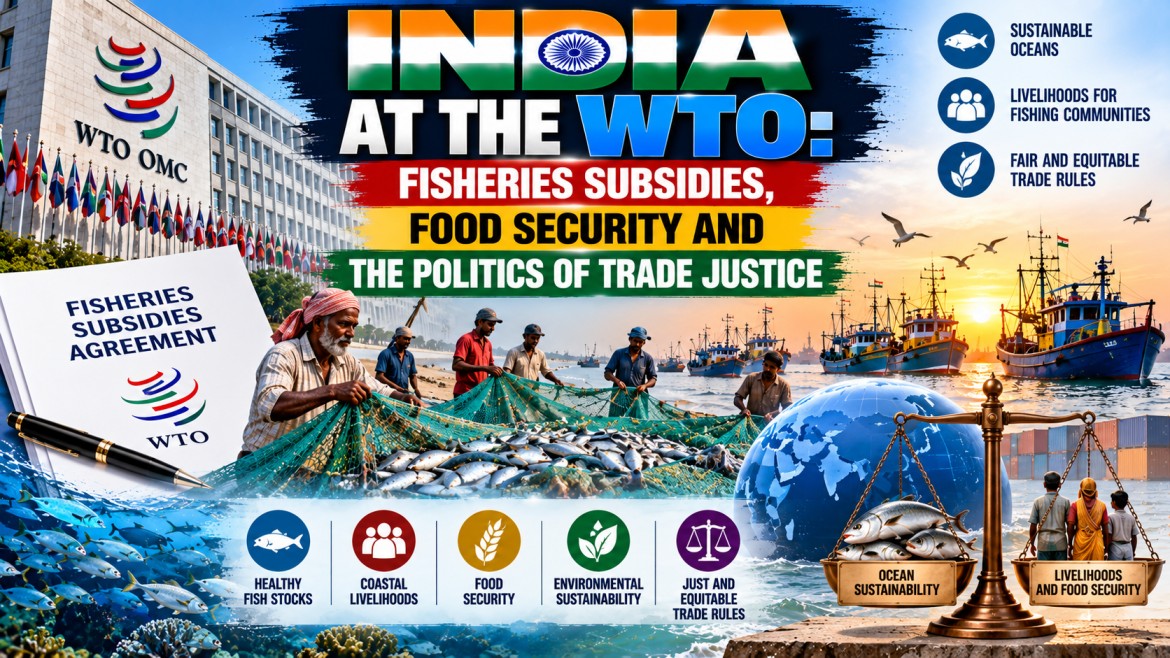
The World Trade Organization (WTO) has traditionally focused on regulating international trade through rules governing tariffs, subsidies, market access and non-discrimination. Increasingly, however, its negotiations have addressed issues that extend beyond commercial exchange, including environmental sustainability, resource conservation and the developmental responsibilities of states. Fisheries subsidies have emerged as an important arena in which these competing objectives intersect.
On 20 July 2026, India deposited its Instrument of Acceptance of the WTO Agreement on Fisheries Subsidies, becoming a party to the agreement. The decision came immediately before India’s Eighth Trade Policy Review at the WTO, held on 21 and 23 July 2026. The review examined India’s trade policies and practices through a transparency process involving other WTO members. India’s acceptance of the fisheries agreement placed its approach to ocean sustainability and trade governance within a wider debate over the obligations of developing economies.
The agreement, adopted at the WTO’s Twelfth Ministerial Conference in 2022, seeks to discipline harmful subsidies that contribute to illegal, unreported and unregulated fishing, overexploitation of fish stocks and unsustainable fishing practices. Yet fisheries are not merely a commercial sector. They provide food, employment and income to coastal communities, including traditional and small-scale fishers. The central challenge is therefore to reconcile environmental sustainability with livelihood protection, food security and equitable trade rules.
India’s position raises a broader question about trade justice: can multilateral rules address genuine environmental problems without imposing disproportionate burdens on developing countries whose fisheries support vulnerable communities and domestic food systems?
THE WTO AGREEMENT ON FISHERIES SUBSIDIES: SCOPE AND SIGNIFICANCE
The WTO Agreement on Fisheries Subsidies was adopted in June 2022 and entered into force on 15 September 2025, after the required threshold of member acceptances was reached. It represents the first WTO agreement specifically directed at environmental sustainability and the first broad, binding multilateral agreement focused on ocean sustainability.
Government subsidies can support fishing communities, reduce operating costs, improve infrastructure and strengthen food supply. However, certain forms of support can also encourage excessive fishing capacity, sustain unprofitable operations and intensify pressure on already depleted marine resources. Subsidies that facilitate illegal fishing or fishing of overfished stocks can undermine conservation measures and disadvantage operators who comply with environmental regulations.
The agreement establishes prohibitions on specified harmful subsidies. These include subsidies to illegal, unreported and unregulated (IUU) fishing, subsidies concerning fishing of overfished stocks in the circumstances specified by the agreement, and subsidies for fishing activities in certain areas of the high seas that are not regulated by relevant regional fisheries management organisations or arrangements.
Its importance lies in addressing the international dimensions of fisheries depletion. Fish stocks frequently cross national maritime boundaries, while fishing fleets and seafood markets operate across jurisdictions. Domestic conservation policies can therefore be undermined when harmful subsidies in one country contribute to unsustainable fishing elsewhere.
However, the agreement is not a comprehensive prohibition on all government assistance to fisheries. Its rules target specified categories of harmful support, while other forms of assistance remain subject to the applicable WTO disciplines and other relevant rules.
Aquaculture and inland fisheries are outside the scope of this agreement. This distinction is particularly important for India, where freshwater fisheries, inland aquaculture and marine fishing contribute differently to livelihoods, nutrition and rural economic activity.
The agreement also provides for continued negotiations on additional disciplines to strengthen its sustainability objectives. These negotiations concern difficult questions surrounding subsidies that contribute to overcapacity and overfishing, as well as the treatment of developing countries.
INDIA’S ACCEPTANCE AND THE JULY TRADE POLICY REVIEW
India’s acceptance of the Fisheries Subsidies Agreement on 20 July 2026 marked a formal commitment to the agreement’s provisions. The instrument was deposited with the WTO before the country’s Eighth Trade Policy Review, which concluded on 23 July.
The Trade Policy Review is a transparency mechanism under which WTO members examine a member’s trade policies and practices. It enables governments to ask questions, exchange views and discuss trade-related measures. It is not a negotiation to approve a country’s entire economic policy, nor is it a judicial determination that every measure complies with WTO rules.
During India’s review, members raised questions about a wide range of trade policies, while India reaffirmed its commitment to a transparent and WTO-consistent trading regime. The process illustrated the interaction between national policy priorities and the expectations of trading partners.
The timing of the fisheries agreement was significant because it demonstrated India’s willingness to participate in a multilateral framework addressing an environmental problem. At the same time, acceptance does not eliminate the need to consider how the agreement will be implemented domestically or how developing-country concerns will be addressed in negotiations over additional disciplines.
India’s position reflects a wider policy challenge. As a major trading economy, it seeks to participate in international rule-making while retaining the ability to protect food security, employment and development priorities. The task is to ensure that international obligations and domestic implementation remain mutually compatible.
Effective implementation will require reliable information about subsidy programmes, coordination among fisheries and trade authorities, appropriate monitoring systems and clarity about the treatment of different forms of assistance. The quality of these arrangements will influence the agreement’s practical impact on fishing communities.
FISHERIES SUBSIDIES, FOOD SECURITY AND COASTAL LIVELIHOODS
Fisheries policy has a direct relationship with food security and employment. Marine and inland fisheries provide livelihoods for fishers, fish workers, processors, traders and other workers throughout the seafood value chain. Fish also contributes to dietary protein and micronutrient intake, making the sector important to nutrition as well as income.
In India, small-scale and traditional fishing communities often operate with limited capital, face fluctuating fuel and input costs, and remain vulnerable to extreme weather, changing fish availability and market volatility. Support for safety equipment, infrastructure, cold chains, storage, insurance, research and access to markets can help strengthen their economic resilience.
The challenge arises when subsidies contribute to excessive fishing effort or undermine conservation. Lower operating costs can encourage additional fishing activity, even when fish stocks are under pressure. The long-term consequences may include declining catches, lower incomes, ecological damage and increased competition between small-scale fishers and larger commercial fleets.
A distinction is therefore necessary between support that strengthens the resilience and welfare of fishing communities and subsidies that contribute to unsustainable fishing practices. The WTO agreement targets specified harmful subsidies; it does not require the elimination of every form of assistance to fishers.
Nevertheless, the distinction must be reflected in domestic policy. Governments need clear programme design, credible data and monitoring systems to identify the purpose and effects of subsidies. Conservation policies must also account for the different capabilities of small-scale operators and large industrial fleets.
India has argued that the interests of traditional fishers and developing countries must be protected in international negotiations. This concern is particularly relevant when the costs of compliance, monitoring or adjustment may be difficult for smaller operators and local administrations to absorb.
Trade justice requires environmental responsibility without undermining the livelihoods of those with the least capacity to absorb transition costs. This calls for targeted welfare measures, improved fisheries management, social protection and assistance for sustainable livelihoods alongside the implementation of international rules.
NORTH–SOUTH RELATIONS AND THE POLITICS OF TRADE JUSTICE
The fisheries negotiations reflect a wider tension in global trade governance: the need for common rules alongside recognition of differences in economic capacity, historical responsibility and development requirements.
Developed countries often possess greater fiscal resources, stronger monitoring systems and more advanced technologies for fisheries management. These capabilities can influence the design and implementation of subsidy disciplines. Developing countries may have larger populations dependent on small-scale fishing, weaker administrative capacity and more limited resources for transition.
The issue is not whether marine resources should be conserved. It is how conservation obligations should be designed and distributed. A rule that appears neutral in its formal wording may have different consequences for countries whose fleets, institutions and fishing communities operate under unequal conditions.
India has consistently argued for special and differential treatment that recognises the developmental circumstances of developing countries. Such treatment is intended to ensure that trade rules do not prevent legitimate development policies or impose disproportionate adjustment costs on vulnerable communities.
However, developing countries are not a homogeneous group. Their fisheries sectors differ in scale, technology, export orientation and regulatory capacity. Some possess large industrial fleets, while others rely heavily on small-scale coastal fishing. Their interests in subsidy disciplines and exemptions may therefore diverge.
The agreement’s existing provisions and the negotiations on additional disciplines must be considered separately. The current agreement establishes specified prohibitions, while further negotiations seek to strengthen disciplines on subsidies associated with overcapacity and overfishing. These additional rules raise particularly sensitive questions about the distribution of responsibilities and the scope of development-related flexibility.
The wider political-economic issue is whether multilateral trade governance can move beyond formally equal obligations towards rules that are environmentally effective and attentive to unequal national circumstances.
A credible framework must prevent harmful subsidies from undermining ocean sustainability while preserving legitimate development objectives. It must also provide adequate technical assistance, transparency and opportunities for developing countries to participate meaningfully in rule-making.
ENVIRONMENTAL SUSTAINABILITY, INDUSTRIAL FISHING AND UNEQUAL COMPETITION
Harmful fisheries subsidies have implications beyond environmental degradation. They can alter the competitive conditions of global seafood markets by allowing subsidised operators to continue fishing despite rising costs, declining stocks or weak commercial returns.
Industrial fishing fleets may benefit from forms of support that are difficult for small-scale operators to match. Where such subsidies encourage excessive fishing capacity, they can place additional pressure on fish stocks and intensify competition for marine resources. The effects may be particularly severe for communities that depend directly on local fisheries for food and income.
The WTO agreement seeks to address specified forms of harmful support and thereby strengthen the relationship between trade regulation and environmental protection. It also creates an opportunity to improve transparency concerning fisheries-related assistance.
Nevertheless, subsidy disciplines alone cannot resolve all fisheries problems. Illegal fishing, weak enforcement, inadequate scientific data, habitat destruction, climate change and ineffective fisheries management also contribute to declining marine resources. International trade rules must therefore complement national conservation measures and cooperation through relevant regional and international institutions.
Effective implementation requires reliable stock assessments, improved reporting, monitoring of fishing activity and coordination among fisheries agencies, customs authorities and trade ministries. Developing countries may need technical and financial assistance to establish these systems.
The environmental objective must also be connected to social policy. Where fishing restrictions or adjustments affect vulnerable communities, governments need mechanisms to protect incomes, support alternative livelihoods and improve access to sustainable fishing practices.
The ultimate objective is not simply to reduce public expenditure on fisheries. It is to remove incentives for destructive fishing while preserving the social and economic foundations of sustainable fisheries.
THE WAY FORWARD: SUSTAINABLE FISHERIES AND EQUITABLE TRADE RULES
India’s implementation of the Fisheries Subsidies Agreement should combine environmental compliance with a development-oriented domestic strategy.
First, India should strengthen coordination among the Ministry of Commerce and Industry, fisheries authorities, coastal administrations and relevant scientific institutions. Clear responsibilities and reliable data are necessary to identify covered subsidies, monitor fishing activity and meet applicable reporting requirements.
Second, public support should be designed around sustainable outcomes. Investment in cold chains, hygienic landing facilities, safety equipment, weather information, research, insurance and sustainable aquaculture can strengthen livelihoods without automatically encouraging excessive marine fishing. Each programme must be assessed against the applicable WTO rules and its environmental effects.
Third, the needs of traditional and small-scale fishers should remain central to implementation. Targeted assistance, social protection, skills development and livelihood diversification can help vulnerable communities adjust to changing fisheries conditions while protecting food security.
Fourth, India should participate actively in negotiations on additional disciplines concerning overcapacity and overfishing. Its negotiating position should seek clear definitions, workable implementation periods where agreed, appropriate flexibility for developing countries and safeguards against disproportionate burdens on vulnerable fishing communities.
Fifth, India should strengthen regional cooperation against IUU fishing and support better data-sharing, monitoring and fisheries management. Marine ecosystems and fish stocks often extend beyond national jurisdictions, making international cooperation essential to effective conservation.
Finally, the WTO should ensure that environmental objectives are accompanied by practical support for developing members. Technical assistance, capacity-building and access to reliable scientific information can improve implementation while strengthening confidence in the multilateral trading system.
The challenge is to create a framework in which conservation, fair competition, food security and development reinforce rather than undermine one another.
THEORETICAL ANGLES
|
Theory or concept |
Application to fisheries subsidies and trade justice |
|
Regime theory |
The agreement demonstrates how multilateral rules can coordinate state behaviour around shared objectives, although implementation depends on national capacity and political commitment. |
|
Global political economy |
Fisheries subsidies reveal how public support, market competition, industrial capacity and control over natural resources shape international trade relations. |
|
North–South relations |
Differences in fiscal resources, technology and development needs influence debates over the distribution of costs and benefits from environmental trade rules. |
|
Dependency theory |
Dependence on export markets and unequal access to capital and technology can constrain the capacity of developing countries to upgrade fisheries and seafood value chains. |
|
Liberal institutionalism |
WTO rules, transparency mechanisms and negotiated commitments provide institutional channels for managing cross-border problems that individual states cannot resolve alone. |
|
Institutional bargaining |
India’s approach illustrates how developing countries seek flexibility, safeguards and recognition of domestic priorities during multilateral negotiations. |
|
Sustainable development |
Fisheries governance requires environmental conservation to be reconciled with employment, nutrition, poverty reduction and long-term economic resilience. |
|
Environmental governance |
The agreement connects trade disciplines with marine conservation, demonstrating the growing interaction between international economic rules and ecological protection. |
CONCLUSION
India’s acceptance of the WTO Agreement on Fisheries Subsidies in July 2026 and its participation in the Eighth Trade Policy Review illustrate the growing interaction between trade governance, environmental sustainability and domestic development priorities.
The agreement addresses specified forms of harmful subsidies that contribute to unsustainable fishing, while the continuing negotiations on additional disciplines raise further questions about overcapacity, overfishing and the treatment of developing countries. For India, implementation must protect marine resources without undermining the livelihoods, nutrition and economic security of coastal communities.
The broader challenge for the WTO is to demonstrate that multilateral rules can respond to environmental threats while recognising unequal national capacities and legitimate development needs. Trade justice requires rules that are environmentally credible, procedurally fair and attentive to the people whose livelihoods depend on the resources being protected.
RELATED READING
PRACTISE QUESTIONS FOR GS2 MAINS
PRACTISE QUESTIONS FOR PSIR
