INTRODUCTION
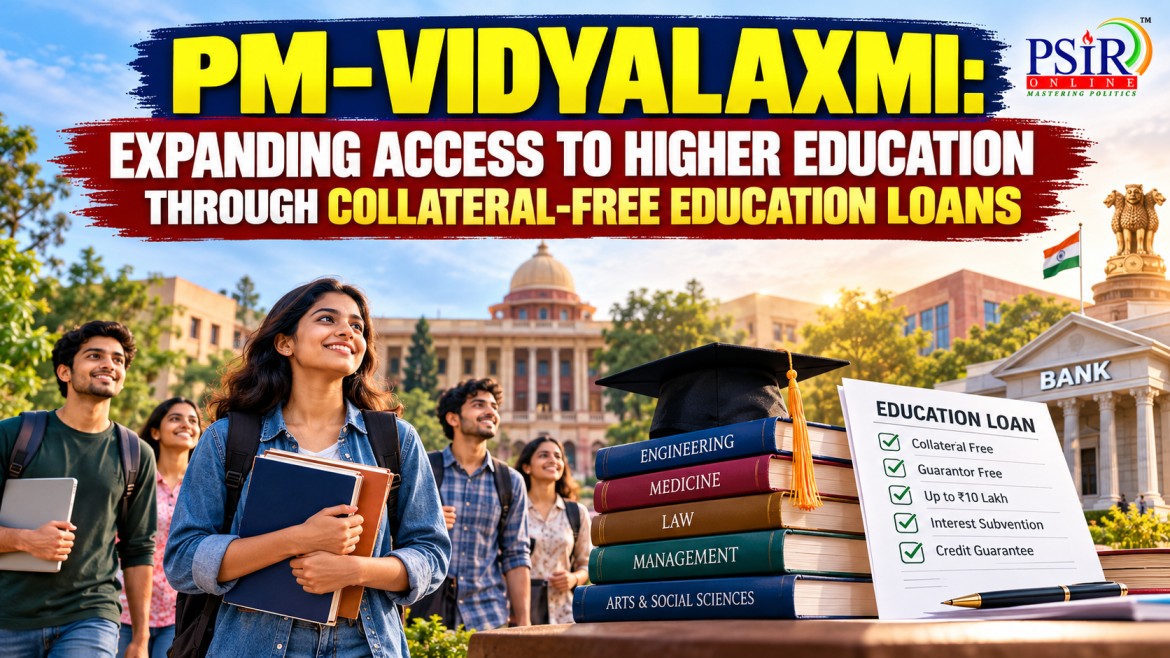
PM-Vidyalaxmi is a Central Sector Scheme of the Department of Higher Education designed to make quality higher education more accessible to students who may face difficulty financing their studies. The Union Cabinet approved the scheme on 6 November 2024, following the announcement in the Union Budget 2024–25 to provide financial support for domestic higher-education loans of up to ₹10 lakh.
The scheme seeks to address an important financial barrier: a student may secure admission to a high-quality institution on merit but still struggle to obtain an education loan because of collateral requirements, guarantor requirements or the cost of borrowing.
PM-Vidyalaxmi therefore combines collateral-free education loans, credit guarantees and interest subvention. Its design is intended to make access to designated high-quality higher-education institutions less dependent on a student's family's ability to provide assets as security.
WHAT DOES PM-VIDYALAXMI PROVIDE?
A student who secures merit-based admission to a designated Quality Higher Education Institution (QHEI) can apply for an education loan without providing collateral or a guarantor.
The loan can cover full tuition fees and other course-related expenses. Unlike earlier interest-subsidy arrangements that focused mainly on technical and professional courses, PM-Vidyalaxmi covers degree and diploma programmes offered by eligible QHEIs.
However, certain categories are excluded, including management-quota and NRI-quota admissions.
The scheme therefore has three important components:
|
Component |
What it provides |
|
Collateral-free & guarantor-free loan |
Eligible students can obtain education loans without pledging collateral or providing a guarantor. |
|
75% Credit Guarantee |
For loans up to ₹7.5 lakh, the Government provides a 75% credit guarantee on the outstanding default, reducing the risk for lending institutions. |
|
3% Interest Subvention |
Students with annual family income up to ₹8 lakh, subject to conditions, receive 3% interest subvention on loans up to ₹10 lakh during the moratorium period. |
The 3% interest subvention is available to students who are not already receiving another government scholarship or interest-subvention benefit. It is limited to one lakh fresh students per year, with preference given to students in government institutions pursuing technical or professional courses.
The loan itself, however, remains bank credit. The Government's ₹3,600 crore allocation is primarily intended to finance the interest-subvention component rather than to provide the entire loan amount directly to students.
WHICH INSTITUTIONS ARE COVERED?
PM-Vidyalaxmi does not cover every higher-education institution. Eligibility is linked to the Government's designated Quality Higher Education Institutions (QHEIs), with the list largely derived from the National Institutional Ranking Framework (NIRF).
The coverage includes:
· Government and private institutions appearing in the top 100 of relevant NIRF overall, category and domain rankings.
· State Government institutions ranked 101–200 in NIRF.
· All Central Government institutions.
The initial list contained around 860 institutions and was subsequently expanded to around 900-plus institutions, including constituent campuses. The potential loan coverage is estimated at around 22 lakh students, although the number actually receiving interest subvention is much smaller because of the annual ceiling.
PM-VIDYALAXMI AND THE DIGITAL LOAN SYSTEM
A significant feature of the scheme is its single-window digital application system. The PM-Vidyalaxmi portal became operational on 25 February 2025. Students can use the portal to:
· apply for education loans;
· choose participating banks;
· track applications;
· monitor loan status;
· access interest-subvention services; and
· raise grievances.
The system is intended to reduce the need for students to approach multiple banks separately. Canara Bank serves as the nodal bank for the scheme. By July 2026, the portal had onboarded 12 public-sector banks, 20 private banks, 25 regional rural banks and 7 cooperative banks. Interest-subvention support is delivered through e-vouchers and CBDC wallets, adding a digital layer to the financial-support mechanism.
SCALE OF IMPLEMENTATION
The scheme has begun to generate significant demand. According to the Ministry of Education's July 2026 update, between the Cabinet approval of PM-Vidyalaxmi on 6 November 2024 and 21 July 2026: 1,12,817 collateral-free and guarantor-free education loans had been sanctioned, with a total value of ₹15,634.78 crore. This indicates that the scheme has moved beyond the policy-announcement stage into substantial implementation.
HOW IS PM-VIDYALAXMI DIFFERENT FROM EARLIER SUPPORT?
PM-Vidyalaxmi builds upon, but is distinct from, the Central Sector Interest Subsidy Scheme (CSIS) under PM-USP.
|
Feature |
PM-USP – CSIS |
PM-Vidyalaxmi |
|
Family income criterion |
Up to ₹4.5 lakh |
Up to ₹8 lakh for 3% subvention |
|
Interest support |
Full interest subvention during moratorium |
3% interest subvention during moratorium |
|
Courses |
Primarily technical/professional |
Degree and diploma courses at designated QHEIs |
|
Institutional coverage |
Accredited technical/professional institutions |
NIRF-based QHEIs and Central Government institutions |
|
Collateral-free element |
Not the central feature |
Collateral-free and guarantor-free loan |
|
Credit guarantee |
— |
75% guarantee for loans up to ₹7.5 lakh |
WHY IS PM-VIDYALAXMI SIGNIFICANT?
The scheme attempts to address two different financial barriers simultaneously.
First is the supply-side barrier. Banks may hesitate to provide large education loans to students who have no collateral or guarantor. The 75% credit guarantee is intended to reduce this risk.
Second is the cost-of-credit barrier. Even when a student receives a loan, interest can make repayment burdensome for families with modest incomes. The 3% interest subvention reduces this burden during the moratorium period for eligible students.
LIMITATIONS OF PM-VIDYALAXMI
Despite its potential, the scheme does not provide universal financial assistance to all higher-education students.
Institutional eligibility is the first limitation. A meritorious student studying in an institution outside the designated QHEI list cannot access PM-Vidyalaxmi simply because the student has financial difficulty.
The interest-subvention benefit is also limited. Only one lakh fresh students per year can receive the 3% subvention. Therefore, even among students studying in eligible institutions, access to subsidised credit is not unlimited.
There is also a priority structure within the subvention component, favouring students in government institutions pursuing technical and professional courses. Consequently, the scheme's promise of wider access to higher education is broader than the group receiving the most favourable interest support.
Another important point is that PM-Vidyalaxmi does not make higher education free. The student still takes a loan and remains responsible for repayment of the principal and the residual interest. The scheme therefore reduces the financial barrier but does not eliminate the possibility of student debt.
THE BANK-LEVEL IMPLEMENTATION CHALLENGE
The most important test of PM-Vidyalaxmi will ultimately be what happens after a student clicks “apply” on the portal. The portal can simplify application, tracking and grievance registration, but it cannot itself sanction or disburse a loan. Under the scheme guidelines, the responsibility for sanctioning and disbursing education loans remains with the respective banks, while the Department of Financial Services monitors loan delivery.
This is significant because education lending has historically presented challenges for banks. Banks have faced repayment and asset-quality concerns in education loans, which can make branch-level officials cautious about lending. Although the situation has improved considerably—with gross NPAs on outstanding education loans of public-sector banks falling from 7% in FY2020-21 to 2% in FY2024-25—the legacy of stressed education-loan portfolios can still influence lending behaviour and risk assessment.
There is also evidence that students have faced difficulties at the branch level. Courts have dealt with cases in which education loans were rejected because of the low credit scores of parents or co-borrowers, even where students had secured admission on merit. In one 2024 case, the Jharkhand High Court directed a bank to reconsider an eligible education-loan application after finding that the student's merit-based admission should not have been defeated by the cited credit-score grounds.
This highlights a crucial implementation gap: a centrally designed credit-guarantee scheme may remove the formal requirement for collateral, but it does not automatically eliminate conservative lending behaviour at the branch level.
Bank-level understanding of the scheme is therefore critical. The PM-Vidyalaxmi guidelines require banks to verify documents such as income certificates and process applications, while the Government's 2026 performance framework itself includes training and sensitisation workshops for nodal officers at State, university and institutional levels and sets a target of a 14-day turnaround time from a completed application to sanction. This means that the success of PM-Vidyalaxmi depends on three stages working together:
Student applies through portal → Bank correctly understands and processes eligibility → Loan is actually sanctioned and disbursed.
If the second stage fails, digital access merely produces a digitally recorded rejection rather than genuine financial inclusion.
OVERALL ASSESSMENT
PM-Vidyalaxmi represents a significant change in the design of education-loan assistance by combining collateral-free lending, government credit guarantees and targeted interest subvention. Its central contribution is to address a specific problem: a student's lack of family assets should not automatically prevent access to an education loan when admission has been secured on merit.
However, the scheme's reach remains conditioned by institutional eligibility, limited interest-subvention slots and continued dependence on bank credit. Its long-term success will therefore depend not merely on the number of loans sanctioned, but on whether students from financially constrained families can actually complete their courses and repay their loans without facing excessive financial stress. In essence, PM-Vidyalaxmi attempts to make access to quality higher education less dependent on collateral—but it does not remove the financial burden of higher education altogether.
UPSC DIMENSION
|
UPSC DIMENSION |
HOW PM-VIDYALAXMI CONNECTS WITH IT |
|
Equality of opportunity |
PM-Vidyalaxmi advances the constitutional commitment to equality of opportunity by reducing the role of family wealth and collateral ownership in accessing quality higher education. By providing collateral-free and guarantor-free education loans, it enables students from families without substantial assets to pursue higher education on the basis of their academic admission rather than their family's capacity to provide security for a loan. |
|
Right to Education |
While Article 21A guarantees free and compulsory education for children between 6 and 14 years, PM-Vidyalaxmi extends the broader policy concern of equitable educational access into higher education. It recognises that educational disadvantage can continue beyond school and that financial barriers can restrict access to higher learning. |
|
Education and social mobility |
PM-Vidyalaxmi promotes human-capital formation, employability and intergenerational social mobility by enabling students who secure admission to designated quality higher educational institutions to overcome financial constraints. Higher education therefore becomes an instrument for reducing the transmission of economic disadvantage across generations. |
|
NEP 2020 |
PM-Vidyalaxmi operationalises the NEP 2020 emphasis on equitable access to quality higher education by strengthening financial support for students from economically weaker backgrounds. It addresses affordability alongside the expansion of access to quality institutions. |
|
Credit guarantee vs subsidy |
PM-Vidyalaxmi combines two different financial instruments: the 75% credit guarantee reduces the lending risk of banks, while the 3% interest subvention reduces the borrowing cost for eligible students. Thus, the scheme simultaneously addresses the supply-side constraint of lender risk and the demand-side constraint of student affordability. |
|
Centre–bank partnership |
PM-Vidyalaxmi represents a public–financial-sector partnership in which the Union Government creates the credit-guarantee and interest-support framework, while banks sanction and disburse the actual education loans. Its effectiveness therefore depends on coordination between government agencies, banks and educational institutions. |
|
Digital governance |
The PM-Vidyalaxmi portal creates a single-window digital system through which students can apply for education loans, track applications, access interest-subvention support and raise grievances. It seeks to reduce procedural fragmentation and improve transparency in welfare delivery. |
|
Merit vs inclusion |
PM-Vidyalaxmi combines merit-based admission with financial assistance, as eligibility is linked to admission in designated QHEIs. This creates a policy question about balancing institutional quality and merit-based targeting with the broader objective of extending financial support to economically disadvantaged students studying outside the designated institutional framework. |
|
NIRF and public policy |
By using NIRF rankings and institutional categories to determine eligible QHEIs, PM-Vidyalaxmi connects public financial support with government-defined indicators of institutional quality. This also raises the question of whether ranking-based eligibility adequately captures the diversity and quality of India's higher-education institutions. |
|
Centre–State dimension |
PM-Vidyalaxmi demonstrates multi-level governance in higher education: the Union Government designs the financing framework, participating institutions facilitate student access, and banks implement the credit component. Its implementation therefore requires coordination across different institutional levels. |
|
Financial inclusion |
By removing the requirement for collateral and third-party guarantees for eligible loans, PM-Vidyalaxmi brings students who may lack family assets into the formal financial system. Education financing thus becomes an important component of financial inclusion. |
|
Student debt |
PM-Vidyalaxmi primarily provides credit rather than a grant, meaning that students eventually have to repay the loan. Therefore, expanding access to higher education must be accompanied by attention to repayment capacity, employment outcomes and the risk of excessive student indebtedness. |
|
Comparison with PM-USP–CSIS |
PM-Vidyalaxmi complements PM-USP–CSIS by providing a broader education-loan framework with collateral-free lending, credit guarantee and interest subvention. Comparing the two schemes helps understand the difference between interest subsidy on education loans and a wider credit-access mechanism. |
|
Credit Guarantee Fund for Education Loans |
PM-Vidyalaxmi strengthens the use of credit guarantees as an instrument of social policy. Instead of the government financing the entire education cost directly, the State shares part of the lending risk with financial institutions, encouraging banks to extend credit to eligible students. |
|
PM-USP Scholarships |
PM-Vidyalaxmi differs from PM-USP scholarship support because scholarships provide direct financial assistance, whereas PM-Vidyalaxmi primarily facilitates access to repayable institutional credit. Together, they illustrate two different approaches to educational inclusion: grant-based support and loan-based support. |
|
Social justice |
PM-Vidyalaxmi addresses a major dimension of social justice by reducing the financial and collateral barriers to higher education. However, equitable access may require complementary support for tuition, living expenses, scholarships and students who remain outside the scheme's institutional eligibility framework. |
WAY FORWARD
PM-Vidyalaxmi can become an effective instrument of social justice only if the focus moves beyond digital access to actual loan delivery.
|
Priority |
Way Forward |
|
Strengthen bank-level implementation |
Standardise processing across branches and ensure that eligible applications are not discouraged through unnecessary procedural hurdles. |
|
Train bank officials |
Regular sensitisation and training should ensure that branch officials clearly understand PM-Vidyalaxmi eligibility, credit guarantee provisions and interest-subvention rules. |
|
Time-bound sanction |
Enforce the prescribed turnaround time and provide students with transparent reasons whenever an application is delayed or rejected. |
|
Effective grievance redressal |
Strengthen the portal-based grievance mechanism so that unresolved bank-level complaints can be escalated quickly. |
|
Use the credit guarantee effectively |
Banks should recognise that the 75% credit guarantee reduces their exposure and should not treat collateral requirements as a substitute for proper scheme implementation. |
|
Broaden social inclusion |
Periodically review whether restricting the scheme to QHEIs leaves deserving students in good-quality institutions outside the designated list without adequate support. |
|
Integrate with scholarships |
PM-Vidyalaxmi should complement scholarships and interest-subsidy schemes rather than operate in isolation. |
|
Monitor outcomes, not applications |
Government should track sanction, disbursement, rejection, turnaround time and grievance resolution, rather than merely counting applications submitted through the portal. |
|
Reduce student debt burden |
Greater interest support and targeted assistance may be considered for economically vulnerable students who face difficulty repaying loans after graduation. |
CONCLUSION
PM-Vidyalaxmi represents an important shift in higher-education financing—from collateral-based access to a more inclusive, credit-guaranteed model. By combining collateral-free loans, credit guarantees, interest subvention and a unified digital platform, it attempts to ensure that family wealth does not become a barrier to accessing quality higher education.
However, digitalisation alone cannot guarantee financial inclusion. The decisive stage begins after the student submits the application, when banks have to process, sanction and disburse the loan. Therefore, the success of PM-Vidyalaxmi will depend not merely on how many students can apply, but on how effectively the banking system converts eligible applications into timely and affordable educational credit.
The real measure of PM-Vidyalaxmi is not digital access to an education loan, but whether that access ultimately becomes an opportunity to study, graduate and achieve social mobility.
RELATED READING
For comprehensive UPSC preparation, students should connect PM-Vidyalaxmi with the following areas:
· Right to Education and Equality of Opportunity – Article 21A, Article 14 and access to education.
· Higher Education and Social Mobility – education as an instrument of human-capital formation and reduction of inter-generational inequality.
· NEP 2020 – financing of higher education, access, affordability and equitable participation.
· Financial Inclusion – collateral-free credit, credit guarantees and formal institutional finance.
· Education Financing in India – education loans, interest subsidies, scholarships and student debt.
· Digital Governance – unified portals, DBT, transparency, grievance redressal and last-mile implementation.
· NIRF and Quality Higher Education – linking public support with institutional quality and rankings.
· Centre–Bank Coordination – role of banks, Department of Financial Services, Department of Higher Education and NCGTC.
· Social Justice and Inclusive Development – ensuring that family income and lack of collateral do not determine access to higher education.
· PM-USP CSIS and Other Education Support Schemes – understanding the complementarity between scholarships, interest subsidies and credit guarantees.
PRACTISE QUESTIONS FOR GS2 MAINS
1. PM-Vidyalaxmi seeks to make higher education more accessible by reducing financial barriers faced by students. Discuss its significance for ensuring equality of opportunity in India. (10 Marks, 150 Words)
2. Digitalisation of welfare delivery does not automatically ensure social justice. Examine the implementation challenges of PM-Vidyalaxmi, particularly at the bank level. (10 Marks, 150 Words)
3. “Credit guarantees and interest subsidies can improve access to higher education, but they cannot substitute for a comprehensive public financing strategy.” Critically analyse in the context of PM-Vidyalaxmi. (15 Marks, 250 Words)
4. PM-Vidyalaxmi represents an important step towards democratising access to quality higher education, but its QHEI-based eligibility and loan-oriented approach raise questions of inclusiveness. Critically examine. (15 Marks, 250 Words)
