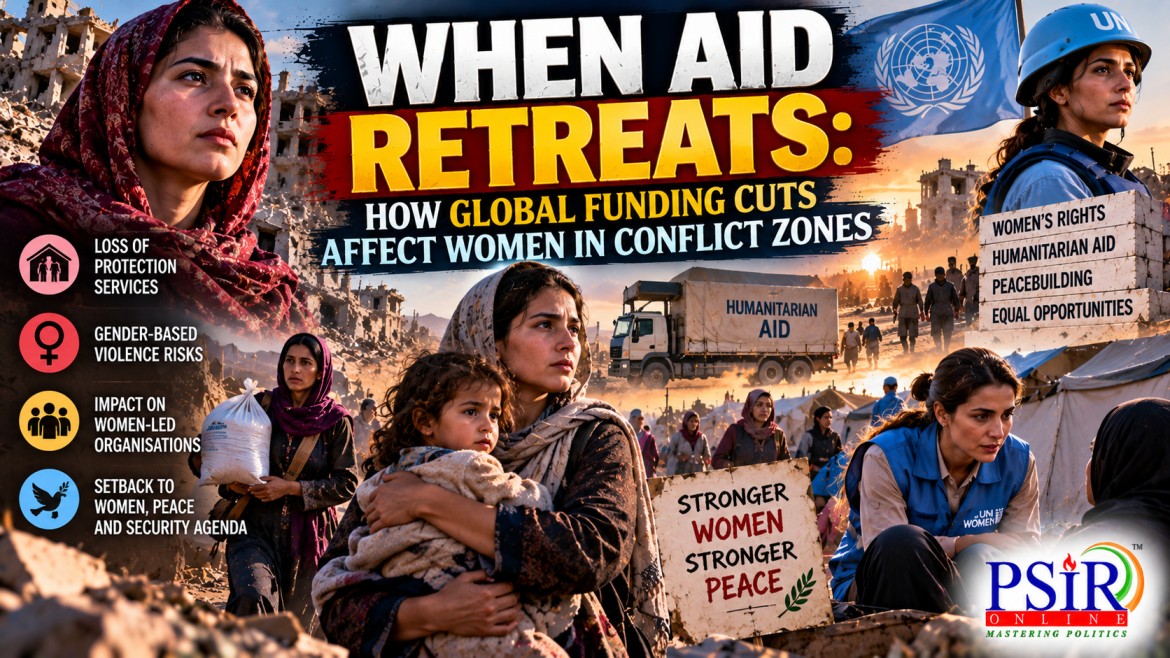
International assistance is a critical component of humanitarian response in conflict-affected societies. It supports displaced families, survivors of gender-based violence, access to healthcare, education, psychosocial care and economic recovery. However, when international donors reduce funding, the consequences extend beyond the number of relief supplies delivered. Women-led organisations, which often provide essential services within local communities, may be forced to reduce operations or close precisely when humanitarian needs are increasing.
On 10 July 2026, UN Women released Beyond the Breaking Point: The Continuing Impact of Funding Cuts on Women’s Organisations in Humanitarian Settings. The report highlighted how declining assistance was affecting women’s organisations and the women and girls who depended on them. The findings raise a fundamental International Relations question: can the international community maintain its commitments to gender equality, civilian protection and peacebuilding while reducing the resources needed to implement them?
The issue connects humanitarian financing with Feminist International Relations, human security and the Women, Peace and Security (WPS) agenda. It also exposes the gap between international commitments and the capacity to translate them into protection on the ground.
THE EVIDENCE: WHEN HUMANITARIAN NEEDS RISE AND FUNDING FALLS
UN Women’s July 2026 assessment was based on responses from 855 women-led and women’s rights organisations across 52 crisis- and conflict-affected countries and contexts. It documented the consequences of funding reductions for organisations already operating under severe pressure.
|
Key finding |
What it reveals |
|
At least one million women and girls lost access to critical services since January 2025 |
Funding reductions have direct consequences for people affected by conflict and crisis |
|
84% of surveyed organisations reported increased demand for their services |
Humanitarian needs were growing while organisational capacity was being constrained |
|
Nearly nine in ten organisations could no longer meet current levels of need |
Existing services were insufficient to respond to demand |
|
Around four in ten organisations working in humanitarian crises expected to close within the following 12 months |
Funding insecurity threatened the continuity of local protection networks |
|
Nearly two-thirds reported that staff were working without pay to sustain critical services |
Organisations were relying on unsustainable personal sacrifices to continue operating |
Source: UN Women, Beyond the Breaking Point, 10 July 2026. These figures describe the surveyed organisations and reported service-access losses; they should not be interpreted as a census of every organisation or affected woman worldwide.
The evidence demonstrates a widening gap between humanitarian demand and available resources. Funding reductions do not necessarily affect every programme equally, but services that depend on sustained local staffing, confidential support and community trust can be particularly vulnerable when grants end.
The consequences are also cumulative. Once a local organisation loses trained staff, secure premises, referral networks or community access, restoring its operations may require considerably more than replacing the funding that was withdrawn.
THE PROTECTION GAP: GENDER-BASED VIOLENCE AND HUMAN SECURITY
Women and girls experience conflict through displacement, loss of livelihoods, family separation, disrupted healthcare and exposure to sexual and gender-based violence. These risks vary across contexts, but they frequently intensify when established protection systems break down.
Women-led organisations may operate safe spaces, provide psychosocial assistance, support survivors in accessing healthcare and legal services, and connect displaced women with humanitarian agencies. When funding is reduced, these services may become unavailable or geographically inaccessible. Survivors may consequently face greater obstacles in seeking confidential assistance or reporting abuse.
UN Women’s July 2026 findings indicated that nearly two-thirds of surveyed organisations reported significant reductions or the disappearance of safe spaces and gender-based violence services in their communities. The report also highlighted rising conflict-related sexual violence and increasing socioeconomic pressures among the populations served.
The relationship between aid and protection is therefore broader than immediate relief. Reduced livelihood assistance can deepen economic insecurity; interruptions to education can increase girls’ vulnerability; and the closure of community services can weaken the support networks through which women obtain information and protection.
The concept of human security helps explain this relationship. Security is not limited to territorial integrity or the survival of the state. It also includes freedom from violence, access to essential services and protection from severe economic and social insecurity.
However, funding cuts should not be treated as the sole cause of violence against women. Armed actors, impunity, discriminatory institutions, restrictions on movement and failures of justice also shape protection outcomes. Funding reductions can compound these existing risks by weakening the organisations that help women navigate them.
WOMEN-LED ORGANISATIONS AND THE POLITICS OF HUMANITARIAN FINANCING
Women-led and women’s rights organisations are not simply delivery partners for international agencies. They often possess local knowledge, community legitimacy and relationships that external organisations cannot easily reproduce.
In Afghanistan, the Democratic Republic of the Congo and Haiti, among other crisis-affected settings, local organisations have faced the combined pressures of growing humanitarian needs and declining resources. In some contexts, restrictions on women’s employment and movement create additional barriers to delivering assistance.
Funding insecurity can affect these organisations in three interconnected ways.
First, service capacity declines when staff are laid off, programmes are suspended or operations are restricted to fewer locations.
Second, institutional autonomy weakens when organisations cannot maintain core administrative systems, retain trained personnel or plan beyond short-term grants. They may become increasingly dependent on unpredictable funding cycles.
Third, local participation suffers when international responses lose the community-based organisations that help identify needs, communicate risks and ensure that services reach women who might otherwise remain excluded.
This produces a paradox in humanitarian governance: international agencies may publicly support localisation while financing arrangements leave local organisations exposed to sudden withdrawals. A commitment to locally led action requires more than transferring implementation responsibilities. It requires predictable funding, reasonable administrative costs, transparent decision-making and meaningful participation in programme design.
Donors also face legitimate constraints, including competing emergencies, fiscal pressures and the need to demonstrate accountability for public expenditure. The policy challenge is not to assume that all assistance must remain unchanged, but to make funding decisions transparent, assess their likely protection consequences and avoid abrupt withdrawals that destroy essential local capacity.
THE WOMEN, PEACE AND SECURITY AGENDA UNDER PRESSURE
The Women, Peace and Security agenda emerged from the recognition that women experience armed conflict in gender-specific ways and must participate meaningfully in conflict prevention, peace negotiations, peacebuilding and post-conflict recovery.
UN Security Council Resolution 1325, adopted in 2000, established a major international framework for women’s participation and protection in situations of armed conflict. Subsequent resolutions developed its principal pillars: participation, protection, prevention and relief and recovery.
Aid reductions can undermine each of these pillars.
|
WPS pillar |
How funding insecurity can weaken implementation |
|
Participation |
Women’s organisations may lose the staff and resources needed to engage in peace processes and local decision-making |
|
Protection |
Safe spaces, survivor support and gender-based violence response services may be reduced |
|
Prevention |
Community-based early-warning, mediation and conflict-prevention initiatives may lose continuity |
|
Relief and recovery |
Women may face reduced access to livelihoods, psychosocial care and services needed to rebuild their lives |
The WPS agenda is not implemented through Security Council resolutions alone. Its practical delivery depends on national institutions, peacekeeping and humanitarian actors, civil society organisations and sustained financial commitments.
This creates an implementation gap between normative commitments and operational capacity. Governments may endorse women’s participation in peacebuilding while local organisations lack the resources required to organise consultations, support survivors or sustain community mediation.
The issue also has implications for the legitimacy of peace processes. When women’s organisations are excluded through financial attrition, peacebuilding can lose important local perspectives and mechanisms for accountability. This does not mean that every underfunded peace process will fail, but it does mean that participation and protection commitments become harder to fulfil.
TOWARDS GENDER-RESPONSIVE AND PREDICTABLE AID
Responding to the crisis requires reforms in both the volume and the structure of humanitarian financing.
First, protect essential services. Donors and humanitarian agencies should assess the likely consequences of funding changes for gender-based violence response, safe spaces, healthcare referrals and other life-saving services before ending programmes.
Second, strengthen direct and flexible financing. Women-led organisations need multi-year funding where feasible, reasonable overhead coverage and resources for institutional capacity, not only narrowly defined project activities. Direct funding must be accompanied by proportionate accountability requirements that do not exclude smaller organisations.
Third, institutionalise women’s participation. Women’s organisations should be involved in humanitarian needs assessments, funding decisions, peacebuilding initiatives and monitoring arrangements. Consultation should influence resource allocation rather than merely legitimise decisions already taken.
Fourth, improve burden-sharing. Governments, multilateral institutions, philanthropic organisations and other funding partners can diversify the sources of support available to local organisations. Such diversification cannot fully substitute for predictable public assistance, but it may reduce exposure to the withdrawal of a single donor.
Fifth, measure outcomes rather than commitments alone. Funding reports should examine whether services remain accessible, whether organisations retain trained staff, whether women participate in decision-making and whether protection mechanisms function in practice. Gender-responsive budgeting and transparent reporting can help identify where resources are failing to reach those most in need.
Finally, national governments in conflict-affected countries must strengthen public protection systems and remove discriminatory restrictions that prevent women from working, moving freely or accessing assistance. International funding cannot replace the responsibilities of states, just as state responsibility cannot eliminate the need for international cooperation during severe humanitarian crises.
THEORETICAL ANGLES
|
Theory or concept |
Application to the issue and exam use |
|
Feminist International Relations |
Demonstrates how conventional security approaches can overlook gendered experiences of conflict and the unequal distribution of protection resources. Use to critique the gap between formal commitments and women’s lived realities. |
|
Human Security |
Shifts analysis from state survival to protection from violence, deprivation and insecurity. Use to explain why funding for healthcare, safe spaces and livelihoods forms part of security policy. |
|
Liberal Institutionalism |
Highlights the role of UN Women, multilateral cooperation and international norms in coordinating collective responses. Funding volatility illustrates the limits of institutions when member-state commitments are not matched by resources. |
|
Constructivism |
Examines how norms concerning gender equality, civilian protection and women’s participation shape international expectations. The case illustrates the difference between accepting a norm and implementing it. |
|
Dependency and Global Inequality |
Helps examine the vulnerability of locally rooted organisations to external funding decisions and unequal control over financial resources. Use carefully: not every aid relationship is necessarily dependency-producing. |
|
Humanitarian Governance |
Focuses on how donors, international agencies, states and local organisations distribute resources and determine priorities. Useful for discussing accountability, localisation and power imbalances in aid delivery. |
CONCLUSION
The withdrawal of international assistance can create consequences that extend well beyond an immediate funding shortfall. When women-led organisations lose staff, services and institutional capacity, women and girls affected by conflict may lose essential protection and support. The damage can also weaken participation in peacebuilding and obstruct implementation of the Women, Peace and Security agenda.
The central policy challenge is to align humanitarian financing with international commitments. Predictable funding, locally led delivery, meaningful participation and accountable protection systems are necessary to reduce the gap between international promises and practical outcomes. For International Relations, the issue demonstrates that global governance depends not only on norms and institutions but also on the resources and local capacities needed to make them effective.
RELATED READING
PRACTICE QUESTIONS FOR GS2 MAINS
PRACTICE QUESTIONS FOR PSIR
