INTRODUCTION: WHEN RECOGNITION BECOMES A POLITICAL QUESTION
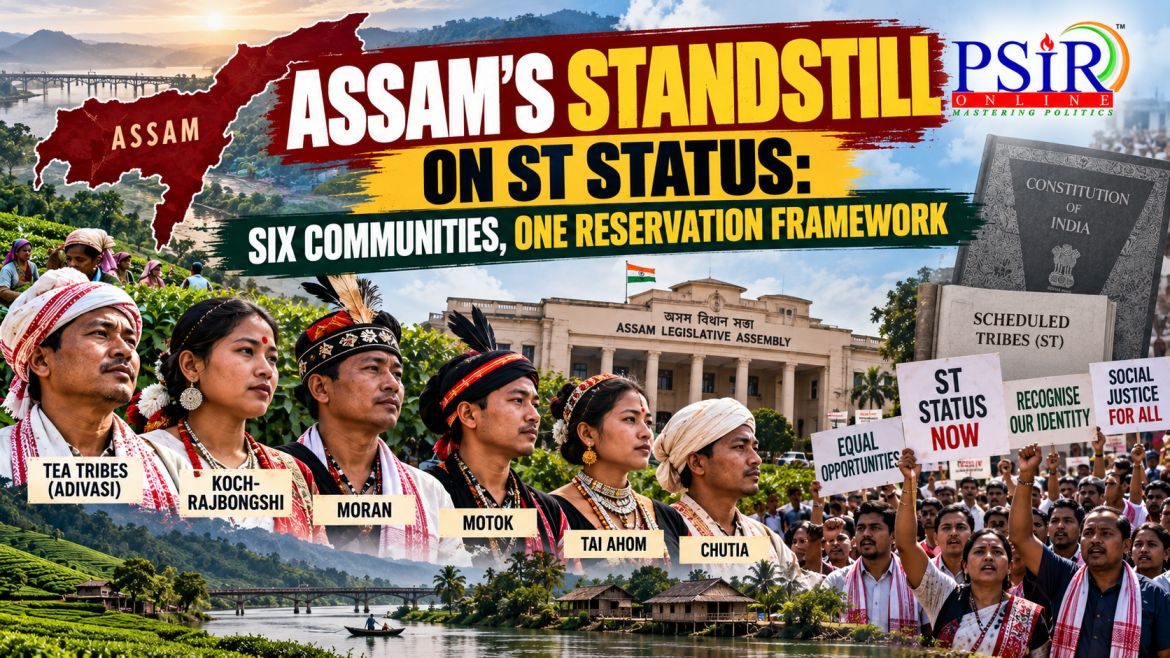
In Assam, the demand for Scheduled Tribe (ST) status by six major communities—Tai Ahom, Chutia, Moran, Motok, Koch-Rajbongshi, and the Tea Tribes/Adivasi communities—has become one of the state's most enduring political battles.
This issue is not new. The Union Government held discussions with representatives of these groups as early as 2016–17. However, the debate took a sharp institutional turn between late 2025 and 2026. A Group of Ministers (GoM) set up by the Assam Government proposed a novel three-tier quota system: adding an ST (Valley) category alongside the existing ST (Plains) and ST (Hills) brackets. The goal was to grant the six communities tribal status while protecting the existing benefits of already recognized tribes.
The controversy highlights a core challenge in democratic politics: How can a state satisfy long-standing political demands for recognition without threatening the constitutional safeguards already enjoyed by existing beneficiaries?
WHO ARE THE SIX COMMUNITIES AND WHAT DO THEY WANT?
The six communities at the heart of this mobilization represent large demographic groups across Assam:
· Tai Ahom: The community associated with the Ahom dynasty that ruled Assam for six centuries.
· Koch-Rajbongshi: A historical community with large populations across western Assam and northern West Bengal.
· Moran and Motok: Two distinct historical communities concentrated mainly in Upper Assam.
· Chutia: An indigenous community with historical roots in Upper and eastern Assam.
· Tea Tribes / Adivasis: Descendants of communities brought to Assam during colonial rule to work in tea plantations.
All six groups are demanding formal notification as Scheduled Tribes under the Constitution, along with the educational, employment, and political reservations that come with that status.
Currently, none of them are on Assam's notified ST list in the way they are demanding. Instead, the state government has provided them with Development Councils (such as the Moran, Mottok, Chutia, Adivasi, Koch-Rajbongshi, and Tai Ahom Development Councils).
However, a Development Council is merely an administrative body funded by the state government for local cultural and economic schemes. It does not carry the constitutional force, job quotas, or legislative protections of Scheduled Tribe status. For these groups, political parity requires full constitutional recognition.
THE STAKES: WHY ST STATUS MATTERS
Scheduled Tribe recognition is not just a change of name; it directly controls access to real political and economic power.
In Assam, ST status determines:
· Reserved seats in state and central government jobs.
· Reserved seats in universities, medical colleges, and technical institutions.
· Political representation via reserved seats in the Assam Legislative Assembly and Lok Sabha.
· Access to targeted central and state tribal welfare funds.
Assam currently divides its tribal reservation into two broad categories:
1. ST (Plains): Carries a 10% reservation in state recruitment and education.
2. ST (Hills): Carries a 5% reservation, tied to the autonomous hill districts (Karbi Anglong and Dima Hasao).
Because the six communities represent millions of people, simply adding them to the existing lists would alter the distribution of these quotas overnight.
HOW A COMMUNITY BECOMES A SCHEDULED TRIBE
A common public misconception is that a state government can simply issue an order declaring a group an ST. Under the Constitution, the process requires strict central executive and legislative action:
State Government Justification & Recommendation
▼
Registrar General of India (RGI)
▼
National Commission for Scheduled Tribes (NCST)
▼
Parliamentary Legislation (Article 342)
· Article 342: The President of India specifies the Scheduled Tribes in relation to a State or Union Territory through a Presidential Order.
· Role of Parliament: Any later inclusion or exclusion of a community from that list can only be enacted by a law passed by the Parliament of India.
· Administrative Modalities: Reaffirmed by the Union Government in December 2025, the established procedure requires the State Government to send an ethnographic report and recommendation, which must then be vetted by the Registrar General of India (RGI) and the National Commission for Scheduled Tribes (NCST) before reaching the Union Cabinet and Parliament.
A political demand or an assembly resolution cannot bypass this multi-stage institutional path.
THE ADMINISTRATIVE CRITERIA: BETWEEN TRADITION AND MODERN REALITY
For decades, the Union Government has evaluated tribal claims against five informal administrative criteria:
1. Indications of primitive traits
2. Distinctive culture
3. Geographical isolation
4. Shyness of contact with the wider community
5. General backwardness
These criteria were created administratively in the 1960s (by the Lokur Committee) rather than written into Article 342 itself.
Modern committees, notably the Xaxa Committee, have pointed out that terms like "primitive traits" and "shyness of contact" are outdated and paternalistic. In a modern economy, evaluating a community requires looking at history, social organization, ethnographic records, and socio-economic deprivation. This gap between older colonial-era definitions and modern social reality is one reason why granting ST status has stalled administratively.
THE GOVERNMENT’S BALANCING ACT: THE "ST (VALLEY)" FORMULA
Faced with intense political pressure from the six communities ahead of election cycles, the Assam Government attempted institutional engineering.
In November 2025, a Group of Ministers (GoM) submitted an interim report to the Assam Assembly suggesting a three-category formula:
· ST (Plains) (Retaining existing plains tribes)
· ST (Hills) (Retaining existing hill tribes)
· ST (Valley) (A new, separate category created specifically for the six communities)
The proposal also suggested regional adjustments: for instance, recommending that Moran, Motok, and Koch-Rajbongshis in the undivided Goalpara district be considered under ST (Plains), while other segments would be categorized under ST (Valley).
Why did the government invent "ST (Valley)"? The political calculation was clear: to fulfill its electoral promises to the six communities while reassuring existing tribes that their existing 10% Plains and 5% Hills quotas would not be diluted. However, this design created new complications:
· While a state can create internal sub-quotas for state-level jobs and colleges, Union-level ST reservations operate through a single, common ST list for the state.
· A new sub-category at the state level does not automatically alter how central jobs, central universities, or parliamentary seats are distributed.
THE COUNTER-MOBILIZATION: WHY EXISTING STS ARE CONCERNED
The debate in Assam is not just between the state government and the six communities; it is an active contest between two mobilized social blocs:
· The Demands of the Six Communities: Organized through student bodies (such as the All Assam Chutia Students' Union, All Moran Students' Union, and All Adivasi Students' Association) and community organizations, they argue that historical neglect, landlessness, and educational backwardness entitle them to constitutional safeguards. They argue that ST status is their historical right, not a political favor.
· The Resistance from Existing ST Communities: Recognized tribes—including the Bodos, Misings, Rabhas, Karbis, and Dimasas—have organized protests against the expansion. Demonstrations erupted in areas like Kokrajhar (the heart of the Bodoland Territorial Region) and Haflong. Their concern is straightforward: the six applicant communities have large populations and advanced political networks. If they enter the ST list, existing tribes fear they will be marginalized in open ST competitions for university admissions, civil service posts, and reserved assembly seats.
THE POLITICAL IMPASSE IN 2026: PROTESTS, ASSEMBLY WALKOUTS, AND ETHNOGRAPHY
By mid-2026, the issue had reached an impasse in the Assam Legislative Assembly:
· Assembly Walkouts (July 2026): Opposition legislators staged walkouts in the Assam Assembly, accusing the government of using the GoM report to delay real action and demanding that a final, concrete proposal be sent to New Delhi immediately.
· The Ethnographic Corrections: In response, Assam Tribal Affairs Minister Ranoj Pegu stated that after the GoM submitted its report, representations from several groups led to further revisions. Specifically, demands by Moran and Motok bodies required updates to their official ethnographic records through the Assam Institute of Research for Tribals and Scheduled Castes. The government maintained that the revised proposal would be forwarded to the Centre once these ethnographic profiles met institutional scrutiny.
This development highlighted an essential truth: political agitation alone cannot deliver ST status without an administratively defensible ethnographic record.
ASSAM’S LAYERED GOVERNANCE SYSTEM
The ST debate is further complicated because Assam already maintains one of the most layered ethnic governance systems in India:
· Sixth Schedule Autonomous Councils: Regions like the Bodoland Territorial Region (BTR), Karbi Anglong, and Dima Hasao enjoy constitutional legislative, administrative, and judicial powers.
· Statutory Autonomous Councils: State-legislated councils for plains tribes, including the Rabha Hasong, Mising, Tiwa, Deori, Sonowal Kachari, and Bodo Kachari councils.
· Community Development Councils: Non-statutory bodies set up for the six aspirant communities (Tai Ahom, Chutia, Koch-Rajbongshi, etc.) to fund local developmental projects.
Because governance in Assam is already fragmented along ethnic and territorial lines, changing the reservation architecture risks upsetting this political balance.
WHAT THE STANDSTILL REVEALS ABOUT INDIAN POLITICS
The ongoing stalemate over Assam’s six communities highlights key features of contemporary Indian politics:
1. Affirmative Action Is Distributive Politics: Reservations are not merely symbolic. They allocate scarce, valuable public goods—jobs, professional seats, and political offices. Expanding the beneficiary pool inevitably creates competition between existing and aspiring groups.
2. Existing Beneficiaries Are Organized Pressure Groups: Groups that already hold constitutional protections will actively organize, protest, and vote to protect their hard-won safeguards.
3. State Governments as Mediators: State administrations often find themselves caught in the middle—making broad political commitments to win over large voting blocs during elections, but then struggling to design institutional mechanisms that pass constitutional muster in New Delhi.
4. The Limits of Identity Politics: A group may have a distinct language, culture, and proud historical identity, but converting that cultural identity into a recognized constitutional category requires empirical proof of backwardness, ethnographic documentation, and parliamentary consensus.
Moving forward, any durable solution will require clear ethnographic justification, transparent quotas that do not reduce the share of existing beneficiaries, and multi-party consensus between both the Union and the State. Until those questions are resolved through formal constitutional procedures, Assam's search for an expanded reservation framework will remain caught between political promises and institutional realities.
PSIR THEORETICAL DIMENSION & EXAMINATION LINKAGES
|
PSIR Theoretical Dimension & Concepts |
How It Connects to Examination Answers (PSIR Paper 1 / Paper 2) |
|
Ethnic Mobilisation & Sub-Nationalism (Paul Brass; Sanjib Baruah – Durable Disorder) |
The Politics of Recognition: Explains why dominant and intermediate communities in Assam (e.g., Tai Ahom, Koch-Rajbongshi) deploy ethnic identity to seek constitutional affirmative action. Highlights how regional anxieties over demographic change and political dominance drive groups to re-tribalize rather than assimilate into an abstract national identity. |
|
Substantive Equality vs. Zero-Sum Distributive Politics (Ronald Dworkin; B.R. Ambedkar) |
Affirmative Action as Resource Allocation: Demonstrates that reservations under Articles 15(4) and 16(4) are finite resources. Expanding the beneficiary pool without expanding opportunities converts social justice into zero-sum inter-group competition, triggering counter-mobilization from existing ST communities (Bodos, Misings, Karbis). |
|
Institutional Engineering & Asymmetric Federalism (Arend Lijphart – Consociationalism; Alfred Stepan) |
Designing Category Tiers: Analyzes the Assam GoM’s proposed three-tier formula—ST (Plains), ST (Hills), and ST (Valley)—as an exercise in institutional engineering. Examines whether internal sub-classification can maintain consensus and prevent majority dominance in a deeply fractured society. |
|
State Legibility & the "Ethnographic State" (James C. Scott – Seeing Like a State; Nicholas Dirks) |
Bureaucratic Standardization of Identity: Connects the role of the Registrar General of India (RGI) and the Assam Institute of Research for Tribals to the state's drive to classify fluid, historically assimilated communities into rigid administrative categories based on older, colonial criteria (e.g., Lokur Committee benchmarks). |
|
Constitutional Morality vs. Electoral Populism (B.R. Ambedkar; Supreme Court of India) |
Procedural Rigor vs. Political Commitments: Highlights the institutional friction where state executive bodies make political promises during election cycles, which then run into the strict, multi-tiered constitutional amendment procedure mandated under Article 342. |
|
Intra-Group Justice & Differentiated Citizenship (Will Kymlicka; Iris Marion Young) |
Sub-Categorisation within Protected Classes: Connects the proposed tiering to contemporary jurisprudence on sub-classification (e.g., State of Punjab v. Davinder Singh). Shows that treating fundamentally unequal groups as a single homogeneous category produces internal marginalization, justifying empirical audits and separate tracks. |
CONCLUSION
The standstill over Scheduled Tribe status for Assam’s six communities highlights the delicate intersection of identity, affirmative action, and constitutional design in contemporary India. For the six aspiring communities, the demand represents an urgent search for substantive political safeguards, educational access, and land protection in an uncertain demographic landscape. For already recognized tribes, the issue is an existential question of protecting hard-won rights from demographic dilution.
The Assam Government’s attempt to craft a three-tier model—ST (Plains), ST (Hills), and ST (Valley)—shows that simple binary classifications are no longer adequate to resolve competing claims in plural states. However, constitutional recognition cannot be resolved solely through political bargains or state-level reports. Lasting institutional peace requires objective ethnographic validation, constitutional amendments under Article 342, and transparent consensus-building that balances expanding opportunities with protecting existing beneficiaries.
RELATED READING & ANALYTICAL ANGLES
1. Constitutional Provisions & Statutory Machinery
· Article 342: Presidential notification of Scheduled Tribes in relation to a State, and the exclusive power of Parliament to modify the list by law.
· Articles 15(4) & 16(4): Enabling provisions for special advancement and reservations in public employment for socially and educationally backward classes and Scheduled Tribes.
· Articles 330 & 332: Reservation of seats for Scheduled Tribes in the Lok Sabha and State Legislative Assemblies, and the electoral impact of altering ST lists on boundary delimitation.
· Article 338A: Statutory duties and advisory jurisdiction of the National Commission for Scheduled Tribes (NCST).
· Sixth Schedule: Autonomous District Councils (ADCs) in Assam (BTR, Karbi Anglong, Dima Hasao) and the territorial friction between regional autonomy and statewide ST lists.
2. Administrative Benchmarks & Commission Reports
· Lokur Committee Report (1965): Established the five traditional administrative criteria for identifying Scheduled Tribes (primitive traits, distinctive culture, geographical isolation, shyness of contact, and backwardness).
· Xaxa Committee Report (2014): Critical modern assessment of tribal identification, land alienation, development deficits, and the limitations of 19th-century colonial ethnographic metrics.
· 1999/2002/2022 Approved Modalities: The central executive procedure governing proposals for inclusion/exclusion in the SC/ST lists via the State Government, RGI, and NCST.
3. Core Conceptual & Thematic Angles
· The Politics of "Re-Tribalisation": Why historically dominant ruling dynasties (e.g., Ahoms) and large peasant federations seek constitutional recognition as tribes rather than identifying within backward-class (OBC) categories.
· Federal Divergence in Affirmative Action: The legal and administrative mismatch between state-level sub-quotas and uniform Union-level reservation schedules.
· Territorial Governance vs. Non-Territorial Community Rights: How Statutory Autonomous Councils and Non-Statutory Development Councils interact with constitutional Sixth Schedule jurisdictions.
PRACTICE QUESTIONS FOR PSIR
