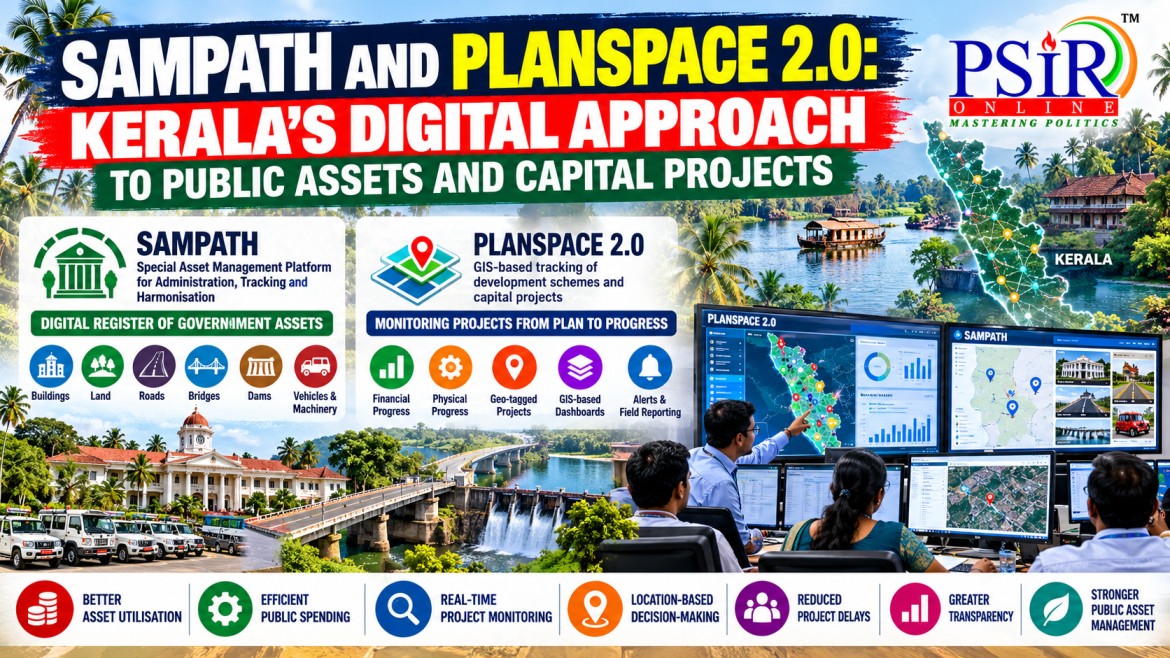
Governments manage extensive public assets, including land, buildings, roads, bridges, dams, vehicles and machinery. They also invest substantial public funds in infrastructure and development projects. However, fragmented records, incomplete asset inventories and delays in updating project information can make it difficult to assess whether public resources are being used effectively.
Kerala’s July 2026 Cabinet decision sought to address these challenges through two complementary digital initiatives: SAMPATH (Special Asset Management Platform for Administration, Tracking and Harmonisation) and an expanded PLANSPACE 2.0, with greater emphasis on the geographical tracking of government projects.
The initiatives focus on two related questions: what public assets does the government possess, and how are public investments progressing across the state? Their significance lies in the possibility of connecting asset information with development planning, expenditure monitoring and administrative accountability.
However, digital records and dashboards do not automatically improve governance. Their effectiveness depends on data accuracy, regular updating, departmental coordination and timely action on the problems they identify.
SAMPATH: CREATING A CONSOLIDATED PUBLIC ASSET REGISTER
SAMPATH was announced as a platform to develop a comprehensive picture of Kerala’s government assets. Its proposed coverage includes land, buildings, heritage buildings, roads, dams, bridges, vehicles and machinery.
When information about government assets is scattered across departments, officials may find it difficult to verify ownership, identify available facilities or determine maintenance requirements. A consolidated digital register could make this information easier to access and use in administrative decision-making.
Its potential applications include:
· Asset identification: creating structured records of public assets, their locations and relevant administrative details.
· Maintenance planning: identifying assets that require inspection, repair or replacement.
· Better utilisation: examining whether existing government buildings and facilities can meet service-delivery needs before new infrastructure is constructed.
· Interdepartmental coordination: enabling departments to access consistent information about assets under their responsibility.
· Budgetary planning: helping officials consider maintenance costs and existing infrastructure while assessing proposals for new expenditure.
For example, before constructing a new public office, the relevant department could examine whether an existing government building is available and suitable for the proposed purpose. Such information may help prevent unnecessary duplication, provided that the existing facility is technically appropriate and accessible.
The platform’s announcement and administrative approval should not, however, be confused with the completion of a statewide asset inventory. The actual benefits will depend on how comprehensively assets are recorded, how their details are verified and how frequently the database is updated.
PLANSPACE 2.0: MONITORING DEVELOPMENT SCHEMES AND CAPITAL PROJECTS
PLANSPACE 2.0 is an established initiative of the Kerala State Planning Board, developed in technical collaboration with Digital University Kerala. The original PLANSPACE system dates to the late 2000s, while version 2.0 was developed and implemented during the 2022–23 financial year.
The platform supports the monitoring of development schemes across departments and administrative levels. Its established features include financial and physical progress monitoring, project implementation calendars, dashboards, alerts, field-level reporting, geo-tagged project images and GIS-based spatial visualisation.
The system is designed to help officials examine implementation progress and identify issues requiring administrative attention. Its monitoring extends to local-body-level information and includes tools for examining scheme indicators and beneficiary-related details.
The July 2026 Cabinet decision proposed an expansion of the existing register of government capital projects, with a major emphasis on geotagging projects. The intention is to improve the geographical visibility of public investments and make project information more useful for monitoring and coordination.
Location-based information can help administrators identify where projects are being implemented, compare progress across areas and examine whether related infrastructure works require coordination. For instance, mapping road, drainage and water-supply projects may help officials identify sequencing requirements and avoid avoidable disruption.
However, a project’s location on a map does not establish that it is progressing on schedule, meeting technical standards or delivering the intended public benefit. Geographic information must be considered alongside verified expenditure, physical progress and field-level assessment.
HOW SAMPATH AND PLANSPACE 2.0 CAN WORK TOGETHER
The two initiatives address different but complementary dimensions of public resource management. SAMPATH focuses on the government’s existing asset base, while PLANSPACE 2.0 focuses on development schemes and their implementation.
|
Dimension |
SAMPATH |
PLAN SPACE 2.0 |
|
Main focus |
Government assets |
Development schemes and projects |
|
Key information |
Asset category, location and administrative details |
Project progress, expenditure, implementation and location |
|
Administrative use |
Maintenance, identification and utilisation of assets |
Monitoring, coordination and review of schemes |
|
Potential benefit |
Better-informed decisions about existing resources |
Better-informed decisions about ongoing and proposed investments |
If the platforms can exchange compatible and verified information, they could help administrators assess the relationship between existing assets and new capital expenditure. A department considering a new facility could examine the availability of suitable government property, while project-monitoring information could help officials review the progress of approved construction.
Such integration could also improve coordination between departments and local institutions. Nevertheless, this is a potential benefit, not proof that the two platforms are already fully integrated. Its realisation would require common data standards, compatible systems and clear responsibilities for maintaining accurate records.
PUBLIC FINANCIAL MANAGEMENT AND ACCOUNTABILITY
Public financial management involves more than allocating funds and recording expenditure. It also requires governments to examine whether spending produces completed infrastructure, functioning facilities and better public services.
SAMPATH could support decisions about asset maintenance and utilisation. PLANSPACE 2.0 could help officials monitor financial and physical progress and identify implementation issues. Together, these functions may strengthen the relationship between planning, budgeting and execution.
Their potential governance contributions include:
· More informed expenditure decisions: existing assets can be considered before new construction is approved.
· Earlier identification of delays: project schedules, progress updates and alerts can help officials identify implementation problems.
· Improved coordination: geographical information can help departments identify overlapping works and related infrastructure needs.
· Stronger budget reviews: expenditure can be assessed alongside physical achievements and project milestones.
· Greater public scrutiny: accessible project information can help citizens and other stakeholders examine implementation, subject to applicable access and security rules.
A critical distinction must be maintained between financial expenditure, physical completion and service outcomes. Spending a large proportion of the project budget does not necessarily mean that the project is complete. A completed building may remain underused if it lacks staff, equipment or operational funding. Similarly, an asset appearing in a digital register does not prove that it is being maintained or utilised effectively.
Therefore, digital monitoring must be complemented by field inspections, verification of project milestones, maintenance reviews and clear procedures for addressing delays and deficiencies.
IMPLEMENTATION CHALLENGES AND THE WAY FORWARD
The effectiveness of SAMPATH and the expanded PLANSPACE 2.0 will depend on the quality of the administrative systems supporting them.
First, data accuracy and verification are essential. Incomplete asset records, duplicate entries and outdated project information could weaken decision-making. Departments need clear procedures for verifying records and correcting errors.
Second, information must be updated regularly. Delayed reporting can make a dashboard appear comprehensive while failing to reflect actual conditions on the ground. Financial progress should be reconciled with physical achievements and relevant field evidence.
Third, digital alerts must lead to administrative action. Identifying a delayed project or underutilised building is only the first step. Officials must investigate the reasons, assign responsibility and take corrective measures within a reasonable timeframe.
Fourth, interoperability requires attention. Departments and local bodies should use compatible data standards and clearly defined procedures for entering, verifying and accessing information. Appropriate safeguards are also necessary for sensitive information.
Finally, the government should evaluate outcomes rather than merely count the number of assets or projects entered into a portal. Useful indicators could include the proportion of assets verified, the regularity of data updates, maintenance backlogs addressed, project delays resolved and improvements in the functionality of public infrastructure.
These measures would help distinguish the establishment of digital systems from demonstrable improvements in administrative performance.
UPSC ANGLES
|
Dimension |
Relevance for UPSC |
|
Governance and transparency |
Digital records can improve access to administrative information and strengthen oversight. |
|
Public financial management |
Connecting expenditure with physical progress supports more informed budget reviews and implementation monitoring. |
|
Administrative reforms |
Common information systems can reduce fragmented records and improve interdepartmental coordination. |
|
E-governance |
The initiatives illustrate the role of digital platforms, analytics and GIS in evidence-based administration. |
|
Cooperative and local governance |
Coordination between state departments and local institutions is essential for reliable project information. |
|
Infrastructure development |
Geographic mapping can help identify gaps, overlapping projects and opportunities for coordinated investment. |
|
Accountability |
Alerts and dashboards require clearly assigned responsibility and timely corrective action. |
|
Implementation challenges |
Data quality, interoperability, staff capacity and regular updating determine the practical usefulness of digital systems. |
|
Outcome evaluation |
Asset utilisation, project completion, service functionality and citizen benefits are more meaningful than portal creation alone. |
CONCLUSION
SAMPATH and the proposed expansion of PLANSPACE 2.0 represent Kerala’s effort to strengthen the digital management of public assets and development projects. A consolidated asset register could inform maintenance and utilisation decisions, while enhanced project mapping could improve the geographical visibility and monitoring of public investment.
Their effectiveness will depend on whether departments maintain accurate records, update information regularly and act on the problems identified through digital monitoring. The ultimate test is not the number of records uploaded or projects mapped, but whether public resources are used more effectively and infrastructure delivers the intended services.
The broader lesson for digital governance is that technology can make public resources more visible, but institutional accountability is necessary to turn that visibility into better administrative outcomes.
OFFICIAL REFERENCES AND FURTHER READING
GS2 MAINS PRACTICE QUESTIONS
10 marks | 150 words
15 marks | 250 words
