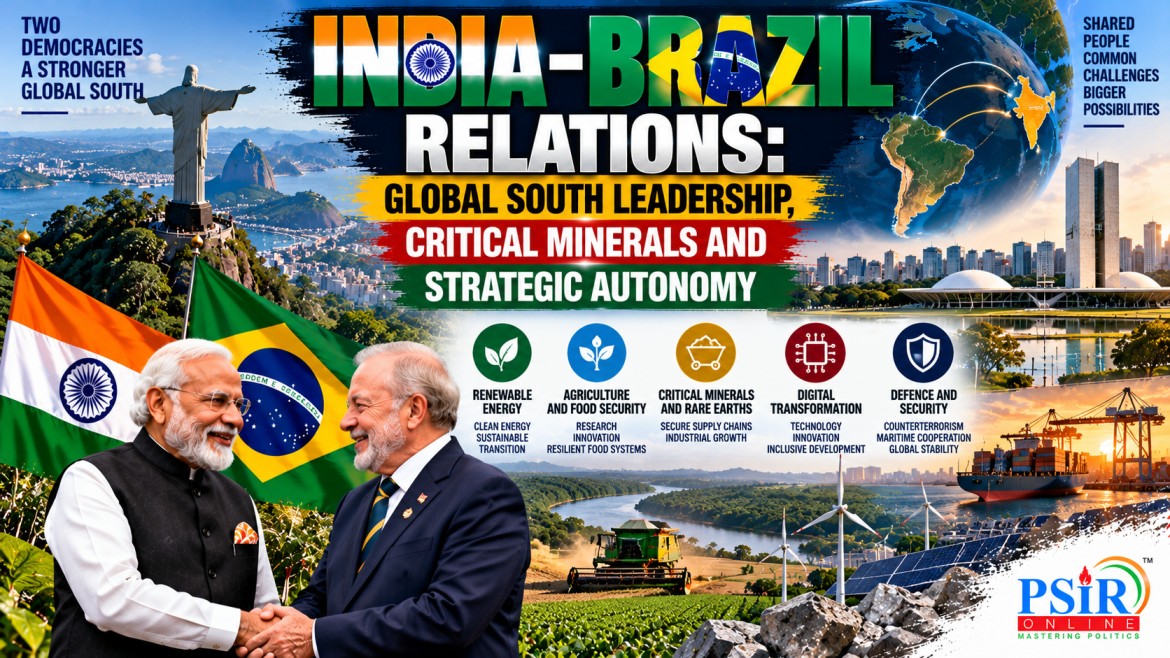
India and Brazil occupy influential positions among the major developing countries and share an interest in a more representative international order. Their bilateral relationship combines democratic institutions, continental scale, agricultural capabilities, industrial ambitions and participation in multilateral groupings such as BRICS, the G20 and the IBSA Dialogue Forum. Both countries have also supported reform of global governance institutions, particularly the United Nations Security Council.
The relationship received renewed momentum during Prime Minister Narendra Modi’s state visit to Brazil on 7–8 July 2025, when the two governments adopted a strategic roadmap covering defence and security, food security, energy transition, digital transformation and industrial partnerships. Six agreements and memoranda of understanding were signed, covering counterterrorism, renewable energy, agricultural research, digital solutions, intellectual property and the exchange and protection of classified information.
The partnership advanced further during Brazilian President Luiz Inácio Lula da Silva’s visit to India in February 2026. The two countries signed agreements on digital partnership and cooperation in rare earths and critical minerals, among other areas. These developments underline the importance of translating diplomatic convergence into industrial collaboration, resilient supply chains and practical cooperation.
The central question is whether India and Brazil can convert their shared Global South identity into sustained influence over international economic and political institutions. Their partnership offers significant opportunities, but its effectiveness will depend on the ability to reconcile national priorities, overcome commercial barriers and implement agreements beyond the summit level.
FROM DIPLOMATIC CONVERGENCE TO PRACTICAL COOPERATION
India and Brazil elevated their relationship to a Strategic Partnership in 2006. Since then, bilateral cooperation has expanded through political consultations, trade, investment, scientific exchanges and engagement in multilateral forums. The July 2025 state visit sought to give this relationship a more structured direction through a roadmap organised around five pillars: defence and security; food and nutritional security; energy transition and climate change; digital transformation and emerging technologies; and industrial partnerships in strategic sectors.
The agreements signed during the visit provided institutional foundations for cooperation. The memorandum on renewable energy strengthened the basis for engagement in clean-energy technologies, while the agricultural research agreement between the Indian Council of Agricultural Research and Brazil’s EMBRAPA created a framework for scientific collaboration. The digital cooperation memorandum focused on sharing successful large-scale digital solutions, and the security agreements addressed counterterrorism, transnational organised crime and the protection of classified information.
The February 2026 visit by President Lula to India further broadened the agenda. The two governments signed arrangements concerning digital partnership and rare earths and critical minerals, while expanding discussions on industrial cooperation, health, pharmaceuticals, agriculture and emerging technologies.
These developments demonstrate a shift from broad political declarations towards sector-specific institutional cooperation. However, the signing of an agreement does not by itself establish that projects have been implemented, investment has materialised or trade barriers have been removed. Their value will depend on operational mechanisms, financing, business participation and measurable outcomes.
The relationship also requires stronger commercial connectivity. Both governments have discussed expanding the India–MERCOSUR Preferential Trade Agreement and addressing non-tariff barriers. These measures could improve market access and diversify economic relations, although progress will depend on negotiations over the interests of domestic producers and the scope of trade liberalisation.
CRITICAL MINERALS, RARE EARTHS AND ECONOMIC SECURITY
Critical minerals have become central to industrial policy, energy transitions and strategic competition. Lithium, graphite, nickel, cobalt, copper and rare earth elements are important to different combinations of batteries, electric vehicles, electronics, renewable-energy equipment and defence technologies. Their strategic significance arises not only from geological availability but also from the concentration of processing, refining and manufacturing capabilities.
Brazil possesses substantial mineral resources, including rare earth-bearing deposits and other minerals relevant to industrial development. India, meanwhile, is seeking to diversify mineral supplies and strengthen its domestic capacity in exploration, processing, recycling and advanced manufacturing.
The critical-minerals and rare-earth cooperation advanced during President Lula’s February 2026 visit provides a basis for collaboration across the supply chain. Potential areas include geological research, mineral exploration, processing technologies, recycling, investment and industrial partnerships. These areas remain opportunities for implementation rather than proof that a complete bilateral supply chain has already been established.
The strategic value of the relationship lies in the possibility of reducing excessive dependence on concentrated international supply networks. Yet mineral security cannot be achieved simply by diversifying the countries from which raw materials are imported. Processing capacity, environmental standards, technology access, infrastructure, financing and long-term commercial contracts are equally important.
For India, cooperation with Brazil could support domestic manufacturing in batteries, electronics, renewable energy and other strategic industries. For Brazil, partnerships with Indian firms could expand investment, technical cooperation and opportunities for domestic value addition. Both countries would benefit from avoiding a model in which resource-rich economies export unprocessed minerals while higher-value manufacturing remains concentrated elsewhere.
There are also environmental and social challenges. Mining can generate land-use conflicts, biodiversity loss, water stress and concerns about the rights of local communities. Mineral cooperation must therefore incorporate environmental safeguards, responsible sourcing and transparent project governance.
Economic security requires resilient value chains, not merely access to resources. The long-term outcome will depend on whether India and Brazil can move from diplomatic agreements towards commercially viable projects that strengthen processing, manufacturing and technological capabilities in both countries.
RENEWABLE ENERGY, AGRICULTURE AND DIGITAL TRANSFORMATION
India–Brazil cooperation extends beyond mineral security into sectors that directly affect development, energy access and economic productivity.
Renewable energy and biofuels constitute an established area of complementarity. Both countries have experience in biofuel production and policies aimed at reducing dependence on conventional fossil fuels. Their participation in the Global Biofuels Alliance creates a multilateral platform for sharing practices and advancing sustainable bioenergy. Cooperation could extend to ethanol blending, sustainable aviation fuel, bioenergy research and the development of technologies that improve production efficiency.
However, biofuel strategies must account for land use, food security, water requirements and lifecycle emissions. The environmental benefits of a fuel depend on how it is produced and transported, not simply on its classification as renewable. Research partnerships and appropriate sustainability standards are therefore essential.
Agriculture provides another important area of cooperation. India and Brazil have extensive experience in tropical agriculture, livestock production, agricultural research and food processing. The ICAR–EMBRAPA agreement can support exchanges on crop productivity, climate-resilient agriculture, soil management, livestock systems and agricultural technology. Such cooperation could strengthen food security while improving productivity and resilience to climate-related disruptions.
Digital transformation offers a different but complementary opportunity. India’s experience with digital public infrastructure and Brazil’s own digital-governance initiatives create scope for exchanges involving digital identity, payments, public-service delivery, data systems and institutional capacity-building. Cooperation in artificial intelligence and emerging technologies could also support research and innovation.
Yet digital partnerships require attention to data protection, cybersecurity, interoperability, access and institutional capacity. Technologies developed in one country cannot always be transferred directly into another administrative or legal environment. Adaptation and joint development are necessary to ensure that digital cooperation produces practical benefits.
Across these sectors, the central objective should be technology collaboration that builds domestic capacity. Joint research, training, local production and knowledge exchange can generate more durable benefits than the simple transfer of finished products.
GLOBAL SOUTH LEADERSHIP AND THE REFORM OF GLOBAL GOVERNANCE
India and Brazil have repeatedly supported reform of international institutions to reflect contemporary geopolitical and economic realities. Their cooperation is particularly visible in BRICS, the G20 and the IBSA Dialogue Forum, where they have raised concerns about representation, development finance, climate justice and the distribution of decision-making power.
Their demand for reform of the United Nations Security Council reflects a shared criticism of the gap between the current institutional structure and the changing distribution of global power. Both countries have sought a greater role in international decision-making, including through their support for a more representative Council.
Economic governance is equally important. Developing countries face constraints relating to access to affordable finance, technology, industrial capabilities and stable supply chains. India and Brazil can coordinate positions on these concerns in multilateral forums and advocate reforms that better accommodate development priorities.
Climate diplomacy offers a further area of convergence. Both countries have emphasised sustainable development, access to finance and technology, and the need to recognise differing national circumstances. Their cooperation in biofuels and renewable energy provides a practical foundation for these positions.
Nevertheless, the Global South is not a unified political bloc. Developing countries differ in their economic structures, geopolitical alignments, regional interests and preferred approaches to international institutions. Agreement on the need for reform does not necessarily produce agreement on the specific institutional arrangements required.
India and Brazil must therefore demonstrate that their partnership can produce outcomes beyond common statements. Coordinated proposals, joint initiatives, technical cooperation and sustained negotiation would provide a stronger basis for influence than diplomatic solidarity alone.
Their ability to shape global governance will depend on the extent to which they can build coalitions with other developing countries while negotiating workable compromises with established powers. The objective is not simply to challenge existing institutions, but to make them more representative, effective and responsive to contemporary global challenges.
STRATEGIC AUTONOMY, ECONOMIC CONSTRAINTS AND THE LIMITS OF PARTNERSHIP
India and Brazil share an interest in preserving foreign-policy independence and avoiding excessive dependence on a single major power. Their engagement with BRICS, the G20 and other international groupings provides opportunities to diversify diplomatic and economic relationships.
This does not mean that their strategic preferences are identical. India’s security environment is shaped by its continental borders, maritime interests and relationships with major powers in the Indo-Pacific. Brazil’s priorities are more directly connected to South American regional dynamics, the Atlantic, agricultural exports and its relationships with other Latin American countries. These differences influence how the two countries approach international crises and strategic partnerships.
Economic cooperation also faces practical constraints. Geographic distance increases transport costs, while differences in regulations, customs procedures and market requirements can complicate trade. The existing preferential trade arrangement between India and MERCOSUR has a narrower scope than a comprehensive free-trade agreement, limiting the extent of tariff liberalisation.
Investment decisions are shaped by infrastructure, market access, regulatory predictability and commercial returns. Political support can facilitate cooperation, but it cannot substitute for competitive projects, clear rules and sustained private-sector participation.
There are also differences in industrial capacity and technological specialisation. Both countries may seek to protect domestic industries while simultaneously pursuing deeper cooperation. These competing priorities can complicate negotiations over market access, intellectual property and the distribution of value in joint projects.
The challenge is therefore to build strategic autonomy through diversified and mutually beneficial partnerships, rather than treating autonomy as economic separation. India and Brazil can increase their freedom of action by broadening their options, but the durability of their relationship will depend on the practical value it generates for both economies.
THE WAY FORWARD: CONVERTING SHARED INTERESTS INTO OUTCOMES
India and Brazil need an implementation-oriented approach that connects diplomatic agreements with measurable economic and institutional results.
First, the two governments should establish clear timelines and review mechanisms for the agreements on critical minerals, digital cooperation, renewable energy and agricultural research. Regular monitoring by relevant ministries and joint commissions would help identify implementation delays and resolve regulatory obstacles.
Second, critical-mineral cooperation should extend across exploration, processing, recycling and manufacturing. Joint ventures, research partnerships and long-term commercial arrangements could help create value within both economies. Environmental standards and community safeguards should be incorporated from the beginning of project development.
Third, trade facilitation should remain a priority. Progress towards expanding the India–MERCOSUR Preferential Trade Agreement, addressing non-tariff barriers and improving customs cooperation could strengthen commercial links. Greater business-to-business engagement would help identify practical constraints that diplomatic consultations alone may not resolve.
Fourth, renewable-energy and agricultural partnerships should focus on technology adaptation, joint research and skills development. Cooperation in biofuels, sustainable aviation fuel, climate-resilient crops and agricultural productivity could generate benefits for energy security, food security and environmental sustainability.
Fifth, digital cooperation should combine technological exchange with institutional safeguards. Joint projects in digital public infrastructure, artificial intelligence and public-service delivery should be designed around interoperability, cybersecurity, privacy and local capacity-building.
Finally, India and Brazil should coordinate more consistently in multilateral institutions while acknowledging differences in their national interests. Joint initiatives on Security Council reform, development finance, climate cooperation and digital governance would give greater substance to their shared Global South agenda.
The partnership will be more consequential when its political declarations produce measurable gains in trade, technology, industrial capacity and international cooperation.
THEORETICAL ANGLES
|
Theory or concept |
Application to India–Brazil relations |
|
South–South cooperation |
The partnership connects two major developing countries through technical exchange, development cooperation and efforts to strengthen their influence in international institutions. |
|
Multipolarity |
India and Brazil seek a more distributed international order in which emerging powers and developing regions exercise greater influence over global decisions. |
|
Strategic autonomy |
Cooperation diversifies diplomatic and economic relationships, helping both countries preserve independent decision-making amid major-power competition. |
|
Dependency theory |
Critical-mineral cooperation raises questions about whether developing countries can move beyond raw-material exports towards processing, manufacturing and higher-value production. |
|
Liberal institutionalism |
Bilateral agreements, joint commissions, BRICS, the G20 and the IBSA Dialogue Forum provide mechanisms for coordinating interests and sustaining cooperation. |
|
Economic statecraft |
Trade, critical minerals, digital infrastructure and renewable-energy partnerships are instruments for strengthening economic resilience and international influence. |
|
Constructivism |
Shared identities as developing democracies and advocates of a more representative global order help shape diplomatic priorities and cooperation. |
|
Global governance |
Their support for Security Council reform, development finance and climate cooperation reflects attempts to reshape institutions and rules governing international affairs. |
CONCLUSION
India–Brazil relations illustrate the possibilities and limitations of cooperation between major developing countries seeking greater influence in international affairs. The July 2025 state visit established a strategic roadmap and a series of agreements across security, agriculture, renewable energy, digital transformation and industrial cooperation. President Lula’s February 2026 visit to India subsequently advanced cooperation on digital partnership and critical minerals.
These developments create opportunities to strengthen supply chains, expand technological capabilities and coordinate positions on global governance. However, shared Global South identity cannot by itself overcome commercial barriers, differences in national priorities or the difficulties of implementing bilateral agreements.
The long-term significance of the partnership will depend on whether it generates practical economic and institutional outcomes. India and Brazil can strengthen their influence in a multipolar world when diplomatic solidarity is supported by productive cooperation, diversified economic relationships and sustained engagement with global institutions.
RELATED READING
PRACTISE QUESTIONS FOR GS2 MAINS
PRACTISE QUESTIONS FOR PSIR
