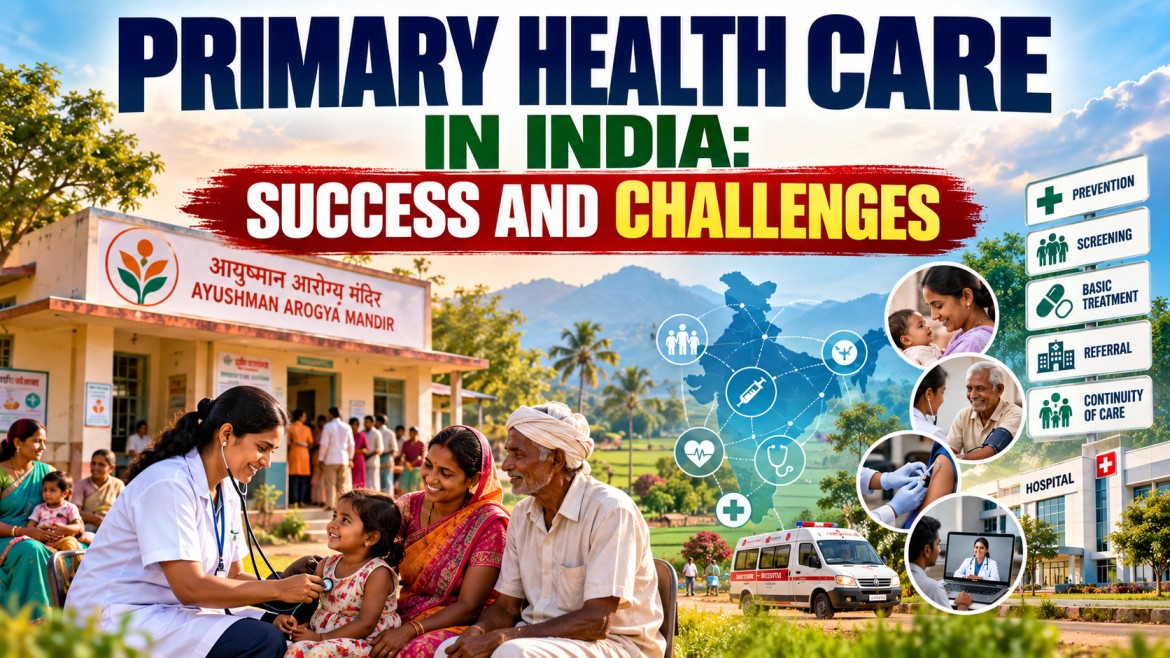
INTRODUCTION: WHY PRIMARY HEALTH CARE MATTERS
Primary health care is not simply about having a small clinic in every village. It is the first and most accessible layer of the health system, bringing health promotion, disease prevention, diagnosis, treatment, rehabilitation and palliative care as close as possible to where people live. The idea goes back to the 1978 Alma-Ata Declaration, which described primary health care as the first level of contact between individuals, families and the health system. WHO today similarly views primary health care as the foundation of Universal Health Coverage (UHC).
A strong primary-care system performs five basic functions: first contact, accessibility, continuity, comprehensiveness and coordination. A person should be able to approach the system close to home, receive basic preventive and curative care, have their health needs followed over time, and be referred to a higher facility only when specialist or hospital care is actually required.
In India, this principle is reflected in a tiered public-health structure. At the community level are Sub-Health Centres/Ayushman Arogya Mandirs, followed by Primary Health Centres (PHCs) and Community Health Centres (CHCs) as referral facilities, with district hospitals and medical colleges providing higher levels of care. Government standards such as the Indian Public Health Standards (IPHS) prescribe benchmarks for infrastructure, equipment, staffing and services.
The effectiveness of this structure ultimately depends on four things coming together:
A facility that is accessible + health workers who are available + medicines and diagnostics that are functional + a referral system that actually works.
If any one of these is missing, patients tend to bypass primary care and approach district hospitals or private facilities directly.
INDIA'S PRIMARY HEALTH-CARE ARCHITECTURE
|
Level |
Broad role |
|
Ayushman Arogya Mandir / Sub-Health Centre |
First community-level contact; preventive, promotive and basic curative care |
|
Primary Health Centre (PHC) |
Medical officer-led primary care and referral support |
|
Community Health Centre (CHC) |
First major referral level with inpatient and specialist services |
|
District Hospital |
Secondary-level hospital care |
|
Medical College / Tertiary Hospital |
Advanced specialist and super-specialist care |
This structure is increasingly being redesigned around continuity of care rather than isolated facilities. The objective is that a patient should move upward through the system when necessary and return to the primary-care level for follow-up and long-term management.
HOW IS THE CENTRAL GOVERNMENT STRENGTHENING PRIMARY HEALTH CARE?
The Union Government's approach has increasingly moved from a narrow focus on maternal and child health towards Comprehensive Primary Health Care (CPHC).
The major institutional vehicle is Ayushman Bharat, launched in 2018. Its primary-care component originally created Health and Wellness Centres, now renamed Ayushman Arogya Mandirs (AAMs), by upgrading existing Sub-Health Centres and PHCs. The objective is to provide a broader package of services closer to the community rather than limiting primary care to maternal and child health and communicable diseases.
The AAM model covers 12 broad service packages, including:
· maternal and reproductive health;
· neonatal, infant, child and adolescent care;
· family planning;
· communicable diseases;
· general outpatient care;
· screening and management of NCDs;
· oral health;
· eye and ENT care;
· elderly and palliative care;
· emergency care; and
· basic mental-health services.
The scale-up has been substantial. The official AAM dashboard recorded 1,87,191 functional Ayushman Arogya Mandirs as of 3 October 2026, including 1,34,858 Sub-Health Centre AAMs and 24,513 PHC AAMs.
The second major pillar is the National Health Mission (NHM). Because health is primarily a State subject, the Centre does not directly run the entire primary-care network. Instead, it provides financial and technical support to States through NHM, establishes standards and national programmes, and supports infrastructure, human resources, medicines, diagnostics and health-system strengthening.
Technology has become another important layer. eSanjeevani teleconsultation allows frontline facilities to connect patients with doctors remotely, potentially reducing the disadvantage faced by facilities that cannot maintain every specialist locally. The broader digital architecture under Ayushman Bharat Digital Mission (ABDM) is intended to facilitate interoperable health records and continuity of care.
Above primary care sits PM-JAY, but it is important not to confuse the two. PM-JAY is primarily a secondary and tertiary hospitalisation financing mechanism, whereas AAMs constitute the primary-care component of Ayushman Bharat. The two are intended to work as a continuum rather than as substitutes.

WHICH STATES ARE PERFORMING BETTER?
For a state comparison, the most recent NITI Aayog SDG India Index 2023–24 – Goal 3: Good Health and Well-being provides a useful benchmark.
However, students should remember that this is not a direct ranking of PHCs or AAMs. It measures broader health outcomes including maternal and child health, immunisation and institutional deliveries.
Top-performing states – SDG Goal 3
|
Rank position |
State |
Goal 3 Score |
|
1 |
Gujarat |
90 |
|
2 |
Maharashtra |
84 |
|
3 |
Uttarakhand |
84 |
|
4 |
Himachal Pradesh |
83 |
|
5 |
Karnataka |
80 |
|
5 |
Kerala |
80 |
There is therefore a tie at fifth position, meaning the top five rank positions contain six states.
These states illustrate different pathways to better health outcomes. Kerala has historically combined strong public-health institutions with high social development. Himachal Pradesh and Uttarakhand demonstrate that difficult geography does not automatically prevent better health outcomes, although their smaller populations create a different administrative context. Gujarat, Maharashtra and Karnataka have relatively large and diversified health systems.
Importantly, Tamil Nadu scores 77, placing it below this top cluster but above several states in the national Goal 3 ranking.
The older NITI Aayog Health Index Round IV (2019–20) provides another useful, though now dated, perspective. Among larger states, Kerala ranked first with 82.20, followed by Tamil Nadu with 72.42. Since the Health Index has not been updated beyond Round IV, it should not be presented as a current 2026 ranking.
WHERE DOES PRIMARY HEALTH CARE STRUGGLE?
The bottom of the NITI Aayog SDG Goal 3 table presents a very different picture:
|
Rank from bottom |
State |
Goal 3 Score |
|
1 |
Madhya Pradesh |
56 |
|
1 |
Chhattisgarh |
56 |
|
3 |
Assam |
60 |
|
4 |
Uttar Pradesh |
61 |
|
5 |
Nagaland |
63 |
The important point is that low health outcomes cannot be explained simply by the number of buildings. Primary-care performance depends on whether facilities have the required staff, medicines, diagnostics, referral links and community-level engagement.
This is where India's biggest challenge lies. The government has expanded the physical network considerably, but infrastructure alone does not guarantee functioning primary care. The official IPHS framework itself recognises the importance of minimum standards for infrastructure, equipment and human resources.
There are also substantial geographical differences. Remote and tribal areas face longer travel distances, difficulties in retaining health professionals and weaker referral connectivity. Urban areas face a different problem: overcrowded public facilities, fragmented private care and uneven access for low-income populations.
CHALLENGES IN PRIMARY HEALTH CARE IN INDIA
India has significantly expanded the institutional architecture of primary health care, particularly through Ayushman Arogya Mandirs, NHM and comprehensive primary health-care services. However, the major challenge is no longer simply creating facilities; it is ensuring that these facilities are adequately staffed, properly equipped, regularly supplied and trusted by communities. WHO identifies workforce availability, geographical access, infrastructure and continuity of care as continuing challenges in underserved areas.
|
Challenge |
Why it matters / Critical analysis |
|
1. Human-resource shortages |
A primary-health facility cannot function merely because a building exists. Shortages and uneven distribution of doctors, nurses, specialists and other health workers remain major constraints. Rural Health Statistics recorded substantial specialist shortfalls at rural CHCs; for example, as of March 2022, Bihar had 754 specialist posts short of the requirement, while Chhattisgarh had a shortfall of 602. |
|
2. Unequal distribution of health workers |
India has expanded its health workforce, including more than 120,000 Community Health Officers, but availability is highly uneven geographically. Remote, tribal and difficult-to-reach areas find it harder to attract and retain professionals. WHO's recent India assessment continues to identify inadequate workforce availability and geographical remoteness as barriers to effective service delivery. |
|
3. Infrastructure does not always mean functionality |
A centre may have a building but lack adequate equipment, electricity, diagnostics, water, staff or medicines. The challenge is therefore shifting from “number of facilities” to “functional facilities.” WHO's work on Indian primary care specifically highlights the need to improve infrastructure alongside drugs, diagnostics and health-worker capacity. |
|
4. Availability of essential medicines and diagnostics |
If patients are forced to purchase basic medicines or diagnostic tests privately, the purpose of accessible primary care is weakened. Ensuring an uninterrupted supply chain is particularly difficult in remote areas. Access to essential medicines, vaccines and diagnostics remains a recognised requirement for strengthening primary health care. |
|
5. High dependence on private health care |
Weaknesses in public primary care can push patients towards private providers. Earlier NITI Aayog analysis noted that the private sector accounted for a large share of outpatient and hospital care, while private treatment can impose significant out-of-pocket expenditure. |
|
6. Out-of-pocket expenditure remains a concern |
Primary care is supposed to provide affordable first-contact care. When patients have to pay for medicines, diagnostics or private consultations, even a relatively minor illness can become financially burdensome. Thus, financial protection must begin at the primary-care level, not only when hospitalisation occurs. |
|
7. Referral system remains uneven |
Primary care works only when there is a functioning link between the village-level facility, PHC, CHC and district hospital. Weak ambulance services, unavailable specialists or poor communication can turn referral into a one-way movement towards overcrowded hospitals rather than a coordinated continuum of care. WHO emphasises integrated services and effective referral and follow-up as essential components of primary care. |
|
8. Rural–urban and geographical inequality |
A uniform national framework operates across very different geographical realities. Himalayan, tribal, island and remote regions face greater transport and workforce challenges than densely populated urban areas. WHO specifically identifies geographical remoteness as a continuing obstacle to equitable access in India. |
|
9. Urban primary health care is a distinct challenge |
India's primary-care architecture historically developed around rural areas, while rapid urbanisation has created large populations living in informal settlements and migrant communities. Urban poor populations may face fragmented access between public facilities, private clinics and charitable providers. NITI Aayog has previously noted the need for a more coherent primary-care model for India's growing urban population. |
|
10. Rising burden of Non-Communicable Diseases (NCDs) |
Primary care must now manage hypertension, diabetes, cancers, cardiovascular disease and other chronic conditions in addition to traditional maternal-child and infectious-disease priorities. This requires continuous screening and long-term follow-up, not one-time treatment. AAMs have expanded into NCD screening, but workforce, diagnostics and continuity remain critical. |
|
11. Mental health remains under-integrated |
Mental health is increasingly recognised within comprehensive primary care, but frontline facilities require trained personnel, referral pathways and appropriate treatment support. Without these, screening may identify a problem without providing meaningful follow-up care. |
|
12. Digital divide |
Teleconsultation and digital health records can connect remote patients to specialists, but digital systems depend on connectivity, devices, digital literacy and reliable data. Technology should therefore supplement—not replace—physical primary care and trained health workers. |
|
13. Quality of care varies between states |
Health is primarily implemented by States, so administrative capacity, financing, workforce management and governance produce substantial interstate variation. NITI Aayog's Health Index itself was designed to encourage states to improve outcomes and learn from better-performing states. |
|
14. Community participation is still inadequate |
Primary health care is not simply a government supply system. Community awareness, participation and trust are essential for vaccination, screening, maternal health, sanitation and early treatment. NITI Aayog has previously identified the limited transformation of health into a genuine community movement as a weakness. |
|
15. Prevention remains weaker than treatment-seeking |
India's health system has traditionally been more visible when people become ill than when it prevents illness. A stronger primary-care model requires systematic screening, health education, nutrition, sanitation, lifestyle interventions and early detection. WHO defines primary health care as encompassing promotive, preventive, curative, rehabilitative and palliative care, not merely treatment. |
|
16. Financing remains a structural issue |
Primary care requires sustained expenditure on personnel, medicines, diagnostics, infrastructure and maintenance. A facility that receives capital investment but lacks recurring funds may become underutilised. NITI Aayog has historically identified inadequate public spending as a constraint on primary-care quality. |
|
17. Continuity of care is difficult |
Chronic diseases require repeated consultations, monitoring and adherence. If a patient moves between AAM, PHC, private clinic and hospital without interoperable records or coordinated follow-up, the system becomes fragmented. This is precisely why India's digital-health and referral architecture is increasingly important. |
|
18. Accountability and data quality |
Measuring the number of centres opened or consultations conducted is easier than measuring whether patients actually received appropriate treatment and achieved better health outcomes. The policy challenge is therefore to move from input/output monitoring towards quality and outcome-based monitoring. NITI Aayog's Health Index was explicitly designed to shift attention towards health outcomes. |
WAY FORWARD
India's next phase of primary health-care reform should move from expanding infrastructure to improving functionality, quality and equity. The objective should be to ensure that an Ayushman Arogya Mandir is not merely available on paper, but is a reliable first point of care.
· Strengthen the health workforce: Fill vacant positions, improve rural postings and provide incentives for doctors, nurses, specialists and community health workers to serve in difficult and remote areas.
· Make every Arogya Mandir functional: Ensure regular availability of essential medicines, diagnostics, electricity, water, equipment and basic emergency services.
· Focus on comprehensive primary care: Strengthen screening and long-term management of NCDs, mental health, elderly care and palliative care, alongside maternal and child health.
· Build stronger referral systems: Develop seamless referral and counter-referral mechanisms between Arogya Mandirs, PHCs, CHCs and district hospitals, supported by reliable ambulance services.
· Use digital health as an enabler: Expand eSanjeevani and ABDM while ensuring that digital systems complement rather than replace physical health workers and facilities.
· Reduce out-of-pocket expenditure: Ensure that essential medicines and diagnostics are available free or at affordable cost at the primary-care level.
· Address geographical inequality: Give greater financial and human-resource support to tribal, hilly, remote and underserved districts.
· Strengthen urban primary health care: Develop dedicated models for slums, migrants and other vulnerable urban populations.
· Promote preventive health: Shift from a predominantly treatment-oriented approach towards screening, health education, nutrition, sanitation and early intervention.
· Strengthen community participation: Empower local communities, ASHAs, Panchayati Raj Institutions and Village Health, Sanitation and Nutrition Committees to participate in planning and monitoring.
· Measure functionality, not merely infrastructure: Future monitoring should ask not only “How many AAMs exist?” but also “How many are adequately staffed, stocked and providing quality care?”
· Increase state-level accountability: Since implementation is largely state-driven, states should be encouraged to set measurable targets for staffing, service availability, quality and health outcomes.
CONCLUSION
India has moved considerably closer to the Alma-Ata vision of accessible primary health care through the expansion of Ayushman Arogya Mandirs, NHM, telemedicine and the broader Ayushman Bharat architecture. The emphasis has also shifted from a narrow focus on maternal and child health towards comprehensive care across the life cycle.
Yet, the success of primary health care ultimately depends on what happens inside the facility, not simply on how many facilities are officially reported. A centre without adequate staff, medicines, diagnostics or referral connectivity cannot become an effective first point of contact.
The real challenge for India is therefore to move:
From access to functionality,
from infrastructure to quality,
from treatment to prevention, and
from fragmented services to continuity of care.
A strong primary-care system is ultimately the foundation of Universal Health Coverage and social justice. When quality health care is available close to where people live, it reduces both avoidable illness and avoidable financial hardship, making health not merely a medical outcome but a foundation of human development and equality.
RELATED READING
For comprehensive UPSC preparation, students should connect Primary Health Care in India with the following areas:
· Universal Health Coverage (UHC) – Accessibility, affordability and quality of health services.
· Alma-Ata Declaration & Astana Declaration – Primary health care as the foundation of universal health coverage.
· Ayushman Bharat – Ayushman Arogya Mandirs, PM-JAY and the continuum of care.
· National Health Mission (NHM) – Public health infrastructure, human resources and state-level implementation.
· National Health Policy, 2017 – Universal access, preventive care and strengthening public health systems.
· Indian Public Health Standards (IPHS) – Norms for infrastructure, staffing, equipment and services.
· Digital Health – Ayushman Bharat Digital Mission (ABDM), ABHA and eSanjeevani.
· Health Financing – Public expenditure on health and out-of-pocket expenditure.
· Non-Communicable Diseases – The growing burden of diabetes, hypertension, cardiovascular diseases and cancer.
· Social Determinants of Health – Poverty, nutrition, sanitation, education, gender and geographical inequalities.
· SDG 3 – Good Health and Well-being – India's progress towards universal health coverage and health-related targets.
· Centre–State Relations – Health as primarily a State subject and the role of the Centre through NHM and centrally supported programmes.
GS PAPER II – MAINS PRACTICE QUESTIONS
1. “The success of primary health care depends not merely on the availability of health facilities, but on their functionality.” Examine the major challenges facing primary health care in India.
(15 Marks, 250 Words)
2. Ayushman Arogya Mandirs represent a shift from selective health interventions towards comprehensive primary health care. Discuss.
(10 Marks, 150 Words)
3. “India's pursuit of Universal Health Coverage requires strengthening primary health care rather than relying predominantly on hospital-centric healthcare.” Analyse.
(15 Marks, 250 Words)
4. Health is primarily a State subject, yet achieving equitable primary health care requires strong Centre–State coordination. Discuss the role of the National Health Mission and Ayushman Bharat in this regard.
(15 Marks, 250 Words)
