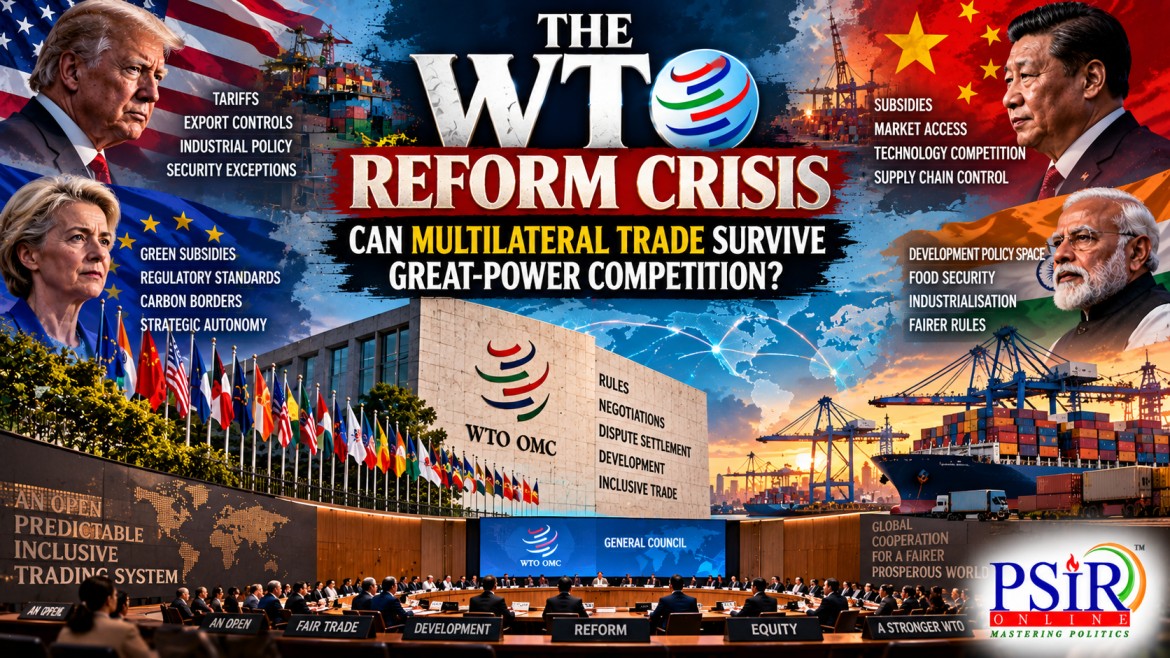
The World Trade Organization (WTO) was established in 1995 to provide a rules-based framework for international trade. Its principles of non-discrimination, transparency, negotiated commitments and dispute settlement were intended to make trade relations more predictable and reduce the risk of unilateral economic coercion.
Today, however, the multilateral trading system faces growing pressure. Major economies increasingly use tariffs, subsidies, export controls, industrial policy and national-security restrictions to pursue strategic objectives. Meanwhile, the WTO’s dispute settlement system remains impaired, and members disagree over how to reform the institution without weakening its negotiating and development functions.
The crisis was visible in the WTO’s 14th Ministerial Conference (MC14), held in Yaoundé, Cameroon, in March 2026, and the General Council discussions of 14–15 July. WTO Director-General Ngozi Okonjo-Iweala called for simultaneous progress on institutional reform and unresolved negotiations. The reform agenda included foundational issues, decision-making, development and the level playing field. Members continued to disagree over issues including electronic commerce and dispute settlement.
For developing countries, the challenge is especially important. They need predictable access to international markets, but also sufficient policy space to support industrialisation, employment, food security and technological development.
The central question is whether multilateral trade rules can remain credible when the most powerful economies increasingly contest how those rules should apply to them.
WHY THE WTO IS FACING A REFORM CRISIS
The WTO rests on several principles. Most-favoured-nation treatment generally requires a member to extend a trade advantage to other WTO members, subject to recognised exceptions. National treatment limits discrimination against imported goods once they enter the domestic market. Members also negotiate tariff commitments and rules governing subsidies, safeguards and other trade measures.
The institution nevertheless faces three connected challenges.
First, dispute settlement has weakened. The WTO Appellate Body has been unable to hear appeals since December 2019 because vacancies have not been filled. Members can still bring disputes and establish panels, but the absence of a functioning appellate mechanism has reduced the certainty and finality of the process.
Second, the negotiating system struggles to achieve consensus. Members differ over agriculture, fisheries subsidies, digital trade, special and differential treatment, industrial subsidies and the relationship between multilateral and plurilateral agreements.
Third, strategic competition has increasingly shaped trade policy. Governments are using economic measures not only to regulate commerce but also to protect critical industries, reduce strategic dependencies and respond to perceived security threats.
The WTO reform process therefore concerns more than administrative adjustments. It asks how a system built around negotiated rules can respond to economic and technological change without becoming either ineffective or dominated by the preferences of its most powerful members.
GREAT POWERS AND MAJOR ECONOMIES: WHEN TRADE RULES ARE CONTESTED
The WTO crisis becomes clearer when examined through specific disputes. Major economies have challenged one another’s measures, while WTO panels have found certain policies inconsistent with particular obligations. The legal status of each dispute matters: a panel finding, an allegation by a complainant and an unresolved dispute are not the same thing.
|
Major economy |
Measure challenged or found inconsistent with WTO rules |
|
United States |
In the Section 232 steel and aluminium dispute (DS544), a WTO panel found that the duties exceeded the US bound tariff rates and that exemptions for certain countries were inconsistent with most-favoured-nation treatment. The United States invoked national-security grounds and contested the panel’s approach. |
|
China |
In the domestic agricultural support dispute (DS511), the United States challenged China’s support for wheat and rice producers. The WTO panel found that China’s support for certain products exceeded its commitment limits under the Agreement on Agriculture. |
|
European Union and member states |
In the Airbus dispute (DS316), WTO findings addressed subsidies provided by the EU and several member states that caused adverse effects to US interests. The separate Boeing dispute (DS353) also produced findings against certain US subsidies, illustrating that subsidy disputes have involved both sides of the transatlantic aircraft rivalry. |
|
India |
In the export-subsidy dispute (DS541), a WTO panel found several Indian export-promotion schemes inconsistent with subsidy rules. India appealed, and India and the United States later reached a mutually agreed solution in 2023, terminating the dispute. |
Sources: WTO dispute summaries DS544, DS511, DS316, DS353 and DS541.
These cases reveal a central contradiction. Major economies rely on the WTO when challenging other countries’ policies, but they may also defend measures that partners consider inconsistent with agreed rules. The legal and economic details differ across cases, and no single dispute establishes that a country disregards the entire trading system.
The United States has questioned the scope and functioning of WTO dispute settlement, particularly its interpretation of agreements and the treatment of national-security measures. China faces disputes concerning agricultural support, industrial policies and market access. The EU has defended trade remedies and industrial measures while also challenging subsidies elsewhere. India has defended policy measures intended to promote domestic manufacturing while facing disputes over their compatibility with WTO commitments.
The issue is not that every protective measure is automatically illegal. WTO agreements contain exceptions, permitted trade remedies and negotiated policy flexibilities. The concern is that recurring unilateral action, unresolved disputes and inconsistent acceptance of adjudication can weaken confidence in the system as a whole.
THE DISPUTE SETTLEMENT CRISIS AND THE RETURN OF UNILATERALISM
The WTO’s dispute settlement mechanism was designed to provide a structured alternative to retaliation and power-based bargaining. Members can request consultations, seek panel adjudication and, where the system functions fully, obtain appellate review of legal questions.
The Appellate Body’s prolonged paralysis has weakened this arrangement. A member dissatisfied with a panel report may appeal into an institution that cannot currently hear the appeal, complicating the adoption and final resolution of some disputes. Some members have developed alternative arrangements, including the Multi-Party Interim Appeal Arbitration Arrangement, but participation is not universal.
This creates a serious asymmetry. Economically powerful countries can sometimes absorb the costs of prolonged trade conflict more easily than smaller economies that depend on a narrow range of export markets. Without dependable adjudication, the practical influence of market size and bargaining power can increase.
Unilateral tariffs may also trigger countermeasures and negotiations outside the WTO. Such measures can be defended by governments as responses to security concerns, unfair competition or domestic economic pressures. However, when they become a substitute for agreed procedures, the predictability of international trade declines.
The reform challenge is to restore a dispute settlement system that members regard as legitimate, timely and consistent with negotiated agreements. This requires addressing concerns raised by members while ensuring that dispute settlement remains a meaningful constraint on arbitrary trade restrictions.
DEVELOPING COUNTRIES, SPECIAL TREATMENT AND POLICY SPACE
Developing countries face a different set of constraints from advanced industrial economies. Their governments may need to support new industries, improve infrastructure, protect food security, develop technological capabilities and create employment. At the same time, WTO agreements impose obligations concerning tariffs, subsidies, intellectual property and non-discrimination.
The principle of special and differential treatment (S&DT) recognises that developing and least-developed members may require longer implementation periods, technical assistance and other forms of flexibility. However, members disagree over the scope and application of these provisions, including whether flexibilities should be differentiated according to economic circumstances and development needs.
The policy-space debate is particularly visible in industrial policy. Governments increasingly support semiconductors, renewable energy, electric vehicles, batteries and other strategic industries. Developing countries argue that rules must not prevent them from building productive capacity, while trading partners raise concerns about discriminatory subsidies, excess capacity and distortions to competition.
Agriculture is another sensitive area. Developing countries seek protection for food security, rural livelihoods and vulnerable farmers, while other members demand reductions in trade-distorting support and greater market access.
The July 2026 General Council meeting adopted decisions benefiting developing and least-developed members, including steps concerning discussions on TRIPS implementation and the launch of the third phase of the Enhanced Integrated Framework. At the same time, the meeting highlighted unresolved differences over electronic commerce and dispute settlement.
For India, these issues are directly relevant to food security, public stockholding, support for farmers, domestic manufacturing and access to technology. India’s approach has emphasised that trade liberalisation must accommodate development priorities and that the WTO should not undermine the ability of developing countries to pursue legitimate public-policy objectives.
The challenge is to distinguish legitimate development measures from policies that discriminate against foreign products or breach agreed commitments. A credible WTO must address both concerns rather than assuming that all industrial policy is protectionism or that all measures justified by development objectives are automatically permissible.
PLURILATERAL AGREEMENTS, DIGITAL TRADE AND THE FUTURE OF CONSENSUS
The WTO’s traditional approach to major decisions relies heavily on consensus. This gives members, including smaller and developing countries, a voice in negotiations. However, consensus can also make it difficult to conclude agreements when interests diverge sharply.
One proposed response is to allow groups of willing members to negotiate plurilateral agreements on particular issues. Supporters argue that this could enable progress in areas such as digital trade, investment facilitation and emerging technologies without requiring every member to participate from the beginning.
Critics worry that plurilateral agreements could fragment the multilateral system, create pressure on developing countries to accept rules they did not negotiate and shift rule-making towards coalitions with greater bargaining power.
Electronic commerce illustrates the disagreement. Members differ over the future of the WTO moratorium on customs duties on electronic transmissions, the wider digital-trade agenda and the balance between predictable cross-border commerce and domestic regulatory autonomy. The July 2026 General Council discussions did not resolve the key differences over the work programme and moratorium.
A sustainable reform model should therefore combine flexibility with inclusiveness. Plurilateral initiatives may be useful when they remain transparent, allow meaningful participation and do not undermine the rights of non-participating members. At the same time, core multilateral rules require broad legitimacy.
The objective should not be consensus at any cost, nor faster rule-making at the expense of inclusion, but a workable balance between participation and progress.
A PRACTICAL AGENDA FOR WTO REFORM
WTO reform requires a coordinated approach to institutional legitimacy, dispute settlement, development and contemporary trade challenges.
First, restore credible dispute settlement. Members need a mechanism that provides timely and authoritative resolution of disputes, while addressing concerns about judicial overreach and the interpretation of negotiated obligations.
Second, clarify the boundaries of national-security measures. Governments require room to protect genuine security interests, but clearer dialogue and agreed disciplines are needed to reduce the risk that security exceptions become a routine justification for trade restrictions.
Third, make development provisions more effective. Reform should improve technical assistance, implementation support and access to markets for least-developed countries, while addressing the specific concerns of developing economies.
Fourth, strengthen transparency over subsidies and industrial policy. Better notification and information-sharing can help members distinguish legitimate public support from measures that create significant trade distortions.
Fifth, protect meaningful participation. Plurilateral agreements should not become a route for excluding developing countries from decisions that later shape global trade rules.
Finally, modernise the negotiating agenda. Digital trade, climate-related trade measures, critical supply chains and technological standards require international discussion, but new rules should be negotiated through transparent processes that respect existing commitments and legitimate policy space.
These reforms cannot eliminate geopolitical rivalry. They can reduce uncertainty and create institutional channels through which competition is managed rather than left entirely to unilateral economic power.
THEORETICAL ANGLES
|
Theory or concept |
How to use it in a PSIR answer |
|
Liberal institutionalism |
Explain how trade rules and dispute settlement can reduce uncertainty, facilitate cooperation and limit arbitrary state behaviour. |
|
Realism |
Analyse how major powers use tariffs, subsidies and market access as instruments of national interest and strategic competition. |
|
International political economy |
Examine the interaction between trade rules, domestic industries, distributional conflict and the global allocation of economic power. |
|
Hegemonic stability theory |
Discuss whether the trading system depends on leadership by major economies and what happens when those powers resist common constraints. |
|
Dependency theory |
Explore how unequal productive capacities and bargaining power affect the ability of developing countries to benefit from trade liberalisation. |
|
North–South relations |
Analyse disagreements over agriculture, subsidies, development flexibilities and special and differential treatment. |
|
Complex interdependence |
Explain why economic interdependence creates incentives for cooperation but can also become a source of coercion and strategic vulnerability. |
|
Global governance |
Assess the tension between effective rule-making, national policy autonomy and inclusive participation in multilateral institutions. |
CONCLUSION
The WTO reform crisis reflects a wider struggle over the relationship between international rules and national power. Major economies continue to use the institution to challenge trade measures, yet disputes over tariffs, subsidies, security exceptions and adjudication demonstrate the limits of the existing system.
For developing countries, the stakes extend beyond export access. The WTO’s future will influence their ability to industrialise, protect vulnerable sectors, participate in digital commerce and negotiate rules that reflect different levels of economic development.
The solution is not simply to defend the existing system unchanged or to abandon multilateral disciplines. It is to make the institution more representative, effective and responsive to contemporary economic realities.
Multilateral trade can survive great-power competition only if powerful states accept meaningful constraints, developing countries retain a credible voice, and WTO rules are applied through institutions that members regard as legitimate.
RELATED READING
PRACTICE QUESTIONS FOR GS PAPER II MAINS
PRACTICE QUESTIONS FOR PSIR
