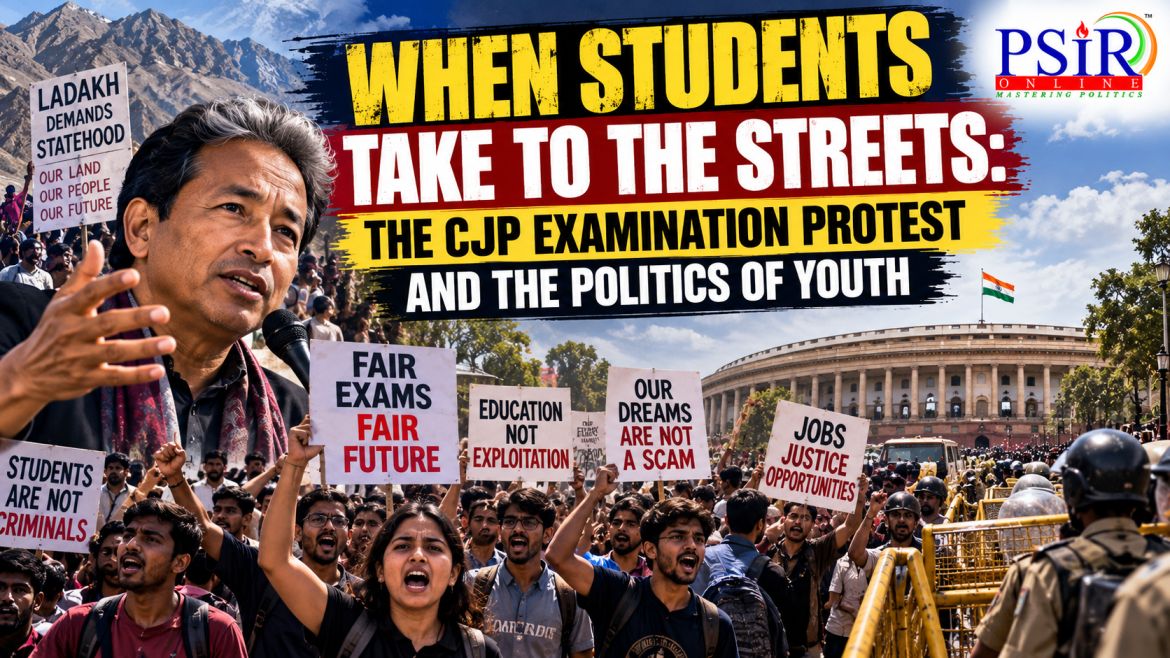
In a democracy, students and young people often protest when institutions stop working properly. If offices and complaint systems do not fix a problem, anger moves from colleges and coaching centres to the streets. The Cockroach Janta Party (CJP) examination protests of mid-2026 did that. They followed the cancellation of NEET-UG 2026 after reports of a paper leak and other irregularities, and doubts over exams such as CUET, CBSE and SSC-GD. What began as a demand that Union Education Minister Dharmendra Pradhan resign soon became a larger youth protest about fair exams, student distress, and trust in the testing system.
THE HISTORY AND ANATOMY OF PAPER LEAKS IN INDIA
The problem with competitive exams in India is not a one-time accident. It is a long-running failure in how exams are set, printed and conducted.
· The Chronic Trajectory: For more than ten years, paper leaks and sudden cancellations have hit both national and state exam bodies. Examples include the Vyapam scam in Madhya Pradesh, repeated leaks in the public service commissions of Uttar Pradesh and Rajasthan, problems in SSC-CGL, and National Testing Agency exams such as NEET-UG.
· The Paper-Leak Nexus: Inquiries have often found the same kind of network: solver gangs, weak printing presses, private exam vendors, some coaching centres, and officials who pass papers or answers before the test.
· Administrative Failure of Centralized Testing: The shift to large, centralised, computer-based exams was meant to reduce local bias and make tests cleaner. In practice, it created one weak point. A leak at one centre could spoil the exam for a very large number of candidates and damage trust in the whole system. By the CJP’s account, the 2026 controversy touched more than a crore of students across NEET, CUET, CBSE and SSC-GD.
THE OUTBREAK OF THE CJP PROTEST
The immediate trigger was the NEET-UG 2026 paper leak. The exam was cancelled days after it was held. Several aspirants were reported to have died by suicide. That became a central rallying point.
· Genesis at Jantar Mantar: The Cockroach Janta Party traces its public origin to a Supreme Court hearing on 15 May 2026, during a contempt case. Its founder is Abhijeet Dipke. It is not a conventional student union. It calls itself the voice of India’s burnt-out youth, and began as internet satire before moving to the street. On 20 June 2026 it began an indefinite sit-in at Jantar Mantar. The sit-in lasted 36 days.
· Core Demands: The main demands were the resignation of Dharmendra Pradhan, compensation of ₹1 crore for the family of every student who died by suicide after the NEET leak and re-examination, and withdrawal of cases against protesters. The group also placed a five-point charter on examination reforms before the government, including concerns over the National Testing Agency and CBSE’s on-screen marking. It did not, at this stage, secure a new anti-paper-leak law or special CBI courts.
METHODS AND SOCIAL MEDIA ACTIVISM: THE DIGITAL-PHYSICAL SYNTHESIS
The protest used both the internet and the street.
· Decentralized Digital Networks: The group began as a meme and then used social media to call students to Delhi and to other cities. News of the sit-in, the 20 July march, and police action spread through short videos faster than through official briefings.
· Vernacular Content Creation: Student creators made short videos and explainers about cancelled exams, coaching-town life, and the demand for the minister’s resignation. The protest’s own language — “cockroach”, “burnt-out youth” — was part of that style.
· Nonviolent Civil Disobedience: The stated method was a peaceful sit-in and a “Chalo Sansad” march on 20 July. That march was stopped by Delhi Police. Clashes followed. Police reported stone-pelting, injured officers and damaged vehicles. Protesters alleged lathi charge, tear gas and excessive force. Dozens were detained. FIRs were filed. On 28 July, after the sit-in had already ended, the Supreme Court ordered the release of protesters below 18 and of those without criminal antecedents, and asked that CCTV, drone and body-camera footage be preserved.
STUDENT MOBILISATION IN LARGE NUMBERS: THE ANATOMY OF UNPRECEDENTED GROWTH
The protest grew from a Delhi sit-in into demonstrations in several states.
· Cross-Cleavage Unity: The CJP sit-in drew Left student groups such as SFI and AISA, besides other youth organisations. Opposition parties later backed the demand for Pradhan’s resignation. The shared complaint was the NEET leak, exam irregularities, and the lack of accountability. It was not a formally united front of general, OBC, SC and ST candidates.
· Coaching Hub Contagion: Before the indefinite sit-in, the group had held protests in cities including Pune, Jaipur, Lucknow and Bengaluru. After the 20 July crackdown in Delhi, student and party protests spread further. Coaching hubs mattered because that is where NEET aspirants live, but the record does not show coaching teachers as the main organisers.
THE HUNGER STRIKE: MORAL COERCION AND THE CLIMAX
The protest gained a second face when Ladakh activist and educator Sonam Wangchuk joined it.
The Satyagraha Dynamic: Wangchuk, who had called himself an “honorary cockroach”, began an indefinite hunger strike at Jantar Mantar on 28 June 2026, with CJP functionaries and six AISA activists. The demand was Pradhan’s resignation. He ended the fast on the night of 23 July after the Centre reached out to him. He was taken to hospital during the fast and later admitted to Medanta in Gurugram.
Escalation of Pressure: The fast, the 20 July march, and pictures of police action made the protest a national story. Civil society groups and opposition parties joined the demand. The Union government opened talks. It could neither ignore the sit-in nor clear it without a political cost.
WHY PEOPLE JOINED: A THOROUGH SOCIO-ECONOMIC ANALYSIS
People joined because the exam crisis touched jobs, family savings and student distress.
1. The "Demographic Dividend" vs. "Jobless Growth" Dilemma: India has a very young population, but formal private-sector jobs have not kept up. Millions of educated young people compete for a small number of secure government and professional seats. A cancelled national exam hits that crowd directly.
2. Sunk Costs and Youth Sunk-Capital: Many candidates spend years, and large family savings, on coaching fees and rent in towns such as Kota and Mukherjee Nagar. A leak is not only a delayed exam. For many families it wipes out a year of spending and a chance at a seat.
3. The Crisis of Regulatory Arbitrariness: The exam was cancelled only after reports of a leak. Students and parents felt the testing agencies admitted failure late. That lag fed the demand for the minister’s resignation.
4. Family and Parental Solidarity: Parents joined rallies because the protest was tied to student suicides, not only to campus politics. Compensation for those families was one of the three core demands.
THE "VICTORY": EXECUTIVE CONCESSIONS AND INSTITUTIONAL POLICY SHIFTS
On 25 July 2026 the Union government conceded the demands that had kept the sit-in going. The CJP then called off the 36-day protest.
Direct Ministerial Dialogue: CJP representatives Saurav Das and Ashutosh Ranka held talks with Union ministers J. P. Nadda and Jitendra Singh. The third round was reported at the Constitution Club of India. Nadda addressed a joint press conference with the CJP.
Judicial Fast-Tracking: This was not part of the 25 July settlement. No special CBI courts were announced. What the government did agree was to withdraw FIRs against protesters in Delhi and other BJP-ruled states, and not to pursue those cases. Court proceedings on police action continued separately. On 28 July the Supreme Court ordered releases and preservation of video evidence.
Legislative and Administrative Overhaul: No new anti-paper-leak Act was passed to end the strike. The agreed points were Pradhan’s resignation, “honourable” compensation — the CJP’s figure was ₹1 crore — for families of students who died by suicide, within existing rules, and a further meeting after four weeks on the five-point examination-reform charter. Pradhan resigned the same day, saying he had taken responsibility for the NEET-UG 2026 leak and did not want students’ futures stuck in the protest.
PSIR DIMENSION: THEORETICAL CONCEPTS & EXAMINATION LINKAGES
|
PSIR Theoretical Dimension & Concepts |
How It Connects to Examination Answers (PSIR Paper 1 / Paper 2) |
|
New Social Movements (NSMs) (Alberto Melucci; Alain Touraine) |
Classic new social movements are often about culture or ecology. The CJP protest is a mix. It began as a meme, organised outside party structures, and used the internet. But it fought for material things: a cancelled exam, compensation, and the minister’s resignation. |
|
Legitimacy Crisis & Communicative Action (Jürgen Habermas) |
A testing agency is trusted because people believe selection is based on merit. When a leak forces cancellation, an administrative failure becomes political anger. This is close to Habermas’s idea of a legitimation crisis. |
|
Relative Deprivation & Political Violence/Dissent (Ted Robert Gurr – Why Men Rebel) |
Students felt they were owed a fair chance after years of work. What they got was a leak, a cancelled exam, and, on 20 July, police action. That gap helps explain why they stayed on the street for 36 days. |
|
The "Silent Revolution" & Social Mobility (Christophe Jaffrelot; Craig Jeffrey – Timepass) |
Craig Jeffrey describes educated, jobless youth in small-town India stuck in endless exam preparation, or “timepass”. Long waiting builds resentment. Coaching hubs and Jantar Mantar then become places where that anger turns into a collective protest. |
|
Nonviolent Coercion and Moral Authority (M.K. Gandhi – Satyagraha; Gene Sharp) |
Wangchuk’s fast from 28 June to 23 July moved part of the pressure from barricades to conscience. It did not by itself produce the resignation. The resignation came on 25 July, after talks, the march, and nationwide protests. |
|
Civil Society as an Autonomous Counter-Public (Nancy Fraser; Antonio Gramsci) |
The CJP worked outside the ruling party and outside traditional student unions, though SFI, AISA and opposition parties later joined. It challenged the official claim that the exam system was under control, and it used that alliance to force a resignation and FIR withdrawals. |
CONCLUSION
The CJP protests show that youth politics in India is no longer limited to party-linked campus unions. A group that began as internet satire held Jantar Mantar for 36 days, forced the resignation of the Union Education Minister, and won commitments on compensation and withdrawal of cases. The larger point is simple. A democracy is not legitimate only because it holds elections. It also has to keep fair and credible the exams through which the next generation seeks seats, jobs and a place in public life.
RELATED READING & ANALYTICAL ANGLES: CONCEPTS, CONSTITUTIONAL PROVISIONS & STATUTES
1. Constitutional Provisions & Statutory Frameworks
· Article 19(1)(a) & Article 19(1)(b): Guarantees the fundamental freedom of speech, expression, and peaceful assembly without arms—the constitutional bedrock invoked by student movements and extra-parliamentary protestors.
· Article 19(2) & Article 19(3): Grounds for reasonable restrictions (sovereignty, integrity, public order, and morality), forming the judicial rationale for spatial/temporal regulations at protest venues like Jantar Mantar.
· Article 16(1) & Article 21: Equality of opportunity in matters of public employment and the right to life/livelihood with dignity—the central normative arguments raised by aspirants against systemic exam leaks and recruitment delays.
· The Public Examinations (Prevention of Unfair Means) Act, 2024: The statutory framework introduced to deter organized paper leaks, institutional collusion, and solver gangs through non-bailable clauses and severe penal deterrence.
2. Key Conceptual & Analytical Angles
· Subaltern Counter-Publics & Digital Satire:
o Core Theme: How youth-led platforms transform satirical tropes (such as subversive self-identification) into political instruments of contestation.
o Theoretical Reference: Nancy Fraser (Rethinking the Public Sphere); James C. Scott (Domination and the Arts of Resistance: Hidden Transcripts).
· The Political Economy of "Waiting" and Exam Hubs:
o Core Theme: The socio-economic crisis of youth stuck in protracted coaching regimes, competitive exam cycles, and structural unemployment.
o Key Works: Craig Jeffrey, Timepass: Youth, Class, and the Politics of Waiting in India; Christophe Jaffrelot, India's First Youths.
· Deliberative Disruption & Non-Violent Coercion:
o Core Theme: Indefinite fasts and civic occupations as communicative shocks that compel executive dialogue when conventional administrative representation breaks down.
o Key Formulations: M.K. Gandhi’s Satyagraha; Jürgen Habermas’s theory of communicative action and legitimation crisis.
PRACTICE QUESTIONS FOR PSIR
