The United Nations Security Council (UNSC) occupies a central position in the international system, bearing primary responsibility under the UN Charter for the maintenance of international peace and security. Yet its composition continues to reflect the geopolitical realities of 1945 rather than the distribution of power, population and regional influence in the contemporary world. This gap has intensified demands for institutional reform, particularly from countries in Asia, Africa and Latin America.
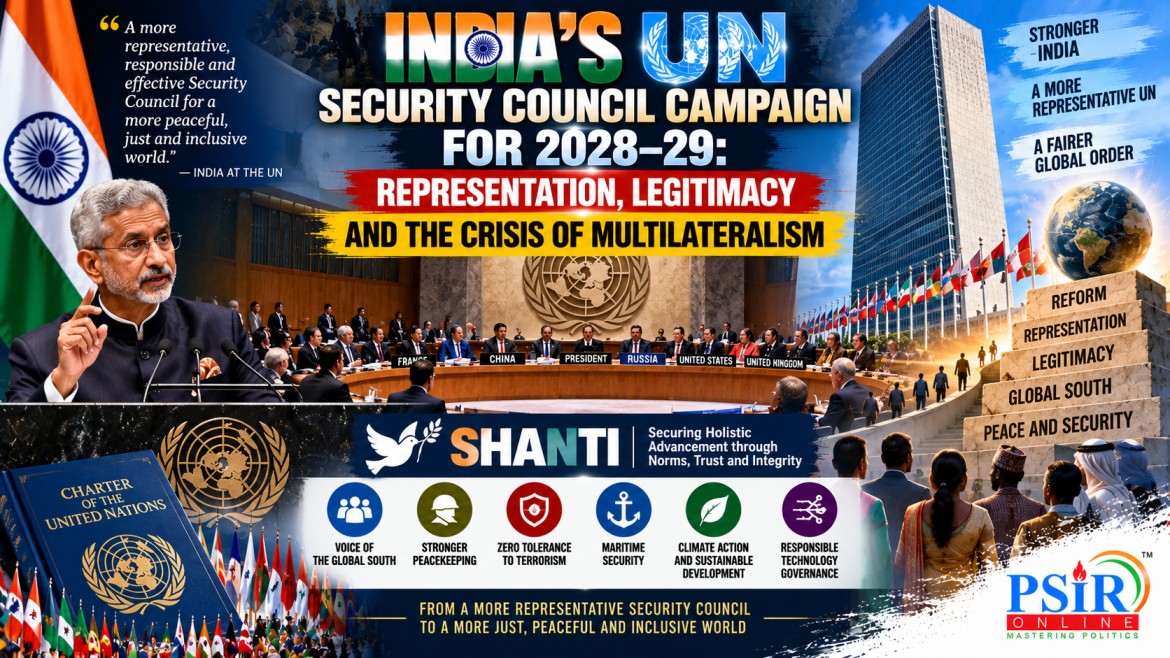
On 13 July 2026, India launched its campaign for election as a non-permanent member of the Security Council for the 2028–29 term. External Affairs Minister S. Jaishankar presented the campaign’s guiding vision as SHANTI — Securing Holistic Advancement through Norms, Trust and Integrity. The priorities included amplifying the concerns of the Global South, strengthening peacekeeping, addressing terrorism, securing maritime routes, promoting responsible technology and advancing climate action. India also highlighted its contributions to UN peacekeeping and international development cooperation.
The campaign is distinct from India’s long-standing demand for a permanent seat in a reformed Council. A successful election would provide India with another two-year term on the Council, but would not alter its institutional status. The campaign nevertheless provides an opportunity to examine the relationship between India’s expanding international role, the legitimacy of global institutions and the obstacles confronting multilateral reform.
THE CAMPAIGN AND INDIA’S VISION OF MULTILATERALISM
India’s campaign for 2028–29 builds on its previous experience as a non-permanent member of the Security Council, most recently during 2021–22. Its July 2026 launch placed the country’s candidature within a wider argument that the UN must become more representative, responsive and capable of addressing contemporary conflicts.
The SHANTI vision connects India’s diplomatic priorities with a broader conception of international security. It emphasises respect for international norms, trust between states, institutional integrity and the interdependence of peace, development and prosperity.
Several substantive priorities emerge from this approach. First, India seeks greater attention to the concerns of the Global South, including the effects of conflicts on food, fuel and fertiliser security. Second, it calls for peacekeeping mandates that are realistic, adequately resourced and responsive to conditions on the ground. Third, it emphasises counterterrorism, particularly action against terrorist financing and the use of objective evidence in listing decisions.
The campaign also highlights maritime security, the protection of commercial sea lanes, humanitarian assistance, disaster response and the governance of emerging technologies. Climate action, clean energy and sustainable growth are presented as connected to wider questions of international stability.
These priorities reflect an attempt to link traditional security concerns with economic vulnerability and emerging global challenges. However, their practical influence would depend on negotiations among Council members, the position of the permanent members and the willingness of states to translate diplomatic statements into agreed decisions.
The campaign therefore serves two purposes: seeking a place in the Council’s decision-making process and presenting a wider argument about the direction of international governance.
REPRESENTATION AND THE LEGITIMACY DEFICIT
The Security Council currently consists of 15 members: five permanent members and ten non-permanent members. The permanent members—China, France, Russia, the United Kingdom and the United States—possess veto power over substantive decisions. Non-permanent members are elected by the General Assembly for two-year terms and do not possess a veto.
This arrangement emerged from the power structure at the end of the Second World War. Although the Council’s membership was expanded in 1965 from 11 to 15, its permanent membership and veto structure remain unchanged.
The resulting representational deficit has several dimensions. Africa, despite comprising a substantial proportion of UN membership, has no permanent seat. Latin America and the Caribbean also lack permanent representation. Asia’s growing economic and demographic significance is not fully reflected in the Council’s permanent membership. The absence of permanent representation for major contemporary powers and underrepresented regions raises questions about the institution’s legitimacy.
Representation is not merely a matter of prestige. Security Council decisions can authorise sanctions, establish peacekeeping operations and shape international responses to conflicts. States affected by these decisions may question their legitimacy when the composition of the decision-making body does not adequately reflect contemporary international society.
Nevertheless, representation and effectiveness are not identical. An enlarged Council could broaden participation but might also make negotiations more complicated. Conversely, a small Council may make decisions more quickly while leaving significant regions and interests insufficiently represented.
India’s campaign draws attention to this tension. Its demographic scale, economic significance, peacekeeping record and diplomatic engagement provide grounds for its demand for a greater role. Yet an individual country’s election to a non-permanent seat cannot resolve the wider representational deficit. The legitimacy question ultimately concerns the structure and functioning of the institution itself.
SECURITY COUNCIL REFORM: PROPOSALS AND COMPETING INTERESTS
Reform of the Security Council has been discussed through the General Assembly’s Intergovernmental Negotiations (IGN) process. Member states have debated the categories of membership, regional representation, the veto, the size of an expanded Council and its working methods.
India works with Brazil, Germany and Japan through the G4, which supports expansion of both permanent and non-permanent membership. The G4 has called for a reformed Council that reflects contemporary geopolitical realities and provides greater representation to major contributors and underrepresented regions.
The African Union’s Ezulwini Consensus and Sirte Declaration demand substantial African representation, including permanent seats with the prerogatives and privileges associated with permanent membership. The African position also reflects opposition to a reform model that would leave the continent without a permanent voice.
The Uniting for Consensus group, which includes countries such as Italy, Pakistan, Mexico and Argentina, has opposed the G4 model of adding new permanent members. It has instead advocated approaches that emphasise expanded or otherwise reconfigured elected membership, reflecting concerns about the creation of additional entrenched national privileges and regional rivalries.
The permanent members also have different positions on the scope and design of reform. Any amendment to the UN Charter must secure the required support in the General Assembly and ratification by two-thirds of UN member states, including all five permanent members. Consequently, reform cannot be achieved solely through a majority vote if the necessary Charter-amendment requirements are not met.
India has argued that the IGN process should move towards text-based negotiations, rather than remain indefinitely at the stage of discussing general positions and areas of convergence. In its June 2026 intervention, India questioned aspects of the co-chairs’ assessment of reform discussions and argued that proposals should reflect positions formally advanced by member states and negotiating groups.
The central obstacle is therefore not a lack of reform proposals. It is the absence of sufficient agreement on the distribution of authority, the treatment of the veto and the composition of an expanded Council. Institutional reform remains inseparable from the national interests of states that would gain, retain or potentially lose influence.
THE VETO, GREAT-POWER RIVALRY AND THE CRISIS OF MULTILATERALISM
The veto is one of the most contested features of the Security Council. It was incorporated into the UN system to secure the participation of the major powers and prevent the organisation from acting against their fundamental interests. At the same time, it gives each permanent member the ability to block substantive decisions, even when a proposal has broad support among other members.
The veto can therefore create a conflict between great-power consent and collective action. When permanent members disagree over a conflict, sanctions or a proposed international response, the Council may be unable to act decisively. This limitation has contributed to recurring criticism of the UN’s capacity to address major international crises.
The problem extends beyond individual vetoes. Rivalry among major powers can shape negotiations before a proposal reaches a vote, narrow the range of politically acceptable outcomes and weaken confidence in collective security. Smaller states may consequently perceive the Council as reflecting the strategic preferences of the powerful rather than a consistent application of international principles.
However, the veto is not the sole explanation for the difficulties of multilateralism. Conflicts may also persist because of divergent national interests, limited enforcement capacity, inadequate resources, weak implementation or the absence of a political settlement. Expanding membership alone would not automatically resolve these problems.
India’s position raises the question of whether a more representative Council could improve both legitimacy and effectiveness. An expanded institution might broaden participation and strengthen political ownership of its decisions, but the relationship between enlargement and effectiveness would depend on the design of the new structure and its working methods.
A durable reform process must therefore address both representation and decision-making power. Changes that increase the number of members without addressing entrenched inequalities may leave the fundamental legitimacy problem unresolved.
INDIA’S CREDENTIALS, GLOBAL SOUTH DIPLOMACY AND INSTITUTIONAL RESPONSIBILITY
India’s candidature draws on several aspects of its international engagement. Its participation in UN peacekeeping, development partnerships, humanitarian assistance and disaster response forms an important part of the case presented by the Indian government.
At the July 2026 campaign launch, India highlighted a cumulative contribution of nearly 300,000 personnel across approximately 50 UN peacekeeping missions and the deployment of around 4,300 personnel across ten active missions at that time. India also emphasised its experience in training peacekeepers, maritime security cooperation, emergency assistance and development projects across multiple regions.
These contributions provide evidence of sustained engagement with international institutions. They also create expectations concerning the responsibilities that accompany a larger role in global governance.
India’s emphasis on the Global South reflects concerns about unequal access to finance and technology, the effects of international conflicts on developing economies and the underrepresentation of developing countries in global decision-making. Its diplomacy has sought to connect these concerns with questions of food security, energy access, climate justice and development.
However, the Global South is not a unified political bloc. Developing countries differ in their security priorities, economic interests, regional rivalries and preferred approaches to institutional reform. Support for a more representative Security Council does not necessarily imply agreement on which states should receive permanent seats or how the veto should be treated.
India’s candidature therefore requires engagement across different regional and political groupings. Its record of peacekeeping and development cooperation forms part of its diplomatic case, but electoral support depends on the choices of other UN member states. A successful term would also require the ability to build coalitions, negotiate compromises and work within the limits of the Council’s mandate.
The broader issue is whether India can connect its national aspiration for greater representation with a credible commitment to collective security and institutional reform.
THE WAY FORWARD: FROM CAMPAIGN DIPLOMACY TO INSTITUTIONAL REFORM
India’s campaign can contribute to the wider reform debate if its diplomatic objectives are connected to concrete proposals and sustained engagement with other member states.
First, the IGN process needs to advance towards text-based negotiations with clear proposals, defined areas of disagreement and a transparent procedure for assessing possible compromises. Continued discussion without an agreed negotiating text risks prolonging the status quo.
Second, reform proposals should address permanent and non-permanent membership together. Expansion limited to elected seats may increase participation without changing the concentration of decision-making power. Any proposal must also address the legitimate demands of Africa and other underrepresented regions.
Third, the question of the veto requires sustained negotiation. Possible approaches include restrictions on its use in mass-atrocity situations, stronger explanations for vetoes, or changes linked to broader membership reform. Such measures differ in their legal and political implications, and none can be assumed to command agreement among the permanent members.
Fourth, the Council’s working methods can be improved even before comprehensive Charter reform becomes possible. Greater transparency, regular engagement with affected states, more meaningful consultation with troop- and police-contributing countries, and clearer explanations of decisions can strengthen institutional accountability.
Fifth, India should continue building coalitions across the G4, the African Union, the L.69 group and other interested states while recognising differences within these groupings. The objective should be to identify areas of agreement without treating regional support as automatic.
Finally, the legitimacy of the Security Council depends not only on its composition but also on the consistency, implementation and perceived fairness of its decisions. A reformed Council must remain capable of responding to conflicts, protecting civilians and addressing threats to international peace and security.
The campaign for 2028–29 and the demand for permanent membership are distinct initiatives, but both raise the same underlying question: how can the United Nations reconcile sovereign equality with the unequal distribution of power in international politics?
THEORETICAL ANGLES
|
Theory or concept |
Application to Security Council reform |
|
Realism |
The permanent members’ control over veto power illustrates how powerful states seek to preserve influence within international institutions. |
|
Liberal institutionalism |
The Security Council demonstrates the importance of institutions in coordinating state action, while also revealing the limits imposed by conflicting national interests. |
|
Constructivism |
Debates over legitimacy, representation and fairness show how shared norms and ideas about appropriate international authority shape demands for reform. |
|
Power transition theory |
India’s demand for greater representation reflects the tension between changes in global power and institutions created under an earlier distribution of power. |
|
Postcolonial approaches |
The underrepresentation of Africa and other developing regions reflects the continuing influence of historical inequalities in the institutional structure of global governance. |
|
Multilateralism |
The campaign highlights the need to reconcile national interests through consultation, negotiation and collective decision-making. |
|
Collective security |
The veto and great-power disagreements expose the difficulties of sustaining collective responses when major states disagree over threats and appropriate action. |
|
Legitimacy and institutional effectiveness |
Security Council reform must balance wider representation with the capacity to make timely, credible and implementable decisions. |
CONCLUSION
India’s campaign for a non-permanent Security Council seat for 2028–29 comes amid continuing debates over the legitimacy and effectiveness of the United Nations. The July 2026 launch, framed by the SHANTI vision, connected India’s candidature with concerns about peacekeeping, terrorism, maritime security, climate action, technology and the representation of the Global South.
Yet the campaign must be distinguished from the more fundamental question of Security Council reform. Election to a non-permanent seat would expand India’s participation in the Council for a limited term, but it would not alter the permanent membership or veto structure. Those changes require a much broader political agreement and the formal amendment of the UN Charter.
The future of multilateralism depends on the ability of member states to reconcile competing interests without allowing institutional arrangements to become permanently disconnected from contemporary realities. Greater representation, accountable decision-making and operational effectiveness must advance together if the Security Council is to retain credibility as the principal international body responsible for peace and security.
RELATED READING
PRACTISE QUESTIONS FOR GS2 MAINS
1. (10 marks) Explain the significance of India’s campaign for a non-permanent seat on the United Nations Security Council for the 2028–29 term.
2. (10 marks) How does the composition of the United Nations Security Council affect its representativeness and legitimacy?
3. (15 marks) Examine the major proposals for United Nations Security Council reform and the obstacles to their implementation.
4. (15 marks) “Reforming the United Nations Security Council requires reconciling equitable representation with the effectiveness of collective security.” Discuss.
PRACTISE QUESTIONS FOR PSIR
1. (10 marks) Explain the relevance of realism in understanding the resistance of permanent members to United Nations Security Council reform.
2. (15 marks) Critically examine the G4 and African Union positions on the reform of the United Nations Security Council.
3. (15 marks) Discuss how the veto power reflects the tension between great-power politics and collective security in the United Nations system.
4. (20 marks) “The crisis of multilateralism reflects the growing contradiction between contemporary global power realities and the institutional structures established in 1945.” Critically analyse with reference to India’s campaign for Security Council reform.
