INTRODUCTION
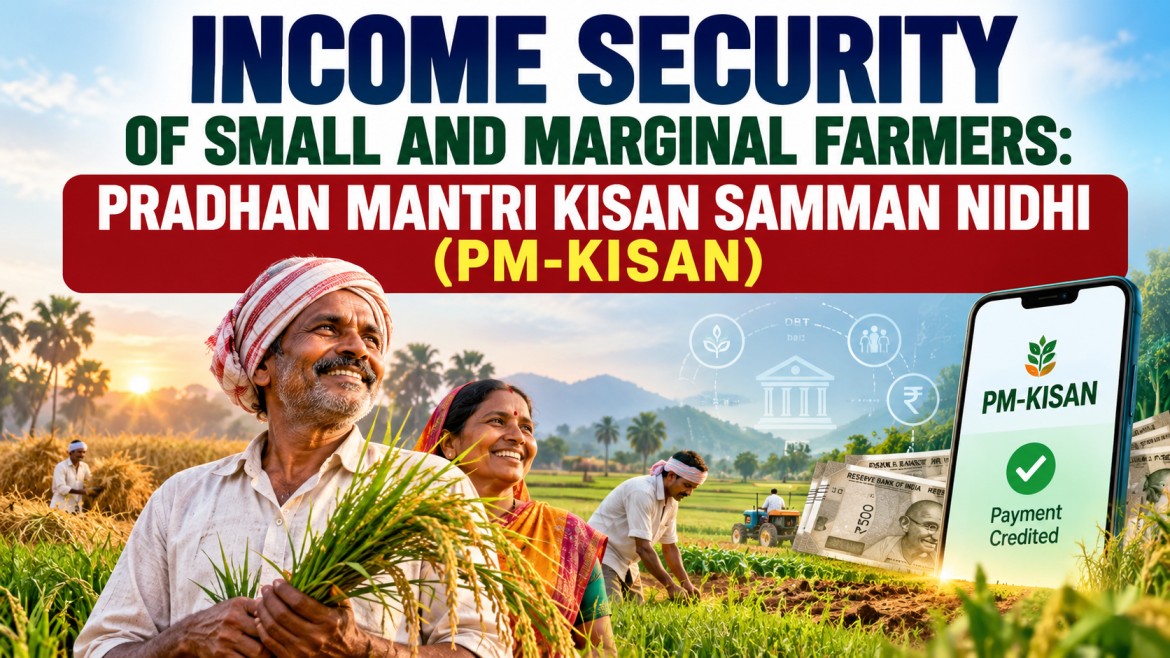
Small and marginal farmers constitute the overwhelming majority of India’s agricultural households, yet they often face unstable farm incomes, rising input costs, climate-related risks and limited access to formal credit. In this context, income support has emerged as an important component of agricultural and social protection policy. The Pradhan Mantri Kisan Samman Nidhi (PM-KISAN) is one of the Union Government’s major interventions aimed at providing a predictable minimum income support to landholding farmer families.
PM-KISAN is a Central Sector Scheme with 100% funding by the Government of India. It provides ₹6,000 per year to eligible farmer families in three equal instalments of ₹2,000, transferred directly into their bank accounts through the Direct Benefit Transfer (DBT) mechanism. The scheme became operational from 1 December 2018 and was formally launched on 24 February 2019.
The significance of PM-KISAN goes beyond the transfer of ₹6,000. It represents a shift towards direct, technology-enabled income support, where government assistance is linked to digitally verified land records, Aadhaar authentication and bank accounts. Thus, the scheme connects farmer welfare, income security, financial inclusion and digital governance.
PRADHAN MANTRI KISAN SAMMAN NIDHI (PM-KISAN): DETAILED OVERVIEW
PM-KISAN was originally conceived to provide income support to small and marginal landholding farmers, particularly those with cultivable land holdings of up to 2 hectares. The scheme was subsequently expanded to cover all eligible landholding farmer families, subject to specified exclusion criteria.
Under the scheme, an eligible farmer family receives ₹6,000 annually, paid in three instalments:
· ₹2,000 – April to July
· ₹2,000 – August to November
· ₹2,000 – December to March
The money is transferred directly into the beneficiary's bank account through DBT, reducing dependence on intermediaries and improving transparency. Aadhaar authentication and digitally verified land records have become important components of beneficiary identification and payment.
START AND EVOLUTION OF THE SCHEME
|
Particular |
Details |
|
Name |
Pradhan Mantri Kisan Samman Nidhi (PM-KISAN) |
|
Type |
Central Sector Scheme |
|
Funding |
100% funded by Government of India |
|
Operational from |
1 December 2018 |
|
Formally launched |
24 February 2019 |
|
Initial target |
Small and marginal landholding farmer families with cultivable land up to 2 hectares |
|
Present coverage |
Eligible landholding farmer families, subject to exclusion criteria |
|
Annual assistance |
₹6,000 per farmer family |
|
Payment structure |
3 instalments of ₹2,000 each |
|
Mode of payment |
Direct Benefit Transfer (DBT) |
|
Beneficiary identification |
State/UT governments through verified land and beneficiary records |
|
Bank account linkage |
Aadhaar-seeded bank account |
|
Latest major milestone |
22nd instalment released in March 2026 |
|
Beneficiaries in 22nd instalment |
More than 9.32 crore farmer families |
|
Cumulative amount transferred by 22nd instalment |
More than ₹4.27 lakh crore |
The 22nd instalment, released in March 2026, transferred more than ₹18,640 crore to over 9.32 crore farmer families. Of these, more than 2.15 crore were women beneficiaries, highlighting the scheme's relevance to women's economic security in rural India
WHO BENEFITS FROM PM-KISAN?
The scheme has developed into one of India's largest direct income-support programmes. Official PM-KISAN data shows that the number of farmers receiving benefits has generally remained around 9–10 crore per instalment, although the beneficiary count varies across agricultural seasons because of verification, eligibility and authentication processes.
|
Beneficiary Dimension |
Details |
|
Primary beneficiaries |
Eligible landholding farmer families |
|
Family definition |
Husband, wife and minor children |
|
Women beneficiaries |
More than 2.15 crore in the 22nd instalment |
|
Beneficiaries – 22nd instalment |
9.32+ crore farmer families |
|
Women’s share |
Around 25% of total benefits, according to government data |
|
Latest seasonal beneficiary figure |
9.44 crore beneficiaries for April–July 2026–27 |
|
Payment mechanism |
Aadhaar-authenticated / Aadhaar-seeded DBT |
|
Identification responsibility |
State Governments and UT administrations |
|
Important condition |
Beneficiaries must satisfy eligibility requirements and must not fall under specified exclusion categories |
The latest PM-KISAN portal data records 9,44,65,646 farmers benefiting during April–July 2026–27, demonstrating the continued scale of the programme.
HOW HAS PM-KISAN FUNCTIONED?
PM-KISAN represents a major shift in India's agricultural welfare policy—from indirect and intermediary-based support towards direct income transfers. Its large-scale DBT architecture has enabled the government to reach millions of farmers with relatively low administrative intermediation. However, its success in transferring money should not automatically be equated with success in ensuring adequate and equitable farm income.
Key Achievements of PM-KISAN
|
Achievement |
Significance |
|
Large-scale coverage |
More than 9.32 crore farmer families received the 22nd instalment in March 2026, demonstrating the enormous reach of the scheme. |
|
Direct Benefit Transfer (DBT) |
Money is transferred directly to beneficiaries, reducing dependence on intermediaries and improving transparency. |
|
Improved targeting |
Aadhaar authentication, e-KYC and digitised land records have strengthened beneficiary verification and reduced the possibility of duplicate or fictitious beneficiaries. |
|
Liquidity support to farmers |
The ₹2,000 instalments provide immediate cash that can help farmers purchase seeds, fertilisers and other inputs or meet short-term household needs. |
|
Support for agricultural investment |
Field studies indicate that PM-KISAN transfers have contributed to higher expenditure on agricultural inputs and cultivation in some regions. |
|
Financial inclusion |
Linking welfare transfers with bank accounts strengthens farmers' participation in the formal financial system. |
|
Women's participation |
More than 2.15 crore women received the 22nd instalment, giving the scheme an important gender dimension. |
|
Reduced administrative discretion |
Digital transfer mechanisms reduce the role of local intermediaries in determining who receives the payment. |
|
Predictable support |
The three-installment structure provides farmers with periodic liquidity across the agricultural year. |
The greatest achievement of PM-KISAN is therefore not the size of the transfer but the transformation in the delivery mechanism. It demonstrates how a large agricultural welfare programme can use DBT and digital identification to deliver assistance directly to beneficiaries. For small farmers facing temporary liquidity constraints, even a relatively modest transfer can help finance agricultural inputs or reduce dependence on informal borrowing.
However, efficient delivery does not necessarily mean adequate income security. The ₹6,000 annual transfer remains relatively small when compared with the cost of cultivation and the broader risks faced by farming households. This leads us to the more important question: who is still being left out?
MAJOR LIMITATIONS AND FAILURES OF PM-KISAN
|
Limitation / Failure |
Why does it matter? |
|
Landholding-based eligibility |
PM-KISAN covers eligible landholding farmer families whose cultivable land is recorded in their name. Therefore, tenants and sharecroppers who cultivate land but do not have cultivable land recorded in their own name are generally outside the central scheme. |
|
Landless agricultural workers are outside the scheme |
A large section of rural workers depends on agriculture for livelihood but receives no PM-KISAN benefit because they do not own cultivable land. |
|
Dependence on land records |
Outdated records, inheritance disputes and failure to mutate land ownership can prevent eligible farmers from receiving benefits. |
|
Digital exclusion |
Aadhaar, e-KYC and banking requirements can create difficulties for beneficiaries facing authentication, documentation or bank-account problems. |
|
₹6,000 may be inadequate |
The annual assistance is useful as supplementary income but is insufficient to provide comprehensive income security amid rising cultivation and household costs. |
|
Women cultivators may remain invisible |
Women may perform substantial agricultural work while land remains registered in the name of male family members. |
|
Does not address price risk |
PM-KISAN provides cash support but does not directly solve problems of low farm-gate prices, market access or inadequate procurement. |
|
Does not address structural indebtedness |
A small annual transfer cannot by itself overcome accumulated agricultural debt or persistent dependence on informal credit. |
|
Regional inequalities remain |
The value and impact of ₹6,000 can vary significantly depending on crop patterns, input costs, irrigation and agricultural conditions across states. |
|
Income support ≠ income transformation |
The scheme can provide temporary liquidity but cannot by itself make small-scale farming economically viable. |
A significant limitation of PM-KISAN is its landholding-based eligibility framework. The scheme identifies beneficiaries primarily on the basis of cultivable land recorded in their name. Consequently, a person may actively cultivate agricultural land as a tenant or sharecropper, but if the land is not recorded in that person's name, cultivation alone does not make them eligible for PM-KISAN. This creates an important social-justice question about whether agricultural income support should remain linked primarily to landholding records or extend to those who actually cultivate the land.
The second major concern is adequacy. ₹6,000 a year can provide useful supplementary income, but it cannot compensate for volatile crop prices, rising input costs, climate shocks and indebtedness. PM-KISAN therefore works better as a liquidity-support mechanism than as a complete farmer-income-security programme.
Finally, the scheme demonstrates an important paradox of digital welfare. Digitisation can reduce leakage, but it can also create new forms of exclusion when land records are outdated or authentication and banking processes fail. Thus, the challenge for the next phase of PM-KISAN is not simply to transfer money to more people, but to ensure that the right people—including actual cultivators—are able to access the support.
OVERALL ASSESSMENT
PM-KISAN has been highly significant as a direct income-transfer mechanism, but its social-justice impact remains constrained by its dependence on land ownership and the modest size of the transfer.
The central challenge is to move from “landholder-based income support” towards “cultivator-centred social protection.”
That would make a very strong transition into the next section of the dossier: “What reforms can make PM-KISAN more inclusive and effective?”
WAY FORWARD
PM-KISAN has established a strong foundation for direct farmer income support, but its next phase should focus on inclusion, adequacy and resilience rather than merely expanding the number of beneficiaries.
· Address the landholding gap: Examine, in coordination with State Governments, appropriate mechanisms to extend income support to genuine tenant farmers and sharecroppers who are currently outside the PM-KISAN eligibility framework, while maintaining effective beneficiary verification.
· Improve land records: Accelerate digitisation, updating and mutation of land records so that genuine beneficiaries are not excluded because of outdated ownership details.
· Strengthen grievance redressal: Establish simple, accessible mechanisms at the village and district levels to resolve payment failures, Aadhaar authentication problems and beneficiary-status disputes.
· Make support more responsive: Periodically review the ₹6,000 annual assistance in light of inflation, cultivation costs and regional variations.
· Strengthen women's access: Improve recognition of women farmers and joint land ownership, ensuring that women who actively cultivate land are not invisible within the welfare system.
· Integrate income support with agricultural policy: PM-KISAN should work alongside crop insurance, institutional credit, irrigation, MSP/procurement, FPOs, agricultural extension and climate-resilient farming.
· Balance digitisation with human intervention: Technology should improve transparency without making welfare inaccessible to farmers who face digital, banking or documentation barriers.
CONCLUSION
PM-KISAN marks an important transition in India's welfare architecture by making direct and technology-enabled income support a central component of agricultural policy. Its enormous scale and DBT mechanism have improved the efficiency and transparency of farmer support.
However, income transfer alone cannot guarantee income security. The exclusion of tenant farmers, dependence on land records, digital barriers and the limited size of the transfer reveal the gap between administrative coverage and substantive social justice.
The future of PM-KISAN should therefore be guided by a simple principle:
From transferring money to landholders to securing the livelihoods of cultivators.
A truly inclusive agricultural social-protection system must ensure that every person who depends on cultivation for livelihood—not merely those whose names appear in land records—is visible to the welfare state.
RELATED READING
For a comprehensive understanding of PM-KISAN and agricultural social protection, students should connect the issue with the following areas:
· Agricultural Income & Farmer Welfare – Farm incomes, rising input costs and the challenges faced by small and marginal farmers.
· Direct Benefit Transfer (DBT) – Aadhaar-based authentication, financial inclusion and technology-enabled welfare delivery.
· Land Reforms & Land Records – Land ownership, tenancy, fragmentation and the role of digitised land records in welfare delivery.
· Agricultural Credit & Indebtedness – Institutional credit, informal borrowing and the relationship between liquidity support and farm debt.
· MSP & Agricultural Markets – Minimum Support Price, procurement, market access and the problem of remunerative farm prices.
· Crop Insurance & Climate Risk – PM Fasal Bima Yojana, crop losses and the growing vulnerability of farmers to climate change.
· Women in Agriculture – Women's contribution to farming, land ownership and recognition of women as farmers.
· Digital Welfare & Social Justice – The opportunities and exclusion risks associated with Aadhaar, e-KYC, DBT and digitised welfare systems.
· SDG 1 & SDG 2 – Poverty reduction, food security and sustainable agriculture.
GS PAPER II – MAINS PRACTICE QUESTIONS
1. “PM-KISAN represents a shift from indirect agricultural subsidies towards direct income support.” Examine its achievements and limitations as an instrument of farmer welfare.
(15 Marks, 250 Words)
2. Landholding-based welfare schemes can improve targeting but may exclude vulnerable cultivators without formal land titles. Discuss in the context of PM-KISAN.
(15 Marks, 250 Words)
3. “Digitalisation of welfare delivery can simultaneously promote transparency and create new forms of exclusion.” Analyse with reference to PM-KISAN.
(10 Marks, 150 Words)
4. PM-KISAN provides important liquidity support to farmers, but income support alone cannot ensure sustainable agricultural livelihoods. Discuss the complementary reforms required to strengthen farmer income security.
(15 Marks, 250 Words)
