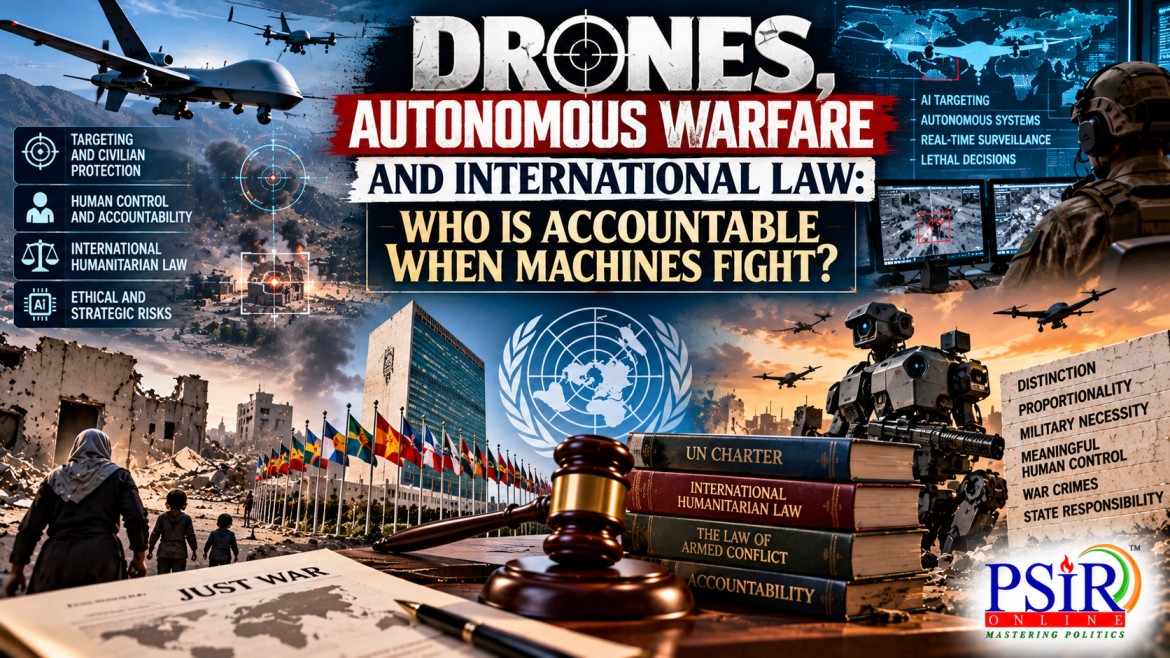
Drones and autonomous technologies are changing the character of contemporary warfare. Unmanned aerial vehicles are used for surveillance, reconnaissance, logistics and attacks, while advances in artificial intelligence are expanding the possibilities for automated target detection and engagement. Similar technologies are also being developed for land and maritime operations.
These developments create a fundamental challenge for international law: when a machine contributes to the decision to use lethal force, who remains responsible for the consequences?
The issue received attention at the 14th World Peace Forum in Beijing on 3 July 2026, where the International Committee of the Red Cross (ICRC), in partnership with Tsinghua University’s Institute of International Relations, convened a panel on unmanned systems in armed conflict. Discussions addressed civilian protection, accountability, human judgment and compliance with international humanitarian law.
The debate is not simply about whether technology makes warfare more efficient. It concerns whether military innovation can be governed by rules that protect human life and preserve accountability.
The central principle is clear: technological autonomy does not remove the legal obligations of those who develop, deploy and use weapons.
FROM REMOTELY PILOTED DRONES TO AUTONOMOUS WEAPONS
The terms drone warfare and autonomous warfare are often used interchangeably, but they describe different technological capabilities.
A remotely piloted drone operates under human control. An autonomous weapon system, by contrast, can select and engage targets without further human intervention after activation. Between these categories lie systems with varying degrees of automation and human supervision.
|
System or capability |
Main characteristic |
Principal legal concern |
|
Remotely piloted drone |
A human operator controls the flight and engagement decisions |
Whether the particular attack complies with international humanitarian law |
|
Automated targeting assistance |
Software assists humans in identifying or prioritising potential targets |
Reliability, bias, verification and the quality of human judgment |
|
Autonomous weapon system |
The system selects and engages targets without further human intervention after activation |
Predictability, meaningful human control and the ability to comply with legal restrictions |
The distinction matters because automation does not automatically mean autonomy. A system may automate navigation or image analysis while leaving the decision to attack with a human. Conversely, a system that selects and engages targets autonomously raises more difficult questions about how its behaviour can be predicted and constrained.
The ICRC has highlighted the humanitarian risks of systems whose effects cannot be sufficiently understood, predicted or controlled. Their use can create dangers for civilians and combatants, complicate legal compliance and increase the risk of unintended escalation.
The challenge for international governance is therefore to assess not only what a weapon is called, but what it can do, under what conditions it operates and how its effects can be controlled.
INTERNATIONAL HUMANITARIAN LAW: THE RULES STILL APPLY
International humanitarian law (IHL), also known as the law of armed conflict, regulates the conduct of hostilities. Its rules apply to the means and methods of warfare, including the use of technologically advanced weapons.
Three principles are especially important.
Distinction: Parties to a conflict must distinguish between civilians and combatants, and between civilian objects and military objectives. Attacks must be directed at lawful military objectives.
Proportionality: An attack is prohibited when the expected incidental civilian harm would be excessive in relation to the concrete and direct military advantage anticipated.
Precautions in attack: Parties must take feasible precautions to verify targets, choose means and methods that reduce civilian harm, and cancel or suspend an attack when required by the law.
These principles do not cease to apply when a weapon incorporates artificial intelligence or autonomous functions. However, their application may become more difficult when a system operates in a complex environment, processes uncertain information or engages targets at a speed that limits human intervention.
For example, a system trained to identify military vehicles may encounter civilian vehicles, damaged infrastructure or changing battlefield conditions that differ from its testing environment. If the system cannot reliably distinguish military objectives from protected objects, its deployment may create serious legal risks.
Article 36 of Additional Protocol I to the Geneva Conventions requires states party to the Protocol to determine, when studying, developing, acquiring or adopting a new weapon, means or method of warfare, whether its employment would be prohibited in some or all circumstances under applicable international law.
Weapons reviews are therefore important safeguards, but they must consider real operating conditions, foreseeable failures and the limits of the technology.
The legal test is not whether a weapon is advanced, but whether its development and use can comply with the applicable rules of armed conflict.
WHO IS ACCOUNTABLE WHEN A MACHINE CAUSES HARM?
When an autonomous or automated system causes civilian casualties, responsibility cannot simply be assigned to the machine. The legal questions concern the conduct of the people and institutions involved in its development, authorisation and use.
Different forms of responsibility may arise.
|
Actor |
Potential responsibility or obligation |
|
Political and military leadership |
Establish lawful policies, rules of engagement and appropriate oversight |
|
Commanders |
Assess operational conditions, issue lawful orders and supervise the use of weapons |
|
Operators |
Follow lawful instructions, observe applicable restrictions and intervene where required |
|
Developers and manufacturers |
Contribute to reliable design, testing, documentation and safety measures; liability depends on applicable law and facts |
|
State authorities |
Meet applicable international obligations, investigate alleged violations and provide remedies where required |
|
Individual perpetrators |
Face potential criminal responsibility where the legal elements of an offence and the relevant jurisdictional requirements are established |
These categories should not be confused. State responsibility under international law is distinct from the individual criminal responsibility of a commander or operator. Civil or product liability may also depend on national legislation and the circumstances of a particular case.
A weapon system itself cannot replace the human legal judgment required to assess the lawfulness of an attack. The ICRC has emphasised that obligations under the rules governing hostilities, and accountability for compliance with them, cannot be transferred to a computer program or weapon system.
However, establishing individual criminal responsibility is not automatic whenever a weapon causes civilian harm. Investigators must examine the available evidence, the applicable legal framework, the conduct of relevant individuals and the required mental elements of any alleged offence.
Autonomous warfare makes this process more difficult when targeting decisions depend on complex software, opaque algorithms or data that are difficult to reconstruct after an incident.
The central accountability challenge is therefore to ensure that the chain of human decision-making remains identifiable and legally reviewable, even when machines perform important functions.
HUMAN CONTROL, ETHICS AND CIVILIAN PROTECTION
The concept of meaningful human control lies at the centre of international discussions on autonomous weapons. It does not necessarily mean that a human must manually approve every technical operation. It means that human judgment and control must remain sufficient to ensure lawful and responsible use.
Several factors are relevant:
· Predictability: Can the system’s behaviour and likely effects be understood under the intended conditions of use?
· Target restrictions: Is the system limited to appropriate targets and operational environments?
· Time and geographical limits: Can its duration, area of operation and scale of use be constrained?
· Human supervision: Can a human understand the situation, intervene where necessary and deactivate the system in time?
· Testing and review: Has the system been evaluated under realistic conditions, including foreseeable failures and changing environments?
The humanitarian concern extends beyond technical malfunction. Decisions involving life and death require judgments about context, uncertainty and the protection of human dignity. An algorithm may process information rapidly, but speed alone does not establish that its decisions are lawful.
There is also a risk of automation bias, in which personnel place excessive confidence in machine-generated recommendations. If operators assume that a system is reliable without independently assessing the situation, human oversight may become merely formal rather than meaningful.
Civilian protection consequently requires more than a human remaining somewhere in the decision chain. It requires sufficient information, authority, time and practical capacity for that person to exercise judgment.
The ICRC has called for prohibitions on unpredictable autonomous weapons and systems designed or used to apply force against people, alongside strict restrictions on other autonomous weapons. These are the ICRC’s recommendations for new international rules; they should not be confused with a universally agreed treaty prohibition already in force.
THE INTERNATIONAL REGULATORY GAP
The regulation of autonomous weapons is being discussed through several international processes, particularly the Group of Governmental Experts on emerging technologies in the area of lethal autonomous weapons systems under the Convention on Certain Conventional Weapons (CCW).
States broadly recognise that international humanitarian law applies to weapons with autonomous capabilities. However, they differ on whether existing rules are sufficient, what additional restrictions are necessary and whether a new legally binding instrument should be negotiated.
The debate involves three broad approaches.
|
Approach |
Main argument |
Central difficulty |
|
Reliance on existing IHL |
Existing principles can regulate weapons regardless of their technological design |
States disagree on how those principles apply to highly autonomous systems |
|
New binding rules |
Specific prohibitions and restrictions could clarify limits and strengthen civilian protection |
Reaching agreement on definitions, scope, verification and enforcement |
|
Technical and operational safeguards |
Testing, human supervision, target restrictions and deployment limits can reduce risks |
Safeguards may be inconsistent or inadequate without common international standards |
In March and August–September 2026, the CCW Group of Governmental Experts continued work on possible elements of an instrument and other measures addressing emerging technologies in lethal autonomous weapons systems. These discussions demonstrate continued international engagement, but they do not amount to a comprehensive global treaty prohibiting all autonomous weapons.
The broader challenge is to develop rules that are specific enough to constrain unacceptable risks while adaptable enough to address technological change. A fragmented regulatory environment could leave states with different interpretations of acceptable human control and different standards for testing and deployment.
The United Nations, the ICRC, national governments, military institutions, scientists and technology developers all have roles in this process. Effective governance will require sustained diplomatic negotiations as well as practical mechanisms for assessing compliance.
A PRACTICAL AGENDA FOR RESPONSIBLE GOVERNANCE
The international community can strengthen accountability and civilian protection through a combination of legal rules, technical safeguards and institutional cooperation.
First, clarify prohibited and restricted systems. States should work towards clear international limits on weapons whose effects cannot be sufficiently predicted or controlled, and on systems that raise unacceptable humanitarian concerns.
Second, preserve meaningful human judgment. Operational rules should ensure that people retain sufficient control over the selection of targets, the circumstances of attack and the ability to intervene where required.
Third, strengthen weapons reviews. States should conduct rigorous legal reviews of new weapons and assess foreseeable risks under realistic conditions, including software updates and changes in operational environments.
Fourth, improve traceability and investigations. Systems should, where feasible and appropriate, retain records that help reconstruct targeting decisions and investigate alleged violations without compromising legitimate security requirements.
Fifth, clarify command responsibility and accountability. Military doctrine, training and rules of engagement should specify the responsibilities of commanders, operators and other relevant personnel.
Finally, advance multilateral negotiations. States should pursue a common framework that combines existing IHL obligations with additional prohibitions, restrictions and safeguards where needed. The objective should be to prevent technological innovation from weakening established protections for civilians.
These measures cannot remove every uncertainty from warfare. They can, however, reduce the risk that increasingly autonomous systems operate beyond effective human judgment and legal accountability.
THEORETICAL ANGLES
|
Theory or concept |
How to connect it to the article |
|
Just war theory |
Use the principles of distinction, proportionality and discrimination to assess whether autonomous weapons can meet ethical and legal standards in warfare. |
|
International law |
Examine how IHL applies to new technologies and whether additional rules are needed to address autonomous targeting. |
|
Human security |
Analyse how civilian protection, accountability and the prevention of unintended harm should shape military innovation. |
|
Realism |
Explain why states may prioritise military advantage and technological competition when negotiating restrictions on weapons. |
|
Liberal institutionalism |
Assess how the UN, ICRC and CCW negotiations can facilitate cooperation and develop shared rules despite competing national interests. |
|
Constructivism |
Explore how norms concerning human dignity, responsibility and acceptable warfare influence the international debate. |
|
Security dilemma |
Examine how autonomous weapons and rapid technological competition may encourage other states to develop similar capabilities, increasing uncertainty and escalation risks. |
|
Transnational actors |
Discuss the role of humanitarian organisations, scientists, technology firms and civil society in shaping international norms and regulation. |
CONCLUSION
Drones and autonomous weapons illustrate a wider challenge for international law: technological change can transform the methods of warfare faster than states agree on new rules. Yet the principles protecting civilians and regulating attacks remain central to the conduct of armed conflict.
The distinction between remotely piloted drones and autonomous weapon systems is essential. The former may be controlled directly by human operators, while the latter can select and engage targets without further human intervention after activation. Each raises legal questions, but the degree of autonomy affects predictability, supervision and accountability.
The ICRC’s July 2026 discussions in Beijing and the continuing UN negotiations demonstrate that civilian protection and human judgment remain major international concerns. The unresolved issue is how to translate these concerns into consistent rules and enforceable safeguards.
Machines may perform functions in warfare, but they cannot replace the legal and moral responsibility of the people and states that develop, authorise and use them.
RELATED READING
PRACTICE QUESTIONS FOR GS PAPER II MAINS
PRACTICE QUESTIONS FOR PSIR
