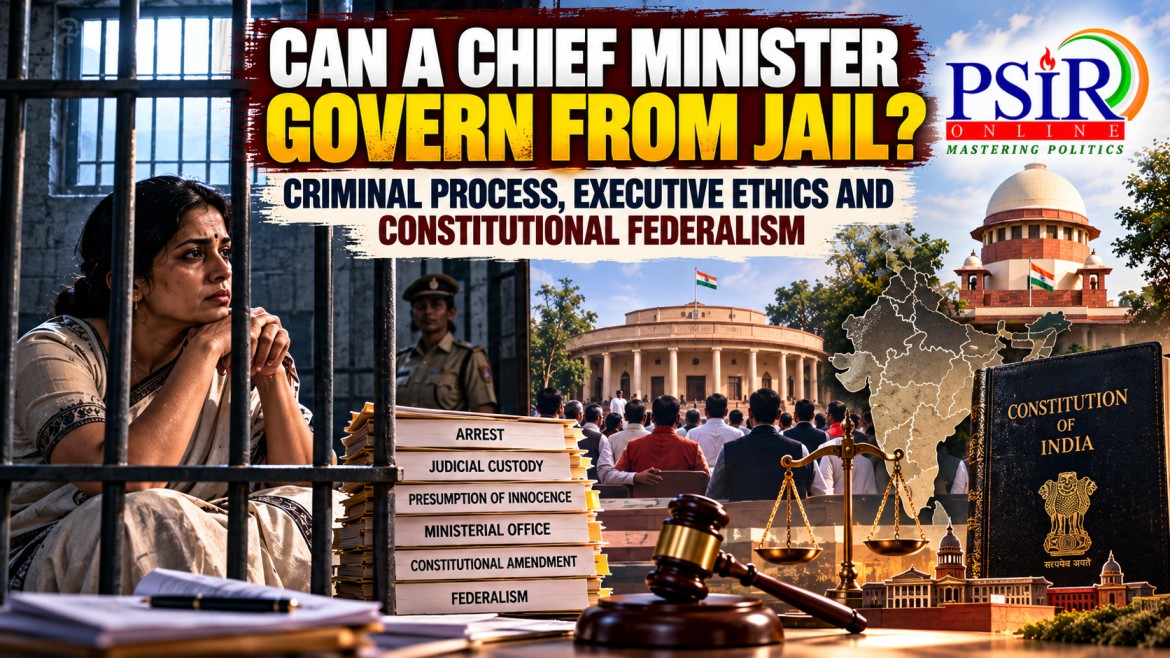
Can an elected Chief Minister or Prime Minister continue to govern after being arrested and placed in judicial custody? Indian political experience demonstrates that this is not merely a hypothetical constitutional question. Arvind Kejriwal continued as Delhi Chief Minister after his arrest in March 2024 and resigned in September. Hemant Soren resigned as Jharkhand Chief Minister shortly before his arrest in January 2024. In Tamil Nadu, Jayalalithaa's departures from office and O. Panneerselvam's succession illustrate how criminal proceedings, legal disqualification and political continuity can interact. In Bihar, Lalu Prasad Yadav's resignation in 1997 enabled Rabri Devi to assume office.
These cases reveal that arrest, detention, conviction, disqualification and resignation are legally distinct events. They also expose a practical dilemma: the Constitution must protect an elected government's ability to function while ensuring that executive office cannot become a shield against criminal accountability.
The Constitution (130th Amendment) Bill, 2025, seeks to address part of this dilemma by proposing a specific consequence for prolonged detention of certain high constitutional office-holders. The central debate is not simply whether a leader can govern from jail. It is whether custody alone should trigger removal from office before conviction, and how such a rule can be reconciled with due process, democratic legitimacy and continuity of government.
THE EXISTING POSITION AND THE PROPOSED 30-DAY RULE
The distinction between the existing legal framework and the proposed amendment is fundamental.
|
Existing constitutional and legal position |
Proposed change under the Constitution (130th Amendment) Bill, 2025 |
|
Arrest alone does not create a general automatic rule requiring every Chief Minister or Prime Minister to leave office after a specified number of days in custody. |
The Bill proposes a defined custody-based trigger for the removal or cessation of office of specified high executive office-holders. |
|
Conviction may result in statutory disqualification, depending on the offence, sentence and applicable law. |
The proposal would operate in qualifying circumstances even without waiting for a criminal conviction. |
|
A Chief Minister may resign, be replaced politically, or become unable to continue for legal or practical reasons. |
The proposed mechanism would make the specified detention threshold a formal constitutional trigger rather than leaving the issue entirely to political choice. |
|
The Constitution does not guarantee that a detained office-holder can exercise executive functions without practical restrictions. |
The proposal seeks to address concerns about prolonged detention and the functioning of government. |
|
Continuation in office and the ability to govern effectively are separate questions. |
The amendment would establish a new rule governing tenure in the circumstances defined by the Bill. |
Under the Bill's original proposal, the relevant trigger concerns 30 consecutive days in custody in connection with an alleged offence punishable with imprisonment of five years or more. The proposed consequences differ according to the office held and the applicable provisions. It is not a general rule that every arrested minister automatically loses office on the thirtieth day.
The 30-day period is not a constitutional licence to govern from jail for a month. Under the general framework currently in force, there is no universal 30-day automatic-removal rule based solely on detention. Equally, the absence of such a rule does not mean that a detained leader has an unrestricted or guaranteed ability to govern.
The Bill was referred to a Joint Parliamentary Committee. Parliamentary committee records available in July 2026 listed consideration of its draft report, but the Bill's enactment must not be assumed without confirmation of subsequent parliamentary action. Its status should therefore be distinguished from the law already in force.
JAYALALITHAA, O. PANNEERSELVAM AND THE DIFFERENCE BETWEEN CUSTODY AND DISQUALIFICATION
The political history of Tamil Nadu provides an important illustration of how a government can continue when its leader cannot lawfully remain in office.
In 2001, Jayalalithaa became Chief Minister despite existing convictions that disqualified her under the Representation of the People Act, 1951. In B. R. Kapur v. State of Tamil Nadu (2001), the Supreme Court held that she could not lawfully hold the office while the disqualification persisted. The Court rejected the argument that the six-month provision under Article 164(4), which allows a minister who is not a legislator to continue temporarily, could overcome the disqualification.
The central issue was legal eligibility for office, not a general constitutional prohibition on governing while physically imprisoned. Jayalalithaa's position in 2001 must therefore not be described as a straightforward example of a Chief Minister automatically removed because of being in jail.
A similar distinction emerged in 2014. On 27 September, a special court convicted Jayalalithaa in the disproportionate-assets case and sentenced her to four years' imprisonment. The conviction triggered disqualification, and she ceased to be Chief Minister. O. Panneerselvam was sworn in as her successor on 29 September. Jayalalithaa spent approximately 21 days in custody before the Supreme Court granted her bail. Her conviction was subsequently set aside by the Karnataka High Court in May 2015, enabling her return to office.
Why did Jayalalithaa not govern from jail through this period? Because the decisive issue in 2014 was conviction and disqualification, not the passage of a 30-day custody threshold. The installation of O. Panneerselvam preserved executive continuity under a leader who could formally occupy the office. The episode demonstrates how party leadership and constitutional rules can combine to maintain government during a political crisis.
The comparison also exposes the limits of using historical cases to settle the present debate. Jayalalithaa's experience does not prove that every arrested Chief Minister must resign. Nor does it establish that a leader who has not been convicted should be permitted to remain in office indefinitely regardless of practical incapacity.
OTHER INDIAN EXAMPLES: DIFFERENT ROUTES TO EXECUTIVE CONTINUITY
Indian political experience offers several contrasting responses to arrest and criminal proceedings. Their differences are as important as their similarities.
|
Political episode |
Constitutional and political significance |
|
Arvind Kejriwal, Delhi, 2024 |
Kejriwal remained Chief Minister after his arrest in March 2024 and resigned in September. His case directly raised the question of whether formal continuation in office is compatible with effective executive functioning during incarceration. |
|
Hemant Soren, Jharkhand, 2024 |
Soren resigned shortly before his arrest in January 2024. Champai Soren subsequently became Chief Minister. This demonstrated how resignation and succession can prevent a prolonged leadership vacuum. |
|
Lalu Prasad Yadav and Rabri Devi, Bihar, 1997 |
Facing mounting pressure and the prospect of arrest in the fodder-scam proceedings, Lalu resigned and Rabri Devi became Chief Minister. The transition maintained the ruling party's control but raised questions about family-based succession and political accountability. |
|
Jayalalithaa and O. Panneerselvam, Tamil Nadu, 2001 and 2014 |
The episodes highlight the consequences of legal disqualification and the use of succession to preserve government continuity. They should not be treated as proof of an automatic custody-based removal rule. |
These cases demonstrate that there is no single political response to criminal proceedings. A leader may remain in office during custody, resign before arrest, be displaced because of statutory disqualification, or arrange for a successor from the same political party.
The Lalu–Rabri episode also reveals an important democratic tension. Continuity of government does not necessarily guarantee the quality of democratic accountability. A successor may preserve administrative stability while also allowing the same political family or party leadership to retain substantial influence. Conversely, forcing an immediate leadership change may destabilise an elected administration without necessarily improving the quality of governance.
The Kejriwal episode is particularly relevant to the practical question of governing from jail, while the Jayalalithaa cases are especially relevant to legal disqualification. Hemant Soren's resignation and the Lalu–Rabri succession illustrate the role of political choice. Treating all four episodes as legally equivalent would obscure the very distinction that constitutional reform must address.
THE CASE FOR A CUSTODY-BASED RULE
The strongest argument in favour of a defined custody-based mechanism concerns the functional capacity and integrity of executive government.
A Chief Minister or Prime Minister is responsible for coordinating departments, supervising administration, responding to emergencies, taking policy decisions and maintaining communication with constitutional authorities. Prolonged incarceration may obstruct access to officials, files, confidential information and routine administrative processes. Even where legal procedures permit communication with government representatives, such arrangements cannot automatically be equated with ordinary executive functioning.
A prolonged leadership crisis may also create uncertainty within the bureaucracy. Civil servants may hesitate to act where instructions are unclear, cabinet coordination may become difficult, and urgent decisions may depend excessively on intermediaries. In a parliamentary system, executive authority must be exercised through established constitutional and administrative channels rather than informal arrangements built around a leader's personal influence.
A custody-based rule could therefore provide predictability and institutional continuity. It could prevent a prolonged dispute over whether a detained office-holder is practically capable of discharging constitutional responsibilities. A clear mechanism may also reduce uncertainty for the Governor, the Council of Ministers, the legislature and the civil service.
The ethical argument is equally significant. Public office carries responsibilities that extend beyond personal political survival. A leader may possess a strong electoral mandate and still face circumstances that make ordinary governance difficult. The public interest requires institutions to function effectively even when the incumbent leader cannot perform the role in the usual manner.
However, these arguments establish the need to consider a mechanism; they do not automatically justify every feature of the proposed Bill. Administrative inconvenience, political controversy and constitutional incapacity are not identical conditions. A sound rule must define the circumstances that justify removal and the safeguards needed to prevent arbitrary use.
THE RISKS: PRESUMPTION OF INNOCENCE, POLITICAL MISUSE AND FEDERALISM
The principal objection to automatic removal is that arrest is not proof of guilt. Criminal proceedings may arise from genuine allegations, but an arrest can also be challenged as unlawful, politically motivated or unsupported by sufficient evidence. If detention alone leads to the loss of elected office, the power to arrest may acquire consequences far beyond criminal investigation.
In a parliamentary democracy, this creates a potential route through which political competition could be converted into executive displacement. A government might lose its leader before a court has determined guilt, even where the allegations ultimately fail. The danger is especially serious where investigative agencies, political parties and governments are engaged in intense conflict.
The problem is not resolved simply by describing the rule as neutral. A formally uniform threshold may have unequal political consequences if the decision to arrest, the timing of arrest and the duration of custody are contested. The presumption of innocence and the requirement of due process therefore remain central to evaluating any custody-based constitutional amendment.
Federalism introduces an additional concern. A Chief Minister leads a government responsible to an elected State Legislative Assembly. A national constitutional rule that automatically affects the tenure of State executive leaders may influence the balance between central institutions and State political autonomy, particularly when criminal investigations involve opposition-led governments. This does not mean that State leaders should enjoy immunity from criminal law. It means that safeguards must be strong enough to prevent a legitimate accountability mechanism from becoming an instrument of partisan destabilisation.
The proposed rule also raises questions about what should happen after the threshold is reached. Should cessation of office be automatic? What happens if detention is challenged successfully or bail is granted? Can the individual return to office if the underlying legal circumstances change? How should the legislature choose a successor, and how should continuity of executive decision-making be secured?
These are not peripheral drafting questions. They determine whether the reform strengthens constitutional government or creates new uncertainty. Any custody-based mechanism must be evaluated not only by its trigger, but also by its safeguards, consequences and provisions for restoring constitutional normality.
A CONSTITUTIONALLY DEFENSIBLE WAY FORWARD
India needs to protect the integrity of executive government without allowing criminal process to become a shortcut for removing elected leaders. The objective should be a balanced and transparent mechanism, not an assumption that either an arrest or an electoral mandate settles every question.
First, the legal trigger must be clearly defined. The relevant offence category, custody period, treatment of interrupted detention and relationship with bail or judicial orders must be unambiguous. Any distinction between different executive offices should be justified by constitutional structure rather than political convenience.
Second, meaningful judicial safeguards are essential. Where removal is linked to detention before conviction, the mechanism must account for the legality of custody and the possibility that detention may be challenged. Safeguards should reduce the risk that a contested arrest produces an irreversible political consequence before judicial scrutiny is available.
Third, the constitutional framework should distinguish loss of office from criminal guilt. A person may cease to hold executive office because a constitutional rule has been triggered without that consequence itself amounting to a finding of guilt. Public communication and legal drafting must preserve this distinction.
Fourth, continuity of government must be built into the arrangement. The relevant legislature and constitutional authorities should be able to establish a functioning successor administration through established procedures. The objective is not merely to remove an incumbent, but to ensure that public administration, legislative accountability and essential government functions continue without disruption.
Finally, the rule should be tested against federalism and democratic legitimacy. Its operation should not depend on the political identity of the office-holder. A credible framework must apply consistently while preserving the constitutional role of legislatures, courts and the relevant constitutional authorities.
The Indian examples show that leadership succession is already possible through resignation and other legal or political processes. The question for reform is whether those processes are sufficient in cases of prolonged detention, or whether a specific constitutional rule is necessary. The answer must rest on clear legal standards, proportionality, due process and institutional continuity, rather than on the political popularity or unpopularity of an individual leader.
UPSC DIMENSION
|
Constitutional provision or polity concept |
Relevance to the issue |
|
Article 164 |
Governs the appointment and tenure of State ministers, including the Chief Minister's position within the parliamentary system. |
|
Article 75 |
Provides the constitutional framework for Union ministers and the Prime Minister, including collective responsibility to the Lok Sabha. |
|
Article 164(4) and Article 75(5) |
Permit a minister who is not a member of the relevant legislature to continue for up to six consecutive months, subject to constitutional requirements; these provisions do not override an applicable legal disqualification. |
|
Representation of the People Act, 1951, Section 8 |
Provides for disqualification in specified circumstances following conviction. The consequences depend on the applicable statutory provisions and judicial orders. |
|
Article 21 and due process |
Inform concerns about personal liberty, lawful detention and the consequences attached to custody before conviction. |
|
Presumption of innocence |
Raises the question of whether detention alone should produce consequences equivalent to removal from public office before guilt is established. |
|
Parliamentary executive and collective responsibility |
Highlight the need for a functioning Council of Ministers and an executive capable of answering to the legislature. |
|
Federalism and State autonomy |
Raise concerns about the effect of a national custody-based rule on elected State governments and the possibility of partisan misuse. |
|
Judicial review |
Provides a means to scrutinise the legality of state action and assess constitutional challenges to a removal mechanism. |
|
Democratic legitimacy and constitutional morality |
Require a balance between electoral mandates, ethical responsibility, institutional integrity and accountability under law. |
|
Constitution (130th Amendment) Bill, 2025 |
Raises the central policy question of whether prolonged detention should trigger cessation of executive office before conviction and what safeguards such a mechanism requires. |
CONCLUSION
The question of whether a Chief Minister can govern from jail has no adequate answer if it is reduced to a contest between the leader's electoral mandate and the fact of arrest. Indian experience demonstrates several different pathways: Jayalalithaa's disqualification and succession, Kejriwal's continuation in office during custody, Hemant Soren's resignation before arrest, and Lalu Prasad Yadav's transfer of office to Rabri Devi. These episodes show that custody, legal eligibility, practical governing capacity and political succession must be analysed separately.
The Constitution (130th Amendment) Bill, 2025, seeks to create a new rule for specified cases of prolonged detention. Its justification must be assessed against two competing risks: an executive that becomes unable to function effectively, and a constitutional system in which arrest can displace an elected leader before conviction. A defensible solution must protect public administration and accountability while maintaining due process and democratic legitimacy.
Ultimately, the objective should be to ensure that no individual is indispensable to the functioning of government, while no elected government can be destabilised through an inadequately safeguarded use of criminal process. The quality of any reform will depend on whether it achieves both aims.
RELATED READING
PRACTISE QUESTIONS FOR GS2 MAINS
PRACTISE QUESTIONS FOR PSIR
