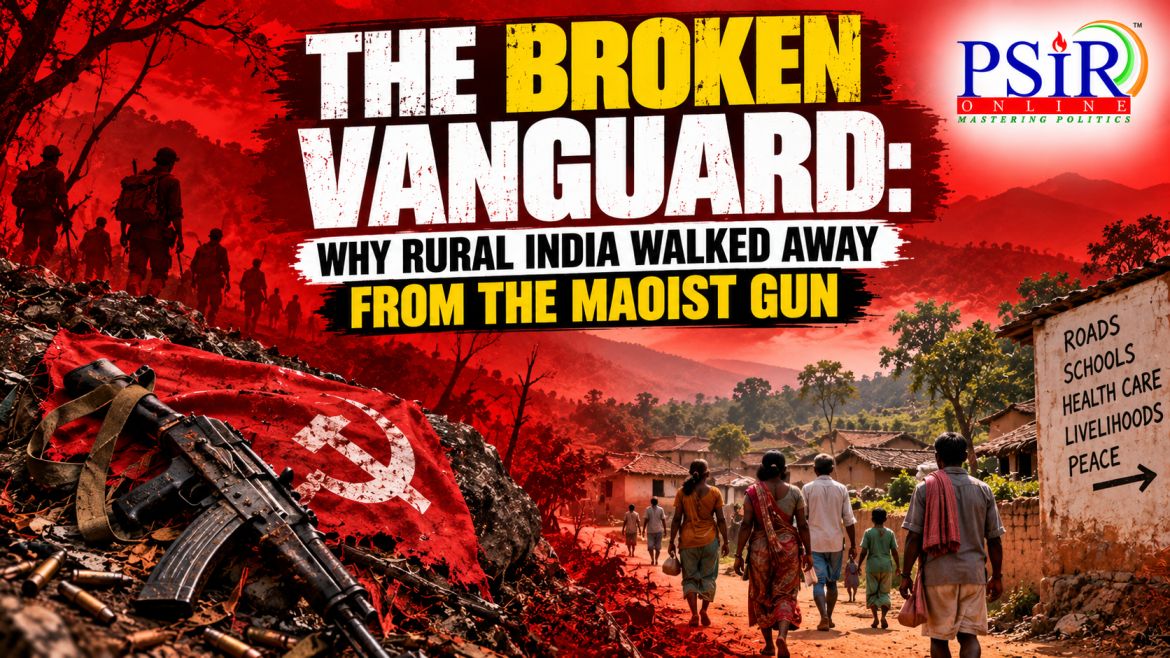
INTRODUCTION: THE END OF AN ARMED ERA
For nearly six decades, the armed insurgency spearheaded by Left-Wing Extremism (LWE)—commonly termed Naxalism or Maoism—represented the most severe internal security challenge to India’s constitutional republic. Operating across a contiguous forest belt historically referred to as the "Red Corridor," the movement contested the sovereignty of the state, established parallel administrative structures, and rejected parliamentary democracy in favor of armed insurrection.
In 2026, this protracted confrontation arrived at a historic inflection point. Following sustained security operations, leadership decimation, and progressive administrative expansion, the Union Government formally recorded that active Maoist territorial control had fallen to zero districts. The March 2026 declaration did not merely reflect military containment; it registered the operational exhaustion and political collapse of an armed party that had irreversibly lost its territory, its leaders, and its recruits.
WHAT IS NAXALISM? THE IDEOLOGY AND THE GUN
Naxalism is an armed communist insurgency rooted in Maoist political philosophy, seeking the overthrow of the Indian democratic state through a protracted armed struggle.
· The Agrarian Origin: The movement originated in 1967 in Naxalbari, West Bengal, as a radical peasant rebellion against feudal land relations and agrarian exploitation. Breaking away from parliamentary communist parties, its early ideologues rejected electoral politics, advocating the encirclement of cities from the countryside through rural armed bases.
· The Parallel Proto-State (Janathana Sarkar): At its peak after the 2004 formation of the CPI (Maoist), the movement operated a parallel authority across isolated tribal belts such as Bastar and Dandakaranya. It levied informal taxes on forest produce (such as tendu leaf) and civil contractors, ran arbitrary kangaroo courts, enforced bans on statutory schools and roads, and carried out lethal boycotts of democratic polling.
· The Vanguard Claim: For decades, the armed party justified its authority on the premise that the constitutional state was entirely absent, asserting that only the gun could represent or defend vulnerable Adivasi communities against administrative neglect and industrial resource extraction.
THE UPROOTING: HOW THE SECURITY GRID DISSOLVED THE SAFE ZONES
The structural collapse of Naxalism was achieved not through sporadic raids, but via an institutional overhaul of counter-insurgency doctrine.
· Permanent Forward Encampment: Guided by the 2015 National Policy and Action Plan, the Centre and affected states abandoned the ineffective cycle of temporary search-and-withdraw operations. Instead, security forces constructed fortified forward operating bases deep inside traditional insurgent sanctuaries, continuously shrinking the Maoists' physical maneuvering space.
· Tactical Coordination and Pressure: Coordinated operations between specialized central units (such as CRPF’s CoBRA) and local state formations (notably Chhattisgarh’s District Reserve Guard) maintained unrelenting ground pressure. Operations such as Operation Kagar / Black Forest systematically dismantled guerrilla bastions that had remained inaccessible for decades.
· Closing Political Gaps: Seamless operational alignment between the Centre and state administrations—particularly after administrative realignments in key battlegrounds like Bastar—eliminated jurisdictional ambiguities that previously allowed armed squads to slip across state boundaries.
DECAPITATION: THE COLLAPSE OF THE UNDERGROUND COMMAND
Because clandestine, banned political organizations operate in secret, they lack the institutional flexibility to reconstitute leadership once the senior cadre is neutralized.
· Loss of the Strategic Core: Between 2024 and 2026, targeted intelligence strikes eliminated the intellectual and operational spine of the CPI (Maoist). Key leadership losses—including General Secretary Nambala Keshava Rao (alias Basava Raju) and military commander Madvi Hidma in 2025—left the central Politburo and Central Military Commission shattered.
· The Succession Void: Unable to convene open party congresses or conduct regular internal elections under continuous surveillance, the underground apparatus found it impossible to replace its veteran ideologues and strategists.
· Destruction of Rear Sanctuaries: Deprived of safe rear bases in which to train, regroup, and induct fresh leadership, younger field commanders were left tactically isolated and administratively leaderless across former operational zones.
THE SOCIO-PSYCHOLOGY OF ALIENATION: WHY PEOPLE LOST INTEREST IN NAXALISM
The collapse of Left-Wing Extremism (LWE) was not solely an operational defeat driven by forward operating bases, arrests, and armed encounters. At a deeper level, the armed movement suffered an irreversible crisis of psychological legitimacy. The initial willingness of rural communities to shelter or tolerate insurgents eroded as the costs of alignment escalated and the material basis of Maoist authority dissolved.
1. The Erosion of the "Protector" Myth: Coercion Over Representation
· Arbitrary Paranoia and Internal Terror: For an insurgency under continuous security pressure, the fear of police intelligence produced intense internal paranoia. The routine branding of local villagers as "police informers," followed by arbitrary executions in kangaroo courts (Jan Adalats), directly severed the bond of trust. Instead of being perceived as community protectors, squads increasingly behaved as armed authoritarians ruling through fear.
· The War Tax Burden: The parallel levy system—extracting shares from tendu leaf collection, small contractors, and local traders—began to feel less like revolutionary redistribution and more like parasitic extortion. Communities experienced continuous economic extraction to fund a protracted war that delivered no tangible social mobility.
2. The Development Paradox: The Collapse of "The Party or Nothing"
· Vulnerability in an Institutional Vacuum: Historically, tribal villagers accepted Maoist parallel authority (Janathana Sarkar) largely because the constitutional state was entirely absent. The movement survived because it was the only actor providing dispute resolution, however crude.
· The Psychological Shock of Tangible Services: When security camps established permanent forward presence, basic governance arrived behind them: grain rations, civil registration, mobile connectivity, all-weather roads, and health centres. The ideological choice had always been framed by the party as "the gun or nothing". Once physical benefits appeared, that psychological binary collapsed.
· Anti-Development as Betrayal: While opposing industrial mining was easy to justify, physically blowing up schools, tearing down telecom towers, and digging up roads to keep out security forces began to directly contradict tribal aspirations. The local population realized that keeping the state out meant keeping their own children illiterate, isolated, and without healthcare.
3. Generational Fatigue and the "Futile War" Syndrome
· Generational War-Weariness: Decades of living in a militarized crossfire—caught between security cordons during the day and armed rebel squads at night—created chronic trauma and psychological exhaustion. Communities grew tired of collective suspicion, routine cordon-and-search operations, and constant instability.
· Loss of Hope in the Vanguard: Decapitation of the veteran leadership (such as Basava Raju and PLGA commanders like Madvi Hidma) dismantled the aura of invincibility. When younger cadres saw their top Politburo and military commanders killed, captured, or surrendering, the belief that an armed revolution could actually win or capture state power evaporated. Revolutionary romance was replaced by a sense of dead-end suicide.
4. The Aspiration Shift: From Armed Isolation to Democratic Agency
· Aspirations of Tribal Youth: Modern tribal youth, exposed via expanding road networks, market integration, and mobile phones, increasingly refused to spend their lives barefoot in the jungle carrying weapons. They sought education, formal employment, and civic mobility—things the underground forest hierarchy could never offer.
· The Power of Alternative Democratic Channels: Electoral politics across the tribal belt (Jharkhand, Chhattisgarh, Odisha, Telangana) provided visible avenues for indigenous leadership through Panchayati Raj, PESA, reserved legislative seats, and mainstream political parties. People realized that political power and cultural assertion could be fought for through the ballot box and mass political mobilization, making armed guerrilla warfare obsolete.
5. Surrender as an Honorable Exit Ramp
· De-stigmatizing Defection: In the 2000s, leaving the underground party meant being branded a traitor and facing assassination. Generous modern surrender and rehabilitation policies (providing immediate financial support, housing, legal aid, and significant cash rewards) altered the risk-reward calculus.
· Normalizing Integration: When thousands of former combatants successfully returned to their families, opened shops, or joined local reserve units, it broke the psychological hold of the party's oath of perpetual rebellion. Surrender stopped being seen as cowardice; it became a rational, pragmatic pathway back to normal family and civic life.
THE UNFINISHED AGENDA: TRANSITIONING FROM SECURITY TO DEMOCRATIC TRUST
The official recording of zero actively affected LWE districts in 2026 does not imply that administrative vigilance or state responsibility has ended.
· The "Legacy and Thrust" Safeguard: To prevent organizational regrouping or vacuum exploitation, 37 districts remain classified under "Legacy and Thrust" status, retaining targeted central security allocations and accelerated development assistance.
· Resolving Structural Grievances: Sustainable peace requires institutional consolidation. The definitive extinction of Left-Wing Extremism depends on settling long-standing land alienations, expediting Community Forest Resource claims under the Forest Rights Act (FRA), and empowering local Gram Sabhas under the Panchayats (Extension to Scheduled Areas) Act (PESA).
· Replacing the Gun with Democratic Agency: The decline of armed insurrection has firmly shifted the political center of gravity. In modern Central India, the struggle for tribal dignity, resource rights, and autonomy is no longer waged through guerrilla warfare in the forest, but through electoral participation, constitutional safeguards, and grassroots democratic mobilization.
WAY FORWARD: SECURING THE POST-INSURGENCY PEACE
Eliminating the armed apparatus of Left-Wing Extremism (LWE) dissolves the parallel coercive state, but it does not automatically resolve the historical conditions that allowed the insurgency to take root. If the administrative state relies solely on a security footprint without systematically cementing institutional trust, resource justice, and local democratic autonomy, the risk of latent disaffection or ideological relapse remains.
To ensure rural and tribal populations never return to Maoist leanings, state intervention must shift from counter-insurgency containment to responsive constitutional governance across six core areas:
1. Transition from Coercive Footprints to Grassroots Democratic Institutions
· Demilitarizing Routine Governance: Security encampments established under the 2015 National Policy served an essential kinetic function. However, long-term civil legitimacy requires transitioning administrative contact from paramilitary outposts to elected local bodies, revenue officials, schoolteachers, and primary healthcare workers.
· Empowering the Gram Sabha under PESA: The Panchayats (Extension to Scheduled Areas) Act (PESA), 1996, must be enforced in letter and spirit across Fifth Schedule areas. Gram Sabhas must hold genuine statutory authority over minor forest produce, local dispute resolution, and community development priorities, preventing decisions from being overridden by district bureaucracies.
2. Resolving Land Alienation and Forest Rights (FRA Consolidation)
· Clearing the FRA Backlog: The historical driver of tribal grievance has been insecure land tenure. The state must fast-track individual and Community Forest Resource (CFR) titles under the Forest Rights Act (FRA), 2006, particularly across deep forest tracts like Abujhmad and southern Bastar.
· Prohibiting Arbitrary Land Diversion: Subsoil mineral extraction and infrastructure projects must not bypass statutory tribal consent. Forest land diversions must involve verifiable, transparent public hearings, avoiding simulated Gram Sabha consents that fuel anti-state mobilization.
3. Institutionalizing Multi-Dimensional Welfare Saturation
· Beyond Roads to Human Capital: Expanding physical connectivity (all-weather roads and telecom towers) was crucial in breaking insurgent control; the next step is consolidating human development. This requires functioning residential schools (such as Eklavya Model Residential Schools), mother-tongue primary education, and functional rural hospitals.
· Securing the Forest Economy: Indigenous livelihoods depend heavily on Non-Timber Forest Produce (NTFP), such as tendu leaf, mahua, and tamarind. Expanding Minimum Support Price (MSP) operations for minor forest produce and establishing local cooperative processing units directly counters predatory middlemen and illegal extortion networks.
4. Sustained, Dignified Cadre Rehabilitation
· Economic Reintegration: Surrender packages—including monthly stipends, vocational training, and housing subsidies—must be disbursed transparently to prevent surrendered cadres from drifting into criminal syndicates or facing social ostracism.
· Legal Clarity and Protection: State authorities must ensure fast-tracked resolution of minor historical FIRs against surrendered fighters while providing physical protection against retaliatory strikes by residual underground remnants.
5. Sustained Administrative Vigilance in "Legacy and Thrust" Zones
· Preventing Power Vacuums: Retaining 37 transitional districts under the "Legacy and Thrust" framework prevents the emergence of administrative blind spots. Coordinated central and state intelligence must remain active to deter extortion syndicates from reconstituting under alternative banners.
· Financial Surveillance: Central and state enforcement agencies must continue monitoring shell entities, illicit hawala conduits, and mining-corridor kickbacks to permanently choke off underground insurgent financing.
6. Building Police-Community Trust and Constitutional Accountability
· Localizing Law Enforcement: Gradually transitioning security responsibilities from central forces to locally recruited state police formations (such as tribal personnel in reserve units) ensures cultural empathy, vernacular communication, and civil restraint.
· Strict Adherence to Constitutional Morality: As affirmed by the Supreme Court in Nandini Sundar (2011), state actions must remain grounded in the rule of law. Upholding civil liberties and preventing arbitrary detentions during residual mop-up operations ensures the state is perceived as a fair constitutional arbiter rather than an occupying force.
PSIR THEORETICAL DIMENSION & EXAMINATION LINKAGES
|
PSIR Theoretical Dimension & Thinkers |
How It Connects to Examination Answers (PSIR Paper 1 / Paper 2) |
|
Monopoly of Legitimate Violence & State-Making (Max Weber; Charles Tilly) |
Reclaiming the Coercive Monopoly: Connects the tactical dismantling of the Janathana Sarkar (parallel courts, revolutionary levies, armed battalions) to the Weberian imperative that a sovereign state cannot tolerate a rival coercive authority within its territorial jurisdiction. |
|
Protracted People’s War & Guerrilla Warfare (Mao Zedong; Che Guevara) |
The "Fish in Water" Dilemma: Evaluates the breakdown of Maoist military doctrine. When local tribal communities (the water) withdrew logistical shelter, intelligence, and recruits due to coercive extortion, the armed guerrilla cadres (the fish) could no longer survive against permanent forward operating bases. |
|
Subaltern Consciousness & Hegemony (Antonio Gramsci; Partha Chatterjee) |
Welfare as Hegemonic Absorption: Demonstrates how public distribution systems, rural roads, direct benefits, and civil infrastructure functioned as counter-hegemonic instruments, dismantling insurgent legitimacy and integrating the subaltern population into the constitutional state. |
|
State Fragility & Institutional Vacuums (Joel Migdal – Strong Societies and Weak States) |
Penetration over Vacuums: Explains how insurgencies thrive in peripheral areas where the formal state is absent. The shift from episodic raids to permanent administrative presence closed the governance deficit that had sustained parallel rebel authority for decades. |
|
Relative Deprivation & Structural Violence (Ted Robert Gurr; Johan Galtung) |
From Negative to Positive Peace: Distinguishes between "negative peace" (the tactical cessation of violence and elimination of combatants) and "positive peace" (the structural resolution of tribal land alienation, displacement, and economic marginalization under the Fifth Schedule). |
|
Electoral Deepening vs. Extra-Legal Insurrection (Rajni Kothari; Yogendra Yadav) |
Democratic Agency Over Armed Struggle: Traces how democratic expansion—through regional political parties, tribal-majority statehood, and reserved legislative representation—provided constitutional avenues for indigenous leadership, rendering armed insurrection politically obsolete. |
CONCLUSION: BEYOND THE GUN
The official determination in 2026 that Left-Wing Extremism (LWE) has been reduced to zero active districts represents a landmark operational milestone, but it is not an automatic guarantee of lasting peace. The collapse of the CPI (Maoist) was sealed when the movement suffered an irreversible socio-psychological rupture with its rural base. For decades, the armed party justified its parallel authority on the claim that only the gun could reach forgotten indigenous populations. That claim disintegrated once the state established permanent security encampments, pushed welfare infrastructure deep into former safe zones, and broke the binary of "the party or nothing". When insurgent squads reacted to their own strategic isolation with arbitrary violence and anti-development sabotage, indigenous communities stopped sheltering the vanguard.
However, extinguishing an armed hierarchy is distinct from resolving the structural grievances that gave it birth. The retention of 37 districts under "Legacy and Thrust" status confirms that administrative vigilance must continue to prevent localized regrouping. Long-term democratic stability now depends on transitioning from security-led containment to responsive constitutional governance. By settling pending Forest Rights Act claims, empowering customary Gram Sabhas under PESA, ensuring the dignified reintegration of surrendered cadres, and respecting tribal land tenure, the Indian state can permanently replace the politics of the gun with the enduring agency of the ballot.
RELATED READING & ANALYTICAL ANGLES
· Constitutional & Statutory Frameworks in Scheduled Areas:
o Article 244 and the Fifth Schedule: The constitutional architecture governing Scheduled Areas, balancing tribal land protection with governor-administered regulations.
o Panchayats (Extension to Scheduled Areas) Act, 1996 (PESA): Statutory devolution of power to village assemblies over natural resources, land acquisition, and dispute resolution.
o Forest Rights Act, 2006 (FRA): Legal recognition of individual and Community Forest Resource (CFR) rights, serving as a primary antidote to tribal land alienation.
o Unlawful Activities (Prevention) Act, 1967 (UAPA): The statutory framework governing the ongoing formal prohibition of the CPI (Maoist) as a terrorist formation.
· Key Judicial Pronouncements on Counter-Insurgency:
o Nandini Sundar & Ors. v. State of Chhattisgarh (2011): The Supreme Court's landmark verdict ruling that arming untrained civilian vigilantes (Salwa Judum / Special Police Officers) violated Articles 14 and 21, establishing that counter-insurgency must operate strictly within constitutional morality.
· Security & Policy Doctrines:
o National Policy and Action Plan (2015): The integrated civil-military framework combining forward base placement, centralized intelligence, critical road infrastructure, and civic action programs.
o The "Legacy and Thrust" Classification: The administrative mechanism retaining central security deployments and focused welfare funding across transitional districts to prevent organizational resurgence.
· Political Economy of Resource Conflict:
o Accumulation by Dispossession (David Harvey): The theoretical dialectic between the developmental state’s demand for coal, bauxite, and iron ore extraction in Central India and local indigenous resistance against ecological and spatial displacement.
PRACTICE QUESTIONS FOR PSIR
