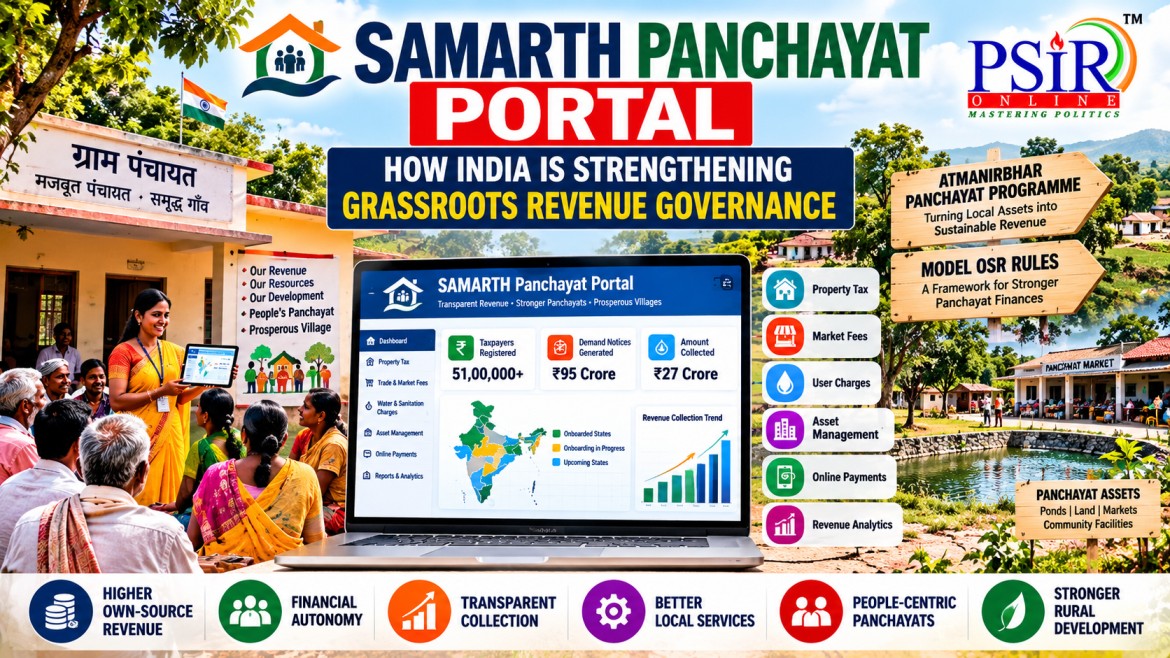
Panchayati Raj Institutions (PRIs) are responsible for delivering essential services and supporting local development, but their ability to perform these functions depends partly on the financial resources available to them. Many Panchayats rely heavily on grants from higher levels of government, limiting their flexibility to respond to local priorities.
The SAMARTH Panchayat Portal, the Atmanirbhar Panchayat Programme and the Model Own Source of Revenue (OSR) Rules were launched or released by the Ministry of Panchayati Raj on 27 July 2026 to strengthen the financial capacity of Panchayats.
The three initiatives address different but complementary dimensions of local revenue governance. SAMARTH digitises revenue assessment, demand generation and collection. The Atmanirbhar Panchayat Programme encourages Panchayats to develop sustainable revenue-generating projects using local assets. The Model OSR Rules provide States and Union Territories with a framework for improving revenue assessment, collection and management.
Together, they seek to strengthen fiscal decentralisation, financial accountability and local-government capacity. However, generating more revenue is only the first step. The ultimate objective must be to improve public services and make local institutions more responsive to citizens.
WHAT IS THE SAMARTH PANCHAYAT PORTAL?
The SAMARTH Panchayat Portal is a digital platform developed by the Ministry of Panchayati Raj to help Panchayats assess, generate, collect and monitor their tax and non-tax revenues.
It seeks to streamline processes that may otherwise depend on fragmented records, manual calculations and inconsistent collection practices. Its public-facing services include taxpayer registration, viewing tax demands, online payment and downloading payment receipts.
The portal can support the following functions:
· Revenue assessment: Maintaining records of properties and other taxable or chargeable activities.
· Demand generation: Generating and communicating tax or fee demands to liable individuals and entities.
· Online collection: Enabling citizens to pay applicable dues digitally.
· Revenue monitoring: Tracking amounts demanded, collected and pending.
· Record management: Improving the systematic maintenance of tax registers and payment information.
Panchayat revenue may include property or house taxes, market fees, rents from local assets, charges for certain services, building-related fees and other permissible receipts, depending on the applicable State law.
The portal is intended to improve administrative efficiency and make revenue collection more transparent. Digital records can help identify outstanding dues, reduce discrepancies and provide administrators with a clearer picture of the Panchayat's revenue position.
At the launch on 27 July 2026, the Ministry reported that Chhattisgarh and Himachal Pradesh had been onboarded, with more than 51 lakh taxpayers registered, demand notices worth approximately ₹95 crore generated, and more than ₹27 crore collected. Onboarding was also underway in Maharashtra, Mizoram, Assam, Haryana, West Bengal and Uttar Pradesh.
These are launch-period figures reported by the Ministry. They demonstrate the initial scale of implementation but do not, by themselves, establish long-term improvements in collection efficiency or service delivery.
ATMANIRBHAR PANCHAYAT PROGRAMME: TURNING LOCAL ASSETS INTO REVENUE
The Atmanirbhar Panchayat Programme complements digital revenue collection by encouraging Panchayats to identify and develop local assets that can generate sustainable income.
A Panchayat may possess or manage assets such as market spaces, shops, community facilities, ponds, land or other locally available resources. Some assets may be underutilised, poorly maintained or not managed through a financially sustainable model.
The programme seeks to help eligible Panchayats convert such resources into viable revenue-generating projects. Its implementation framework includes technical assistance, project preparation and an open challenge process at the State and national levels.
The programme is designed as a four-year initiative. Under the announced framework, 50 projects are envisaged in the first year and 100 projects annually in each of the following three years.
Eligibility conditions include minimum own-source-revenue thresholds—generally ₹50 lakh for Gram Panchayats and ₹1 crore for Block Panchayats—with relaxed norms for eligible Northeastern and hill States. The programme also requires Gram Sabha clearance and provides support for developing project proposals into sustainable, bankable concepts.
Potential financing options include convergence with government schemes, Corporate Social Responsibility (CSR) funding and public-private partnerships, where appropriate.
For example, a Panchayat might explore improving the management of a local market, developing a community facility or establishing a viable service around an existing asset. The feasibility of each project would depend on local demand, legal ownership, operating costs, environmental considerations and the Panchayat's capacity to manage it.
The programme's significance lies in moving beyond the collection of existing taxes towards planned and sustainable local revenue generation. However, revenue projects must remain consistent with public welfare, environmental safeguards and the rights of local communities. An asset should not be commercialised merely because it can generate income.
MODEL OSR RULES: BUILDING A FRAMEWORK FOR REVENUE GOVERNANCE
The Model Own Source of Revenue Rules provide States and Union Territories with a guiding framework to strengthen the legal and administrative arrangements through which Panchayats collect their own revenue.
The framework covers the assessment, collection and management of revenue sources such as property taxes, user charges, fees and other permissible non-tax revenues.
A central feature is that the Model Rules are advisory in nature. States and Union Territories may adopt, adapt or modify them according to their existing laws, administrative arrangements and local requirements. They do not automatically impose a uniform tax structure across India.
The need for such a framework arises because local revenue governance depends on more than the existence of a tax. Panchayats also need clear rules on assessment, billing, collection, record maintenance, accountability and the handling of disputes.
|
Governance requirement |
How the Model OSR framework can help |
|
Clear revenue rules |
Provides a reference for States reviewing or strengthening Panchayat revenue provisions. |
|
Consistent assessment |
Encourages systematic procedures for identifying liable properties and activities. |
|
Transparent collection |
Supports clear demands, documented payments and accountable revenue administration. |
|
Better records |
Encourages reliable registers and monitoring of outstanding dues. |
|
State-level adaptation |
Allows rules to reflect State laws, local conditions and the different capacities of Panchayats. |
The framework also connects with the broader constitutional objective of strengthening local self-government. Article 243H of the Constitution enables State Legislatures to authorise Panchayats to levy, collect and appropriate taxes, duties, tolls and fees, subject to the constitutional and State-law framework.
Thus, the Union government's Model OSR Rules can provide policy guidance, but their practical effect depends on State-level legal action, institutional capacity and implementation.
WHY OWN-SOURCE REVENUE MATTERS FOR LOCAL GOVERNANCE
Own-source revenue refers to resources raised by a Panchayat through its own authorised revenue instruments rather than transfers received from the Union or State governments.
Grants remain essential for rural development, particularly in poorer regions where the local tax base is limited. However, a stronger own-source-revenue base can give Panchayats greater flexibility to meet local needs and maintain assets.
First, it can strengthen fiscal autonomy. A Panchayat with predictable local revenue may be better positioned to plan maintenance, support local services and respond to immediate community priorities.
Second, it can improve accountability. When residents pay taxes or user charges, they may demand clearer information about how the money is spent. Transparent collection and expenditure records can strengthen the relationship between local taxation and public responsibility.
Third, it can improve asset management. Revenue records and project assessments can encourage Panchayats to identify underutilised assets, maintain them properly and consider financially sustainable uses.
Fourth, it can strengthen local planning. Reliable revenue estimates help Panchayats prepare realistic budgets and distinguish between recurring expenditure, maintenance requirements and new development projects.
Fifth, it can improve administrative efficiency. Digitisation can make outstanding demands more visible and reduce the time spent reconciling paper records, provided that the underlying data is accurate.
Nevertheless, higher revenue collection does not automatically mean better governance. A Panchayat might collect more money but continue to face poor sanitation, inadequate water supply or deteriorating public infrastructure. The quality of governance depends on how revenue is raised, how it is spent and whether citizens receive better services.
IMPLEMENTATION CHALLENGES AND THE WAY FORWARD
Several challenges will determine whether these initiatives produce durable improvements.
Unequal revenue capacity: Panchayats differ in population, economic activity, property values and available assets. A uniform expectation of revenue growth could disadvantage poorer and remote areas. State support and differentiated targets are therefore important.
Taxpayer identification and valuation: Incomplete property records, outdated valuations and disputes over ownership can weaken assessment. Digital systems need accurate records and accessible grievance-redressal procedures.
Affordability and fairness: Tax and fee increases can place pressure on low-income households if implemented without safeguards. Revenue mobilisation must follow applicable law and consider affordability, exemptions and due process.
Administrative capacity: Panchayats need trained staff, reliable digital access and adequate technical support. Digital platforms cannot compensate for weak institutions or poor record maintenance on their own.
Asset viability: Revenue-generating projects require careful feasibility assessment, transparent procurement and realistic estimates of operating costs. Projects that depend on uncertain demand or neglect environmental and community concerns may fail to deliver sustainable income.
Transparency in expenditure: Citizens need information not only about taxes collected but also about the purposes for which the revenue is used. Public disclosure of budgets, expenditure and project outcomes can help connect revenue collection with accountability.
Dependence on transfers: Own-source revenue should complement, not replace, constitutionally and legally appropriate intergovernmental transfers. Many Panchayats serve communities with limited ability to pay, making grants essential for equitable service delivery.
The way forward is to link revenue mobilisation with transparent budgeting, citizen participation, sound asset management and measurable service outcomes. State governments should strengthen local revenue laws, provide technical assistance and encourage Panchayats to prepare realistic revenue and expenditure plans. Independent reviews should assess not merely the amount collected but also collection efficiency, fairness and improvements in local services.
UPSC ANGLES
|
Dimension |
Relevance for UPSC GS-II |
|
Constitutional governance |
Connects Article 243H and State legislative authority with the fiscal powers of Panchayati Raj Institutions. |
|
Fiscal decentralisation |
Highlights the relationship between local revenue, financial autonomy and dependence on higher-level grants. |
|
Local self-government |
Shows how stronger revenue capacity can support the functioning of institutions established under the 73rd Constitutional Amendment. |
|
Accountability and transparency |
Connects digital tax records, demand notices and payment receipts with public scrutiny of local administration. |
|
Participatory governance |
Emphasises Gram Sabha approval, citizen involvement and local priorities in revenue-generating projects. |
|
Rural development |
Links local asset management and own-source revenue with the maintenance of public facilities and rural services. |
|
Social justice |
Raises questions about affordability, unequal tax bases and the need to protect low-income households. |
|
Digital governance |
Illustrates how digital platforms can improve record-keeping while remaining dependent on accurate data and administrative capacity. |
|
Cooperative federalism |
Shows the role of the Union in providing guidance and the responsibility of States to adapt rules to their legal and institutional contexts. |
|
Public finance |
Demonstrates the distinction between revenue generation, budget management and expenditure outcomes. |
|
Sustainable development |
Highlights the need to develop local assets without compromising environmental protection or community interests. |
|
Policy evaluation |
Encourages assessment through collection efficiency, financial sustainability, transparency and improved service delivery rather than revenue totals alone. |
CONCLUSION
The SAMARTH Panchayat Portal, the Atmanirbhar Panchayat Programme and the Model OSR Rules represent complementary efforts to strengthen the financial foundations of grassroots governance.
SAMARTH seeks to improve the administration of tax and non-tax revenue. The Atmanirbhar Panchayat Programme encourages viable projects based on local assets, while the Model OSR Rules provide States and Union Territories with a framework for strengthening their revenue systems.
Their broader significance lies in connecting fiscal decentralisation with administrative accountability. Yet financial self-reliance should not be understood as the withdrawal of higher-level support or the pursuit of revenue at any cost.
The real measure of success will be whether Panchayats can raise resources fairly, manage them transparently and convert them into better services and stronger local institutions. Revenue mobilisation is a means; accountable and responsive local governance is the objective.
OFFICIAL REFERENCES AND FURTHER READING
GS2 MAINS PRACTICE QUESTIONS
10 marks — 150 words
15 marks — 250 words
