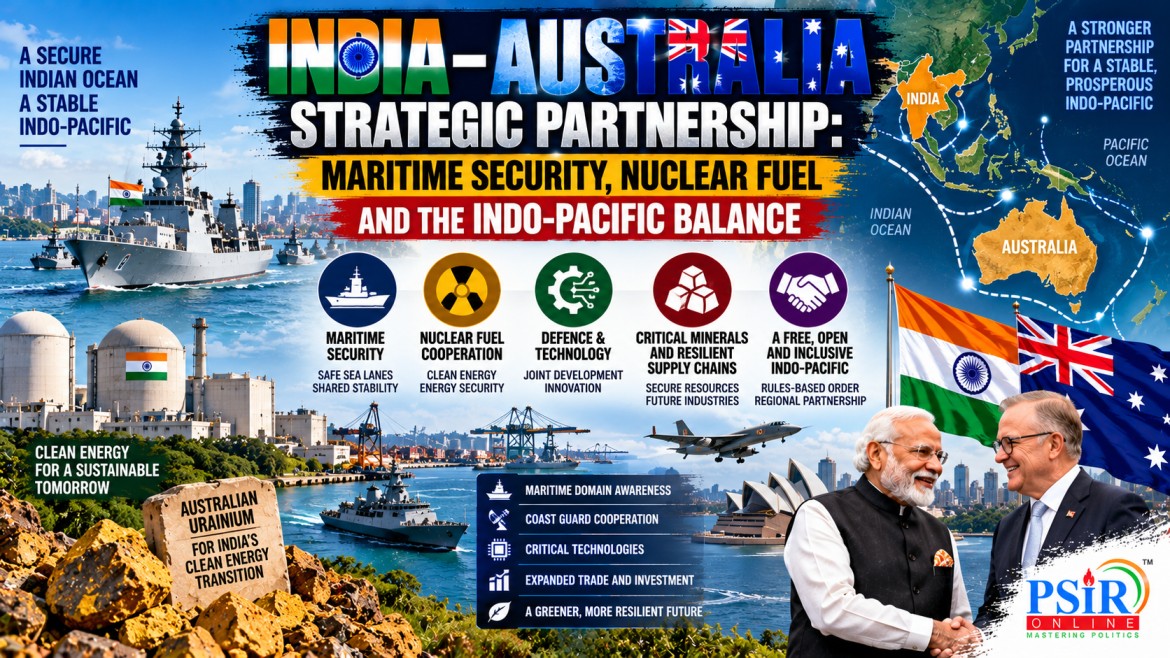
India–Australia relations have evolved from a partnership centred largely on trade, education and people-to-people exchanges into a broader relationship encompassing defence, maritime security, energy, critical technologies and regional governance. The establishment of the Comprehensive Strategic Partnership (CSP) in 2020 accelerated this transformation, while the Quad and expanding bilateral defence cooperation created additional platforms for strategic coordination.
The Third India–Australia Annual Summit, held in Melbourne from 8 to 10 July 2026, marked another stage in this evolution. Prime Ministers Narendra Modi and Anthony Albanese announced a Joint Declaration on Defence and Security Cooperation, advanced maritime-security collaboration and finalised administrative arrangements enabling long-term Australian uranium exports to India for peaceful purposes under International Atomic Energy Agency (IAEA) safeguards.
The summit also highlighted cooperation in critical technologies, resilient supply chains, energy security and defence-industrial development. These developments raise a central question: can India and Australia translate strategic convergence into sustained operational cooperation while preserving their independent foreign-policy choices? The answer depends on implementation, the management of economic and technological interdependence, and the contribution both countries make to a stable and inclusive Indo-Pacific regional order.
THE JULY SUMMIT: INSTITUTIONALISING STRATEGIC CONVERGENCE
The July 2026 summit consolidated a partnership whose institutional foundations have developed over several years. The CSP, the Economic Cooperation and Trade Agreement (ECTA), the Mutual Logistics Support Arrangement and regular defence dialogues have created mechanisms for cooperation across security and economic domains.
The summit produced a Joint Declaration on Defence and Security Cooperation, committing both countries to deeper strategic consultation, more complex military exercises, improved interoperability, expanded information sharing and stronger defence-industrial collaboration. The leaders also supported an Annual Defence Ministers’ Dialogue as a mechanism for sustained consultation.
The two governments advanced the India–Australia Maritime Security Collaboration Roadmap and welcomed a memorandum of understanding between Australia’s Maritime Border Command and the Indian Coast Guard. These arrangements establish a framework for cooperation in maritime awareness, capability development, capacity-building and operational coordination.
Economic and technological cooperation also featured prominently. Both governments committed to advancing negotiations towards a Comprehensive Economic Cooperation Agreement (CECA), strengthening investment and developing resilient supply chains. Critical minerals, clean-energy technologies, cyber security and space cooperation were identified as additional areas of engagement.
The summit therefore sought to connect political commitments with institutional procedures and practical cooperation. Its significance will ultimately depend on the implementation of these arrangements rather than the number of declarations issued.
MARITIME SECURITY AND THE INDO-PACIFIC BALANCE
Maritime security is central to the India–Australia partnership. Both countries depend on uninterrupted maritime commerce for energy supplies, industrial inputs and economic growth. Disruptions to shipping, maritime crime, illegal fishing, natural disasters and strategic competition can therefore affect their security and prosperity.
The July summit placed greater emphasis on information sharing, capability development and operational coordination. Cooperation between the Indian Coast Guard and Australia’s Maritime Border Command can support responses to maritime incidents, illegal activities and threats to commercial shipping. Naval exercises, personnel exchanges and logistics arrangements can further improve familiarity between the two defence forces.
The partnership is reinforced by the Quad, comprising India, Australia, Japan and the United States. The Quad provides a forum for cooperation on maritime domain awareness, humanitarian assistance, disaster relief, critical technologies and regional resilience. However, it is not a collective-defence alliance and does not impose an automatic military-response obligation on its members.
This distinction is important for India. New Delhi seeks to strengthen its maritime capabilities and cooperate with partners while retaining freedom of strategic choice. Australia, meanwhile, views closer engagement with India as part of its broader approach to regional stability and a rules-based maritime order.
The relationship also operates within a wider regional architecture. Engagement with ASEAN-led mechanisms, the Indian Ocean Rim Association and the Pacific Islands Forum can help connect bilateral security cooperation with broader regional concerns.
Nevertheless, maritime cooperation cannot eliminate strategic competition. Divergent threat perceptions, resource limitations and the political sensitivities of regional states may constrain coordination. An approach perceived as exclusively directed against a particular country could also complicate engagement with other Indo-Pacific partners.
The central challenge is to strengthen maritime capabilities while maintaining regional inclusiveness, freedom of navigation and respect for international law, including the United Nations Convention on the Law of the Sea.
CIVIL NUCLEAR COOPERATION AND INDIA’S ENERGY SECURITY
One of the summit’s major outcomes was the finalisation and signature of the administrative arrangement under the India–Australia Civil Nuclear Cooperation Agreement. The arrangement enables long-term Australian uranium exports to India for exclusively peaceful purposes under IAEA safeguards.
Australia possesses substantial uranium resources, while India seeks to diversify its nuclear-fuel supply and expand the contribution of nuclear power to its electricity system. The agreement creates a framework for cooperation between the two governments and their industries, strengthening the institutional basis for long-term fuel supply.
The development has both economic and strategic significance. Nuclear power can provide low-carbon electricity alongside renewable sources, although its expansion depends on financing, reactor construction, safety regulation, waste management and reliable fuel supplies. Access to Australian uranium can improve India’s supply options, but it does not independently resolve all the constraints facing the country’s nuclear programme.
The arrangement also reflects the gradual evolution of Australia’s approach to nuclear cooperation with India. Earlier differences concerning nuclear non-proliferation and India’s position outside the Nuclear Non-Proliferation Treaty complicated cooperation. The bilateral framework now permits civil nuclear engagement under agreed safeguards, while Australia has reiterated its support for India’s membership of the Nuclear Suppliers Group.
The agreement should not, however, be interpreted as unrestricted nuclear cooperation or as a general relaxation of non-proliferation obligations. IAEA safeguards and peaceful-use conditions remain central to the arrangement.
Energy security also extends beyond uranium. Both governments highlighted cooperation in renewable energy, energy efficiency, low-carbon technologies and resilient energy supply chains. Their relationship thus combines immediate resource-security concerns with longer-term energy-transition objectives.
For India, the priority is to use external partnerships to diversify supplies while strengthening domestic capabilities in nuclear energy, renewable power, storage and energy efficiency. The objective is diversification rather than dependence on a single supplier.
CRITICAL TECHNOLOGIES, DEFENCE INDUSTRY AND ECONOMIC SECURITY
The July summit connected traditional security cooperation with emerging questions of economic security. Supply-chain resilience, technological capability and industrial capacity increasingly influence national power, making these issues integral to the wider strategic relationship.
The Australia–India Partnership on Cyber, Critical Technologies and Supply Chains provides a framework for cooperation in cyber security, digital resilience, critical technologies and supply-chain security. Both governments also highlighted the importance of collaboration in space, defence innovation and emerging technologies.
Critical minerals represent another area of potential complementarity. Australia’s resource base and India’s growing industrial demand create opportunities for investment, long-term supply arrangements and processing capabilities. Cooperation could support batteries, renewable energy, electronics and advanced manufacturing.
However, access to raw materials does not automatically create technological independence. Processing capacity, intellectual property, specialised equipment, finance and skilled labour influence the distribution of value across supply chains. If cooperation remains limited to exporting raw materials and importing finished technologies, India may capture fewer long-term industrial benefits.
Defence-industrial cooperation presents similar opportunities and limitations. Joint research, technology collaboration and industry engagement may improve capability development, but the practical results will depend on procurement procedures, commercial incentives, technology-sharing arrangements and sustained investment.
The economic relationship also contains unresolved questions. Both countries welcomed progress under ECTA and committed to advancing CECA negotiations. A broader agreement will require the reconciliation of differing commercial priorities and regulatory concerns.
The strategic value of the partnership will therefore depend on whether it creates productive interdependence—a relationship in which both countries acquire capabilities and economic opportunities—rather than simply shifting dependence from one external supplier to another.
STRATEGIC AUTONOMY AND THE LIMITS OF CONVERGENCE
India and Australia share important interests in an open Indo-Pacific, secure maritime routes and resilient supply chains. Their cooperation also reflects concern about coercion, unilateral changes to the status quo and disruptions to regional stability. However, shared interests do not make their foreign policies identical.
India’s strategic autonomy reflects its preference for maintaining independent decision-making across different partnerships. It cooperates with the United States, Japan and Australia through the Quad while continuing to engage other major powers and participating in institutions where its interests may differ from those of its partners.
Australia’s strategic outlook places considerable emphasis on alliances and security partnerships, including its alliance with the United States. India and Australia can therefore agree on the importance of maritime stability without necessarily adopting identical positions on every regional crisis or strategic question.
Their partnership is best understood as strategic convergence without a formal alliance. The July declaration deepens consultation, interoperability and information sharing, but it does not create an automatic obligation to participate in one another’s military operations.
The same principle applies to nuclear and economic cooperation. The uranium arrangement provides a more predictable framework for fuel supply, but India’s energy strategy will continue to depend on a broader mix of domestic and external resources. Similarly, critical-technology cooperation can improve resilience only when accompanied by domestic capacity-building.
The partnership also has a wider regional responsibility. Cooperation in maritime awareness, disaster response, search and rescue, and protection of sea lanes can provide practical benefits to smaller states. Such initiatives are more sustainable when they respond to regional needs and complement ASEAN-led and Indian Ocean institutions.
The durability of the relationship will depend on the ability of both governments to manage differences, implement commitments and prevent strategic competition from narrowing the agenda to military concerns alone.
THE WAY FORWARD
India and Australia should prioritise the implementation of the July commitments through measurable work programmes, regular reviews and clear institutional responsibilities.
First, the Maritime Security Collaboration Roadmap should translate political commitments into sustained cooperation on maritime domain awareness, information exchange, Coast Guard coordination, search and rescue, and humanitarian assistance. Such cooperation should remain consistent with international law and responsive to regional requirements.
Second, civil nuclear cooperation should be accompanied by predictable regulatory procedures, transparent safeguards compliance and long-term planning for fuel security. Nuclear power must be evaluated alongside safety, waste management, project costs and the wider energy transition.
Third, defence-industrial and critical-technology partnerships should emphasise joint research, technical training, skills development and opportunities for domestic firms. This would help ensure that supply-chain diversification generates industrial capabilities rather than merely new import relationships.
Fourth, both governments should continue CECA negotiations while addressing trade barriers and investment constraints. Stronger commercial ties can reinforce the strategic partnership, but trade and security cooperation should not be treated as interchangeable or automatically mutually reinforcing.
Fifth, India and Australia should maintain cooperation through the Quad while strengthening engagement with ASEAN-led mechanisms, the Indian Ocean Rim Association and the Pacific Islands Forum. This would connect bilateral strategic coordination with broader regional public goods.
Finally, the partnership should retain sufficient flexibility to accommodate different national interests. Institutional depth, practical delivery and mutual respect will matter more than the number of declarations issued.
THEORETICAL ANGLES
|
Theory or concept |
Application to India–Australia relations |
|
Realism |
Maritime coordination, defence exercises and critical-supply arrangements reflect efforts to protect national interests in a competitive regional environment. |
|
Balance of power |
Cooperation through the Quad and bilateral defence mechanisms contributes to strategic coordination in the Indo-Pacific without creating a formal collective-defence alliance. |
|
Strategic autonomy |
India deepens cooperation with Australia while retaining independent decision-making and the ability to engage multiple major powers. |
|
Liberal institutionalism |
Annual summits, defence dialogues, maritime roadmaps and nuclear arrangements reduce uncertainty and provide procedures for sustained cooperation. |
|
Complex interdependence |
Security, trade, energy, technology and people-to-people links connect the two countries through multiple channels rather than military relations alone. |
|
Economic statecraft |
Uranium supply, critical minerals, investment and technology partnerships demonstrate how economic relationships can advance national-security and diplomatic objectives. |
|
Constructivism |
Shared emphasis on an open Indo-Pacific, international law and regional cooperation shapes the language and institutional identity of the partnership. |
|
Regional security complex |
India–Australia cooperation reflects interconnected security concerns across the Indian and Pacific Oceans, while regional institutions and smaller states influence the strategic environment. |
CONCLUSION
The July 2026 India–Australia Annual Summit advanced the relationship towards more detailed cooperation in maritime security, nuclear fuel, defence technology and economic resilience. The defence declaration, maritime-security roadmap and administrative arrangements for safeguarded uranium exports provide institutional foundations for the next phase of the partnership.
However, declarations alone do not establish operational success. The relationship must demonstrate reliable implementation, commercially viable cooperation and tangible benefits for regional security and domestic capability development. For India, the central task is to deepen cooperation without surrendering strategic autonomy; for Australia, it is to build a durable partnership that combines security coordination with economic and regional engagement.
The long-term significance of the relationship will depend on whether strategic convergence can be translated into practical cooperation while preserving independent foreign-policy choices and an inclusive Indo-Pacific order.
RELATED READING
PRACTICE QUESTIONS FOR GS-II MAINS
PRACTICE QUESTIONS FOR PSIR
