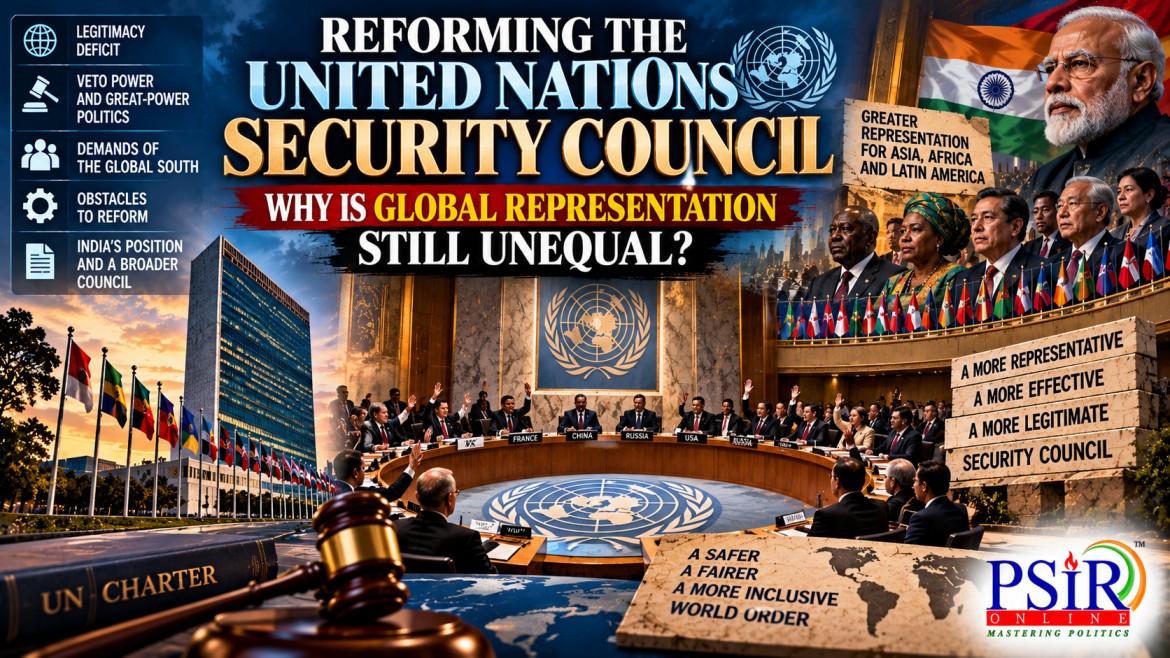
The United Nations Security Council (UNSC) occupies a central position in the international security system. Under the UN Charter, it bears primary responsibility for maintaining international peace and security and can adopt decisions that UN member states are obligated to carry out under the Charter.
However, the Council’s structure continues to reflect the geopolitical realities of 1945 rather than the distribution of power and membership in the contemporary international system. Africa has no permanent seat, Latin America and the Caribbean lack permanent representation, and Asia’s representation remains limited despite the region’s growing economic and political significance.
The issue returned to the centre of multilateral diplomacy during the UN General Assembly’s discussions on equitable representation and Council expansion. On 28 July 2026, the General Assembly decided to continue intergovernmental negotiations and carry the question into its 81st session. This continued the reform process without producing an agreed new Council structure.
For India, reform is closely connected to the principles of sovereign equality, effective multilateralism and the need to give developing countries a greater role in global decision-making. The central question is whether the UN can reform its most powerful organ without losing the cooperation of the states that currently hold privileged positions.
THE STRUCTURAL IMBALANCE: A COUNCIL DESIGNED FOR A DIFFERENT WORLD
The Security Council originally had 11 members. In 1965, an amendment to the UN Charter expanded it to 15 members. Today, it consists of five permanent members and ten non-permanent members elected by the General Assembly for two-year terms.
|
Category |
Present arrangement |
Central concern |
|
Permanent members |
China, France, Russia, the United Kingdom and the United States |
Privileged status reflects the post-Second World War settlement |
|
Non-permanent members |
Ten members elected for two-year terms |
Representation is temporary and does not provide a permanent regional voice |
|
Africa |
No permanent seat |
The continent remains underrepresented despite its importance to the UN’s peace and security agenda |
|
Latin America and the Caribbean |
No permanent seat |
The region lacks permanent representation in the Council |
|
Asia-Pacific |
China is the only Asian permanent member |
The region’s contemporary political and economic diversity is not adequately reflected |
The imbalance is not simply numerical. Permanent members enjoy institutional privileges unavailable to other states, especially the veto. Consequently, the Council’s ability to respond to international crises can depend on the interests of a small group of countries.
The world has changed considerably since 1945. The UN has expanded to 193 member states, decolonisation has transformed international politics, and countries across Asia, Africa and Latin America have become important participants in global economic and diplomatic affairs.
The representation deficit is therefore both geographical and political: many states affected by decisions on conflict, sanctions, peacekeeping and international security have limited influence over the Council’s permanent decision-making structure.
THE LEGITIMACY DEFICIT AND THE VETO PROBLEM
The Council’s legitimacy depends not only on its legal authority but also on whether states consider its decisions representative, consistent and credible.
The veto permits each of the five permanent members to block a substantive resolution, even when it enjoys broad support among the other Council members. This privilege was incorporated into the post-war settlement to secure the participation of major powers in the UN system.
Supporters argue that the veto reflects the political realities of great-power relations and can prevent the UN from adopting measures that directly confront a permanent member. Critics argue that it creates unequal accountability and can paralyse collective action when a permanent member or its close partner is involved in a conflict.
|
Issue |
Consequence for global governance |
|
Veto power |
A single permanent member can block a substantive resolution |
|
Selective effectiveness |
The Council’s capacity to respond may vary according to the interests of permanent members |
|
Unequal representation |
Regions without permanent seats have limited influence over the Council’s long-term direction |
|
Credibility concerns |
Perceived double standards can weaken confidence in collective security |
|
Reform deadlock |
The states benefiting from the existing structure have a decisive role in approving changes to it |
The veto is particularly contentious when the Council considers conflicts involving the interests of its permanent members. In such situations, disagreement can prevent collective action even when the consequences extend far beyond the countries directly involved.
Nevertheless, reform must also consider the practical requirements of collective security. A Council that is larger but unable to reach decisions could face its own effectiveness problems. The challenge is to improve representation, accountability and decision-making capacity together, rather than treating them as separate objectives.
INDIA’S POSITION: A PERMANENT SEAT AND COMPREHENSIVE REFORM
India has consistently supported an expanded Security Council that reflects contemporary geopolitical realities. Its argument rests on its population, international responsibilities, participation in UN peacekeeping and role in the developing world. India also maintains that the Council’s credibility depends on giving greater representation to underrepresented regions.
India’s position operates through the G4 grouping of Brazil, Germany, India and Japan, which supports expansion in both permanent and non-permanent membership categories.
India has also supported the Common African Position, articulated through the Ezulwini Consensus and the Sirte Declaration. This is significant because it connects India’s demand for permanent membership with the broader claim that Africa should receive permanent representation rather than treating reform solely as a competition among individual aspirants.
India’s main positions can be summarised as follows.
|
Issue |
India’s position |
|
Permanent membership |
Supports expansion of the permanent category, including India’s own candidature |
|
Regional representation |
Supports greater representation for Africa and other underrepresented regions |
|
G4 cooperation |
Works with Brazil, Germany and Japan to advance comprehensive reform |
|
African representation |
Supports the Common African Position and the demand to correct historical underrepresentation |
|
Negotiating process |
Calls for text-based negotiations to move beyond repetitive discussions of general principles |
|
Council effectiveness |
Supports reform that improves representation and enables the Council to discharge its responsibilities more effectively |
In its 20 April 2026 statement, India welcomed the presentation of the African reform model and reiterated support for African representation. In its June 2026 intervention, India again aligned itself with G4 and L.69 positions and emphasised the need for substantive progress in the intergovernmental negotiations.
India’s approach also raises difficult questions. Should new permanent members possess the same veto powers as the existing five? How should seats be distributed among regions? Should expansion occur through a single comprehensive settlement or through transitional arrangements?
These questions cannot be resolved by India alone. Any amendment must attract the necessary support among UN member states and, under Article 108 of the Charter, be ratified by two-thirds of the members, including all five permanent members of the Security Council.
India’s position therefore illustrates a wider tension in global governance: the demand for democratic representation must be reconciled with a legal amendment process that preserves the privileges of existing permanent members.
THE GLOBAL SOUTH AND COMPETING REFORM MODELS
The Global South has made Security Council reform a central demand in debates about multilateralism. However, developing countries do not support a single identical model. Their proposals differ over the number of seats, the distribution between permanent and elected members, the veto and regional representation.
The G4 advocates expansion in both membership categories and has supported an enlarged Council of approximately 25–26 members. The African Union’s Common African Position calls for at least two permanent seats with the same prerogatives, including the veto while it exists, and five additional non-permanent seats for Africa.
The L.69 group, comprising developing countries from different regions, also calls for a more representative Council and stronger progress towards negotiations on a concrete reform text.
These proposals share a demand for more equitable representation but differ in emphasis and institutional design.
A further disagreement concerns the veto itself. Some states favour extending veto rights to new permanent members for the sake of equality, while others advocate restricting or abolishing the veto. Still others prioritise adding elected seats and improving working methods.
The issue is therefore not simply whether the Council should expand. It is how to distribute authority within an expanded Council without creating new inequalities or making collective action more difficult.
WHY HAS REFORM REMAINED ELUSIVE?
Despite decades of discussion, Security Council reform has not produced an agreed amendment to the Charter. Several obstacles explain the impasse.
First, the amendment procedure is demanding. Article 108 requires a two-thirds General Assembly majority and ratification by two-thirds of UN members, including all five permanent members. Any permanent member can therefore prevent an amendment from entering into force by withholding ratification.
Second, regional competition complicates the distribution of seats. Countries within the same region may disagree over which states should receive permanent membership, how seats should rotate and what criteria should determine eligibility.
Third, disagreements over the veto remain fundamental. Extending the veto could create additional centres of obstruction, while denying it to new permanent members could establish a second tier of permanent membership.
Fourth, the negotiating process has struggled to move from broad principles to a consolidated text. States may support reform in general but disagree over the number of seats, membership categories, regional allocation, the veto and the Council’s working methods.
The July 2026 General Assembly decision to continue intergovernmental negotiations illustrates both the persistence of the issue and the absence of a completed agreement. The process continues, but continuation alone does not guarantee substantive progress.
A PRACTICAL PATH TOWARDS REFORM
A credible reform process must address both the Council’s representational deficit and its capacity to act.
· Move towards text-based negotiations: Member states should work from concrete proposals and clearly identify areas of agreement and disagreement.
· Expand representation in both categories: Reform should improve the voice of underrepresented regions while preserving meaningful opportunities for smaller and medium-sized states.
· Address the veto transparently: Negotiations should clarify whether veto powers will be extended, restricted or subject to agreed restraints.
· Strengthen accountability: Permanent and elected members should explain their positions more clearly when vetoes block action in situations involving mass atrocities or serious threats to international peace.
· Improve working methods: Greater transparency, consultation with affected states and stronger engagement with regional organisations can improve the Council’s legitimacy even before comprehensive reform is achieved.
· Build cross-regional agreement: The G4, African Union, L.69 and other groups need sustained dialogue to identify common ground without ignoring legitimate differences.
For India, the practical priority is to maintain support for comprehensive reform, strengthen cooperation with the G4 and African partners, and press for negotiations that produce an actual reform text. Diplomatic advocacy will remain necessary because no single proposal can succeed without a broad coalition and the required Charter ratifications.
THEORETICAL ANGLES
|
Theory or concept |
Application to the article and exam use |
|
Realism |
Explains why permanent members seek to preserve institutional privileges and why power politics shapes reform negotiations. |
|
Liberal institutionalism |
Highlights the need to adapt international institutions so that they continue to facilitate cooperation and collective security. |
|
Democratic deficit |
Analyses the gap between the Council’s global authority and the limited representation of much of the UN membership. |
|
Hegemonic stability theory |
Explores the argument that major powers must remain involved for collective security to function, while examining the costs of entrenched privilege. |
|
Multilateralism |
Examines how states negotiate common rules and why institutional legitimacy depends on meaningful participation. |
|
Postcolonial perspectives |
Connects the absence of permanent African representation with the historical inequalities inherited from the colonial and post-war international orders. |
|
Collective security |
Evaluates whether the Council’s current structure enables consistent action against threats to international peace and security. |
|
Institutional reform |
Explains the tension between changing an institution to reflect contemporary realities and preserving the political cooperation required to make it effective. |
CONCLUSION
The Security Council’s representational deficit is one of the most persistent challenges facing contemporary multilateralism. Its composition reflects a historical settlement that has not kept pace with the expansion of UN membership or the changing distribution of international influence.
India’s demand for permanent membership is part of a wider argument for a Council that better reflects Asia, Africa and Latin America. At the same time, the G4, African Union and other groups differ over the number of seats, regional allocation and the future of the veto.
The difficulty lies in the institutional structure itself: reform requires agreement from states whose privileges would be affected by that reform. Yet prolonged inaction can further weaken confidence in the Council’s representative character.
Meaningful reform must combine equitable representation, responsible use of power and the capacity to maintain international peace and security. Without progress on all three, the Security Council risks remaining legally authoritative but increasingly contested in political legitimacy.
RELATED READING
PRACTICE QUESTIONS FOR GS PAPER II MAINS
PRACTICE QUESTIONS FOR PSIR
