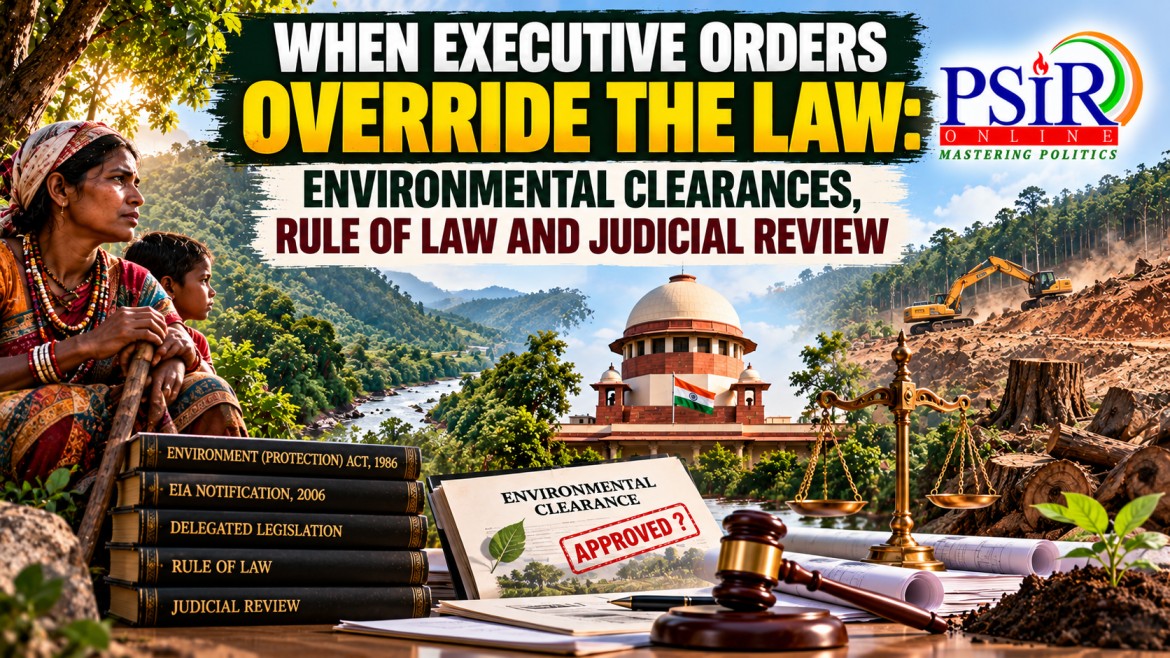
Can the executive government relax a statutory environmental safeguard through an administrative office memorandum? Can a project that begins construction without obtaining mandatory environmental clearance subsequently seek approval merely by paying compensation and complying with remedial conditions? These questions lie at the intersection of executive power, environmental governance and the rule of law.
On 29 July 2026, the Supreme Court of India delivered an important judgment in Vanashakti v. Union of India, addressing the validity of the Central Government's 2021 Office Memorandum that enabled certain projects to seek ex post facto environmental clearance after commencing construction or operations without the required prior approval. The Court struck down the 2021 memorandum, holding that an administrative instruction could not substantially alter the existing statutory environmental-clearance framework. At the same time, it upheld the validity of the 2017 notification, which had created a limited, time-bound mechanism for addressing specified past violations. The Court recognised that narrowly tailored exceptions could be created through a valid statutory instrument under the Environment (Protection) Act, 1986, rather than through an ordinary administrative memorandum.
The judgment is significant because it distinguishes between administrative convenience and legal authority. Governments require flexibility to address exceptional circumstances and reconcile environmental protection with development. However, such flexibility must operate within the law, respect procedural safeguards and remain subject to judicial review. The case therefore offers a broader lesson about the limits of executive discretion in a constitutional democracy.
PRIOR ENVIRONMENTAL CLEARANCE AND THE STATUTORY FRAMEWORK
Environmental clearance is a preventive regulatory mechanism intended to assess the likely environmental consequences of specified development projects before they commence. It enables authorities to examine ecological impacts, consider alternatives, prescribe mitigation measures and, where required, facilitate public participation before potentially irreversible changes occur.
The Environment (Protection) Act, 1986, provides the principal statutory framework for environmental protection. Section 3 empowers the Central Government to take measures to protect and improve environmental quality, including measures concerning environmental pollution. The Environment (Protection) Rules, 1986, provide procedures for exercising specified regulatory powers.
Under the Environmental Impact Assessment (EIA) Notification, 2006, projects falling within its scope must ordinarily obtain prior environmental clearance before undertaking the activities covered by the notification. Depending on the project category, the process may involve screening, scoping, appraisal, environmental-impact assessment and public consultation.
The timing of clearance is crucial. Environmental appraisal conducted before construction can influence the location, design, scale and environmental safeguards of a project. By contrast, assessment after construction has commenced may leave regulators confronting a fait accompli: substantial investment has already occurred, infrastructure may be partially completed and reversing the damage may be costly or difficult.
This does not mean that every violation must automatically lead to the same consequence. The nature of the project, the environmental damage, the applicable law and the availability of lawful remedial measures may differ. Nevertheless, prior clearance is the regulatory norm, and exceptions must have a valid legal basis rather than arise from the assumption that violations can routinely be regularised later.
THE 2017 NOTIFICATION AND THE 2021 OFFICE MEMORANDUM
The dispute concerned two different instruments issued by the Ministry of Environment, Forest and Climate Change. Their distinction is central to understanding the Supreme Court's reasoning.
The 2017 notification introduced a time-bound mechanism to address certain projects that had already commenced without obtaining prior environmental clearance. It created a defined route for appraisal and consideration of specified violations, subject to environmental safeguards and regulatory conditions. The Supreme Court upheld this notification as a valid, narrowly tailored form of delegated legislation under the Environment (Protection) Act, 1986, read with Section 21 of the General Clauses Act, 1897. The Court emphasised its limited and time-bound character.
The 2021 Office Memorandum, dated 7 July 2021, adopted a different approach. It provided a mechanism through which eligible projects that had commenced without prior environmental clearance could seek subsequent approval. The memorandum did not establish the same kind of defined cut-off for the class of projects it covered. Its operation raised the question of whether an administrative instruction could create an open-ended route for regularising violations of the 2006 EIA Notification.
The distinction was not simply between two policy choices. It concerned the legal instrument through which the executive exercised its power. The 2017 notification had followed the prescribed process for delegated legislation, including publication of a draft, consideration of objections and parliamentary oversight. The 2021 memorandum, by contrast, was an administrative instruction that substantially altered how the prior-clearance requirement operated.
The Court held that an executive instruction may supplement an existing statutory framework where the law permits, but it cannot override or replace delegated legislation. The 2021 memorandum therefore exceeded the permissible limits of administrative power.
THE SUPREME COURT'S REASONING: RULE OF LAW OVER ADMINISTRATIVE CONVENIENCE
The judgment rests on several interconnected constitutional and administrative-law principles.
First, executive instructions cannot override law. Administrative memoranda are often used to explain procedures, coordinate departments or implement existing policy. They cannot, however, be used to create a regime that contradicts the requirements of a statutory notification. Where the law requires prior environmental clearance, an executive instruction cannot simply replace that requirement with a general system of retrospective approval.
Second, the form of delegated legislation matters. The Court's treatment of the 2017 notification and the 2021 memorandum illustrates the difference between a legally authorised regulatory measure and an administrative instruction. Delegated legislation must remain within the authority conferred by the parent statute and comply with applicable procedural requirements. The existence of broad statutory powers does not eliminate the need to exercise them through the legally prescribed route.
Third, an open-ended amnesty requires stronger justification. A limited mechanism for addressing specified past violations is not necessarily equivalent to a permanent route through which projects can begin work first and seek clearance later. The Court found that the 2021 memorandum created a perpetual mechanism without a sufficiently justified classification of eligible projects linked to a supervening public interest. It therefore failed the requirements of proportionality and reasonableness.
Fourth, environmental protection involves competing constitutional interests. Development supports employment, infrastructure, housing and economic activity. Environmental regulation protects public health, ecological systems and the interests of future generations. The Court approached the dispute through the need to balance development with the right to a pollution-free environment, rather than treating either objective as automatically overriding the other.
The resulting principle is that public interest must be demonstrated through lawful and proportionate measures. It cannot be invoked as a general justification for bypassing statutory safeguards.
ENVIRONMENTAL JUSTICE, ARTICLE 21 AND THE PRECAUTIONARY PRINCIPLE
Environmental governance in India has developed substantially through the interaction of legislation and judicial interpretation. Article 21, which protects life and personal liberty, has been interpreted by the Supreme Court to encompass dimensions of environmental quality and the conditions necessary for a dignified life.
The judgment must be understood alongside earlier decisions on environmental regulation. In Vellore Citizens' Welfare Forum v. Union of India (1996), the Supreme Court recognised the importance of the precautionary principle and the polluter-pays principle in Indian environmental law. The precautionary principle supports preventive action where environmental harm is threatened, even when scientific certainty is incomplete. The polluter-pays principle requires those responsible for pollution to bear appropriate costs associated with preventing and remedying environmental damage.
In Alembic Pharmaceuticals Ltd. v. Rohit Prajapati (2020), the Court strongly criticised the routine grant of ex post facto environmental clearance. In Common Cause v. Union of India (2017), the Court also examined the consequences of unlawful extraction and the need for accountability in natural-resource governance. These decisions form part of the jurisprudential background against which the later dispute was considered. The July 2026 judgment clarified the relevant precedents in their respective factual and legal contexts rather than treating every earlier observation as an absolute prohibition on all exceptions created through valid legislation.
Retrospective clearance creates a particular environmental risk. If projects can routinely proceed without prior assessment and subsequently obtain approval, compliance may become a cost-benefit calculation rather than a binding legal obligation. Developers could be encouraged to commence work in anticipation of later regularisation, weakening deterrence and disadvantaging those who follow the prescribed process.
However, the opposite concern also deserves consideration. Where a project has already been built, automatic demolition may not always be the most environmentally beneficial response. A lawful authority may need to consider the actual environmental consequences, remediation options, public interest and the legal position of affected communities.
The appropriate distinction is between exceptional, legally authorised remediation and routine retrospective regularisation. Environmental justice requires effective remedies for existing damage without creating incentives for future violations.
THE JUDGMENT'S PRACTICAL CONSEQUENCES
The Supreme Court's ruling has important consequences for government departments, project proponents, environmental regulators and affected communities.
|
Issue |
Consequence of the judgment |
|
The 2021 Office Memorandum |
Quashed prospectively because it created an impermissible open-ended mechanism through an administrative instruction. |
|
The 2017 notification |
Upheld as valid, narrowly tailored and time-bound delegated legislation. |
|
Existing clearances |
Clearances already granted under the 2017 notification or the 2021 memorandum were protected, unless separately challenged on their individual merits. |
|
Pending applications |
The Court directed that pending applications be dealt with in accordance with its directions and applicable law, including reconsideration of certain applications affected by earlier interim proceedings. |
|
Fresh applications |
No fresh applications under the 2017 notification or the 2021 memorandum are to be entertained under the directions of the judgment. |
|
Future executive action |
The Central Government cannot use future administrative orders to establish a comparable route for retrospective clearance. Any permissible exception must follow a valid statutory route. |
|
Exceptional judicial relief |
The Court clarified that its ruling does not restrict the Supreme Court's constitutional power under Article 142 to grant appropriate relief in exceptional cases to do complete justice. |
The judgment does not establish that every project previously granted clearance under the impugned instruments is automatically invalid. Its prospective operation protects existing clearances, while preserving the possibility of separate challenges on their merits. This qualification is important because the Court sought to correct the legal framework without disregarding the consequences of decisions already taken under the instruments then in operation.
For regulators, the ruling reinforces the need to ensure that environmental approvals rest on legally valid instruments. For project proponents, it highlights the risks of commencing regulated activities without the required prior clearance. For communities, it strengthens the principle that environmental safeguards cannot be diluted merely through administrative convenience.
REFORMING ENVIRONMENTAL GOVERNANCE: FROM RETROSPECTIVE APPROVAL TO PREVENTIVE COMPLIANCE
The judgment provides an opportunity to improve the administration of environmental law beyond the immediate dispute. Effective reform must address not only the validity of executive instruments but also the capacity of institutions to prevent violations, detect them early and impose proportionate remedies.
Strengthen prior appraisal and monitoring. Environmental authorities require adequate technical capacity, transparent project information and effective monitoring mechanisms. Digital tracking, satellite imagery and periodic compliance reports can help identify construction or operations undertaken without the required approval.
Improve transparency and public participation. Environmental-impact assessments and compliance reports should be accessible in usable formats and relevant regional languages. Where public consultation is legally required, it should take place at a stage when the information can influence project design and decision-making.
Make enforcement proportionate but credible. Enforcement should consider the seriousness of the violation, environmental harm, deliberate non-compliance, remedial possibilities and the applicable statutory framework. Compensation alone should not become a predictable price for ignoring prior-clearance requirements. Restoration orders, penalties and other consequences should be determined under valid legal authority.
Separate genuine exceptions from blanket amnesty. If the government considers a limited exception necessary in the public interest, it should identify the statutory source of power, define eligibility criteria, explain the public-interest rationale and establish safeguards against arbitrary treatment. The process should be time-bound where appropriate and subject to transparent appraisal and judicial review.
Improve institutional accountability. Environmental regulators should publish data on violations detected, applications considered, compliance conditions imposed, environmental compensation assessed and remediation completed. Such information would help assess whether the system is preventing harm or merely processing violations after they occur.
These reforms would support a model of preventive environmental governance in which legal compliance is expected before irreversible activity begins. Exceptions, where lawfully authorised, should remain exceptional rather than become an alternative route for routine project approval.
UPSC DIMENSION
|
Constitutional provision or polity concept |
Relevance to the judgment |
|
Article 14 — Equality before law |
Administrative decisions must rest on intelligible criteria and withstand scrutiny against arbitrariness. |
|
Article 21 — Life and personal liberty |
Environmental quality is linked to life, health and human dignity. |
|
Article 48A — Environmental protection |
Directs the State to protect and improve the environment and safeguard forests and wildlife. |
|
Article 51A(g) — Fundamental duty |
Requires citizens to protect and improve the natural environment. |
|
Article 253 — International agreements |
Provides Parliament with legislative power to implement treaties and international decisions, subject to constitutional requirements. |
|
Environment (Protection) Act, 1986 |
Supplies statutory authority for central environmental-protection measures, including Section 3 powers. |
|
EIA Notification, 2006 |
Establishes the prior environmental-clearance framework for specified projects. |
|
Delegated legislation |
Demonstrates the distinction between rules or notifications issued under statutory authority and ordinary executive instructions. |
|
Rule of law |
Prevents the executive from changing statutory requirements through an instrument lacking the necessary legal authority. |
|
Separation of powers |
Illustrates judicial review of executive action without transferring routine policy-making to the judiciary. |
|
Judicial review |
Enables courts to examine whether executive instruments exceed statutory authority or violate constitutional principles. |
|
Sustainable development |
Requires development decisions to account for environmental costs and long-term ecological consequences. |
|
Precautionary principle |
Supports preventive assessment where proposed activity may cause environmental harm. |
|
Polluter-pays principle |
Places appropriate responsibility for pollution prevention and remediation on those responsible. |
|
Cooperative federalism |
Highlights the coordination required between the Union, state governments, pollution-control boards and local authorities. |
CONCLUSION
The Supreme Court's 29 July 2026 judgment in Vanashakti v. Union of India demonstrates that the executive's authority to govern is bounded by the legal framework established under the Constitution and legislation. The government may respond to practical difficulties, pursue development and design environmental policy, but it cannot use an ordinary administrative memorandum to displace a statutory regulatory regime.
The distinction between the 2017 notification and the 2021 memorandum is therefore more than a technical question about administrative procedure. It concerns whether environmental protection remains a binding legal obligation or becomes a requirement that can routinely be addressed after a project has already begun. By invalidating the open-ended administrative mechanism while upholding the narrowly tailored 2017 notification, the Court emphasised the importance of lawful authority, proportionality and accountable environmental governance.
The broader lesson is that sustainable development requires both administrative flexibility and legal discipline. A credible environmental regime must permit reasoned decisions in exceptional circumstances without rewarding routine non-compliance. Executive discretion is legitimate when exercised within the law; it becomes arbitrary when used to bypass the law.
RELATED READING
PRACTISE QUESTIONS FOR GS2 MAINS
PRACTISE QUESTIONS FOR PSIR
