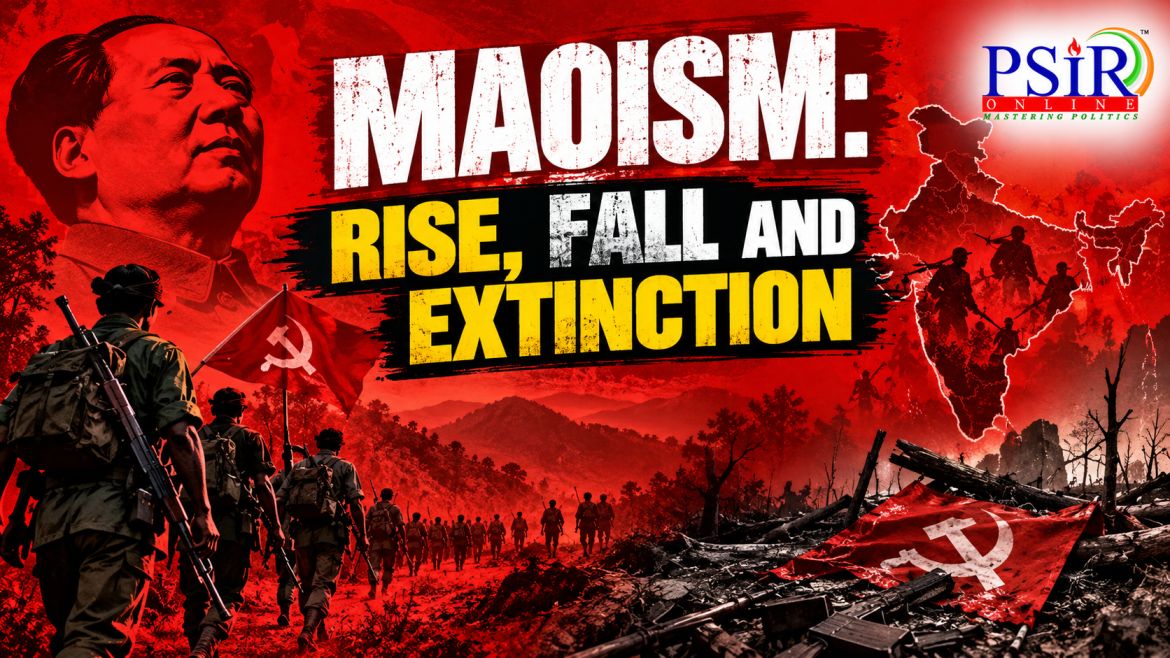
For nearly six decades, the armed insurgency launched by Left-Wing Extremism (LWE)—commonly termed Naxalism or Maoism—stood as one of the most formidable internal security challenges to the Indian constitutional republic. What began in 1967 as a localized peasant revolt against feudal land relations evolved into an interconnected insurgent corridor stretching from the forests of Central India to the southern plateaus, famously termed the "Red Corridor." At its zenith, the insurgency contested the sovereignty of the state, established parallel administrative systems, and disrupted electoral democracy across vast swathes of remote, tribal-dominated geography.
In 2026, the trajectory of this protracted armed conflict reached a decisive, historic milestone. Through successive high-level statements and administrative notifications in Parliament, the Union Government declared that India had effectively brought an end to active Maoist territorial influence. The announcement marked the transition of an armed movement from its radical rise to its structural collapse and administrative extinction.
HOW THE GOVERNMENT DECLARED THE END OF NAXALISM/MAOISM IN INDIA
The formal end of Maoism as an organized territorial security threat was marked by specific parliamentary and administrative announcements in the first half of 2026:
The 30 March 2026 Lok Sabha Declaration:
· A day before his previously set operational deadline, Union Home Minister Amit Shah informed the Lok Sabha that India had become free of active Naxal violence.
· He noted that the central organizational structure and the supreme Politburo of the banned Communist Party of India (Maoist) were almost completely dismantled. State-committee networks across Madhya Pradesh, Maharashtra, and Chhattisgarh had collapsed under surrenders and operations, while Telangana ceased to hold any functional armed committee.
· Bastar, long considered the movement's impenetrable citadel, had been cleared, enabling the extensive penetration of civil administration, schools, ration distribution, health centres, and welfare connectivity.
· Home Minister Shah stated that Naxalism was "on the verge of extinction" and that the country could be characterized as Naxal-free, while maintaining the firm policy that talks would be entertained solely with cadres who lay down their arms.
The 29 July 2026 Administrative Reclassification: Clarifying the operational status in the Rajya Sabha, Minister of State for Home Affairs Nityanand Rai presented an administrative series documenting the reduction of LWE-affected districts to absolute zero. The official trajectory outlined the progressive shrinkage of the insurgent footprint:
· Pre-April 2018: 126 districts
· April 2018: 90 districts
· July 2021: 70 districts
· April 2024: 38 districts
· December 2025: 8 districts
· March/April 2026: 0 districts
By July 2026, even the final holdouts—Bijapur in Chhattisgarh and West Singhbhum in Jharkhand, along with the transitional "District of Concern" in Kanker—were formally reclassified, leaving zero districts officially categorized as LWE-affected.
HISTORY OF NAXAL/MAOIST MOBILISATION IN INDIA
The origin and trajectory of the Maoist movement developed across distinct historical phases:
· The Naxalbari Spark (1967) and Early Consolidation: The movement traces its origin to March 1967 in the village of Naxalbari, West Bengal, spearheaded by radical communist leaders Charu Majumdar, Kanu Sanyal, and Jangal Santhal. Breaking away from parliamentary communist parties, they advocated armed agrarian revolution inspired by Mao Zedong’s thesis of encircling cities from the countryside. In 1969, the formation of the Communist Party of India (Marxist-Leninist) formalized the insurgent strategy of "annihilation of class enemies."
· Regional Dispersal and Andhra Peasant War: Following heavy state crackdowns in Bengal in the early 1970s, the movement fractured but found fertile soil in the Telengana and North Andhra regions under the People’s War Group (PWG), founded by Kondapalli Seetharamaiah in 1980. Concurrently, in Bihar and Jharkhand, the Maoist Communist Centre (MCC) leveraged entrenched agrarian caste oppression and feudal exploitation to build an armed base.
· The 2004 Merger and the "Red Corridor": On 21 September 2004, the two principal insurgent streams—the People's War Group and the MCC—merged to establish the Communist Party of India (Maoist). This merger unified fragmented armed squads into the People’s Liberation Guerrilla Army (PLGA), creating an interconnected red belt spanning eastern and central India. The party established a parallel proto-state (Janathana Sarkar) across remote forest areas such as Abujhmad and Dandakaranya, levying illegal levies, enforcing boycotts of parliamentary polls, and ambushing security forces.
GOVERNMENT RESPONSES ACROSS DECADES TO SUPPRESS MAOISM
The Indian state’s response evolved over successive decades from reactive, fragmented police measures to an integrated civil-military security doctrine:
· Early Kinetic Measures and Operation Steeplechase (1970s): Initial state responses treated the movement primarily as a localized law-and-order disruption, relying on state police crackdowns and coordinated military cordons (such as Operation Steeplechase in 1971) to scatter armed groups.
· Vigilante Experiments and Controversies (2000s): In response to expanding Maoist control in central India, counter-insurgency witnessed local proxy strategies, notably the Salwa Judum militia in Bastar, Chhattisgarh. However, human rights controversies, retaliatory massacres, and systemic tribal displacement led to the Supreme Court invalidating the use of special police officers (Nandini Sundar v. State of Chhattisgarh, 2011), prompting a return to formal, constitutional security mechanisms.
· The Strategic Shift: The 2015 National Policy and Action Plan: The turning point in counter-insurgency statecraft arrived with the formulation of the 2015 National Policy and Action Plan. This framework integrated security operations, intelligence sharing, and grassroots development into a holistic model:
o Operational Modernization: Deployment of specialized anti-Naxal central armed forces (CRPF, CoBRA) coordinated with state elite commando units (Greyhounds in Andhra/Telangana, District Reserve Guard in Chhattisgarh, C-60 in Maharashtra, and Jharkhand Jaguars).
o Forward Operating Bases: Systematic construction of heavily fortified security encampments inside core insurgent bastions, breaking territorial monopolies and enabling civil engineering wings to build roads, bridges, and telecommunication towers.
o Financial Disruption: Coordinated inter-agency crackdowns by the National Investigation Agency (NIA) and Enforcement Directorate (ED) to seize extortion revenues, dismantle shell businesses, and disrupt urban support networks.
THE FINAL NAIL TO MAOISM: DECAPITATION AND CADRE COLLAPSE
The ultimate dismantling of the armed insurgency between 2024 and 2026 was accelerated by targeted operational intelligence that shattered the central leadership and tactical operational battalions of the CPI (Maoist):
· Decapitation of Core Military Leadership: Security forces eliminated key figures who formed the intellectual and military spine of the insurgency. In 2025, the General Secretary of the CPI (Maoist), Nambala Keshava Rao (alias Basava Raju), was killed, dealing an unrecoverable blow to the central Politburo. This was followed in November 2025 by the neutralisation of Madvi Hidma, the commander of PLGA Battalion No. 1, who had planned numerous ambushes in Dandakaranya.
· Mass Attrition and Surrenders: Comprehensive Home Ministry data for the 2024–2026 phase demonstrated decisive cadre attrition:
o Approximately 706 Maoists killed in tactical operations.
o Over 2,218 cadres arrested.
o More than 4,839 cadres formally surrendered to civil authorities.
· Loss of Territorial Monopoly: Combined with the evacuation or desertion of entire state committees across Maharashtra, Madhya Pradesh, and Chhattisgarh, the armed party lost its capacity to replenish losses from indigenous tribal communities, ending its organizational continuity.
THE WAY FORWARD: SECURING THE PEACE AND INSTITUTIONAL INTEGRATION
While the Union Government no longer classifies any administrative district as actively LWE-affected, post-conflict management requires sustained caution to prevent ideological resurgence:
· Sustaining the "Legacy and Thrust" Framework: The zero-affected classification has not prompted an immediate withdrawal of the security apparatus. Instead, 37 districts have been designated as "Legacy and Thrust" districts, retaining targeted security presence and central development assistance to ensure tactical gains are not lost. Additionally, administrative vigilance remains active in designated "Districts of Concern" to verify that dormant networks do not regroup.
· Saturation of Constitutional Welfare: Lasting pacification requires substituting the parallel authority of the former insurgent councils with responsive democratic administration. The post-LWE focus centres on universal coverage of statutory welfare: establishing formal primary schools, health centres, public distribution shops, and civil registration networks.
· Empowering Customary Grassroots Institutions: Transitioning away from security-dominated governance requires strengthening democratic platforms in Scheduled Areas. Implementing the Panchayats (Extension to Scheduled Areas) Act (PESA) and settling individual and Community Forest Resource (CFR) claims under the Forest Rights Act (FRA), 2006, directly addresses historical alienation regarding natural resources, mining, and land tenure.
· Comprehensive Cadre Rehabilitation: Sustained execution of surrender and rehabilitation policies—ensuring economic security, vocational training, and protection against retaliatory violence—is essential to permanently integrate former insurgents into normal democratic society.
PSIR THEORETICAL DIMENSION & EXAMINATION LINKAGES
|
PSIR Theoretical Dimension & Concepts |
How It Connects to Examination Answers (PSIR Paper 1 / Paper 2) |
|
Monopoly of Legitimate Violence & Weberian Statehood (Max Weber; Charles Tilly) |
The Reclamation of Sovereign Monopoly: Connects the tactical elimination of armed squads, seizure of parallel tax networks, and dismantling of Janathana Sarkars to the Weberian imperative that a sovereign state cannot tolerate a rival coercive authority within its territorial jurisdiction. |
|
Maoist Insurgency & Protracted People’s War (PPW) (Mao Zedong; Charu Majumdar) |
The Exhaustion of Revolutionary War: Evaluates the structural breakdown of the Maoist strategy to "encircle cities from the countryside." Demonstrates how modern drone surveillance, forward operating bases, and road connectivity severed the organic guerrilla link between the armed vanguard and rural forest sanctuaries. |
|
"Strong Societies and Weak States" / Governance Deficit (Joel Migdal; Gunnar Myrdal – The Soft State) |
Institutional Penetration over Vacuums: Frames the origin of Naxalism in peripheral institutional vacuums (lack of schools, healthcare, and formal policing) and its eventual pacification through administrative saturation, welfare delivery, and bureaucratic presence. |
|
Subaltern Counter-Hegemony vs. State Co-optation (Antonio Gramsci; Partha Chatterjee – Politics of the Governed) |
Welfare as Hegemonic Neutralisation: Analyzes how welfare schemes, public distribution systems, and direct bank transfers weakened the insurgent counter-hegemonic appeal, absorbing agrarian and tribal discontent directly into the state's institutional framework. |
|
Accumulation by Dispossession & Internal Colonialism (David Harvey; Nirmal Sengupta) |
The Underlying Material Dialectic: Explores the political economy thesis that tribal vulnerability stems from state-led mineral extraction and industrial land alienation in Fifth Schedule areas, demonstrating why lasting peace requires addressing resource justice rather than relying solely on kinetic military victories. |
|
Post-Conflict Pacification & Democratic Integration (Johan Galtung – Negative vs. Positive Peace) |
Negative Peace vs. Positive Peace: Distinguishes between the tactical cessation of armed violence / "zero-affected" administrative categorisation (negative peace) and the structural resolution of tribal grievances through the Forest Rights Act and PESA empowerment (positive peace). |
CONCLUSION
The declaration of a Naxal-free India in 2026 marks the end of an era in the nation's internal security landscape. The official determination that zero districts remain LWE-affected is an administrative and security evaluation: it reflects the systematic dismantling of the armed party's Politburo, the neutralisation of its military leadership, and the loss of its territorial strongholds. It does not represent a repeal of the statutory ban on the CPI (Maoist), nor does it erase democratic dissent or the legitimate electoral presence of parliamentary Left parties. Instead, it signifies the exhaustion of the idea that an armed insurrection could subvert India's constitutional democracy from the forests. The long-term extinction of Maoism will ultimately be sealed not solely by tactical dominance, but by the state's capacity to deliver justice, governance, and dignified development to India's most vulnerable hinterlands.
RELATED READING & ANALYTICAL ANGLES
· Constitutional & Statutory Guarantees in Conflict Zones:
o Fifth Schedule & Article 244: Governor’s special legislative discretion and regulation-making powers in Scheduled Areas.
o PESA Act, 1996 & Forest Rights Act (FRA), 2006: Statutory recognition of Gram Sabha authority over land diversion, minor minerals, and community forest resources.
o Unlawful Activities (Prevention) Act, 1967 (UAPA): The statutory framework underpinning the ongoing prohibition of the CPI (Maoist) as a terrorist formation.
· Key Judicial Pronouncements on Counter-Insurgency:
o Nandini Sundar & Ors. v. State of Chhattisgarh (2011): The landmark Supreme Court ruling declaring the arming of civilian vigilantes (Salwa Judum / Special Police Officers) unconstitutional and violative of Articles 14 and 21.
· Analytical Frameworks for Examination:
o The Security-Development Continuum: Examine the 2015 National Policy and Action Plan to evaluate whether kinetic operations or development delivery played the primary role in collapsing the Red Corridor.
o The "Legacy and Thrust" Transition: Assess the administrative risks of premature troop withdrawals versus the necessity of transitioning from paramilitary encampments to civilian grassroots administration.
o Agrarian Question to Resource Conflict: Trace how the ideology shifted from classic 1967 land-redistribution feudal battles (Naxalbari) to modern 21st-century resistance against industrial and mineral extraction.
PRACTICE QUESTIONS FOR PSIR
