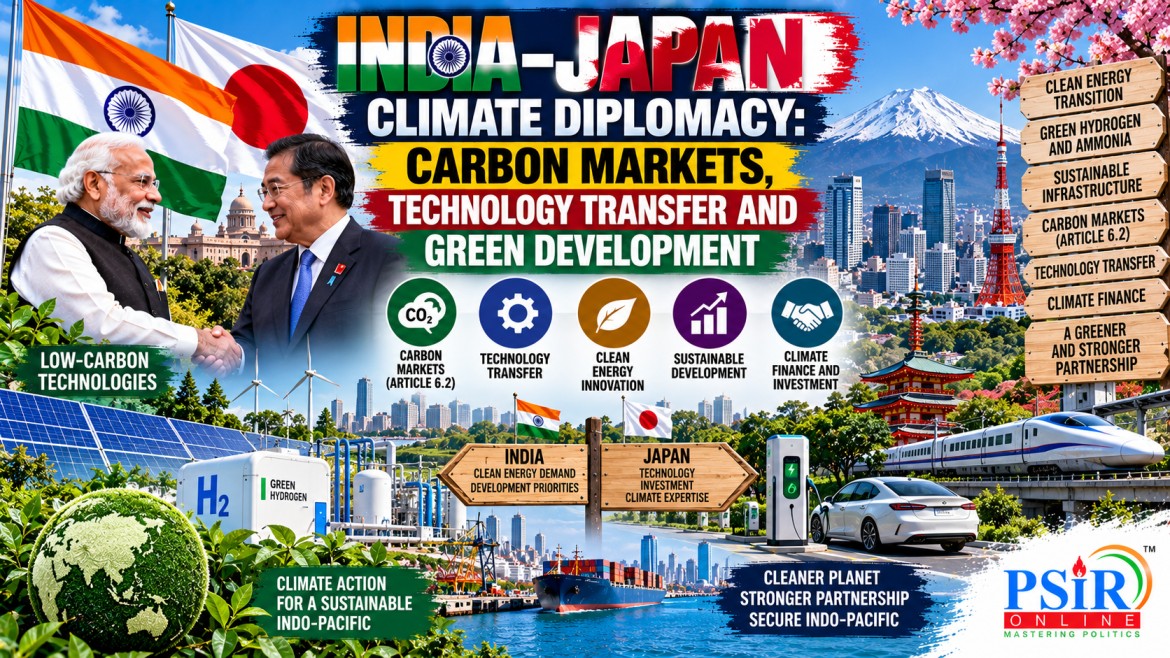
Climate change has emerged as an important dimension of India–Japan relations, connecting environmental protection with economic modernisation, energy security and strategic cooperation. For India, the challenge is to expand industrial capacity, meet rising energy demand and improve living standards while pursuing its climate commitments. Japan brings experience in energy-efficient manufacturing, advanced industrial technologies, low-carbon infrastructure and climate finance. Their partnership therefore offers an opportunity to connect India’s development priorities with Japan’s technological capabilities.
A significant development came with the establishment of the India–Japan Joint Crediting Mechanism (JCM) under Article 6.2 of the Paris Agreement. The two countries signed the memorandum of cooperation in August 2025, adopted the Rules of Implementation on 8 June 2026 and launched the JCM Operational Manual on 30 September 2026. The manual establishes procedures for moving projects from initial proposals towards approval, verification, credit issuance and authorisation.
The development marks an important transition from diplomatic commitments to institutional implementation. However, the mechanism’s success will depend on whether carbon-market cooperation produces credible emission reductions, meaningful technology transfer and tangible development benefits in India.
THE JOINT CREDITING MECHANISM: FROM CLIMATE COMMITMENTS TO IMPLEMENTATION
The JCM is a bilateral framework designed to facilitate the deployment of low-carbon technologies and infrastructure through cooperation between India and Japan. It seeks to quantify greenhouse-gas emission reductions or removals generated through eligible projects, while supporting sustainable development and the climate commitments of both countries.
Article 6.2 of the Paris Agreement provides a framework for countries to cooperate in achieving their nationally determined contributions (NDCs), including through internationally transferred mitigation outcomes, subject to applicable accounting and reporting requirements. The JCM creates an institutional pathway for India and Japan to pursue such cooperation.
The 2026 Rules of Implementation established governance arrangements, including a bilateral Joint Committee, transparent project-approval procedures, third-party validation and verification, sustainable-development safeguards and national registries. The subsequent Operational Manual provides more detailed procedures across the project cycle, from the submission of a Project Idea Note to credit issuance and authorisation.
The significance lies in the institutionalisation of climate cooperation. Instead of relying exclusively on grants or general investment commitments, the framework can connect emission-reduction projects, private investment and measurable climate outcomes.
Potential areas of cooperation include compressed biogas, green hydrogen and ammonia, industrial decarbonisation, carbon capture and storage, energy efficiency, renewable-energy integration and waste management. These are potential areas for project development, not a guarantee that every proposed technology or project will qualify for credits.
CARBON MARKETS AND THE POLITICS OF CLIMATE RESPONSIBILITY
Carbon markets assign economic value to verified emission reductions or removals. Properly designed, they can direct finance towards mitigation activities that might otherwise struggle to attract investment. They can also help governments and firms identify lower-cost pathways to reduce emissions.
For India and Japan, the JCM could support Japanese investment in Indian projects while generating measurable mitigation outcomes. India may benefit from new industrial capabilities and lower-emission infrastructure; Japan may be able to account for eligible, authorised mitigation outcomes towards its climate commitments, subject to the rules governing the mechanism.
Yet carbon markets are not politically neutral. Their design raises questions about who finances mitigation, who owns the resulting credits, who claims the climate benefit and how benefits are distributed between the host country and the investing country.
Environmental integrity is central to these questions. Projects must demonstrate that claimed reductions are credible, measurable and not merely the result of accounting adjustments. Baselines must be robust, monitoring must be reliable and reductions must not be counted twice towards the respective national climate targets.
Under Article 6.2, corresponding adjustments are important where mitigation outcomes are authorised for international use. They help prevent the same outcome from being claimed towards both countries’ NDCs. The precise treatment depends on the applicable authorisation and accounting rules; not every emission reduction generated by a bilateral project automatically becomes an internationally transferable credit.
India must also ensure that carbon-market cooperation complements its domestic climate institutions, including the Carbon Credit Trading Scheme. International cooperation should strengthen domestic measurement, reporting and verification capabilities rather than create fragmented or competing systems.
The broader challenge is to balance market efficiency with climate justice. Carbon trading can mobilise finance, but it cannot substitute for deep domestic emission reductions, effective regulation or adequate climate finance for developing countries.
TECHNOLOGY TRANSFER: BEYOND THE PURCHASE OF EQUIPMENT
Technology transfer is a critical test of the India–Japan climate partnership. Japan possesses capabilities in industrial energy efficiency, advanced manufacturing, hydrogen-related technologies, battery systems, pollution control and other low-carbon solutions. Indian industries, meanwhile, require affordable technologies that can be deployed at scale without undermining competitiveness or employment.
The JCM can create incentives for Japanese companies to introduce eligible technologies and participate in projects in India. This may help improve industrial productivity, reduce energy consumption and support the modernisation of infrastructure.
However, technology transfer is not synonymous with technology purchase. Importing equipment does not necessarily generate domestic manufacturing capability, skilled employment, research capacity or long-term technological independence.
A stronger partnership would combine technology deployment with local supplier development, technical training, joint research, university–industry collaboration and opportunities for Indian firms to participate in manufacturing and maintenance. Cooperation could also support adaptation of technologies to Indian conditions, including local energy systems, industrial requirements and affordability constraints.
Intellectual-property arrangements, licensing costs, access to technical knowledge and the distribution of commercial risks will influence the depth of transfer. These issues require negotiated solutions that protect legitimate innovation incentives while enabling wider adoption.
The partnership should therefore be assessed not only by the volume of Japanese investment or the number of projects approved, but also by whether it builds durable Indian technological capacity.
GREEN DEVELOPMENT, ENERGY SECURITY AND INDUSTRIAL TRANSFORMATION
India’s climate transition is closely linked to its development requirements. Expanding electricity access, building infrastructure, generating employment and supporting industrial growth remain important policy objectives. Climate cooperation must therefore produce benefits that extend beyond carbon accounting.
The JCM could support industrial energy-efficiency improvements, cleaner production, waste-to-energy and compressed-biogas projects, as well as other eligible low-carbon activities. If designed effectively, these initiatives may reduce energy costs, improve air quality, strengthen waste management and encourage investment in cleaner infrastructure.
Cooperation in green hydrogen and ammonia could contribute to the development of lower-carbon fuels and industrial processes. Nevertheless, the actual climate benefit will depend on production methods, energy sources, lifecycle emissions, infrastructure costs and the availability of reliable demand. A technology should not be treated as environmentally beneficial simply because it is labelled “green”.
Japan’s investment and technical expertise may also contribute to resilient supply chains and the diversification of India’s clean-energy technology base. This has economic-security implications: dependence on a narrow set of foreign suppliers can expose industries to price volatility and geopolitical disruption.
For India, the priority is to align bilateral projects with domestic manufacturing, skill development, energy-transition planning and regional development. For Japan, the partnership provides opportunities to expand the application of its technologies while contributing to climate goals.
A successful model would connect decarbonisation with employment, productivity and domestic value creation. Otherwise, climate cooperation risks producing technically successful projects without sufficiently broad development benefits.
CHALLENGES: EQUITY, ACCOUNTABILITY AND IMPLEMENTATION
Despite its potential, the India–Japan climate partnership faces several challenges.
First, the distribution of benefits requires careful negotiation. Project developers, technology providers, investors and host-country institutions may have different expectations concerning costs, credit ownership and financial returns. Transparent contractual arrangements are essential to avoid disputes and ensure that India receives a fair share of the economic and developmental gains.
Second, carbon accounting must remain credible. Weak baselines, inadequate monitoring or inflated claims can undermine environmental integrity. Independent verification, transparent registries and effective oversight are necessary to maintain confidence in the mechanism.
Third, advanced low-carbon technologies may involve substantial upfront costs. Even when a project produces long-term savings, financing constraints, uncertain demand and infrastructure gaps can delay implementation. Smaller firms may find project-development and verification requirements particularly difficult to meet.
Fourth, climate cooperation must recognise differentiated national circumstances. India’s development needs, per-capita emissions, historical contribution to climate change and available fiscal resources differ from those of Japan. Bilateral market cooperation should not become a substitute for the broader obligations of developed countries concerning climate finance, capacity-building and technology cooperation.
Finally, there is a risk that carbon credits become the primary measure of success. A credible partnership must also examine domestic emissions reductions, industrial transformation, employment, local environmental effects and the resilience of the technologies introduced.
These concerns do not negate the value of the JCM. They underline the need for effective institutions, transparent implementation and a development-oriented approach.
THE WAY FORWARD: A DEVELOPMENT-CENTRED CLIMATE PARTNERSHIP
India and Japan should treat the JCM as a platform for long-term industrial and environmental cooperation rather than merely a mechanism for generating tradable credits.
First, both governments should establish clear project-selection criteria, robust baselines and accessible public reporting. Project approval, verification, authorisation and credit transfers should be transparent, with safeguards against double counting and misleading environmental claims.
Second, technology transfer should be measured through outcomes. Indicators could include Indian participation in manufacturing, technical training, local supplier development, joint research, operating-cost reductions and the availability of technologies to domestic firms.
Third, the partnership should make participation easier for credible small and medium enterprises. Standardised procedures, technical assistance and appropriate financing arrangements could reduce transaction costs without weakening environmental safeguards.
Fourth, project selection should reflect India’s development priorities. Industrial energy efficiency, clean fuels, waste management and other suitable sectors could be assessed against measurable climate benefits, local employment, affordability and domestic capacity-building.
Fifth, India should coordinate international carbon-market cooperation with its domestic carbon-market institutions and NDC implementation. This would help prevent fragmented accounting systems and ensure that international cooperation supports rather than displaces domestic climate action.
Finally, bilateral cooperation should contribute to wider international discussions on climate finance, equitable technology access and sustainable development. India and Japan can demonstrate that climate diplomacy need not be limited to negotiating targets; it can also create practical institutions for financing and implementing the transition.
THEORETICAL ANGLES
|
Theory or concept |
Application to India–Japan climate diplomacy |
|
Liberal institutionalism |
The JCM illustrates how rules, joint committees, verification procedures and registries can facilitate cooperation between states pursuing shared climate objectives. |
|
Complex interdependence |
Climate change links trade, technology, finance, energy and environmental policy, creating multiple channels of cooperation beyond traditional security relations. |
|
Neoliberal institutionalism |
Monitoring, reporting, verification and common procedures can reduce uncertainty, transaction costs and the risk of opportunistic behaviour in bilateral climate projects. |
|
Green political economy |
The JCM raises questions about ownership of technology, distribution of profits, control over carbon credits and the relationship between markets and environmental protection. |
|
North–South relations |
India’s development requirements and Japan’s technological and financial capabilities highlight tensions over climate responsibility, technology access and the distribution of mitigation costs. |
|
Regime theory and global governance |
Article 6.2 demonstrates how the Paris Agreement’s rules can enable decentralised cooperation while requiring common standards for accounting and transparency. |
|
Strategic interdependence |
Clean-energy cooperation can diversify supply chains and strengthen economic-security ties, while also creating new dependencies on technologies, intellectual property and specialised inputs. |
|
Sustainable development |
The partnership’s legitimacy depends on whether emission reductions are accompanied by employment, industrial capacity, affordability and wider social and environmental benefits. |
CONCLUSION
India–Japan climate diplomacy represents an important convergence of environmental governance, economic cooperation and strategic partnership. The Joint Crediting Mechanism provides an institutional route for combining Japanese investment and low-carbon technologies with India’s development priorities, while the 2026 implementation rules and Operational Manual establish a framework for moving towards project-level implementation.
However, the mechanism’s success cannot be judged by the number of credits generated alone. Its long-term value will depend on credible emission reductions, fair benefit-sharing, meaningful technology transfer and measurable development outcomes. If these conditions are met, the partnership can demonstrate how bilateral climate cooperation contributes to both national development and global climate governance.
RELATED READING
PRACTICE QUESTIONS FOR GS-II MAINS
PRACTICE QUESTIONS FOR PSIR
