INTRODUCTION: WHO IS A GIG WORKER?
The nature of work in India is changing rapidly. Alongside traditional employees who work for a clearly identified employer, a growing number of people now earn their livelihood through short-term, flexible or task-based work. They may deliver food, drive passengers, provide household services, undertake online assignments, sell products or complete other tasks through digital platforms. Such workers are commonly referred to as gig workers.
The Code on Social Security, 2020 provides India's first statutory definition of a gig worker. It defines a gig worker as a person who performs work or participates in a work arrangement and earns from such activities outside the traditional employer–employee relationship. In simple terms, a gig worker is a person who earns by completing individual tasks, assignments or work arrangements rather than working under a conventional, continuous employer–employee relationship.
A food-delivery executive completing deliveries through an app, a cab driver accepting passenger trips through an online platform, or a person undertaking independent assignments through a digital platform can therefore fall within the broader gig economy.
However, gig worker and platform worker are not exactly the same term. The Social Security Code separately defines a platform worker in relation to work facilitated through an online platform. The wider gig economy can therefore include both platform-based workers and other workers engaged in non-traditional work arrangements.
The rise of gig work provides workers with flexibility and new earning opportunities, but it also raises an important question: when a person works without a traditional employer, who provides social security when the worker becomes sick, suffers an accident, becomes unable to work, becomes old or needs maternity protection?
This question has become increasingly important in India as the gig economy expands. NITI Aayog estimated that 7.7 million people were engaged in gig work in 2020–21, with the number projected to reach 23.5 million by 2029–30.
HOW IS THE CENTRAL GOVERNMENT PROVIDING SOCIAL SECURITY TO GIG WORKERS?
For a long time, gig workers occupied a difficult position in India’s labour system. They worked and earned, but their relationship with the platform or aggregator was generally not treated as a conventional employer–employee relationship. The Code on Social Security, 2020, which came into force on 21 November 2025, changed this position by giving gig workers and platform workers formal recognition in central labour law for the first time. The Code defines a gig worker as a person who earns from work outside the traditional employer–employee relationship, while a platform worker is a gig worker engaged in platform work through an online platform.
Code does not automatically give every gig worker a complete package of ESI, pension, maternity or accident benefits. Instead, it creates a legal framework through which the Central Government can formulate specific social-security schemes for them. Under Section 114, schemes may cover life and disability protection, accident insurance, health and maternity benefits, old-age protection, crèche facilities and other welfare measures. Thus, the approach is to bring gig workers into the social-security framework and then build appropriate schemes around their nature of work.
1. Creating a Social Security Fund
One of the most important features is the creation of a dedicated Social Security Fund for gig and platform workers. The Code provides that aggregators can be required to contribute towards this fund. The contribution is to be fixed by the Central Government within a range of 1–2% of the aggregator’s annual turnover, subject to a ceiling of 5% of the amount paid or payable by the aggregator to gig and platform workers. The Code also allows social-security schemes to be financed through different combinations of Central Government, State Government, aggregator and other sources.
This represents a significant change because the social-security burden is no longer conceived as something that the worker has to bear alone. The platform economy itself is brought into the financing architecture of worker protection.
At the same time, an important limitation remains: the 1–2% rate is a statutory range, not necessarily the final rate being collected from aggregators at present. The 2026 Rules provide the machinery for assessment and payment, but the specific rate under the statutory range has to be notified by the Central Government.
2. Bringing workers into the e-Shram system
The second pillar is registration and identification. The Government has been using the e-Shram portal, launched in 2021, as the national database for unorganised workers, including gig and platform workers. Registration is linked with Aadhaar and provides a Universal Account Number (UAN), allowing a worker's social-security identity to remain portable rather than being tied to one particular workplace.
The Government also introduced an Aggregator Module on e-Shram in December 2024 to bring platform companies into the registration process. By January 2026, the Government reported that major aggregators including Zomato, Blinkit, Urban Company, Uber, Ola, Swiggy, Amazon, Rapido, Zepto and Porter had been onboarded to the system.
The Social Security (Central) Rules, 2026, notified on 8 May 2026, strengthen this mechanism. Aggregators are required to share worker information with the designated Central Government portal, while new workers have to be registered through electronic means in real time or on a daily basis, with exit information also updated. Existing workers were to be brought into the system within the prescribed initial period.
This creates the administrative foundation for portable social security. A delivery worker who changes platforms, for example, should not have to start from zero every time he or she moves from one aggregator to another.
3. Establishing eligibility based on actual engagement
The 2026 Rules also try to answer an important question: who should qualify for benefits?
Registration alone is not sufficient. The Rules provide an engagement threshold. A gig or platform worker must generally have been engaged for at least 90 days with one aggregator or 120 days cumulatively across multiple aggregators during the preceding financial year, subject to the conditions of the particular scheme. A day of engagement is counted when the worker earns income from work performed for the aggregator on that day. This is particularly relevant to the gig economy because workers may simultaneously work for several platforms. The rules therefore recognise that a worker's livelihood may be spread across multiple aggregators rather than being tied to one company.
4. Health protection: moving towards wider coverage
Health protection is another important component of the Central Government's approach. The Union Budget 2025–26 announced the registration of online platform workers on e-Shram, issuance of identity cards and extension of healthcare benefits under Ayushman Bharat–PM Jan Arogya Yojana (AB-PMJAY). AB-PMJAY provides health cover of up to ₹5 lakh per family per year for eligible beneficiaries.
The Government has also worked on interoperability between e-Shram and AB-PMJAY so that eligible platform workers can be identified and linked with health protection.
However, this should not be understood as equivalent to full Employees' State Insurance (ESI). As of September 2026, the Labour Ministry was still working on an ESI-like social-security scheme for gig and platform workers and consulting stakeholders. The proposed framework is therefore still evolving.
5. National Social Security Board
The Code also provides an institutional mechanism through the National Social Security Board. When the Board deals specifically with gig and platform workers, the framework provides for representation of aggregators, gig and platform workers, States and relevant social-security institutions. This is intended to bring the major stakeholders into the formulation and administration of welfare measures.
The importance of such representation lies in the nature of gig work itself. The Government has to design social protection for workers who may have multiple platforms, variable incomes, flexible engagement periods and no conventional employer.
6. What is available today—and what is still being built?
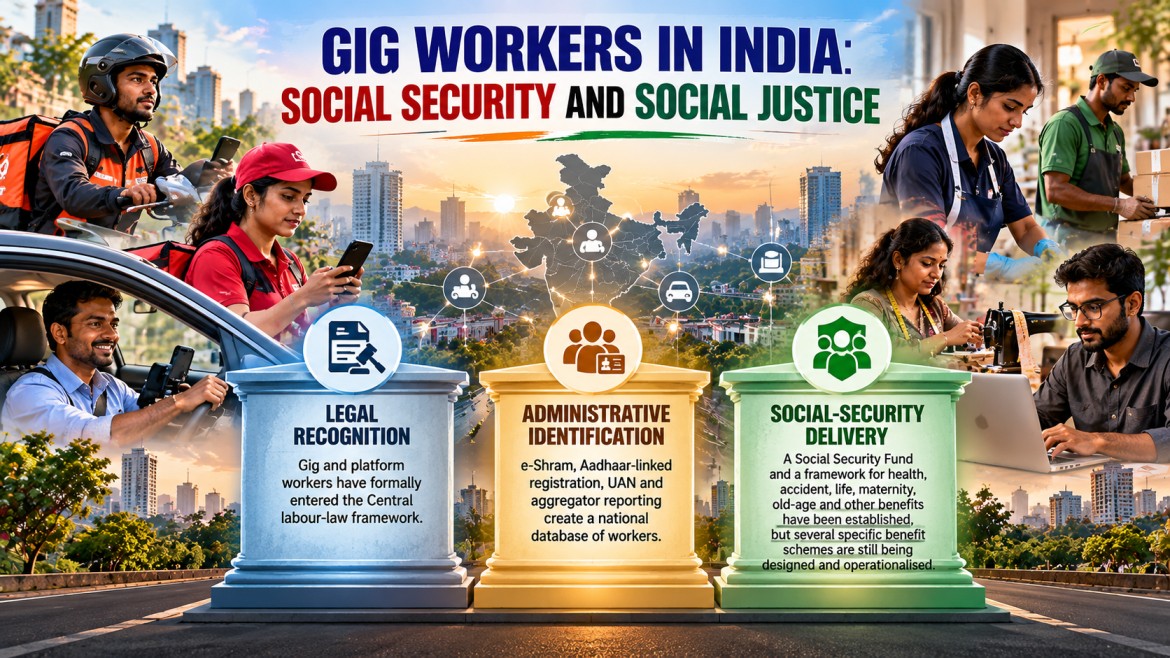
Therefore, the Central Government's approach in 2026 can be understood as a three-stage process:
· Legal recognition: Gig and platform workers have formally entered the Central labour-law framework.
· Administrative identification: e-Shram, Aadhaar-linked registration, UAN and aggregator reporting create a national database of workers.
· Social-security delivery: A Social Security Fund and a framework for health, accident, life, maternity, old-age and other benefits have been established, but several specific benefit schemes are still being designed and operationalised.
This distinction is important for understanding the present situation. India has moved from having almost no dedicated central statutory framework for gig workers to having a legal and institutional architecture for social security. But the architecture is still ahead of the actual benefit package. The Social Security Code provides the legal route; the 2026 Rules provide the administrative machinery; the next challenge is to translate these provisions into predictable and comprehensive benefits for workers.
As of late September 2026, the Government was still working on the ESI-like model, while the contribution mechanism and the precise package of benefits such as pension, maternity protection and crèche support had not yet become automatic entitlements for every gig worker.
WHAT ARE STATE GOVERNMENTS PROVIDING FOR GIG WORKERS?
The Central Government has created a national framework for gig and platform workers, but the States also have an important role because labour and social security involve both Union and State responsibilities. This has led some States to move ahead with their own laws, welfare boards, registration systems and funds. The State-level approach is particularly significant because gig work is concentrated in cities and States may be better placed to address local issues such as registration, grievance redressal, insurance and welfare delivery.
Rajasthan: The first State-level legal framework
Rajasthan was the first State to enact a dedicated law for platform-based gig workers. The Rajasthan Platform Based Gig Workers (Registration and Welfare) Act, 2023 created a framework for registration of gig workers and aggregators and provided for a Gig Workers Welfare Board and a Gig Workers Welfare and Development Fund. The Rajasthan Government had announced a ₹200 crore fund for gig workers in its 2023–24 Budget while proposing the legislation.
The Rajasthan model is based on the idea that platforms should contribute towards the welfare of the workers who generate economic activity through them. The Act provides for a welfare fee linked to transactions involving gig workers, with the exact rate to be specified by the State Government. The welfare fund can then be used for social-security and welfare measures for registered workers. The State has also created an online registration mechanism through which workers can submit details such as Aadhaar, PAN, company ID, bank or wallet statements and UPI details.
Karnataka: Moving beyond social security towards platform accountability
Karnataka subsequently developed a more detailed framework. The Karnataka Platform Based Gig Workers (Social Security and Welfare) Act, 2025 provides for a Gig Workers Welfare Board and a Karnataka Gig Workers' Social Security and Welfare Fund. The framework provides for registration of workers and aggregators, a unique identification system and access to social-security schemes and grievance redressal.
One of the distinctive features of the Karnataka model is the welfare fee on aggregators. The legislation provides for a fee of between 1% and 5% of the payout to the gig worker for each transaction, with the precise rate depending on the category of aggregator as determined by the State Government. The fund can receive welfare fees, worker contributions, grants from the Central and State Governments and other permitted sources.
Karnataka has also gone beyond the conventional idea of insurance or financial assistance. The law addresses the relationship between the worker and the digital platform itself. Aggregators have obligations relating to payment, deductions, working conditions, automated decision-making and grievance redressal. Workers are to be informed about parameters used by automated systems that affect fares, earnings, customer feedback and other working conditions.
The law also provides safeguards around deactivation and termination. This is significant because a gig worker may lose his or her livelihood not through conventional dismissal, but through suspension or deactivation of an account. Karnataka's framework therefore attempts to bring a degree of procedural transparency into the platform-worker relationship.
Telangana: Building a similar framework through legislation
Telangana has also moved towards a dedicated framework. In 2025, the State Government placed the Draft Telangana Gig and Platform Workers (Registration, Social Security and Welfare) Bill, 2025 in the public domain and invited suggestions from stakeholders.
The proposed framework provides for registration of gig workers and aggregators, a Welfare Board, and a Social Security and Welfare Fund. It proposes a welfare fund fee of 1–2% of the payout to gig workers in each transaction, along with contributions from workers for specific schemes and grants from the Central and State Governments. It also proposes a system to verify payments and welfare-fee collections made through platforms.
Other States: The model is beginning to spread
The State-level movement is not confined to Rajasthan, Karnataka and Telangana. Bihar enacted legislation in 2025, while Jharkhand has also worked on a draft framework. The emerging State models generally contain common elements—registration of workers and aggregators, a welfare board, a dedicated fund, a platform-linked contribution or fee and grievance redressal.
At the same time, the design differs considerably. For example, the Karnataka law places greater emphasis on transparency in automated decision-making and payment systems, whereas Rajasthan's earlier framework concentrated more on registration, welfare administration and financing. This means India is effectively witnessing different State-level experiments in designing social security for a workforce that does not fit neatly into the conventional employer–employee model.
CHALLENGES IN PROVIDING SOCIAL SECURITY TO GIG WORKERS
|
Challenge |
Why is it a problem? |
|
1. Identifying all gig workers |
Workers frequently join, leave or work for multiple platforms. Maintaining an accurate database is difficult. |
|
2. Multiple-platform employment |
A worker may work for several aggregators. Determining engagement, contributions and eligibility becomes complicated. |
|
3. Sustainable financing |
Social security requires continuous funding for health, accident, disability, maternity and old-age protection. |
|
4. Unclear employer responsibility |
Platforms may not have a traditional employer–employee relationship with workers. This makes responsibility for social security more complex. |
|
5. Irregular incomes |
Gig workers do not receive fixed salaries. Contributions and benefits must therefore accommodate fluctuating earnings. |
|
6. Portability of benefits |
Workers may change platforms or States. Social security must remain with the worker rather than being tied to one platform or location. |
|
7. Algorithmic control |
Ratings, incentives, work allocation and account deactivation are often controlled digitally. Lack of transparency can affect workers' incomes and livelihood security. |
|
8. Occupational risks |
Delivery workers and drivers face accidents, long working hours, traffic risks and weather exposure, requiring adequate accident and disability protection. |
|
9. Digital exclusion |
Registration and claims may depend on Aadhaar, smartphones and online systems. Digital or documentation problems can exclude eligible workers. |
|
10. Low awareness |
Workers may not know about registration, eligibility, available benefits or the process for making claims. |
|
11. Gender-specific concerns |
Women gig workers may face safety, maternity, childcare and mobility-related challenges that require specific protection. |
|
12. Centre–State coordination |
Central schemes, State welfare boards and platform-level systems must work together to avoid duplication and gaps. |
|
13. Registration is not enough |
The ultimate test is whether workers actually receive benefits when they face illness, accidents, disability, maternity or old age. |
WAY FORWARD: FROM SOCIAL SECURITY TO REAL SOCIAL JUSTICE
Social justice for gig workers should mean more than registration on e-Shram or access to a welfare scheme. It should ensure that workers have adequate, portable and affordable protection against the major risks of life and work, while preserving the flexibility of the gig economy.
· Universal registration: Ensure that all eligible gig and platform workers are easily registered through e-Shram and aggregator platforms.
· Portable social security: Make benefits portable across platforms, employers and States, with one social-security identity for the worker.
· Comprehensive protection: Gradually provide health, accident, disability, maternity, life and old-age protection, rather than focusing only on health insurance.
· Sustainable financing: Ensure timely and transparent contributions from aggregators, supported where necessary by Central and State Government funding.
· Protect workers from arbitrary deactivation: Establish transparent procedures, prior notice and effective grievance redressal when workers are suspended or removed from platforms.
· Regulate algorithmic management: Require greater transparency in algorithms determining work allocation, ratings, incentives and earnings.
· Simplify access: Provide multilingual, assisted and offline mechanisms so that digital or documentation barriers do not exclude workers.
· Special protection for women: Include maternity benefits, childcare, workplace safety and protection against harassment.
· Strengthen Centre–State coordination: Integrate the Central framework with State welfare boards, funds and schemes to avoid duplication and gaps.
· Measure outcomes: Success should be measured not by the number registered, but by benefits actually received, claims settled and workers protected during social and economic risks.
CONCLUSION
India’s gig economy has created new opportunities for employment and flexible work, but it has also created new forms of insecurity. The Central Government and States have now begun building a social-security framework through registration, welfare funds, insurance and dedicated institutions. The next step is to ensure that these provisions translate into real and portable protection.
For social justice to become meaningful, a gig worker should not lose protection when changing platforms, moving across States or facing illness, accident or loss of income. The future of gig work must therefore combine flexibility with dignity, economic opportunity with security, and digital innovation with worker protection.
RELATED AREAS OF STUDY
For comprehensive UPSC preparation, students should connect the issue of gig workers with the following areas:
· Government Policies and Interventions – Social Security Code and welfare measures for gig workers.
· Labour Laws and Labour Reforms – Changing nature of employment and labour protection.
· Welfare Schemes for Vulnerable Sections – Extending social protection to informal workers.
· Digital Economy and Platform Economy – Growth of app-based work and digital platforms.
· Social Security and Inclusive Development – Health, accident, maternity, disability and old-age protection.
· e-Shram and Digital Governance – Registration, identification and portability of benefits.
· Centre–State Relations – Role of Central and State Governments in gig-worker welfare.
· Women and Labour Force Participation – Opportunities and challenges for women gig workers.
· Technology and Labour Rights – Algorithmic management, ratings and platform control.
· Social Justice and Dignity of Labour – Ensuring decent working conditions and economic security.
GS-II MAINS PRACTISE QUESTIONS
1. The recognition of gig and platform workers under India's new social-security framework marks a shift in the approach to labour welfare. Examine the challenges in providing them effective social security. (15 marks, 250 words)
2. “Registration of gig workers is only the first step towards ensuring social justice.” Discuss the measures required to make social security portable and accessible to gig workers. (10 marks, 150 words)
3. Examine the role of Central and State Governments in extending social security to gig and platform workers in India. (10 marks, 150 words)
4. The platform economy provides employment flexibility but also creates new forms of worker insecurity. Discuss the need to balance flexibility with social protection. (15 marks, 250 words)
