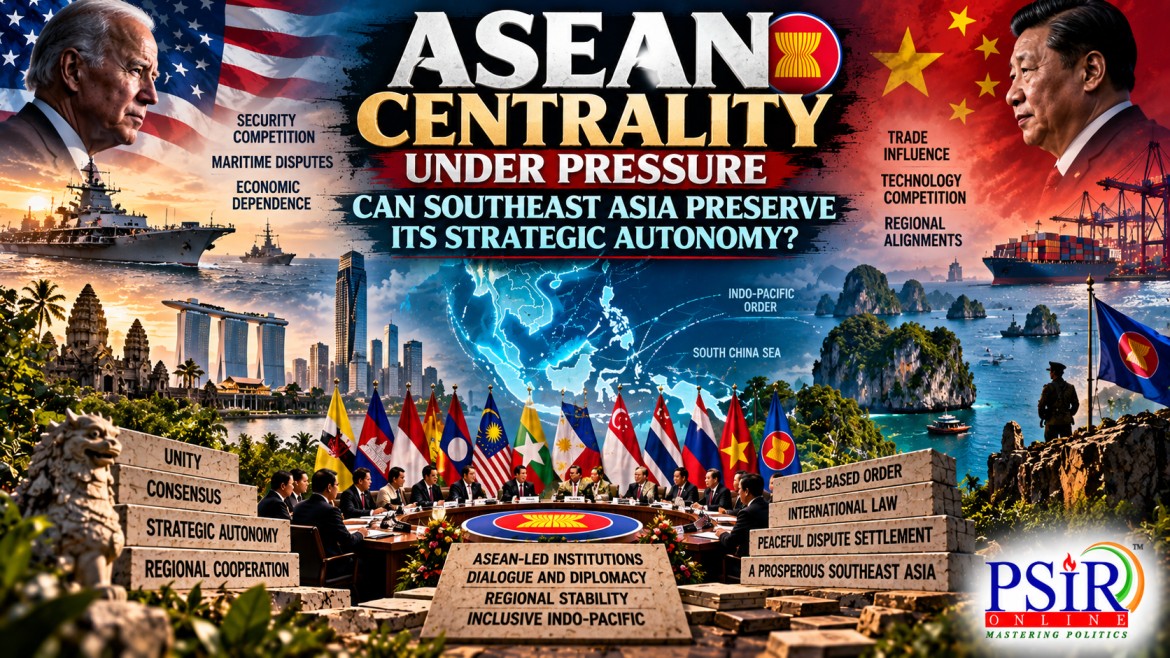
Southeast Asia occupies a strategically important position between the Indian and Pacific Oceans. Its maritime routes, manufacturing networks, energy flows and technological connections make the region central to the economic and security interests of both the United States and China. As competition between these powers intensifies, the Association of Southeast Asian Nations (ASEAN) faces a difficult challenge: how can it preserve regional autonomy without alienating the major powers on which its members depend?
The 59th ASEAN Foreign Ministers’ Meeting, held in Manila on 21 July 2026 under the Philippines’ chairship, addressed this challenge alongside regional integration, maritime security, Myanmar and external partnerships. The wider ministerial meetings from 18–24 July also involved ASEAN-led diplomatic forums and dialogue partners.
The meeting reaffirmed ASEAN’s commitment to unity and centrality, but the underlying challenge remains unresolved. ASEAN’s influence depends on its ability to convene major powers, maintain a common regional agenda and promote cooperation even when its members have different strategic interests.
The central question is whether ASEAN can remain the organiser of regional diplomacy rather than become an arena in which external powers compete for influence.
UNDERSTANDING ASEAN CENTRALITY AND STRATEGIC AUTONOMY
ASEAN was established in 1967 and has gradually developed from a regional association into a central platform for Southeast Asian diplomacy. Its institutional network includes the ASEAN Regional Forum (ARF), ASEAN Plus Three, the East Asia Summit (EAS) and the ASEAN Defence Ministers’ Meeting-Plus (ADMM-Plus).
ASEAN centrality refers to ASEAN’s role in convening, shaping and sustaining regional cooperation through these institutions. Rather than allowing one major power to determine the regional agenda, ASEAN seeks to maintain forums in which multiple powers can participate.
Strategic autonomy is related but distinct. It refers to the ability of ASEAN members to retain meaningful freedom of diplomatic and policy choice without becoming excessively dependent on, or constrained by, a single external power.
|
Concept |
Meaning in Southeast Asian diplomacy |
|
ASEAN centrality |
ASEAN remains at the centre of regional dialogue and institution-building |
|
Strategic autonomy |
Regional states preserve freedom of choice in foreign and security policy |
|
ASEAN unity |
Members coordinate sufficiently to sustain common positions |
|
Inclusive regionalism |
External powers participate through ASEAN-led and other regional mechanisms |
These concepts reinforce one another, but they are not interchangeable. ASEAN may remain the formal convenor of a regional meeting while struggling to influence the decisions made by its participants. Similarly, individual members may maintain autonomy through diversified partnerships even when ASEAN cannot agree on a common position.
The real test is therefore not the number of diplomatic meetings ASEAN hosts, but whether these mechanisms generate meaningful cooperation, regional influence and respect for international law.
US–CHINA COMPETITION AND ASEAN’S BALANCING STRATEGY
The United States and China are central to Southeast Asia’s strategic environment, but ASEAN members do not share identical relationships with either power. China is deeply integrated into regional trade and production networks, while the United States remains an important security partner for several Southeast Asian countries. Japan, India, Australia, South Korea and the European Union also contribute to the region’s economic and strategic relationships.
ASEAN’s preferred response has generally been to maintain broad engagement rather than choose a single geopolitical camp. This approach allows its members to benefit from trade, investment, technology and security cooperation with different partners.
However, the strategy is becoming more difficult to sustain.
· First, technological restrictions, export controls and competition over semiconductors and artificial intelligence can force governments to make choices that affect their economic relationships.
· Second, tensions in the South China Sea create direct security concerns for claimant states and raise questions about freedom of navigation and the application of international law.
· Third, differences in national threat perceptions make collective responses difficult. Countries that prioritise maritime security may favour stronger external security partnerships, while others may place greater emphasis on preserving economic relations and avoiding confrontation.
ASEAN’s response is therefore not a uniform balancing alliance. It is better understood as institutional hedging: maintaining relationships with competing powers, diversifying partnerships and preserving diplomatic space.
This approach can reduce dependence on any single actor, but it cannot eliminate strategic pressure. If US–China competition becomes increasingly tied to trade, technology, finance and security, ASEAN members may find it harder to separate economic cooperation from geopolitical alignment.
THE SOUTH CHINA SEA: THE TEST OF ASEAN UNITY
The South China Sea remains one of the clearest tests of ASEAN’s ability to translate centrality into practical outcomes. The disputes involve competing maritime claims, fishing rights, resource access, military activities and freedom of navigation.
ASEAN members do not have identical territorial claims or threat perceptions. The Philippines and Vietnam have particularly direct interests in maritime disputes with China, while other members place different emphasis on economic relations, regional stability and non-confrontation.
At the July 2026 meetings, the Philippines highlighted progress in ASEAN–China negotiations on a proposed Code of Conduct in the South China Sea, with the stated objective of concluding it by the end of 2026. This was a negotiating target, not an agreement already completed.
The Code of Conduct is important because it could provide agreed procedures and expectations for managing maritime tensions. However, its practical value will depend on the eventual text, its legal character, implementation arrangements and the willingness of parties to comply.
ASEAN’s broader diplomatic position emphasises peaceful dispute settlement and the 1982 United Nations Convention on the Law of the Sea (UNCLOS). Yet declarations alone cannot prevent incidents at sea or resolve incompatible claims.
The challenge is to combine diplomacy with credible implementation, crisis communication and adherence to international law. ASEAN unity is most consequential when it produces practical restraint and predictable behaviour, rather than statements without follow-through.
MYANMAR AND THE LIMITS OF NON-INTERFERENCE
The Myanmar crisis illustrates a different challenge: ASEAN’s difficulty in responding collectively when domestic conflict has major regional and humanitarian consequences.
ASEAN’s Five-Point Consensus calls for an end to violence, dialogue among relevant stakeholders, humanitarian assistance and the involvement of the ASEAN Chair’s special envoy. However, implementation has remained difficult, and ASEAN has struggled to secure a comprehensive political resolution.
At the July 2026 meetings, ministers reaffirmed the Five-Point Consensus and called for concrete and measurable progress, including a cessation of violence, the release of political prisoners and safe humanitarian access. Myanmar did not have political representation at the ministerial level, reflecting ASEAN’s internal arrangements.
The crisis exposes a tension between non-interference and regional responsibility. Non-interference has historically helped ASEAN members build trust among states with different political systems. However, rigid interpretations can limit collective action when violence, displacement and humanitarian emergencies cross borders.
ASEAN does not need to abandon its founding principles to improve its response. It can strengthen humanitarian access, support inclusive dialogue, coordinate with relevant stakeholders and assess progress against clear benchmarks.
Nevertheless, ASEAN’s effectiveness depends on the cooperation of the parties involved and the willingness of member states to sustain a common approach. The Myanmar crisis therefore affects not only the lives of those directly involved but also ASEAN’s credibility as a regional institution.
ASEAN-LED INSTITUTIONS AND THE FUTURE OF REGIONAL ORDER
ASEAN centrality is sustained through a network of diplomatic mechanisms rather than a single institution.
|
Mechanism |
Strategic function |
|
ASEAN Regional Forum |
Confidence-building and dialogue on political and security issues |
|
East Asia Summit |
Strategic discussion involving ASEAN and major regional and global powers |
|
ASEAN Plus Three |
Cooperation with China, Japan and South Korea, particularly on economic and functional issues |
|
ADMM-Plus |
Defence dialogue and practical cooperation among ASEAN members and external partners |
|
ASEAN Outlook on the Indo-Pacific |
Promotes an open, inclusive and cooperative approach to the wider region |
The July meetings also marked the 50th anniversary of the Treaty of Amity and Cooperation in Southeast Asia, a foundational instrument emphasising sovereignty, non-interference, peaceful settlement of disputes and renunciation of the threat or use of force.
On 24 July 2026, Lithuania, Sweden, Romania and Poland signed instruments of accession to the Treaty. This demonstrated the continuing appeal of ASEAN’s diplomatic framework beyond Southeast Asia.
The wider significance is that ASEAN-led mechanisms can offer platforms where major powers interact without requiring every participant to share the same strategic outlook. They can sustain communication, build habits of cooperation and reduce the risk of regional diplomacy becoming exclusively organised around competing power blocs.
However, institutional centrality is not equivalent to material power. ASEAN does not possess the collective military capacity or unified foreign policy of a major alliance. Its influence depends on convening power, diplomatic credibility, economic relevance and the willingness of external partners to participate constructively.
The long-term objective under ASEAN 2045: Our Shared Future is to strengthen regional resilience and community-building. Achieving this requires institutions that do more than host meetings: they must help deliver practical cooperation on security, connectivity, economic resilience and emerging technologies.
A PRACTICAL AGENDA FOR PRESERVING STRATEGIC AUTONOMY
ASEAN can strengthen its strategic autonomy through a combination of institutional reform and practical cooperation.
First, deepen economic diversification. Expanding trade, investment and technology partnerships with multiple external partners can reduce excessive dependence on any one economy. Supply-chain resilience is especially important in critical minerals, semiconductors, energy and digital infrastructure.
Second, strengthen ASEAN unity without demanding complete uniformity. Members can develop minimum common positions on maritime law, crisis communication and regional stability while recognising differences in their bilateral relationships.
Third, improve the implementation capacity of ASEAN-led mechanisms. Regular dialogue should be supported by monitoring, technical cooperation, crisis-management channels and measurable follow-up.
Fourth, uphold international law consistently. UNCLOS and peaceful dispute settlement provide a common framework for maritime stability. Consistent application strengthens the credibility of ASEAN’s regional approach.
Fifth, engage external powers without surrendering agenda-setting capacity. ASEAN should continue working with the United States, China, India, Japan, Australia and other partners while ensuring that regional priorities remain central to its institutional processes.
Finally, the implementation of ASEAN 2045 should connect strategic ambition with practical outcomes in economic resilience, connectivity, digital development, energy security and humanitarian cooperation.
These measures will not remove great-power rivalry. They can, however, strengthen ASEAN’s ability to manage competition and preserve meaningful regional choice.
THEORETICAL ANGLES
|
Theory or concept |
How to use it in a PSIR answer |
|
Realism |
Analyse how ASEAN members respond to the distribution of power and the strategic competition between the United States and China. |
|
Neorealism |
Explain how changes in the regional balance of power encourage hedging, partnerships and institutional adaptation. |
|
Balance of power |
Assess how regional states use diversified partnerships to prevent excessive dependence on one major power. |
|
Liberal institutionalism |
Explain how ASEAN-led forums facilitate dialogue, reduce uncertainty and sustain cooperation despite strategic differences. |
|
Constructivism |
Examine how ASEAN identity, diplomatic norms and the principles of consensus and non-interference shape regional behaviour. |
|
Regional security complex theory |
Analyse how the security concerns of Southeast Asian states are interconnected while remaining distinct from those of external powers. |
|
Strategic autonomy |
Evaluate the extent to which ASEAN members can retain freedom of choice amid economic interdependence and security competition. |
|
Regionalism |
Assess whether ASEAN’s institutions can develop a stronger regional order without becoming a military alliance or a unified foreign-policy bloc. |
CONCLUSION
The July 2026 ministerial meetings in Manila reaffirmed ASEAN’s central role in regional diplomacy while exposing the pressures created by US–China competition, maritime disputes and internal divisions.
ASEAN’s strategic autonomy does not require neutrality on every issue, nor does it mean avoiding cooperation with major powers. It requires the ability to engage different partners without allowing external rivalry to determine the region’s entire political and security agenda.
The future of ASEAN centrality will depend on whether its institutions can convert diplomatic convening power into practical cooperation, whether its members can sustain minimum common positions and whether external powers continue to recognise ASEAN-led forums as useful platforms.
ASEAN can preserve its strategic autonomy not by escaping great-power competition, but by strengthening its unity, diversifying its partnerships and making regional institutions more effective.
RELATED READING
PRACTICE QUESTIONS FOR GS PAPER II MAINS
PRACTICE QUESTIONS FOR PSIR
