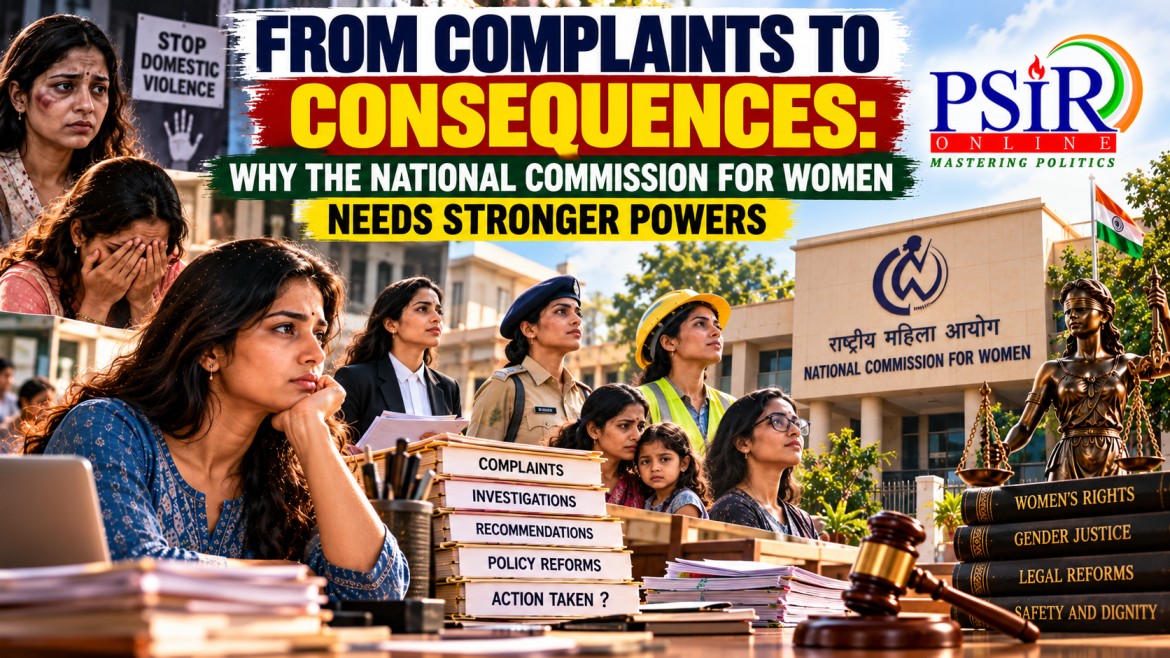
The National Commission for Women (NCW) was established on 31 January 1992 under the National Commission for Women Act, 1990, to safeguard and promote the rights and interests of women. Its mandate includes examining legal safeguards, investigating complaints, recommending legislative reforms, reviewing government policies and taking up cases involving the deprivation of women's rights. Yet, the existence of a national institution dedicated to women's rights does not automatically guarantee effective remedies for women facing domestic violence, sexual harassment, dowry-related abuse, cybercrime, discrimination or institutional apathy.
The central institutional problem is the gap between the power to investigate and recommend and the power to ensure that its recommendations produce timely, enforceable consequences. Calling the NCW entirely powerless would be inaccurate: Section 10 of its parent legislation grants it significant investigative functions, while Section 10(4) provides specified civil-court powers during certain inquiries. However, it generally cannot independently prosecute offenders, convict accused persons or replace police authorities and courts. The challenge is therefore to strengthen its independence, accountability, investigative capacity and remedial effectiveness without undermining due process or the jurisdiction of other institutions. [Source: National Commission for Women Act, 1990.]
A STATUTORY COMMISSION WITH LIMITED ENFORCEMENT CAPACITY
The NCW is a statutory body, unlike a constitutional commission whose existence and core framework are directly established by the Constitution. Its powers derive principally from the National Commission for Women Act, 1990.
Section 10 authorises the Commission to investigate safeguards for women, review legislation, recommend remedial measures, take up complaints, initiate suo motu action and undertake studies. Section 10(4) gives it specified powers of a civil court while investigating matters covered by the provision, including summoning persons, requiring documents, receiving evidence on affidavits and requisitioning public records. These are meaningful powers, but they do not make the Commission a criminal court or a substitute for the police.
The institutional limitation emerges when an inquiry identifies serious wrongdoing. The NCW may seek an explanation from the relevant authority, request action, monitor a response and recommend corrective measures. However, a recommendation is not equivalent to an enforceable judicial order. If a police authority delays an investigation or an administrative department fails to implement a recommendation, the Commission does not possess a general power to impose criminal punishment or independently compel every form of corrective action.
Consequently, its practical influence may depend heavily on the responsiveness of the police, state governments, district administration, employers and other institutions. The effectiveness of the NCW therefore depends not merely on the breadth of its mandate but also on the institutional consequences of non-compliance.
THE COMPLAINTS BURDEN AND THE PROBLEM OF FRAGMENTED REDRESSAL
The Commission operates across a wide range of concerns, from domestic violence and dowry harassment to sexual harassment, cybercrime, trafficking, discrimination and the rights of women in vulnerable circumstances. Its official complaint portal provides online registration and complaint-status facilities, while its published procedures describe coordination with police authorities and other institutions.
The NCW's Annual Report for 2023–24 recorded 28,650 complaints during the financial year from April 2023 to March 2024. The largest listed categories included the right to live with dignity, protection against domestic violence and harassment of married women or dowry harassment. These figures demonstrate the breadth of demand placed on the Commission, although complaint totals alone do not establish the quality or timeliness of disposal.
A woman approaching the Commission may still need to pursue parallel remedies through the local police, a magistrate, a protection officer, a workplace Internal Committee, a State Commission for Women or a legal services authority. These institutions have different jurisdictions and powers. Without effective coordination, a complainant can face repeated referrals, procedural delays and uncertainty over responsibility.
A complaint-forwarding mechanism is useful, but it is not sufficient when the receiving authority does not act promptly. An effective NCW must be able to establish whether the complaint was received, what action followed, why a delay occurred and whether the complainant remains at risk.
INDEPENDENCE, APPOINTMENTS AND ACCOUNTABILITY
An institution responsible for examining failures by public authorities must be sufficiently independent to scrutinise those authorities without fear of administrative or political pressure. The NCW's statutory framework provides for a Chairperson and members appointed by the Central Government. The appointment process and the Commission's dependence on government funding make institutional independence and transparent selection important questions of governance.
The issue is not that government appointment necessarily produces interference in every case. Rather, a credible system should protect the Commission against actual or perceived conflicts of interest. Appointment criteria, transparent selection procedures, fixed and clearly defined tenure, published reasons for vacancies and safeguards against arbitrary removal can improve public confidence.
Accountability must accompany independence. The Commission should publish measurable information on complaints received, cases resolved, referrals, response times, repeat complaints, recommendations accepted and action taken by the authorities concerned. Annual reports should be laid before Parliament promptly, with clear follow-up on the implementation of recommendations.
The objective is to create an institution that is independent enough to question the government and accountable enough to demonstrate results. Independence without performance review risks opacity; accountability without independence risks institutional dependence.
HOW THE NCW CAN BE MADE MORE EFFECTIVE
Reform should focus on giving the Commission a stronger capacity to secure responses and remedies rather than simply expanding its formal mandate.
First, introduce time-bound action requirements. Police departments and public authorities should be required to acknowledge and respond to specified categories of NCW referrals within prescribed periods, subject to justified extensions. Serious complaints involving threats to life, sexual violence, trafficking or repeated domestic abuse should receive priority assessment. Delays should be recorded and escalated to designated senior officers.
Second, create a structured compliance mechanism. The NCW should be able to issue reasoned findings and recommendations, seek a formal written response from the concerned authority and publish non-compliance where appropriate. Parliament could consider a carefully defined statutory framework requiring authorities to respond to specified recommendations within a time limit, explain rejection and report corrective action. Any stronger binding powers should be precisely defined and subject to judicial review.
Third, strengthen investigation and legal support. The Commission requires adequate legal officers, trained investigators, counsellors, digital-forensics expertise and regional-language support. It should be able to conduct or commission independent fact-finding within its lawful jurisdiction, preserve relevant records and refer criminal conduct to competent agencies. Its procedures must protect confidentiality, prevent retaliation and avoid forcing complainants to repeatedly narrate traumatic experiences.
Fourth, decentralise access. District-level facilitation arrangements, periodic legal-aid camps and stronger coordination with State Commissions for Women can reduce the distance between complainants and the national institution. The Commission's digital platform should be complemented by telephone, postal and in-person access for women who lack reliable internet access or digital literacy.
Fifth, strengthen financial and administrative capacity. A national commission cannot effectively perform investigation, research, legal support, outreach and monitoring if staffing or resources are insufficient. The Parliamentary Standing Committee on the Ministry of Women and Child Development, in its 2026–27 Demands for Grants report, noted that the NCW's Budget Estimate for 2026–27 was ₹36 crore, compared with a Revised Estimate of ₹38.41 crore for 2025–26. It considered the proposed allocation inadequate for the Commission's mandate and recommended reviewing funding needs, including support for public hearings, district-level legal-aid camps, complaint redressal and awareness programmes.
A PRACTICAL REFORM MODEL: FROM INTERVENTION TO VERIFIED OUTCOMES
A reformed NCW should be judged by the outcomes it helps secure, not merely by the number of complaints it receives or notices it issues. A proposed performance framework could combine the following measures:
|
Reform area |
Proposed institutional mechanism |
|
Complaint management |
A single tracking number, accessible status updates and clear identification of the authority responsible for action |
|
Response deadlines |
Prescribed acknowledgement and response periods for referrals, with escalation procedures for serious or delayed cases |
|
Compliance |
Written reasons for rejecting recommendations, time-bound action reports and publication of aggregate compliance data |
|
Emergency protection |
Priority referral protocols for immediate threats, with clear responsibility assigned to competent police and protection authorities |
|
Investigation |
Specialist legal, social-work and digital-evidence teams, with safeguards for confidentiality and due process |
|
Accessibility |
Regional-language support, district facilitation, legal-aid camps and offline complaint channels |
|
Independence |
Transparent appointments, adequate staffing, protected tenure and predictable funding |
|
Public accountability |
Timely annual reports, disaggregated data and parliamentary scrutiny of recommendations and follow-up |
|
Institutional coordination |
Formal working arrangements with State Commissions for Women, police, legal services authorities and relevant ministries |
The Commission should not become a parallel criminal justice system. Police investigation, prosecution and adjudication must remain with legally authorised institutions. Instead, the NCW should become a strong monitoring and accountability institution capable of identifying systemic failures, demanding reasoned responses and ensuring that complaints do not disappear between departments.
A carefully designed statutory amendment could strengthen selected enforcement mechanisms, including mandatory responses and escalation for unjustified non-compliance. Any quasi-judicial or binding powers would require clear jurisdictional limits, fair-hearing safeguards, appeal or review mechanisms and protection against conflicting orders from courts or other statutory bodies.
THE CONSTITUTIONAL AND GOVERNANCE DIMENSION
The case for strengthening the NCW arises from the constitutional commitment to equality, dignity and protection against discrimination. Articles 14 and 15 establish equality before the law and prohibit specified forms of discrimination; Article 15(3) permits special provisions for women and children. Article 21 protects life and personal liberty, while Article 39(a) calls for an adequate means of livelihood for men and women equally. Article 42 directs the State to make provision for just and humane conditions of work and maternity relief.
Article 51A(e) places a fundamental duty on citizens to renounce practices derogatory to the dignity of women. The Protection of Women from Domestic Violence Act, 2005, the Sexual Harassment of Women at Workplace Act, 2013, and other legislation provide substantive protections and remedies through designated authorities and legal processes. The NCW's role is to help ensure that these safeguards work in practice, identify gaps in implementation and recommend reforms.
Strengthening the Commission must therefore complement, not displace, existing legal remedies. A woman should not have to choose between approaching the NCW and pursuing an available remedy before a police station, magistrate, workplace committee or court. An effective national commission would help connect these mechanisms while respecting their separate legal mandates.
UPSC DIMENSION
|
Constitutional provision or polity concept |
Connection to the NCW |
|
Article 14 — Equality before law |
Supports equal protection and scrutiny of discriminatory state action. |
|
Article 15 — Prohibition of discrimination |
Provides the constitutional basis for addressing discrimination and permitting special provisions for women. |
|
Article 21 — Life and personal liberty |
Connects women's safety, dignity, autonomy and access to effective remedies. |
|
Article 15(3) — Special provisions for women and children |
Supports targeted legal and institutional measures to address structural disadvantage. |
|
Article 39(a) — Adequate means of livelihood |
Links women's empowerment with economic security and substantive equality. |
|
Article 42 — Humane conditions of work and maternity relief |
Relates to workplace protections and the implementation of gender-sensitive labour policy. |
|
Article 51A(e) — Fundamental duty |
Establishes a civic responsibility to renounce practices derogatory to women's dignity. |
|
Statutory bodies and commissions |
Illustrates the difference between a body with investigative and recommendatory powers and one with enforceable adjudicatory authority. |
|
Parliamentary accountability |
Highlights the importance of annual reports, budget scrutiny and follow-up on institutional recommendations. |
|
Cooperative federalism |
Requires coordination among the NCW, State Commissions for Women, police and state administrations. |
|
Access to justice |
Emphasises timely remedies, legal aid, accessibility and effective grievance redressal. |
|
Good governance |
Connects transparency, measurable outcomes, responsiveness and administrative accountability. |
CONCLUSION
The National Commission for Women is not without powers; its statutory framework provides investigative, recommendatory and specified civil-court functions. Its central weakness lies in the gap between identifying a violation and ensuring that the responsible institution takes timely corrective action. Expanding the Commission's authority without improving resources, independence, coordination and accountability would risk creating another layer of administration rather than a more effective remedy.
The reform objective should be to move from complaint registration to verified resolution. Transparent appointments, adequate funding, time-bound responses, specialist investigation, district-level access and parliamentary scrutiny can improve the Commission's effectiveness. Carefully defined enforcement mechanisms could further strengthen compliance while preserving due process and the authority of courts.
A national women's commission becomes meaningful not simply when it hears grievances, but when its intervention helps produce safety, accountability and accessible justice.
RELATED READING
PRACTISE QUESTIONS FOR GS2 MAINS
PRACTISE QUESTIONS FOR PSIR
