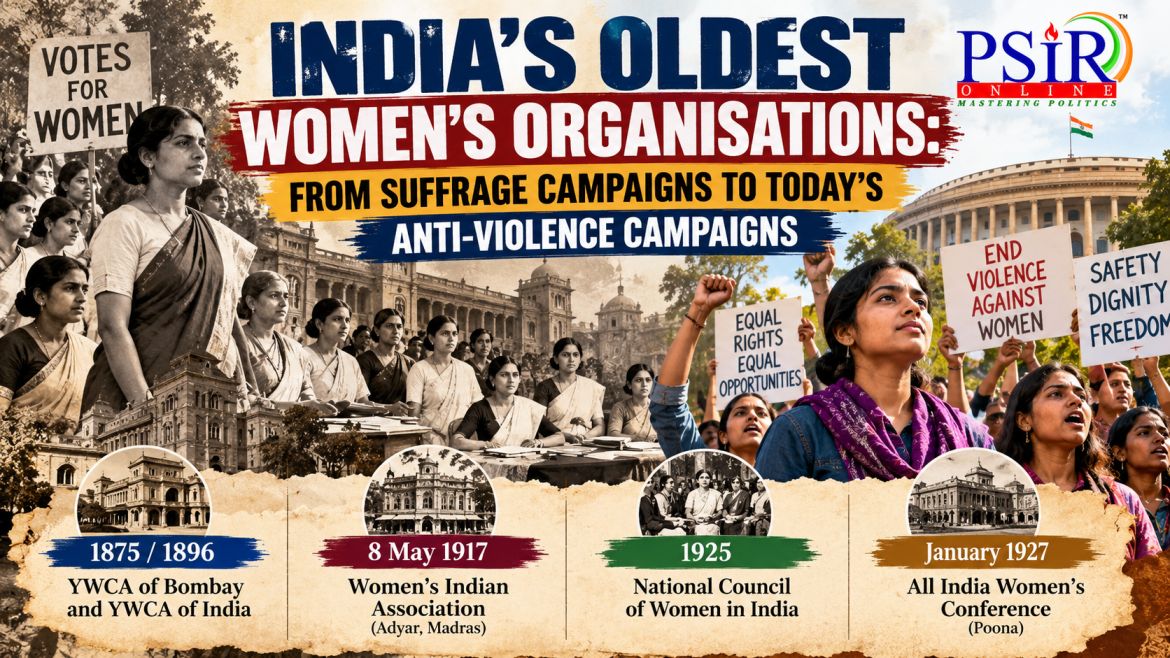
The struggle for women’s political agency, legal protection, and social reform in India did not emerge overnight; it is rooted in over a century of continuous institutional organisation. While several prominent nineteenth-century reform initiatives faded with time, a handful of pioneering bodies survived. These historic institutions—originating in colonial-era battles over franchise, child marriage, and literacy—laid the essential groundwork for modern feminist discourse, culminating in contemporary constitutional debates surrounding legislative reservations for women.
THE ENDURING PIONEERS: A CONTINUITY OF INSTITUTIONAL ADVOCACY
The landscape of Indian women's activism is defined by organisations that succeeded in institutionalising their mission, surviving post-colonial political realignments and expanding their work across the country.
YWCA of Bombay and YWCA of India (1875 / 1896):
Marking the oldest continuously traced women’s association in India, local YWCA work commenced in Bombay in 1875. The national federated body followed in 1896. Today, the YWCA of India operates approximately 95 local associations nationwide, focusing on women’s leadership development, gender justice, addressing violence against women, and providing cross-community livelihood support.
Women’s Indian Association (8 May 1917, Adyar, Madras):
Founded by Annie Besant, Margaret Cousins, and Dorothy Jinarajadasa, alongside legendary Indian leaders such as Dr. Muthulakshmi Reddy, the WIA served as the primary vehicle connecting social reform with political rights. It led early campaigns for female suffrage, raising the age of consent, abolishing child marriage, and expanding female literacy. Operating from Chennai under current leadership such as Dr. Padma Venkataraman, the association remains active, serving as an umbrella link for women’s bodies across Tamil Nadu.
National Council of Women in India (1925):
Established with Lady Meherbai Tata, the NCWI provided India with its earliest institutional affiliation to the International Council of Women (ICW). Operating welfare and training centres (including long-standing facilities in Shimla), it continues to work on vocational skilling and socio-economic support for underprivileged women.
All India Women’s Conference (January 1927, Poona):
Convened by Margaret Cousins with Maharani Chimnabai of Baroda serving as its first president, the AIWC began as an advocacy platform for girls' education before quickly expanding into legal and political reform. The AIWC was instrumental in lobbying for the landmark Child Marriage Restraint Act (Sarda Act) of 1929, franchise rights, equal inheritance, and divorce legislation. It remains the largest continuous national women’s organisation in India, coordinating hundreds of branches, shelter homes, working women’s hostels, and vocational training facilities.
Pre-Independence Milestones: Nineteenth-Century Roots and Divergent Trajectories
Before the consolidation of pan-Indian organisations in the 1910s and 1920s, several early reform efforts emerged to challenge orthodoxy. While foundational, many did not maintain organizational continuity.
· Arya Mahila Samaj (1882, Pune): Founded by Pandita Ramabai, this society championed female education, rescued young widows, and combated oppressive social practices. Though Ramabai’s pioneering work laid the intellectual groundwork for Indian feminist theory, the organisation did not survive into the modern era as an active pan-Indian rights body.
· Ladies’ Society / Sakhi Samiti (1880s, Calcutta): Established by Swarnakumari Devi and Sarala Devi Chaudhurani, these initiatives organised exhibitions and vocational training for widows and impoverished women.
· Bharat Stree Mahamandal (1910, Allahabad): Initiated by Sarala Devi Chaudhurani, it is often celebrated as the first national women’s association founded entirely by an Indian woman. It established branches across multiple provinces, though its organisational footprint faded after the First World War.
Later decades also witnessed the emergence of distinct, long-running movements that took different strategic directions:
· Rashtra Sevika Samiti (1936): Founded by Lakshmibai Kelkar, the Samiti is one of India's oldest continuous women's formations. However, its mandate diverges significantly from the constitutional rights-and-suffrage framework of the WIA and AIWC, focusing primarily on cultural consolidation, character-building, and nationalist service.
· Self-Employed Women’s Association (SEWA, 1972): Formed decades later by Ela Bhatt, SEWA transformed the modern rights discourse by unionizing informal women workers. While it is India’s foremost modern economic and labour-rights collective, its lineage belongs to the post-Independence trade union movement rather than early colonial-era suffrage politics.
MODERN REORIENTATION: HOW INDIA’S OLDEST WOMEN’S ORGANISATIONS OPERATE TODAY
While these historic organisations trace their roots to early twentieth-century franchise and personal law campaigns, their operational grammar has undergone a significant transformation. Today, none function as wings of political parties—remaining strictly non-aligned with the BJP, the Congress, or regional outfits. Instead, their public positioning has migrated toward service delivery, crisis intervention, skills-based livelihood support, and international developmental frameworks.
Within this broader landscape, their engagement with high-stakes legislative fights—most notably the implementation timeline of the 2023 Women’s Reservation Act—reveals distinct strategic choices:
YWCA of India: Explicit Political Assertion and Rights-Based Mobilisation
o Rights and Leadership Grammar: Positions itself as the most openly political and assertive of the four, framing issues around gender justice, equal legislative presence, sexual and reproductive health, and dismantling caste and economic barriers to leadership.
o Systemic Interventions on Violence: Engages in public street dissent rather than solely shelter support; in August 2024, its national leadership joined protests at Jantar Mantar following the RG Kar Hospital incident, publicly demanding accountability for violence against women as an institutional and systemic failure.
o Frontline on Women’s Reservation: Unlike its historical peers, the YWCA has taken a definitive stand in the current political contest over the 2023 constitutional amendment. Aligning with the National Coalition for Women’s Reservation in July 2026, it publicly demanded immediate implementation of the 33% quota based on the existing strength of Parliament and state assemblies—rejecting any postponement tied to the decennial census or delimitation.
All India Women’s Conference (AIWC): From Landmark Legislation to the UN SDG Framework
o Historical Continuity as Public Pitch: Retains its historic legacy as the prime mover behind the Sarda Act (1929), the Hindu Code reforms, and universal adult franchise, operating through an extensive network of roughly 500 local branches.
o Shift to Developmental and Climate Language: Has shifted its primary public rhetoric from electoral confrontation to non-partisan developmentalism, shelter networks, livelihood training, and leadership workshops.
o Global Consultative Presence: Anchors its rights advocacy in international spaces through consultative status at the United Nations and active membership in the Women and Gender Constituency at global climate negotiations—adopting the vocabulary of Sustainable Development Goals (SDGs) and environmental justice rather than domestic party friction.
o Distance from Polarising Debates: Intentionally refrains from leading agitations over contentious legislative disputes, such as the Uniform Civil Code (UCC) or the timeline linking women’s legislative quotas to the delimitation process, choosing to collaborate with state departments and corporate CSR bodies on health, clean energy, and vocational skills.
Women’s Indian Association (WIA): Regional Federation and Civic Welfare
o Civic and Peace-Building Framework: Retains its traditional vocabulary centered on civic public service, literacy, community health, and social peace, operating primarily as an institutional federation for women’s societies across Tamil Nadu.
o Contemporary Grassroots Programming: Modern activities concentrate on localized social interventions, including mental health awareness, environmental sustainability projects, relief work, and conflict-resolution initiatives through institutional memorandums.
o Absence from National Legislative Lobbying: Despite its historic role in dispatching India's first franchise delegation to the colonial government in 1917, the WIA functions today as a state-level civic network rather than an active lobbying presence in New Delhi, maintaining organizational ties through its affiliation with the AIWC without running independent campaigns on national reservation or criminal law changes.
National Council of Women in India (NCWI): Depoliticised Skilling and Grassroots Welfare
o Explicit Non-Political Identity: Represents the most depoliticised posture among the surviving colonial-era formations, formally defining its institutional character as purely voluntary, charitable, and non-political.
o Focus on Economic Self-Reliance: Centers its public outreach almost exclusively on pragmatic economic empowerment through accredited diploma training, running centers for tailoring, stitching, beauty culture, and traditional crafts for underprivileged women.
o Complete Detachment from Legislative Arena: Entirely abstains from legal reform advocacy, electoral parity discussions, or public interventions regarding personal law and judicial updates, limiting its organizational scope strictly to socio-economic service delivery.
THE BROADER TRAJECTORY: SERVICE DELIVERY VS. POLITICAL ASSERTION
Taken together, the surviving colonial-era bodies illustrate a clear institutional shift:
· The Transition to Service Delivery: Most have substituted the intense constitutional lobbying of the 1920s–1950s with social safety nets, accredited vocational courses, and UN-aligned development work.
· The Exception to Depoliticisation: In the contemporary debate over women's legislative representation, only the YWCA of India actively steps onto the national political stage to demand an immediate quota without waiting for delimitation, while the others maintain a studied distance from active political contestation.
PSIR THEORETICAL DIMENSION & EXAMINATION LINKAGES
|
PSIR Theoretical Dimension & Concepts |
How It Connects to Examination Answers (PSIR Paper 1 / Paper 2) |
|
Substantive Representation vs. Descriptive Presence (Anne Phillips – The Politics of Presence; Iris Marion Young) |
The Quota vs. Presence Dilemma: Evaluates the historic transition from colonial-era limited suffrage delegations (WIA/AIWC) to contemporary debates over the 106th Constitutional Amendment Act (Nari Shakti Vandan Adhiniyam). Distinguishes between nominal numerical inclusion (descriptive presence) and effective legislative voice on gendered socio-economic transformation (substantive representation). |
|
Civil Society: Co-optation vs. Autonomous Contestation (Antonio Gramsci; Alexis de Tocqueville) |
Service Delivery vs. Political Assertion: Contrasts Tocqueville's model of vibrant, autonomous voluntary associations against the Gramscian concept of institutional absorption. Analyzes how groups like AIWC and NCWI shifted toward state-partnered service delivery, CSR execution, and UN-aligned SDG language, whereas the YWCA of India retains a politically contentious stance by demanding immediate legislative quota implementation. |
|
Social Movement Institutionalisation & "NGO-isation" (Sidney Tarrow; Sonia Alvarez) |
Professionalisation of Feminist Advocacy: Illustrates the institutional lifecycle of social movements—from radical street-level civil disobedience and anti-colonial franchise struggles to formalized, depoliticised non-governmental formations focused on vocational diplomas, crisis shelters, and donor-driven welfarism. |
|
Feminist Critiques of the Secular, Universalist State (Catharine MacKinnon; Nivedita Menon) |
The Uniform vs. Community Law Conundrum: Examines why long-standing women's bodies traditionally maintained caution regarding the Uniform Civil Code (UCC) and personal law modifications. Highlights the unresolved theoretical tension between abstract gender rights and minority cultural rights in a plural post-colonial democracy. |
|
Demographic Federalism & Representational Sequencing (Hannah Pitkin – Concept of Representation) |
The Census-Delimitation Conditionality: Connects the 2026 demands by the YWCA and the National Coalition for Women's Reservation to the mechanics of electoral engineering. Analyzes the normative friction of deferring a constitutional guarantee of representation behind decennial census enumeration and territorial delimitation. |
|
Subaltern and Autonomous Women's Movements (Gail Omvedt; Susie Tharu & K. Lalita) |
Elite Hegemony vs. Intersectionality: Highlights the structural limitations of early upper-caste, elite-led formations (e.g., WIA, AIWC, NCWI). Explains why modern working-class and marginalized women's struggles required autonomous platforms (like SEWA in 1972 and Dalit feminist collectives) to address caste, labor, and economic exploitation. |
CONCLUSION
From their nineteenth-century origins in anti-colonial reform, female literacy, and suffrage delegations to their modern positions on legislative quotas and systemic justice, India’s oldest surviving women’s organisations—the YWCA, the Women’s Indian Association (WIA), the All India Women’s Conference (AIWC), and the National Council of Women in India (NCWI)—have undergone a major structural reorientation. While early battles were fought directly in legislative corridors to secure adult franchise, the Sarda Act (1929), and the Hindu Code reforms, modern demands have largely migrated from partisan confrontation toward institutional service delivery, vocational skilling, and United Nations Sustainable Development Goal (SDG) frameworks. Yet, as contemporary national controversies surrounding systemic violence and the implementation timeline of the 2023 Women’s Reservation Act demonstrate—most visibly through the YWCA’s public mobilisations—the century-long continuum from colonial suffrage campaigns to modern political assertion underscores that genuine gender justice requires an autonomous civil society capable of translating civic presence into substantive, structural power.
RELATED READING: CONCEPTS, CONSTITUTIONAL PROVISIONS & STATUTES
1. Constitutional Provisions
· Article 15(3): Enables special protective and affirmative provisions for women, providing the constitutional baseline for gender-directed state policies.
· Article 325 & Article 326: Guarantees a single, non-discriminatory electoral roll and universal adult suffrage, realizing the core anti-colonial demands championed by early suffrage delegations.
· Article 330A & Article 332A (Constitution 106th Amendment Act): Provides 33% horizontal reservation for women in the Lok Sabha and State Legislative Assemblies, alongside the procedural clause tying its implementation to the post-census delimitation exercise.
· Article 39(a) & (d) (Directive Principles of State Policy): Mandates state action toward adequate livelihood and equal pay for equal work, intersecting directly with the economic welfare work of older women's councils.
2. Key Historical & Contemporary Legislation
· Child Marriage Restraint Act, 1929 (Sarda Act) & Prohibition of Child Marriage Act, 2006: Landmark legislative achievements directly lobbied by the AIWC and WIA to eliminate child marriages and establish legal age-of-consent baselines.
· The Hindu Code Bills (1955–1956): Structural post-independence reforms establishing women's rights regarding marriage, divorce, succession, and guardianship, actively steered by first-wave women's formations.
· The Constitution (106th Amendment) Act, 2023 (Nari Shakti Vandan Adhiniyam): The contemporary statutory flashpoint regarding the commencement timeline of legislative seat quotas.
3. Conceptual & Analytical Angles for Students
· From Suffrage to Substantive Power: Trace how the nature of female political participation evolved from demanding the right to vote (1917 Montagu-Chelmsford deputation) to demanding the structural power to legislate.
· The Depoliticisation of Grassroots Platforms: Examine why early rights-advocacy organizations transitioned toward skill training, micro-credit, and UN SDG alignment, leaving direct political confrontation to trade-unionist and student collectives.
· Intersectionality and Representation: Evaluate how contemporary women's organizations address the double marginalization of caste and class within gender-rights advocacy.
PRACTICE QUESTIONS FOR PSIR
1. "The trajectory of India's earliest women's organizations reflects a transition from legislative contestation to developmental service delivery." Comment. (10 Marks / 150 Words)
2. Examine the tension between descriptive representation and substantive power in the context of the debate over implementing the Women's Reservation Act. (15 Marks / 250 Words)
3. How did early suffrage campaigns led by organizations like the WIA and AIWC shape the constitutional guarantee of universal adult franchise in post-colonial India? (20 Marks / 300 Words)
4. "The institutionalization of women's movements into non-governmental organizations has expanded social welfare but tempered radical political assertion." Discuss. (20 Marks / 300 Words)
