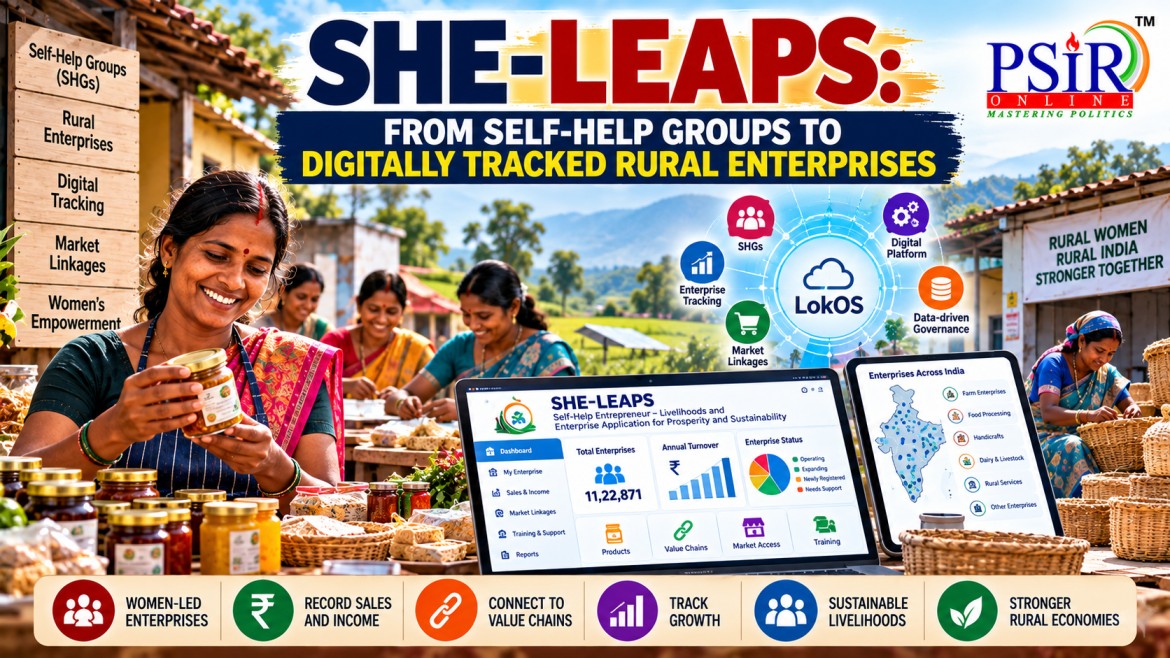
India’s rural women’s empowerment programmes have traditionally relied on Self-Help Groups (SHGs) to mobilise savings, provide access to credit and promote collective livelihoods. However, the formation of an SHG or the provision of a loan does not automatically guarantee that a woman’s enterprise will remain profitable or generate a stable income.
The Self-Help Entrepreneur–Livelihoods and Enterprise Application for Prosperity and Sustainability (SHE-LEAPS) seeks to address this gap through digital enterprise monitoring. Launched on 29 June 2026 at the Rashtriya Gramin Vikas Sammelan in New Delhi, the application was developed by Digital India Corporation and implemented under the LokOS platform of the Deendayal Antyodaya Yojana–National Rural Livelihoods Mission (DAY-NRLM).
The platform is designed to capture enterprise-related information, monitor business performance and help rural livelihood institutions make better decisions. Its significance lies in the shift from simply recording the number of women receiving assistance to tracking the enterprises they establish and operate.
The central governance question is whether better digital information can help rural women build viable businesses, access markets and achieve lasting economic independence.
WHAT IS SHE-LEAPS AND WHY WAS IT INTRODUCED?
SHE-LEAPS is a digital application designed to support women entrepreneurs associated with SHGs under DAY-NRLM. It covers both farm and non-farm enterprises, providing a common digital framework for enterprise creation, business management and performance monitoring.
Its objectives include:
· Strengthening women-led rural enterprises.
· Capturing enterprise information and operational performance.
· Improving the visibility of livelihood activities.
· Supporting financial inclusion and access to enterprise support.
· Connecting rural producers with formal value chains.
· Enabling data-informed planning by State Rural Livelihood Missions and other implementing institutions.
The Ministry of Rural Development reported on 4 August 2026 that SHE-LEAPS had been operationalised and was being implemented across 34 States and Union Territories through their State Rural Livelihood Missions. The application also provides for recording annual turnover and enterprise continuity.
The platform therefore represents an administrative shift: enterprises supported under a rural livelihood programme can be followed through digital records instead of being assessed only through periodic beneficiary counts.
However, operationalisation and enterprise registration are implementation milestones. They should not be treated as proof that every registered enterprise is profitable or that participating women have achieved economic independence.
HOW SHE-LEAPS WORKS THROUGH LokOS
SHE-LEAPS operates within LokOS, the digital platform used under DAY-NRLM to manage SHGs and their federations. LokOS supports digital records relating to community institutions, membership, savings, lending, repayments, financial transactions and livelihood activities. Its mobile and web applications serve different users involved in field-level recording, administration and approval.
The relationship between the two platforms can be understood as follows:
|
Component |
Role in rural enterprise development |
|
DAY-NRLM |
Provides the institutional framework for SHGs, community organisations and livelihood support. |
|
LokOS |
Digitises records and activities of SHGs and their federations and supports financial and livelihood monitoring. |
|
SHE-LEAPS |
Captures enterprise-related information and supports the monitoring of business performance and continuity. |
|
State Rural Livelihood Missions |
Facilitate implementation, enterprise onboarding, monitoring and support for planning and decision-making. |
|
Community institutions and field personnel |
Help connect enterprise development with local livelihood planning and implementation. |
The platform can create a more systematic record of enterprises supported under DAY-NRLM. This is particularly relevant when a woman receives assistance to establish a dairy unit, tailoring business, food-processing activity, retail shop or another rural enterprise.
Instead of treating assistance as the endpoint, the programme can use enterprise information to follow business activity and identify where further support may be required.
The Ministry’s August 2026 update also reported 11,22,871 SHG enterprises registered on SHE-LEAPS in the listed States and Union Territories. This is a dated administrative figure reflecting registrations, not a count of independently verified profitable or continuously operating enterprises.
RECORDING TURNOVER, INCOME AND ENTERPRISE CONTINUITY
One of SHE-LEAPS’ important features is its provision for recording annual turnover and enterprise continuity. These indicators can help administrators understand whether enterprises supported through public programmes remain active and what scale of business activity they report.
For example, consider a rural woman who receives assistance to start a food-processing unit. Recording the enterprise’s turnover over time can help track whether business activity is expanding, stagnating or declining. Information on continuity can help distinguish an enterprise that remains operational from one that has ceased functioning.
However, three concepts must be distinguished.
· Turnover refers to the value of sales over a period. It does not indicate how much money the enterprise retains after expenses.
· Net profit or net business income reflects revenue after relevant costs, although the precise calculation depends on the accounting method used.
· Household income includes income from the enterprise and other sources, such as agriculture, livestock, wages or employment.
An enterprise with high sales may still face low profits because of the cost of raw materials, transport, rent, electricity, loan repayments or unsold inventory. Similarly, an enterprise may remain operational without providing its owner with a sufficient or stable income.
Therefore, enterprise monitoring should ideally be complemented by information on sales, costs, profit margins, debt obligations, business continuity and the woman’s control over earnings. These are important dimensions for evaluating economic empowerment, but they should not all be assumed to be publicly available or automatically measured by SHE-LEAPS.
Digital records can improve visibility, but their usefulness depends on accurate data entry, consistent definitions and appropriate verification. The platform’s real value will emerge when recorded information helps institutions identify enterprises at risk and provide timely support.
CONNECTING WOMEN’S ENTERPRISES WITH MARKETS AND VALUE CHAINS
Enterprise survival depends not only on finance but also on demand, product quality, reliable suppliers, transport, storage, branding and access to customers. A business may receive credit and training but struggle if it cannot sell its products at remunerative prices.
SHE-LEAPS’ stated objective of integrating rural producers with formal value chains must therefore be understood alongside the wider market-support ecosystem under DAY-NRLM.
The Ministry of Rural Development has developed several channels to promote SHG products, including the Saras and SarasAajeevika brands, State-level brands, Saras Melas, retail outlets and the eSaras e-commerce platform. It has also reported partnerships with digital commerce platforms and procurement channels, including ONDC and the Government e-Marketplace (GeM). These are complementary market-access mechanisms; their existence does not mean that every SHE-LEAPS enterprise is automatically listed or guaranteed sales through them.
Consider a group of women producing millet-based food products. Their enterprise may need better packaging, quality certification, working capital, transport and regular buyers. Digital enterprise records can help officials understand the business’s needs, while branding, e-commerce, procurement and retail channels can help expand market access.
For such arrangements to succeed, market linkages must be commercially viable. Listing a product online is not the same as generating regular orders, and a large order is not necessarily profitable if delivery costs are excessive.
SHE-LEAPS can contribute by improving enterprise visibility and supporting evidence-informed interventions. Its effectiveness, however, depends on whether digital monitoring is connected to practical assistance, market demand and reliable business infrastructure.
WHAT DIGITAL TRACKING CAN—AND CANNOT—TELL US
SHE-LEAPS illustrates the growing use of digital systems in development administration. Yet the distinction between administrative visibility and actual empowerment remains crucial.
|
What digital tracking can help establish |
What it cannot establish by itself |
|
How many enterprises have been registered |
How many are independently verified as profitable |
|
Reported annual turnover |
Net profit or disposable household income without additional data |
|
Whether an enterprise is recorded as continuing |
Whether it is commercially viable over the long term |
|
Where enterprises are concentrated geographically |
Whether all social groups have equitable access to opportunities |
|
Which enterprises may require attention |
Whether corrective assistance was delivered effectively |
|
Trends in recorded enterprise performance |
Whether women control the income and make key business decisions |
There are several implementation challenges.
Data quality: Incomplete records, inconsistent reporting and delays in updating information can weaken the reliability of performance indicators. Small enterprises may also have limited formal accounting practices.
Digital capacity: Women entrepreneurs and field-level personnel may require training and support to use digital systems effectively. Technology should not shift excessive reporting burdens onto women who already face substantial unpaid care responsibilities.
Privacy and data protection: Enterprise and financial information must be collected and accessed for legitimate purposes, with suitable safeguards against unauthorised disclosure or misuse.
Unequal market conditions: Women in remote areas may face higher transport costs, weaker connectivity, limited access to working capital and fewer buyers. Digital monitoring alone cannot remove these structural disadvantages.
The empowerment gap: Enterprise performance and women’s empowerment are related but not identical. A business may generate income while the woman lacks control over earnings, ownership of productive assets or influence over household financial decisions.
The way forward is to connect digital information with time-bound corrective action. Enterprises experiencing declining sales may need market support; those facing high costs may need technical assistance; and those with limited working capital may need suitable credit. Periodic evaluation should examine not only registrations but also enterprise survival, profitability, income stability and women’s agency.
UPSC ANGLES
|
Dimension |
Relevance for UPSC GS-II and GS-III |
|
Governance and accountability |
Demonstrates how digital platforms can improve programme monitoring and support evidence-based administrative decisions. |
|
Women’s empowerment |
Highlights the distinction between access to livelihood opportunities and control over income, assets and enterprise decisions. |
|
SHGs and participatory development |
Shows how community institutions can support enterprise creation, collective action and local development. |
|
Digital governance |
Raises questions about data quality, digital capacity, privacy and the limits of technology-led administration. |
|
Rural development |
Connects livelihood diversification with rural entrepreneurship, employment generation and poverty reduction. |
|
Financial inclusion |
Demonstrates the relationship between SHG institutions, credit, enterprise support and livelihood sustainability. |
|
Market integration |
Highlights the importance of branding, procurement, e-commerce, logistics and formal value chains for rural producers. |
|
Social justice |
Raises questions about unequal access to finance, infrastructure and markets among women from disadvantaged communities. |
|
Policy evaluation |
Illustrates why enterprise registration and turnover must be distinguished from profitability, sustainability and social impact. |
|
Institutional coordination |
Requires coordination among the Union government, State Rural Livelihood Missions, banks, community institutions and market actors. |
|
Sustainable Development Goals |
Relates to SDG 1 (No Poverty), SDG 5 (Gender Equality) and SDG 8 (Decent Work and Economic Growth). |
|
Implementation reforms |
Suggests linking enterprise data to targeted support, independent evaluation and outcome-oriented accountability. |
CONCLUSION
SHE-LEAPS represents an effort to strengthen rural enterprise development by integrating digital monitoring with the institutional network of DAY-NRLM and LokOS. Its provision for recording enterprise information, annual turnover and continuity can help administrators move beyond counting beneficiaries towards understanding the performance of women-led businesses.
However, digital registration is not equivalent to economic empowerment. Sustainable progress requires profitable enterprises, reliable market access, manageable debt, stable income and greater control for women over their economic resources.
The ultimate test of SHE-LEAPS will be whether the information it generates leads to timely support, stronger businesses and measurable improvements in women’s livelihoods. Technology can make enterprises more visible to the state; effective governance must ensure that this visibility translates into lasting economic opportunity.
OFFICIAL REFERENCES AND FURTHER READING
GS2 MAINS PRACTICE QUESTIONS
10 marks — 150 words
15 marks — 250 words
