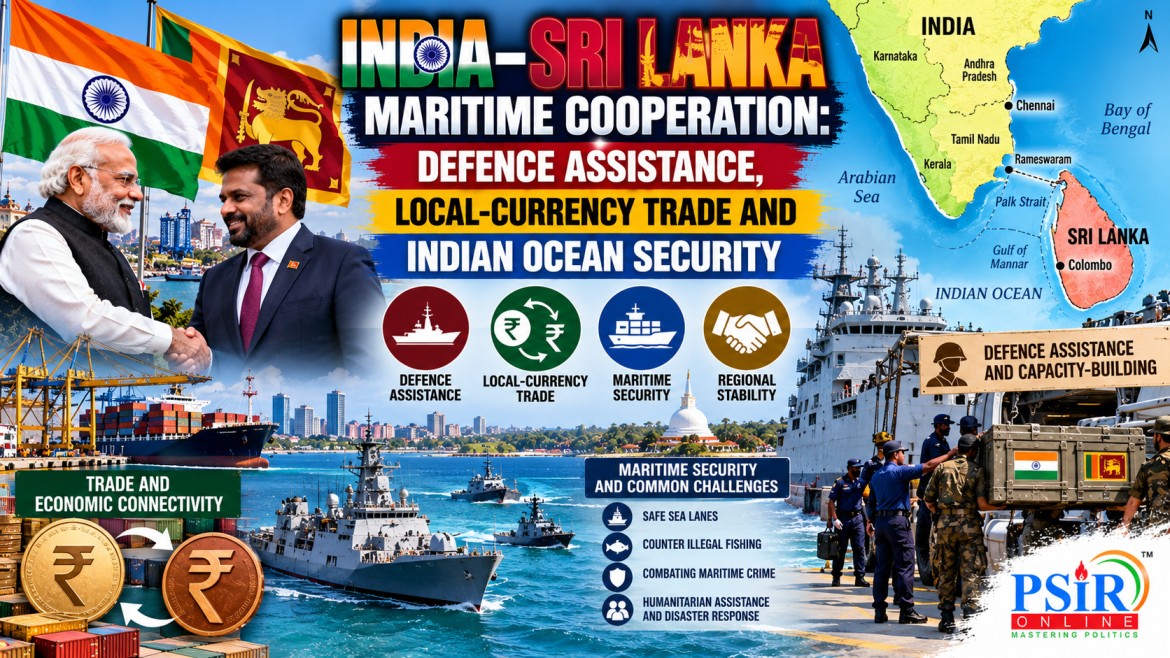
India–Sri Lanka relations occupy a strategically important position in the Indian Ocean. Their geographical proximity, extensive commercial connections and shared maritime environment create common interests in regional security, economic resilience and the uninterrupted movement of goods. At the same time, bilateral relations are shaped by Sri Lanka’s domestic political priorities, its need to diversify external partnerships and the wider strategic competition surrounding the Indian Ocean.
June 2026 illustrated the multidimensional nature of this relationship. On 16 June, India handed over military stores and a trauma-care system valued at more than US$5 million to the Sri Lankan Army under its grant-assistance programme. Earlier, on 15 June, the High Commission of India in Colombo organised a roundtable on local-currency settlement, bringing together government officials, banks and commercial stakeholders to examine the use of Indian rupees and Sri Lankan rupees in bilateral transactions.
These developments complement established naval cooperation, maritime surveillance, training and capacity-building initiatives. Together, they demonstrate how defence assistance, financial connectivity and maritime security can reinforce a broader neighbourhood partnership.
However, cooperation should not be confused with automatic strategic alignment. Sri Lanka must balance its security requirements, economic recovery and independent foreign-policy choices. India, meanwhile, must protect its maritime interests while respecting Sri Lanka’s sovereignty and regional agency.
The central question is how defence cooperation and local-currency trade can strengthen mutual resilience without turning economic or strategic asymmetry into political dependence.
MARITIME GEOGRAPHY AND THE STRATEGIC IMPORTANCE OF SRI LANKA
Sri Lanka lies close to major Indian Ocean shipping routes connecting the Middle East, Africa, South Asia and East Asia. These routes carry energy supplies, manufactured goods, food products and other commodities essential to regional and global commerce.
For India, the surrounding maritime environment is closely connected to energy security, commercial shipping, port connectivity and the safety of its southern coastline. Sri Lanka’s location makes it an important partner in addressing maritime challenges that cannot be managed effectively by one country alone.
These challenges include illegal fishing, narcotics trafficking, human smuggling, maritime accidents, environmental emergencies and threats to commercial shipping. They also include the need to maintain maritime domain awareness—the ability to understand activities and movements across a maritime area through surveillance, information-sharing and operational coordination.
Sri Lanka has its own interests in a secure maritime environment. Its economy depends on external trade, port services, shipping and the protection of maritime resources. Disruptions in surrounding waters can affect commercial activity, public safety and economic stability.
Consequently, India and Sri Lanka share a practical interest in maritime cooperation, even when their wider diplomatic priorities are not identical.
The strategic importance of the relationship does not imply that Sri Lanka must adopt India’s position on every regional issue. Rather, it creates a basis for cooperation in areas where interests overlap, particularly maritime safety, information-sharing, disaster response and the protection of lawful commerce.
DEFENCE ASSISTANCE AND CAPACITY-BUILDING DIPLOMACY
Defence assistance is an important instrument of India’s engagement with Sri Lanka. It can strengthen the capacity of a neighbouring country to address security challenges while building professional relationships between their armed forces.
On 16 June 2026, India handed over a consignment of military stores and a trauma-care system valued at more than US$5 million to the Sri Lankan Army. The consignment was provided under India’s grant-assistance programme and transported aboard the Indian Navy ship INS Sharda during its operational visit to Colombo from 10 to 13 June.
This assistance illustrates a form of defence diplomacy that extends beyond the transfer of military equipment. Training, professional exchanges, medical support, logistics and institutional cooperation can strengthen the ability of partner countries to respond to security and humanitarian challenges.
India and Sri Lanka also maintain established naval engagement, including the bilateral maritime exercise SLINEX, army cooperation through MITRA SHAKTI and professional exchanges between defence institutions. The two countries have developed cooperation in maritime surveillance, hydrography, search and rescue, and capacity-building. India’s grant assistance supported the establishment of Sri Lanka’s Maritime Rescue Coordination Centre, commissioned in June 2024.
Such cooperation can improve operational familiarity and provide channels for coordination during emergencies. It may also help Sri Lanka strengthen its own maritime capabilities while enabling India to develop a more cooperative security environment in its immediate maritime neighbourhood.
Nevertheless, defence assistance has limits. Equipment transfers cannot independently resolve illegal fishing disputes, eliminate maritime crime or guarantee common positions on regional security questions. Their effectiveness depends on training, maintenance, institutional coordination and sustained political engagement.
Defence diplomacy is most durable when it strengthens the partner’s capabilities rather than creating expectations of political alignment.
LOCAL-CURRENCY TRADE: FINANCIAL CONNECTIVITY AND ECONOMIC RESILIENCE
The use of local currencies in bilateral trade is another important dimension of India–Sri Lanka relations. On 15 June 2026, the High Commission of India in Colombo convened the roundtable titled Rupee to Rupee: Strengthening the India–Sri Lanka Commercial Corridor. Participants included government institutions, banks, importers, exporters and business stakeholders.
Discussions examined the practical use of Indian rupee–Sri Lankan rupee settlement mechanisms, banking arrangements, financial connectivity and opportunities to expand commercial transactions. Participants also discussed the potential benefits of smoother payments, improved liquidity management and reduced transaction costs.
Local-currency settlement can provide an alternative to routing every bilateral transaction through a third-country currency. Depending on the transaction and banking arrangements, it may reduce conversion costs, simplify payment processes and improve liquidity management for participating businesses.
However, local-currency settlement does not eliminate foreign-exchange risk. Exchange-rate movements between the rupee and the Sri Lankan rupee can still affect importers and exporters. Businesses also require sufficient liquidity, reliable correspondent banking arrangements and confidence that funds can be used or converted when necessary.
Nor does settlement in local currencies automatically remove the need for foreign currency in transactions with other countries. Its principal benefit is to provide an additional mechanism for bilateral trade, not to replace the international financial system.
For Sri Lanka, the mechanism can support commercial diversification and reduce some transaction frictions. For India, it can strengthen economic connectivity with a neighbouring market and encourage greater use of domestic financial infrastructure.
The wider lesson is that financial connectivity can complement diplomatic cooperation by making bilateral economic relationships more practical and resilient. Its success will depend on business participation, transparent rules, competitive banking services and confidence in both currencies.
THE MARITIME–ECONOMIC CONNECTION: SECURITY AND COMMERCIAL STABILITY
Defence cooperation and local-currency trade may appear to belong to separate policy domains, but they address interconnected dimensions of regional stability.
Maritime security helps protect the movement of goods, energy supplies and commercial vessels. Financial connectivity can make bilateral transactions easier to conduct. Together, they contribute to an environment in which trade and investment can operate with greater predictability.
For India and Sri Lanka, this connection is particularly relevant because economic activity depends on reliable maritime transport. Disruptions to shipping routes, maritime crime or regional instability can raise insurance costs, interrupt supplies and weaken commercial confidence.
The relationship also extends to disaster response and humanitarian assistance. Cyclones, maritime accidents, oil spills and other emergencies can affect both countries and require timely coordination. Established communication channels and professional exchanges can improve the ability to respond to such incidents.
Yet a stronger bilateral relationship cannot guarantee the security of the entire Indian Ocean. The region includes multiple coastal states, external powers and commercial actors with different interests. Maritime governance therefore requires wider cooperation through regional mechanisms and adherence to international law.
India–Sri Lanka initiatives should consequently complement broader arrangements for information-sharing, maritime safety, disaster management and lawful navigation.
The strategic objective is not to create an exclusive security arrangement, but to strengthen an open and cooperative maritime environment in which regional states retain their independence while addressing shared challenges.
ASYMMETRY, STRATEGIC COMPETITION AND SRI LANKA’S POLICY AUTONOMY
India’s economic size, military capabilities and geographical proximity give it a different position in the bilateral relationship from that of Sri Lanka. This asymmetry can facilitate assistance and cooperation, but it can also generate concerns about dependence and political influence.
Sri Lanka seeks investment, trade, financial stability and security cooperation from multiple partners. Its engagement with India must therefore be understood alongside its wider diplomatic and economic relationships. Diversification is a normal feature of small-state diplomacy, particularly when a country seeks to preserve its bargaining capacity.
For India, the challenge is to maintain a close relationship without assuming that geographical proximity guarantees political alignment. Defence assistance and local-currency trade are more likely to produce lasting cooperation when they are based on transparent terms, reciprocal benefits and respect for Sri Lanka’s domestic priorities.
The wider Indian Ocean environment adds another dimension. Competition among major powers for access to ports, infrastructure, logistics and maritime influence can place pressure on smaller coastal states. Sri Lanka must navigate these competing interests while protecting its own sovereignty and economic needs.
India’s response requires sustained consultation and credible delivery. Development and security initiatives should be evaluated by their practical benefits rather than by whether they secure exclusive strategic alignment.
This approach also recognises that bilateral disagreements can persist despite cooperation. Fishing-related tensions, questions concerning maritime access and differing external-policy priorities require dialogue rather than assumptions of complete convergence.
Strategic partnership is strengthened by predictable cooperation and respect for policy autonomy, not by the elimination of independent choices.
POLICY PRIORITIES: FROM BILATERAL INITIATIVES TO REGIONAL STABILITY
India and Sri Lanka can strengthen the relationship through coordinated action across defence, finance and maritime governance.
First, defence cooperation should prioritise capacity-building, training, maritime surveillance, search and rescue, disaster response and the maintenance of jointly supported systems. These areas produce practical benefits while preserving the distinction between bilateral cooperation and exclusive strategic alignment.
Second, local-currency settlement should be supported by clear banking procedures, transparent exchange-rate arrangements, effective payment infrastructure and appropriate mechanisms for managing currency risk. Banks and commercial stakeholders need reliable information on transaction costs, liquidity and regulatory requirements.
Third, maritime cooperation should include regular information-sharing and operational coordination against narcotics trafficking, illegal fishing, human smuggling and other transnational challenges. Such cooperation should operate within applicable national laws and international maritime law.
Fourth, India and Sri Lanka should strengthen channels for addressing sensitive issues, including fisheries-related disputes and incidents involving vessels or personnel. Early communication and predictable procedures can help prevent local disagreements from damaging the broader relationship.
Fifth, regional cooperation should extend beyond the bilateral framework. Engagement with relevant Indian Ocean institutions and coastal states can support maritime safety, environmental protection, disaster response and the security of commercial shipping.
Finally, progress should be assessed through observable outcomes: the effectiveness of training and assistance, the reliability of financial settlement arrangements, the quality of information-sharing, the handling of maritime incidents and the benefits experienced by businesses and coastal communities.
The objective should be to build a relationship in which security cooperation reinforces economic confidence and economic connectivity supports regional stability.
THEORETICAL ANGLES
|
Theory or concept |
Application to India–Sri Lanka relations |
|
Realism |
Maritime geography and security interests encourage India and Sri Lanka to cooperate in protecting shipping routes and addressing shared threats, while each state continues to pursue its own national interests. |
|
Complex interdependence |
Defence cooperation, financial settlement, trade, shipping and disaster response create multiple channels of interaction that extend beyond traditional military relations. |
|
Economic statecraft |
Defence assistance, financial infrastructure and commercial arrangements can support diplomatic objectives and strengthen bilateral relationships. |
|
Asymmetrical interdependence |
Differences in economic and military capabilities affect bargaining power. Sustainable cooperation requires attention to unequal vulnerabilities and the sovereignty of the smaller partner. |
|
Small-state diplomacy |
Sri Lanka seeks to diversify partnerships and preserve independent choices while benefiting from cooperation with India and other external partners. |
|
Cooperative security |
Maritime surveillance, training, information-sharing and disaster response can address shared threats without requiring identical strategic positions on every issue. |
|
Liberal institutionalism |
Formal mechanisms, regular dialogue and established procedures can improve predictability, reduce transaction costs and support sustained cooperation. |
|
Strategic autonomy |
India can strengthen its maritime position through reliable partnerships, while Sri Lanka can pursue cooperation without surrendering its freedom of external-policy decision-making. |
CONCLUSION
India–Sri Lanka maritime cooperation illustrates how defence assistance, financial connectivity and shared security interests can reinforce a broader neighbourhood partnership. The June 2026 transfer of military stores and trauma-care equipment demonstrated the practical role of grant assistance, while the local-currency trade roundtable highlighted efforts to improve bilateral commercial transactions.
These initiatives can strengthen professional ties, reduce selected financial frictions and support a more predictable maritime environment. Their significance, however, depends on sustained implementation and their contribution to the interests of both countries.
Defence assistance cannot substitute for political dialogue, and local-currency settlement cannot eliminate exchange-rate risk or wider economic vulnerabilities. Nor should bilateral cooperation be interpreted as requiring Sri Lanka to abandon independent diplomatic choices.
Ultimately, a resilient India–Sri Lanka partnership must combine maritime security, mutually beneficial commerce and respect for sovereignty. Its contribution to Indian Ocean stability will depend on whether practical cooperation can be sustained through credible institutions, regional engagement and a shared commitment to lawful and peaceful maritime activity.
RELATED READING
PRACTICE QUESTIONS FOR GS2 MAINS
PRACTICE QUESTIONS FOR PSIR PAPER II
