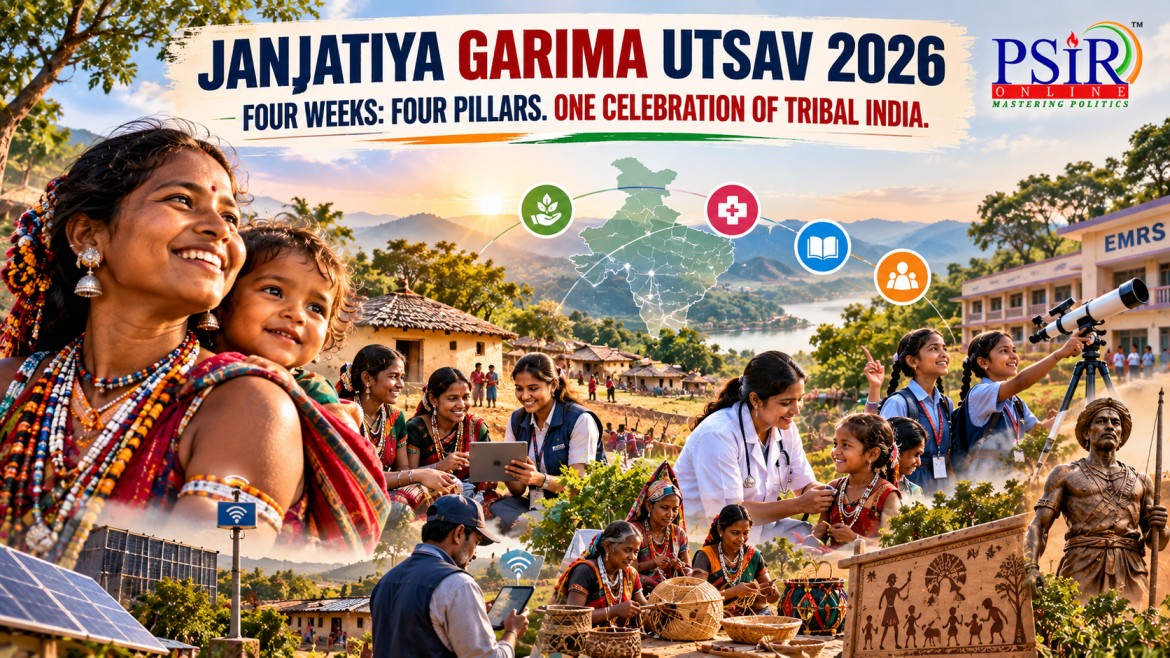
Janjatiya Garima Utsav 2026 was a month-long national observance of the Ministry of Tribal Affairs, held from 10 May to 9 June 2026. Its stated purpose was to honour the dignity, heritage, and contributions of tribal communities and to showcase schemes for tribal development as part of the wider Viksit Bharat narrative. Official messaging framed it as “four weeks, four pillars, one celebration of tribal India.”
The four themes were not parallel slogans. They were sequential weekly chapters: technology, last-mile participation, historical and cultural recognition, and education.
1. TECHNOLOGY AS A DEVELOPMENT DRIVER
This was the opening thematic week, observed from 11 to 17 May 2026. The official principle was that development should reach the last habitation without treating tribal languages, culture, and traditional knowledge as obstacles to be removed.
The scale behind that claim is large. The Secretary of the Ministry of Tribal Affairs, Ranjana Chopra, wrote that PM-JANMAN, the Dharti Aaba Janjatiya Gram Utkarsh Abhiyan (DAJGUA), the National Sickle Cell Anaemia Elimination Mission, and related schemes cover more than 63,000 villages across 549 districts and 2,911 blocks in 30 States and Union Territories, touching more than 5.5 crore tribal citizens, with special focus on Particularly Vulnerable Tribal Groups (PVTGs).
Concrete instruments linked to this week included:
· BIRSA 101, described as India’s first indigenous CRISPR-based gene therapy for sickle cell disease, developed with financial support from the Ministry and collaboration among CSIR, CSIR-IGIB, and Serum Institute of India. The stated aim is an affordable, one-time curative treatment.
· Adi Vaani, an AI translator for tribal languages, covering text-to-text and text-to-speech translation, OCR, and scheme information in languages spoken at home.
· TriBoT, a multilingual conversational assistant for guidance and grievance support in remote areas.
· Survey Setu, used under PM-JANMAN for geo-tagged PVTG household surveys, reported to have recorded 3.43 lakh household submissions with 8,552 surveyors across 18 States and one Union Territory.
· An AI-enabled Forest Rights Act platform for claims, GIS mapping, workflow monitoring, and grievances.
· Planned tools such as the TribeX cultural platform, a GI Potential Art and Craft Atlas of tribal handicrafts and forest products, and innovation hubs at Tribal Research Institutes.
During the week, the Ministry and the Bhagwan Birsa Munda Cell at IIT Delhi held a seminar on “Role of AI and Technology in Strengthening Sustainable Tribal Development,” with panels on an “AI to last mile” roadmap. Workshops were also held across 10 States and Tribal Research Institutes on 15 May 2026.
2. JAN BHAGIDAARI — SABSE DOOR, SABSE PEHLE
The second pillar carried the fuller tagline “Jan Bhagidaari — Sabse Door, Sabse Pehle” (people’s participation: the farthest first). It shifted the focus from tools to delivery and voice.
The Ministry monitored the launch of this campaign across about 600 districts by video conference. In Arunachal Pradesh, the week ran from 18 to 25 May 2026, involving the Tribal Research Institute, Rajiv Gandhi University, district administrations, and local communities, with outreach on awareness, digital inclusion, and grassroots engagement, and a debrief at the Directorate of SJETA in Itanagar.
The idea is saturation plus feedback: housing, water, sanitation, education, health, connectivity, and livelihoods are meant to reach the most remote PVTG and Scheduled Tribe habitations, while Jan Sunwai-style contact is meant to surface gaps. It sits inside the larger architecture of PM-JANMAN (PVTG saturation) and DAJGUA (tribal village uplift).
3. BIRSA LIVES IN NEW BHARAT
The third week treated tribal history and living knowledge as part of the present, not as a closed past. It is anchored in Birsa Munda (1875–1900), the Munda leader of the late-19th-century resistance in the Chota Nagpur region. In 2021, 15 November, his birth anniversary, was declared Janjatiya Gaurav Diwas. The Janjatiya Gaurav Varsh (15 November 2024 to 15 November 2025), marking 150 years of his birth, was reported to have involved more than two lakh events and reached over three crore citizens.
Under this week, States held scholarship dialogues and recognition events. In Jharkhand, the Tribal Research Institute felicitated writers and scholars of tribal literature, language, folklore, and indigenous philosophy, including Mahadeo Toppo, Vandana Tete, Parvati Tirkey, and Santosh Kiro, alongside AI and technology training by NIELIT and IIIT Ranchi for officials from all 24 districts. Bihar’s Chief Minister launched a post-matric scholarship beneficiary dialogue in Patna under the same theme. Manipur held an interaction with post-matric ST scholarship students.
The week’s argument is twofold: restore names and knowledge systems that mainstream history under-recorded, and treat the next generation of tribal students and professionals as the continuation of that legacy.
On 3 June 2026, still within the Utsav calendar, the President of India, Droupadi Murmu, addressed a National Conclave at Vigyan Bhawan on strengthening Integrated Tribal Development Agencies and Projects (ITDAs and ITDPs), and inaugurated a Training Fab at CeNSE, IISc Bengaluru, and Space Labs in 75 Eklavya Model Residential Schools.
4. FROM CLASSROOM TO CONFIDENCE
The fourth week, confirmed by the Ministry as the education week, centred on tribal students, especially in Eklavya Model Residential Schools under NESTS. The official line was: “Education opens doors. Confidence helps walk through them.”
EMRSs were given a multi-week activity roadmap running roughly from 10 May into mid-June, covering letters to the Prime Minister on aspirations and identity, preservation of oral traditions, and “hands of heritage and innovation” through crafts and experiential learning. The Space Labs in 75 EMRSs and the IISc training fab were presented as the hardware side of the same idea: moving students from classroom access to science, technology, and institutional confidence.
Post-matric scholarships featured as the bridge after school. State dialogues treated the scholarship not only as a cash transfer but as a route into higher education, and students used those forums to raise practical issues such as timing of releases, rent, study material, and placement.
HOW THE FOUR PILLARS FIT TOGETHER
|
Week |
Theme |
Core claim |
|
1 |
Technology as a Development Driver |
Science and digital systems should serve remote tribal citizens in their own languages |
|
2 |
Jan Bhagidaari — Sabse Door, Sabse Pehle |
Saturation fails without participation from the farthest habitations |
|
3 |
Birsa Lives in New Bharat |
Dignity requires recognition of history, language, and indigenous knowledge |
|
4 |
From Classroom to Confidence |
Schooling, scholarships, and labs should produce capability, not only enrolment |
WHAT IT ACHIEVED
· The Jan Bhagidari Abhiyan (“Sabse Door, Sabse Pehle”) reached nearly 90 lakh tribal citizens in about 57,000 villages.
· More than 76,000 camps and outreach activities were held.
· Over 13.5 lakh welfare benefits were facilitated, according to a Ministry report carried by Hindustan Times (3 June 2026).
· About 13,000 Jan Sunwai programmes heard roughly 2 lakh grievances.
· Enrolments included about 2.27 lakh Ayushman Bharat cards and 1.76 lakh Aadhaar cards.
· More than 1.35 lakh tuberculosis and sickle-cell screenings were done.
· Camps also pushed ration cards, pensions, Jan Dhan accounts, PM-Kisan registrations, MGNREGA job cards, and insurance.
· In Jamui, Bihar, 4,279 people joined an eight-day drive in 89 tolas; 303 of 401 cases were closed on the spot, and 1,310 people were screened.
· In Seraikela-Kharsawan, PVTG camps in 20 panchayats linked people to pensions, ration cards, Ayushman cards, and housing applications.
· Andhra Pradesh linked its grievance system to WhatsApp so complaints could be tracked by SMS.
· President Droupadi Murmu addressed a national conclave on strengthening ITDAs and ITDPs.
· She inaugurated a training fab at CeNSE, IISc Bengaluru, and Space Labs in 75 Eklavya Model Residential Schools, including 13 in Odisha.
· NESTS had already reported Space Labs in 40 EMRSs in an earlier phase.
· Post-matric ST scholarship dialogues were held in States such as Bihar and Manipur, putting students in front of chief ministers.
· In Jharkhand, writers and scholars of tribal literature, language, and philosophy were felicitated.
· BIRSA 101, the indigenous CRISPR therapy for sickle cell, had a technology-transfer agreement with Serum Institute of India; Phase 1 involved three patients.
· Adi Vaani and TriBoT were showcased as language-sensitive AI tools.
· Seminars with IIT Delhi and workshops in 10 States put “AI to the last mile” on the official agenda.
CONSTITUTIONAL PROVISIONS IT LEANED ON
· Article 46 (Directive Principle). The State must promote the educational and economic interests of Scheduled Tribes and protect them from social injustice and exploitation. Saturation camps, scholarships, EMRS activities, sickle-cell screening, and livelihood enrolments are the administrative form of this duty.
· Article 275(1), first proviso. The Union gives grants-in-aid to States for the welfare of Scheduled Tribes and for raising the level of administration in Scheduled Areas. ITDAs and ITDPs, reviewed at the Vigyan Bhawan conclave, are the field machinery through which much of this money is spent. The conclave addressed the delivery arm of this provision.
· Article 244 read with the Fifth Schedule. Scheduled Areas are administered under the Fifth Schedule, with a Tribal Advisory Council and special powers of the Governor. PVTG and tribal-village saturation under PM-JANMAN and DA-JGUA, and the ITDA review, sit inside this framework.
· Article 244 read with the Sixth Schedule. In Assam, Meghalaya, Tripura, and Mizoram, tribal areas have Autonomous District and Regional Councils. Outreach in the North-East touched this geography.
· Articles 15(4) and 15(5). Special provisions for the advancement of Scheduled Tribes, including in education. EMRS expansion, Space Labs, post-matric scholarships, and the “classroom to confidence” week are expressions of this enabling power.
· Article 29. Any section of citizens with a distinct language, script, or culture has the right to conserve it. Felicitation of tribal writers, language sessions, and AI tools such as Adi Vaani are aligned with this cultural right.
· Article 21. Life and personal liberty have been read to include health and dignity. The word garima in the Utsav’s title tracks this idea.
HOW IT CATERED TO ARTICLE 21 WITH REGARDS TO TRIBAL COMMUNITY
|
What Article 21 includes (according to various judgements) |
How the Utsav carried it to tribal people |
|
Dignity, not mere survival. |
The month was framed as dignity rather than only scheme delivery: cultural felicitation, scholarship dialogues in which students spoke for themselves, and last-mile camps meant to reach the person instead of waiting for the person to reach the office. |
|
Health. |
The Jan Bhagidari week reported more than 1.35 lakh tuberculosis and sickle-cell screenings and about 2.27 lakh Ayushman Bharat enrolments. BIRSA 101, the indigenous CRISPR therapy named for Birsa Munda, was the curative step beyond the camp: a trial-stage answer to a disease concentrated in tribal districts. The duty under this reading is a path from test to treatment, not the screening count alone. |
|
Livelihood. |
Camps facilitated MGNREGA job cards, pensions, Jan Dhan accounts, PM-Kisan registrations, and insurance. For a forest-fringe household these are not charity. They are the legal claim on the State that keeps seasonal hunger from becoming a denial of life. |
|
Shelter and habitat. |
Housing applications and PVTG saturation under PM-JANMAN were pushed into habitations that routine administration misses. The Utsav did not build the houses. Removal from ancestral land without rehabilitation was not its work, and remained open after the month ended. |
|
Education and self-expression. |
The fourth week, EMRS activities, Space Labs in 75 schools, and post-matric scholarship dialogues were the tribal form of that content. Residential schooling and scholarships are how the State continues the right for first-generation learners once Article 21A stops. |
|
Culture and language as part of personhood. |
Adi Vaani, TriBoT, and the felicitation of tribal writers treated language as part of dignity. The technology week stated the principle that last-mile delivery should not require the citizen to give up the language of the habitation. |
|
A fair procedure. |
About 13,000 Jan Sunwai programmes heard roughly 2 lakh grievances. A camp hearing is a weak form of natural justice. It is still closer to Article 21 procedure than a file that never leaves the block office. |
WAY FORWARD
· Follow up after the camps: The camp should be the beginning of the process, not the end. Every Ayushman card, job card, pension and housing application should be followed up for 90 days. Each case should be recorded as approved, rejected with a clear reason, or still pending. The pending cases should be made available at the block level.
· Ensure treatment after sickle-cell screening: Screening is only the first step. Families should be clearly informed about the test results, and those who need treatment should be connected to the appropriate health facility. BIRSA 101 should also have a clear timeline, cost and eligibility details before being presented as a solution.
· Make Space Labs and scholarships useful: EMRS students should regularly use the Space Labs as part of their education, rather than seeing them only as newly inaugurated facilities. Similarly, scholarship support should reach students on time and should be connected, where possible, with internships, placements and further education.
· Turn technology into actual services: Platforms such as Adi Vaani and TriBoT should help people perform real tasks. For example, tribal communities should be able to file a forest-rights claim, grievance or welfare application in their own language and track its progress. TribeX and the craft atlas should be judged by actual sales, benefits to artisans and proper recognition of their contribution.
· Follow up on unfinished work: New campaigns should also look at pending work under programmes such as PM-JANMAN and DA-JGUA. Future campaigns should begin by reviewing what remains unfinished from previous years and then focus on completing it.
· Keep culture and rights separate: Cultural programmes and festivals are valuable and can continue. But issues such as land rights, forest rights and rehabilitation require proper consultation and decision-making at the village level. Reports should clearly show both the number of outreach activities and the number of land titles granted or families properly rehabilitated.
· Measure results, not just reach: The success of the programme should not be measured only by the number of people who attended camps. More useful indicators would be the number of benefits that remained active after six months, patients who received treatment after screening, grievances that were resolved, and students who continued their education or entered employment.
CONCLUSION
Janjatiya Garima Utsav 2026 successfully brought many government services, health screenings, educational initiatives, tribal languages and welfare programmes together on one national platform. It helped take government outreach to tribal communities and habitations that may not always receive such attention.
However, holding camps and reaching people is only the first step. A health screening must lead to treatment, a scholarship must reach the student, a welfare application must lead to a benefit, and a land-rights application must lead to a decision.
Therefore, the real success of Janjatiya Garima Utsav should not be measured only by the number of camps held or people contacted. It should ultimately be measured by how many people continued to receive benefits, how many patients received treatment, how many grievances were resolved, how many students continued their education, and how many tribal families secured their rights over land and resources.
RELATED AREAS OF STUDY
For comprehensive UPSC preparation, students should connect Janjatiya Garima Utsav 2026 with the following areas:
· Government Policies and Interventions for Tribal Development – PM-JANMAN, DAJGUA and other interventions for Scheduled Tribes and PVTGs.
· Welfare Schemes for Vulnerable Sections – health, nutrition, housing, education, livelihoods, pensions and social-security measures for tribal communities. JANJATIYA GARIMA UTSAV 2026 FOU…
· Tribal Rights and Constitutional Safeguards – Article 46, Article 244, Fifth and Sixth Schedules, and special provisions for the protection and advancement of tribal communities. JANJATIYA GARIMA UTSAV 2026 FOU…
· PVTGs and Last-Mile Delivery – challenges in reaching remote tribal habitations and ensuring saturation of basic services.
· Health and Nutrition among Tribal Communities – sickle-cell disease, TB screening, maternal and child health, nutrition and access to healthcare. JANJATIYA GARIMA UTSAV 2026 FOU…
· Tribal Education and Human Development – Eklavya Model Residential Schools, post-matric scholarships, Space Labs and educational opportunities for first-generation learners. JANJATIYA GARIMA UTSAV 2026 FOU…
· Digital Governance and Tribal Inclusion – use of AI, multilingual technology, digital platforms and GIS for welfare delivery, grievance redressal and forest-rights claims.
· Tribal Culture, Language and Indigenous Knowledge – protection of tribal languages, literature, folklore, traditional knowledge and cultural identity.
· Forest Rights and Tribal Livelihoods – Forest Rights Act, access to forest resources, livelihood security and protection of community rights.
· Participatory Governance and Grievance Redressal – Jan Bhagidari, Jan Sunwai and the role of local communities in identifying gaps in welfare delivery. JANJATIYA GARIMA UTSAV 2026 FOU…
· Centre–State and Local-Level Coordination – role of Union ministries, State governments, district administrations, Tribal Research Institutes and frontline institutions in tribal development.
· Social Justice and Inclusive Development – reducing geographical, economic, technological and administrative barriers faced by tribal communities.
GS-II MAINS PRACTICE QUESTIONS
1. Janjatiya Garima Utsav 2026 sought to take welfare delivery to the remotest tribal habitations through technology, participation, health, education and livelihood interventions. Examine the challenges involved in achieving effective last-mile delivery among tribal communities. (15 Marks, 250 Words)
2. Tribal development requires more than welfare coverage; it also requires protection of land, forest, language and cultural rights. Discuss with reference to the Janjatiya Garima Utsav 2026. (15 Marks, 250 Words)
3. Digital technologies can improve tribal welfare delivery, but may also create new forms of exclusion. Discuss with reference to initiatives such as Adi Vaani, TriBoT, Survey Setu and the AI-enabled Forest Rights platform. (10 Marks, 150 Words)
4. “The success of tribal welfare programmes should be measured by outcomes rather than the number of camps or beneficiaries reached.” Examine this statement in the context of Janjatiya Garima Utsav 2026. (10 Marks, 150 Words)
