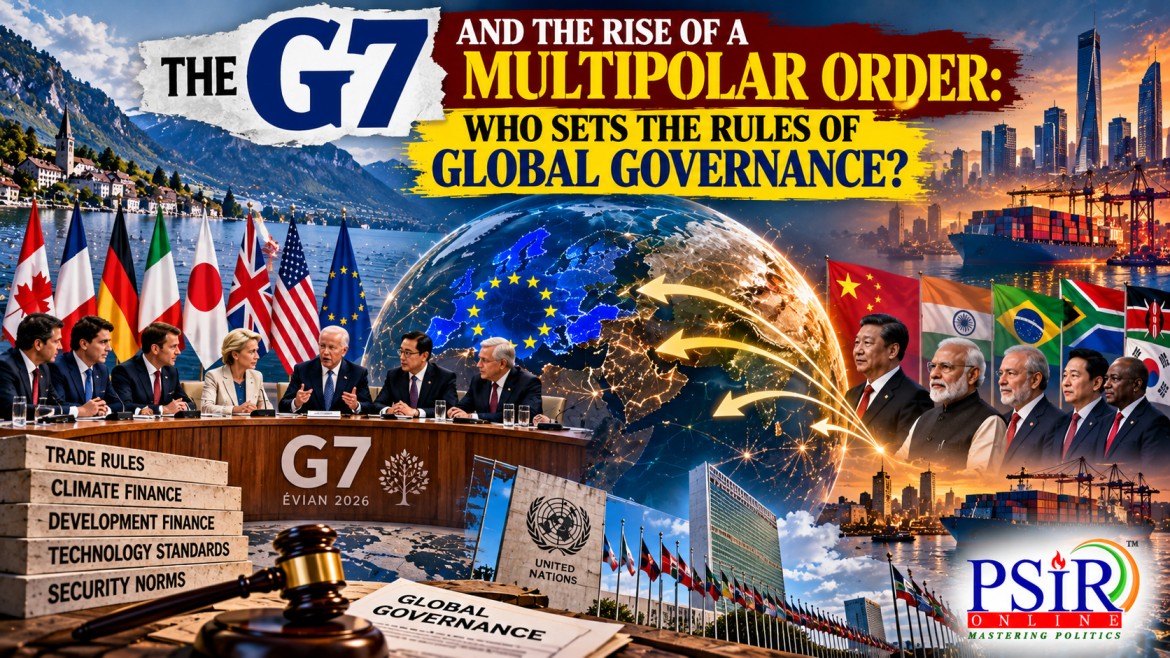
The Group of Seven (G7) remains an influential forum for coordinating the economic and strategic policies of seven advanced industrial democracies: Canada, France, Germany, Italy, Japan, the United Kingdom and the United States, alongside the European Union’s participation. Yet the international system in which the G7 operates is changing. China has emerged as a major economic and technological power, India has expanded its international influence, and countries across Africa, Asia and Latin America increasingly demand a greater voice in global decision-making.
The June 2026 G7 discussions in France brought this tension into focus. The Évian summit addressed Ukraine, Russia, international security, economic imbalances and critical supply chains. A related Global Convergence for Growth meeting on 11 June involved G7 countries alongside China, India, Brazil, South Korea and Kenya. These discussions highlighted the need to engage countries beyond the traditional G7 framework.
The central issue is not whether the G7 will disappear, but whether a small group of established powers can continue shaping global rules without broader participation from emerging and developing economies.
THE G7 IN A CHANGING INTERNATIONAL SYSTEM
Established in the 1970s, the G7 developed as a forum for consultations among major advanced economies during a period of monetary instability, energy shocks and changes in the global economy. Over time, its agenda expanded to include international security, development finance, climate policy, technology and geopolitical crises.
The G7 possesses considerable influence through the economic weight of its members, their financial institutions, technological capabilities and diplomatic networks. Its members also have substantial influence in institutions such as the International Monetary Fund and World Bank.
However, the G7 is an informal grouping rather than a universal decision-making institution. Its declarations can coordinate member policies and influence wider negotiations, but they do not automatically create binding obligations for countries outside the group.
The rise of the G20, the expansion of South–South cooperation and the growing influence of emerging economies have complicated the G7’s position. The G20 provides a wider forum for discussions involving major advanced and emerging economies, while the United Nations offers broader formal representation.
The distinction is important: the G7 can coordinate influential positions, but it cannot independently establish legitimate global rules for every country.
THE JUNE 2026 DISCUSSIONS: UKRAINE, RUSSIA AND GLOBAL ECONOMIC IMBALANCES
The G7 summit held in Évian, France, from 15 to 17 June 2026 illustrates the continuing importance of traditional geopolitical coordination.
Ukraine was represented by President Volodymyr Zelenskyy during discussions on peace and European security. The G7 statement on geopolitical issues reaffirmed support for Ukraine’s sovereignty and territorial integrity and committed members to additional air-defence assistance, long-range capabilities and support for Ukraine’s energy resilience. Leaders also discussed increasing pressure on Russia’s war economy, including through sanctions.
Russia was therefore central to the summit’s security agenda, but it was not a participant in the G7 meeting. The distinction matters when assessing how established powers respond to conflict: the G7 can coordinate measures among its members and partners, but a durable settlement involving Russia requires a wider diplomatic process.
Economic governance was another important dimension. France’s Global Convergence for Growth meeting on 11 June brought together G7 countries and representatives from China, India, Brazil, South Korea and Kenya. Discussions focused on global macroeconomic imbalances and the conditions for more balanced and sustainable growth.
|
June 2026 discussion |
Wider significance |
|
Ukraine and European security |
Demonstrated the G7’s role in coordinating security assistance and responses to Russia’s war |
|
Global economic imbalances |
Highlighted the need to engage economies beyond the traditional G7 |
|
Development finance |
Raised questions about debt vulnerabilities, concessional finance and the effectiveness of development institutions |
|
Critical-mineral supply chains |
Connected economic security with the distribution of industrial capacity and strategic resources |
The summit demonstrates that geopolitical coordination and wider international cooperation increasingly operate together. The G7 can organise responses among its members, but global economic stability depends on countries whose interests and policy choices extend beyond the group.
MULTIPOLARITY AND THE DEMAND FOR REPRESENTATION
Multipolarity refers to an international system in which significant capabilities and influence are distributed among several major centres of power. The contemporary international system displays elements of this tendency, although power remains unevenly distributed across military, economic, technological and institutional dimensions.
China’s economic and technological capabilities make it central to discussions on trade, industrial policy, critical minerals and supply chains. India has become an important participant in debates on development, digital infrastructure, energy transitions and reform of international institutions. Brazil, South Africa and other developing countries also seek greater influence over decisions affecting finance, trade and development.
The demand for representation is not simply about the number of countries invited to diplomatic meetings. It concerns who sets the agenda, whose priorities shape the final commitments and who bears the costs of implementing international rules.
Developing countries frequently argue that existing arrangements reflect historical distributions of power and do not adequately represent contemporary economic realities. They seek more meaningful participation in international financial institutions, fairer development-finance arrangements and greater consideration of their policy constraints.
However, emerging powers do not constitute a unified bloc. China, India, Brazil and other countries differ in their strategic interests, economic structures and approaches to international institutions. Their participation therefore does not automatically produce consensus.
Multipolarity expands the number of influential actors, but it does not guarantee equal power or a shared vision of global governance.
WHO SETS THE RULES? THE G7, G20 AND UNITED NATIONS
The struggle over global governance is visible in the relationship between three important institutional settings.
|
Institution |
Principal contribution |
Main limitation |
|
G7 |
Rapid coordination among advanced industrial democracies on economic and strategic issues |
Limited membership and representation |
|
G20 |
Broader consultation among major advanced and emerging economies |
Consensus can be difficult, and declarations do not automatically become enforceable rules |
|
United Nations |
Broad sovereign representation and a framework for international law and collective action |
Decision-making can be slow, particularly where major-power interests conflict |
These institutions perform different functions rather than simply competing for authority. The G7 can develop common positions, the G20 can broaden economic coordination, and the UN provides a universal framework for diplomacy and international legitimacy.
The problem arises when coordination among powerful states is mistaken for universal agreement. A decision negotiated by a small group may influence global markets or international institutions even when countries outside that group have had limited influence over its formulation.
At the same time, broader representation does not automatically produce effective action. Larger forums may struggle to reconcile divergent interests, and governments may resist commitments that conflict with their national priorities.
A workable global governance system must therefore balance effectiveness, representation and accountability. Informal groups can contribute to policy coordination, but their decisions should connect with inclusive institutions where wider international rules are negotiated and implemented.
DEVELOPMENT FINANCE AND THE GLOBAL SOUTH
The debate over multipolarity is closely connected to development finance. Many developing economies face high borrowing costs, debt-servicing pressures, infrastructure deficits and substantial requirements for climate adaptation and technological development.
The G7’s 16 June 2026 declaration on mutually beneficial international partnerships recognised the need to improve the effectiveness of development cooperation. It called for better coordination among development actors, more effective multilateral development banks, transparent lending and the mobilisation of public and private capital.
These commitments reflect an important policy challenge: international development finance must respond to the needs of recipient countries while addressing concerns about debt sustainability, effectiveness and financial dependency.
However, the approach to development finance remains contested. Greater reliance on private investment may mobilise additional resources, but commercially viable projects are not always the same as projects that deliver the greatest social benefit. Concessional finance and public investment remain important where returns are long-term or difficult to capture privately.
Emerging economies also differ in their roles. Some are major providers of finance and infrastructure, while others remain primarily recipients. Their preferences cannot be reduced to a single Global South position.
A more representative system would give developing countries meaningful participation in decisions about financing priorities, lending conditions and institutional reform. It would also recognise that global challenges such as climate change, pandemics and economic instability cannot be addressed through narrow coordination among wealthy economies alone.
LIMITS OF THE MULTIPOLAR ORDER
The transition towards a more distributed international system does not automatically produce a fairer or more peaceful order. Several challenges remain.
First, great-power rivalry can obstruct cooperation. Competition among the United States, China, Russia and other influential states may limit agreement on trade, technology, sanctions and security.
Second, emerging powers may support institutional reform while disagreeing on its details. Differences over representation, voting rights, sovereignty and intervention can complicate efforts to establish common positions.
Third, global institutions face a gap between commitments and implementation. Governments may endorse broad principles while resisting the financial contributions or domestic policy changes required to fulfil them.
Finally, informal groupings can improve coordination but may also reinforce exclusive decision-making. Expanding invitations to selected partner countries is not equivalent to giving all affected countries a voice in setting global rules.
The way forward is not necessarily to abandon the G7. Its coordination role can remain useful, provided it is complemented by wider consultation, transparent commitments and cooperation with universal and representative institutions.
THEORETICAL ANGLES
|
Theory or concept |
How to connect it to the article |
|
Realism |
Examine how the G7 coordinates the interests of powerful states and uses economic and diplomatic instruments to protect strategic priorities. |
|
Neorealism |
Analyse how the diffusion of economic and technological capabilities changes the distribution of power and encourages institutional adaptation. |
|
Liberal institutionalism |
Explain why the G7, G20 and UN remain important mechanisms for coordination despite differences among states. |
|
Hegemonic stability theory |
Discuss whether major powers provide the resources and leadership needed to maintain international economic stability, and the limits of that leadership. |
|
Multipolarity |
Assess the emergence of several centres of power and the consequences for agenda-setting, bargaining and international cooperation. |
|
Constructivism |
Explore how ideas of sovereignty, development, fairness and international legitimacy influence competing visions of global governance. |
|
Dependency theory |
Examine how unequal financial relationships and historical economic structures shape developing countries’ demands for reform. |
|
Global governance |
Evaluate the tension between effective decision-making by smaller groups and inclusive participation through universal institutions. |
CONCLUSION
The June 2026 discussions illustrate the changing relationship between established economic powers and an increasingly diverse set of influential states. The G7 remains capable of coordinating responses to security crises, development challenges and economic uncertainty. Yet its influence operates within an international system in which China, India, Brazil and other emerging economies have become essential participants in many global policy debates.
The rise of multipolarity therefore raises a question of institutional adaptation rather than simply the replacement of one dominant group by another. Effective global governance requires cooperation among major powers, but legitimacy also depends on the participation of countries affected by international decisions.
The central challenge is to ensure that global rules are not only negotiated by powerful states, but also regarded as legitimate, inclusive and workable by the wider international community.
RELATED READING
PRACTICE QUESTIONS FOR GS PAPER II MAINS
PRACTICE QUESTIONS FOR PSIR
