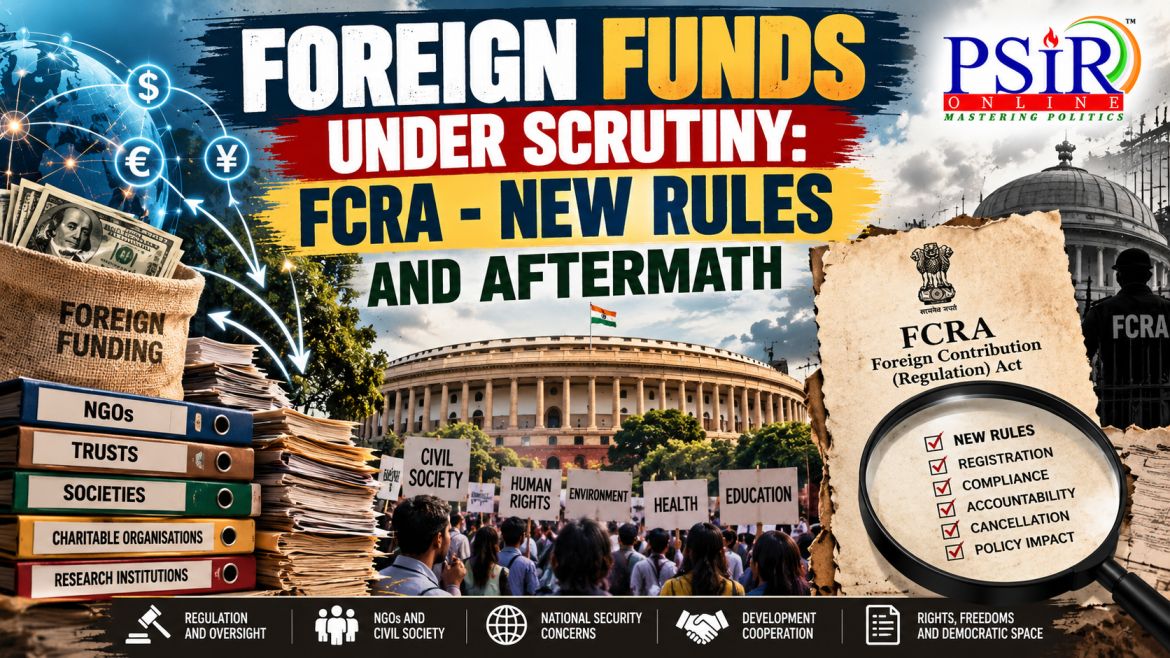
The regulation of foreign funding to non-governmental organisations (NGOs) and civil society groups has long been a sensitive flashpoint in Indian politics. While the state views unrestricted external capital as a potential risk to internal security, public order, and sovereign decision-making, civil society organisations argue that over-regulation chokes legitimate social development, grassroots advocacy, and human rights work.
This regulatory net tightened further in 2026. On March 25, 2026, the Union Government introduced the Foreign Contribution (Regulation) Amendment Bill, 2026 (Bill No. 97 of 2026) in the Lok Sabha. Soon after, on June 22, 2026, the Ministry of Home Affairs (MHA) notified the Foreign Contribution (Regulation) Amendment Rules, 2026 via executive notification. Together, these measures have triggered strong political protests, legal questions, and pushback from civil society.
FCRA: PROPOSED CHANGES UNDER THE AMENDMENT BILL
The Foreign Contribution (Regulation) Amendment Bill, 2026, introduced in the Lok Sabha on March 25, 2026, proposes structural amendments to the parent Act of 2010. Its primary provisions include:
· Creation of a "Designated Authority" and Asset Vesting: If an organisation's FCRA certificate is cancelled, surrendered, or ceases due to non-renewal, all unutilised foreign contributions and movable or immovable assets created using foreign funds will provisionally vest in an executive-appointed Designated Authority. If registration is not restored, the state can permanently reallocate or transfer these assets to government departments, local authorities, or designated agencies.
· Centralised Investigation Filter: The Bill introduces Section 43(2), mandating that no police force or state investigating agency can initiate an investigation for any offence under the FCRA without prior sanction from the Central Government.
· Rationalised Penalties: The maximum term of imprisonment for certain non-fraudulent FCRA offences is reduced from five years to one year, shifting the regulatory focus from custodial deterrence to administrative and asset oversight.
(Note: The Foreign Contribution (Regulation) Amendment Bill, 2026 has not yet been enacted into law. Following its introduction and subsequent parliamentary debate during the Monsoon Session, it was referred on August 12, 2026, to a Joint Parliamentary Committee (JPC) for detailed clause-by-clause examination and remains pending.)
FCRA: NOTIFIED RULES: CHANGES UNDER THE FCRA AMENDMENT RULES, 2026
Independent of the pending Bill, the Ministry of Home Affairs exercised its existing delegated rule-making powers under Section 48 of the FCRA, 2010, to notify the Foreign Contribution (Regulation) Amendment Rules, 2026 on June 22, 2026 (via S.O. 3272(E)). Because these are subordinate procedural rules, they came into force immediately upon notification:
· Activity-Specific and State-Specific Registrations: Organisations can no longer operate under broad permissions. Applications and renewals must specify chosen activities from a closed roster of 105 pre-approved permissible purposes across cultural, economic, educational, religious, and social heads, and delineate the exact States and Union Territories of operation. Existing holders are granted a one-year window to align their operations.
· The ₹10 Lakh Minimum Utilisation Threshold: To establish "reasonable activity" and eliminate paper or dormant NGOs, an organisation must demonstrate a minimum foreign fund utilisation of ₹10 lakh over the preceding two financial years to be eligible for certificate renewal.
· Expansion of "Key Functionaries": The definition of accountable persons has been formally widened beyond basic office-bearers to include directors, trustees, and the Karta of a Hindu Undivided Family (HUF), alongside restrictions barring foreign nationals (other than Persons of Indian Origin) from holding these roles without specific approval.
· Enhanced Disclosure and Operational Filings: Mandates granular reporting formats, including the disclosure of ultimate beneficial donors, official websites, publications, and social media handles of the applicant organisation.
THE PROTESTS AND CIVIL SOCIETY BACKLASH
The announcement and enforcement of the new rules sparked immediate demonstrations and coordinated opposition across several sectors:
1. Church Leadership and Nationwide Faith-Based Protests
· Catholic Bishops’ Conference of India (CBCI) & Regional Dioceses: Because the notified rules introduced an exhaustive, closed schedule of permissible activities and tightened geographic/purpose registration for faith-based organisations, Christian institutions voiced strong opposition.
· Pan-India Protest Prayer Day (June 28, 2026): Catholic bodies organized nationwide prayer and protest meetings across dioceses in Kerala, Tamil Nadu, and central India against what they termed "administrative choking" of legitimate social, medical, and educational charitable missions.
2. Civil Society and Human Rights Coalitions
· Joint Statements by Global & National Watchdogs: A coalition of major civil rights platforms—including Amnesty International, CIVICUS, Human Rights Watch, Front Line Defenders, and the International Commission of Jurists (ICJ)—issued joint statements in July 2026 condemning the rules.
· The "Closed List" Critique: They argued that restricting activities to an executive-curated roster of "reasonable activities" violates the fundamental right to freedom of association under Article 19(1)(c) of the Constitution and Article 22 of the ICCPR, forcing grassroots advocacy and watchdog NGOs into narrow administrative silos.
· The ₹10 Lakh Benchmark: Small and grassroots civil society organizations protested the mandatory condition requiring at least ₹10 lakh in foreign funds utilisation over two consecutive years for renewal, arguing it would systematically weed out smaller regional non-profits while favoring large institutional NGOs.
3. Political and Parliamentary Backlash
· Opposition Rallies and Street Protests: Left parties and regional formations led public demonstrations—including a large-scale protest rally in Madurai and demonstrations in Kerala—denouncing the executive bypass of the pending parent Bill. Opposition MPs (such as CPI(M)'s John Brittas) attacked the notification for enforcing stringent conditions through executive fiat while the Amendment Bill was stalled.
· Echo in the Monsoon Session of Parliament: The controversy over the June rules notification directly fed into the Parliament session in August 2026. Facing intense protests and walkouts from Opposition MPs arguing that the regulatory framework was disproportionately targeting minorities and critical civil society, the Union Government was forced to refer the parent Foreign Contribution (Regulation) Amendment Bill, 2026 to a Joint Parliamentary Committee (JPC) on August 12, 2026.
THE GOVERNMENT’S POSITION AND JUSTIFICATION
The Union Government and the Ministry of Home Affairs defended both the legislative Bill and the notified rules on several sovereign grounds:
· Protecting Sovereign Integrity: The government reiterated that foreign funding is neither a fundamental right nor an entitlement. Sovereign nations maintain the legitimate right to regulate how foreign capital flows into domestic socio-political spaces, citing global trends where democracies enact foreign-influence transparency measures.
· Weeding Out Dormant and "Ghost" Entities: The MHA clarified that thousands of organizations hold active FCRA licences without executing declared philanthropic work. The ₹10 lakh benchmark and project-specific registrations ensure that only functioning, accountable, and transparent organizations retain foreign receipt privileges.
· Closing Regulatory Loopholes on Assets: The government pointed out that Section 15 of the 2010 Act had always provided for the vesting of assets upon cancellation. The 2026 Bill simply provides a clear procedural framework via a Designated Authority to prevent defunct societies from liquidating or diverting assets built with foreign money.
· Consensus-Building Referral: Responding to legislative debate during the Monsoon Session, the Union Government agreed on August 12, 2026, to refer the Amendment Bill to a Joint Parliamentary Committee (JPC) for detailed clause-by-clause stakeholder consultation.
THE JUDICIAL POSITION: PRECEDENTS AND CONSTITUTIONAL QUESTIONS
While specific high-court challenges against the June 2026 notification's closed activity lists are currently emerging, the broader legal landscape is anchored in landmark Supreme Court jurisprudence:
· The Noel Harper Benchmark (2022): In Noel Harper v. Union of India (2022), a three-judge bench of the Supreme Court upheld the constitutional validity of the 2020 FCRA amendments. The Court ruled that no entity has an absolute fundamental right to receive unhindered foreign contributions. It held that Parliament is fully competent to impose strict statutory conditions to prevent foreign funds from influencing political, economic, or social policies.
· Subordinate Legislation and the Ultra Vires Test: Despite the state's broad leeway under Noel Harper, legal experts note that the 2026 Rules face a separate administrative law challenge: whether the executive exceeded its delegated powers under Section 48 of the parent Act. Under constitutional law, administrative rules cannot create substantive property forfeitures (such as taking over NGO assets or denying renewals without an explicit statutory bar) that have not yet been passed by Parliament into the parent Act.
· The Absence of a Statutory Appeal Mechanism: A significant legal vulnerability identified by constitutional lawyers is that the 2026 framework does not prescribe a clear appellate tribunal for NGOs whose licences automatically cease due to non-renewal, leaving aggrieved entities with no alternative remedy except filing Article 226 writ petitions before High Courts.
PSIR DIMENSION: THEORETICAL CONCEPTS & EXAMINATION LINKAGES
|
PSIR Theoretical Dimension & Concepts |
How It Connects to Examination Answers (PSIR Paper 1 / Paper 2) |
|
Sovereignty & External Non-Interference (Jean Bodin; Thomas Hobbes; Hedley Bull) |
The "Foreign Hand" & Democratic Shielding: Provides the normative foundation for the state’s restrictive posture on external financial flows. Demonstrates how post-colonial sovereign states defend political, social, and economic self-determination from trans-border capital interference, covert foreign influence, and extraterritorial geopolitical lobbying. |
|
Civil Society as Contested Domain (Alexis de Tocqueville vs. Antonio Gramsci) |
Democratic Vitality vs. Hegemonic Vanguard: Juxtaposes Tocqueville’s celebration of voluntary associations as the lifeblood of participatory democracy against the Gramscian critique of civil society as an arena of manufacture and ideological hegemony. Explains why the state views certain externally funded NGOs as proxy agents contesting national policy paradigms. |
|
Delegated Legislation & Administrative Overreach (A.V. Dicey; Lord Hewart – The New Despotism) |
Executive Bypass of the Legislature: Analyzes the constitutional friction between primary statutes passed by Parliament (FCRA 2010 / 2026 Bill) and subordinate rule-making under Section 48 (notified June 2026 Rules). Critically evaluates the doctrine of ultra vires when executive decrees impose closed activity rosters and minimum utilisation hurdles without prior statutory amendment. |
|
Rights-Based Citizenship vs. Sovereign Prerogative (Hannah Arendt; Ronald Dworkin) |
Limits of Fundamental Association: Connects the constitutional jurisprudence (Noel Harper 2022) to the nature of rights. Reconciles Article 19(1)(c) (freedom of association) and Article 22 of the ICCPR with the state's judicial justification that receiving foreign funds is a statutorily conditioned privilege, not an inherent constitutional right. |
|
Security State vs. Democratic Space (Giorgio Agamben; Max Weber) |
Shrinking Space for Dissent: Explores how legal instruments ostensibly framed around national security and financial integrity (FATF compliance, anti-money laundering) can be deployed to discipline, surveil, or delegitimize grassroots advocacy, minority confessional charities, and human rights watchdogs. |
|
Plutocratic Skew in Regulatory Regimes (Charles Lindblom – Politics and Markets) |
Unequal Regulatory Burden: Uses Lindblom’s "privileged position of business" to assess institutional asymmetries: while corporate cross-border investments and political party donations (via corporate electoral conduits) face continuous procedural liberalization, civil society organizations operate under micro-surveillance and capital caps. |
|
Faith-Based Mobilisation & Minority Rights (Will Kymlicka – Multicultural Citizenship) |
Secular State & Denominational Institutions: Connects the nationwide pushback by minority religious institutions (e.g., CBCI and Christian diocesan networks) to the state's intervention in charitable institutions. Highlights the tension between secular regulatory uniformity and the autonomy of minority-run social, educational, and medical missions under Article 30. |
|
Administrative Due Process & Natural Justice (Lon Fuller – Morality of Law) |
Statutory Safeguards and Asset Confiscation: Analyzes the rule-of-law implications of automatic certificate cessation and asset vesting in a "Designated Authority." Emphasizes that legal systems forfeit internal moral integrity when statutory provisions omit affordable administrative appellate remedies, forcing aggrieved citizens to rely solely on high-cost constitutional writ litigation. |
CONCLUSION
The 2026 FCRA amendments reflect a continuing shift in how the Indian state engages with the non-profit sector—moving from routine financial reporting toward granular administrative monitoring and physical asset control. The core governance challenge remains striking a balance between protecting national security against covert influence and preserving an open, vibrant civil society space. As the Joint Parliamentary Committee examines the 2026 Bill and High Courts review the operational rules, the final outcome will define the institutional autonomy of India's voluntary sector for years to come.
RELATED READING & ANALYTICAL ANGLES
Jurisprudential Anchors of NGO Regulation:
· Core Focus: The constitutional evolution of foreign funding jurisprudence in India and its balance against fundamental freedoms.
· Key Judicial Benchmark: Noel Harper & Ors. v. Union of India (2022) (Supreme Court upheld the 2020 amendments, holding that foreign contribution is neither an absolute nor a fundamental right, and can be strictly circumscribed by sovereign parliamentary discretion).
· Constitutional Articles: Article 19(1)(c) (Freedom of Association), Article 19(4) (Reasonable Restrictions in the interests of sovereignty, public order, or morality), Article 26 (Freedom to manage religious affairs), Article 30 (Rights of minorities to establish and administer educational institutions), and Article 226/32 (Writ jurisdictions).
The Global Architecture of Financial Regulation:
· Core Focus: How international soft-law frameworks intersect with domestic sovereign security.
· Key Reference: Financial Action Task Force (FATF) Recommendation 8 on Non-Profit Organisations (NPOs) and the ongoing international debate on the disproportionate de-risking and administrative over-regulation of civil society organizations under the guise of counter-terror financing (CFT).
Administrative Law: The Limits of Delegated Rule-Making:
· Core Focus: The doctrine of excessive delegation and the ultra vires standard in subordinate legislation.
· Key Institutional Dynamic: The relationship between primary parent legislation (Section 48 of FCRA, 2010), parliamentary scrutiny (Section 48(3) laying of rules on the table of each House for 30 days), and the executive introduction of substantive conditions (closed schedules of permissible activities, minimum expenditure thresholds) via administrative notifications.
The Shifting Political Economy of Civil Society:
· Core Focus: The transition of the non-profit sector from rights-based advocacy and grassroots agitation to corporate-aligned service delivery.
· Key Formulations: Neera Chandhoke, State and Civil Society: Explorations in Political Theory; Pratap Bhanu Mehta on the changing grammar of voluntary associations in India; the structural impact of Corporate Social Responsibility (CSR) mandates (Section 135 of the Companies Act, 2013) replacing foreign philanthropic funding.
PRACTICE QUESTIONS FOR PSIR
