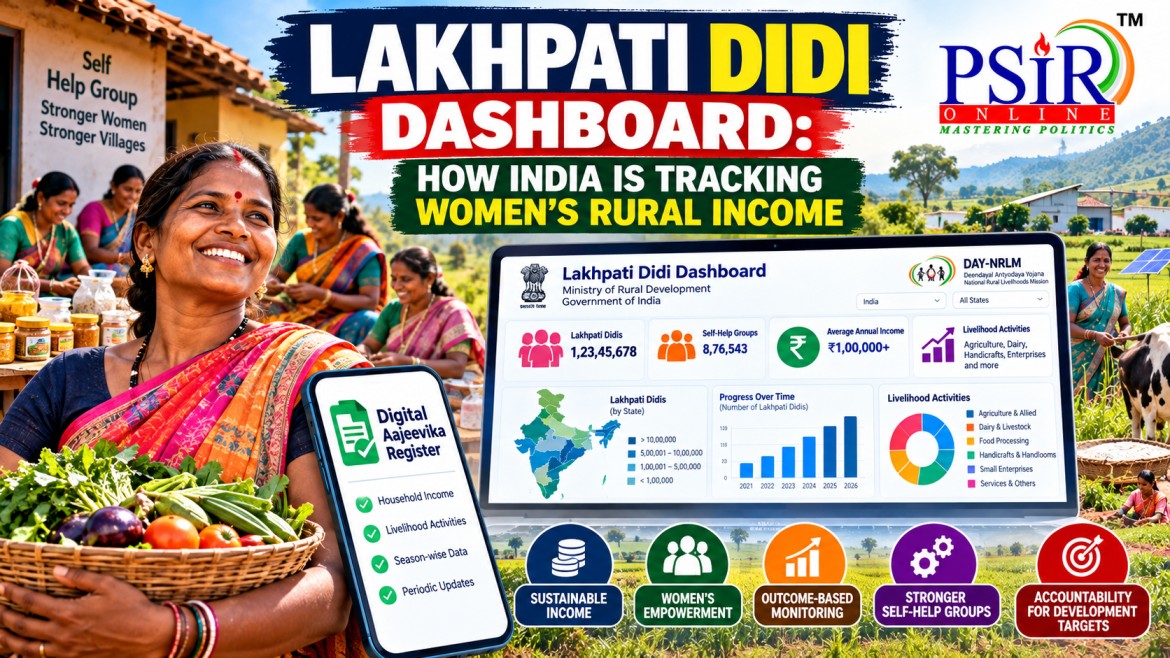
Women’s empowerment programmes are increasingly being evaluated not merely by the number of beneficiaries reached, but by their ability to generate sustained improvements in income, financial security and economic independence. The Lakhpati Didi initiative, implemented under the Deendayal Antyodaya Yojana–National Rural Livelihoods Mission (DAY-NRLM), reflects this shift towards measurable livelihood outcomes.
On 29 June 2026, the Ministry of Rural Development launched the Lakhpati Didi Dashboard, alongside the SHE LEAPS digital platform, to strengthen the monitoring and promotion of rural women’s livelihoods and enterprises. The launch was announced at the Rashtriya Gramin Vikas Sammelan.
The dashboard is significant because it connects a national development target with household-level livelihood information. However, its ultimate value depends on whether the data helps governments identify income gaps, improve implementation and ensure that women’s economic gains are sustained over time.
WHAT IS THE LAKHPATI DIDI INITIATIVE?
A Lakhpati Didi is a woman associated with a Self-Help Group (SHG) whose household earns at least ₹1 lakh annually through livelihood activities on a sustainable basis. The official framework specifies that income should be assessed across at least four agricultural seasons and/or business cycles, with an average monthly income of around ₹10,000 or more. The emphasis is therefore on sustained income rather than a temporary increase in earnings.
The initiative operates through DAY-NRLM, which organises rural women into SHGs and supports them through financial inclusion, capacity-building, credit access and livelihood development.
The income target can be pursued through multiple activities, including:
· Agriculture, horticulture and allied activities.
· Dairy farming, livestock rearing and fisheries.
· Food processing, handicrafts and handlooms.
· Small manufacturing, trading and service enterprises.
· Wage employment, commissions and other income-generating activities.
The objective is to diversify household income and reduce dependence on a single, uncertain source of livelihood. The official strategy also emphasises access to productive assets, skills, bank finance, market linkages and convergence with other government programmes.
WHAT DOES THE DASHBOARD MONITOR?
The Lakhpati Didi Dashboard provides a digital interface for tracking progress under the initiative. It makes programme information accessible through a centralised platform, allowing users to view the scale of implementation and the reported progress of women’s livelihood development.
Its significance lies in the potential to connect information about beneficiaries, livelihood activities and programme implementation with decisions taken by administrators.
The dashboard must be understood alongside the Digital Aajeevika Register, which records the livelihood activities and income of SHG households. The register is designed to support planning at the village level and is maintained through the Village Organisation (VO) structure. It is updated every six months, linked to agricultural seasons or the completion of business cycles.
The register captures several categories of income and support, including:
· Income from agriculture and allied activities, calculated after deducting relevant expenses.
· Net income from manufacturing, trading and service enterprises.
· Salary, fees, honoraria and earnings from work.
· Commission income, remittances and other income sources.
· Information about financial support, bank linkages and grants or loans.
This is important because rural household income is often generated through a combination of seasonal agriculture, livestock, wage work and small enterprises. Recording these sources can provide a more complete picture than relying on a single activity or one-time survey.
The official implementation process also envisages training staff and community resource persons, data entry through the management information system, district-level monitoring and periodic third-party evaluation to check data authenticity.
The public dashboard provides a monitoring interface, while the Digital Aajeevika Register is an underlying tool for recording and assessing livelihood information. They are complementary elements of the wider monitoring framework.
THE ROLE OF SELF-HELP GROUPS IN INCOME GENERATION
Digital monitoring alone cannot generate income. The economic foundation of the Lakhpati Didi initiative is the network of Self-Help Groups and their federations, which connects rural women with finance, skills, collective action and markets.
SHGs can help women pool savings, access formal credit, develop financial literacy and undertake livelihood activities collectively. Their federations and community resource persons can assist in preparing livelihood plans, identifying suitable enterprises and connecting women with relevant government schemes and technical support.
For example, a woman may combine dairy farming with vegetable cultivation or food processing. Such diversification can reduce the risk associated with crop failure, seasonal demand or fluctuations in prices. However, the viability of each activity depends on local conditions, access to working capital, infrastructure and reliable buyers.
The official Lakhpati Didi strategy envisages convergence with programmes relating to rural employment, skills, agriculture, horticulture, animal husbandry, food processing and enterprise development. It also recognises the importance of branding, packaging, e-commerce and other market linkages.
The dashboard can strengthen this ecosystem by helping administrators identify where progress is uneven and where additional support may be needed. For example, if income gains are limited in a particular area, the underlying issue may be inadequate credit, insufficient training, weak market access or a lack of productive assets.
The governance lesson is that data should trigger support, not merely produce rankings or reports.
FROM BENEFICIARY COUNTING TO OUTCOME-BASED GOVERNANCE
Traditional welfare monitoring often focuses on inputs and outputs: money released, loans sanctioned, women trained, SHGs formed or beneficiaries identified. These measures are important, but they do not necessarily establish whether household income has improved or whether the improvement has lasted.
The Lakhpati Didi framework offers an opportunity to move towards outcome-based monitoring.
|
Monitoring dimension |
What it should establish |
|
Coverage |
How many eligible women and SHG households have been reached? |
|
Livelihood development |
Which income-generating activities are being undertaken, and what support has been provided? |
|
Income outcomes |
What is the household’s net income across relevant activities and seasons? |
|
Sustainability |
Does income remain at or above the benchmark across the required seasons or business cycles? |
|
Economic resilience |
Has income become more diversified, and can the household manage seasonal shocks or business setbacks? |
|
Corrective action |
Are gaps in credit, training, infrastructure or market access being addressed? |
The first two dimensions primarily track reach and implementation. The remaining dimensions help determine whether the initiative is achieving its intended outcomes.
The distinction matters for accountability. A woman may receive a loan, complete a training programme or start an enterprise without generating a sustainable profit. Similarly, gross sales should not be confused with net income after expenses. A single profitable season does not necessarily establish long-term economic security.
The Digital Aajeevika Register’s periodic recording of livelihood income can support a more consistent assessment. However, reliable conclusions depend on the quality of the underlying data, appropriate verification and the ability of administrators to respond to identified problems.
The public dashboard should therefore be viewed as an instrument for monitoring and decision-making, not independent proof that every reported beneficiary has achieved durable economic independence.
CHALLENGES AND THE WAY FORWARD
Several challenges will determine whether digital monitoring translates into meaningful economic outcomes.
First, data quality and verification: Household income can fluctuate across seasons, and records may be incomplete or inaccurate. Clear definitions of income, consistent reporting practices and credible verification are essential. The official framework’s provision for periodic third-party evaluation is relevant in this context.
Second, the difference between household and individual empowerment: The income benchmark is based on household income. While this is useful for assessing family livelihoods, it does not automatically establish that the woman has control over income, assets, savings or business decisions. Monitoring should therefore be complemented by evidence of women’s agency and financial autonomy.
Third, regional and social inequalities: Women’s opportunities vary according to land ownership, education, caste and social position, access to markets, geography and household responsibilities. A uniform target must be accompanied by context-sensitive livelihood plans and support for vulnerable households.
Fourth, market and climate risks: Small enterprises may face weak demand, price fluctuations, transport costs and limited access to storage or processing facilities. Agricultural and livestock-based incomes are also exposed to climate-related shocks. Credit and training must be complemented by viable market linkages, risk management and appropriate infrastructure.
Fifth, digital capacity and accountability: Community resource persons and local institutions require adequate training and support. Administrators must also ensure that data entry does not become a compliance exercise disconnected from field realities. Public reporting should protect personal information while enabling citizens and institutions to scrutinise aggregate progress.
A practical way forward is to link dashboard indicators to time-bound corrective action. If a household remains below the income benchmark, the monitoring system should help identify the constraint and connect the woman with suitable credit, training, technical assistance or market opportunities. Independent evaluation should examine both the accuracy of reported income and the durability of livelihood gains.
UPSC ANGLES
|
Dimension |
Relevance for UPSC GS-II |
|
Governance and accountability |
Demonstrates the use of dashboards, management information systems and outcome indicators in monitoring development programmes. |
|
Women’s empowerment |
Connects economic empowerment with financial autonomy, decision-making power and control over productive resources. |
|
SHGs and participatory development |
Illustrates how community institutions can support credit access, collective action and livelihood planning. |
|
Social justice and inclusion |
Raises questions about whether disadvantaged women and remote rural households can access programme benefits equitably. |
|
Digital governance |
Highlights the benefits and limitations of digitised records, data quality, privacy and administrative capacity. |
|
Rural economy and employment |
Links income diversification, women-led enterprises, agricultural livelihoods and non-farm employment. |
|
Public policy evaluation |
Illustrates the difference between inputs, outputs, outcomes and long-term impacts in programme assessment. |
|
Cooperative federalism |
Requires coordination among the Union government, State Rural Livelihood Missions, district administrations and village-level institutions. |
|
Sustainable development |
Connects women’s livelihoods with poverty reduction, gender equality and resilient rural development, particularly SDGs 1, 5 and 8. |
|
Implementation reforms |
Suggests linking identified income gaps with corrective support, market access and independent verification rather than relying solely on beneficiary totals. |
CONCLUSION
The Lakhpati Didi Dashboard represents an important development in the monitoring of women-centred rural livelihood programmes. By combining public reporting with the Digital Aajeevika Register’s periodic recording of income and livelihood activities, it creates an opportunity to assess development through more meaningful indicators.
Nevertheless, recording beneficiaries is not the same as securing economic independence. The real test is whether women can sustain adequate income, diversify their livelihoods, withstand economic shocks and exercise greater control over household resources.
For the dashboard to fulfil its governance potential, digital information must lead to timely administrative action, credible verification and stronger support for women-led enterprises. The ultimate measure of success should be not simply how many women are counted, but how many are able to maintain dignified and economically secure livelihoods.
OFFICIAL REFERENCES AND FURTHER READING
PRACTISE QUESTIONS FOR GS2 MAINS
10 marks — 150 words
15 marks — 250 words
