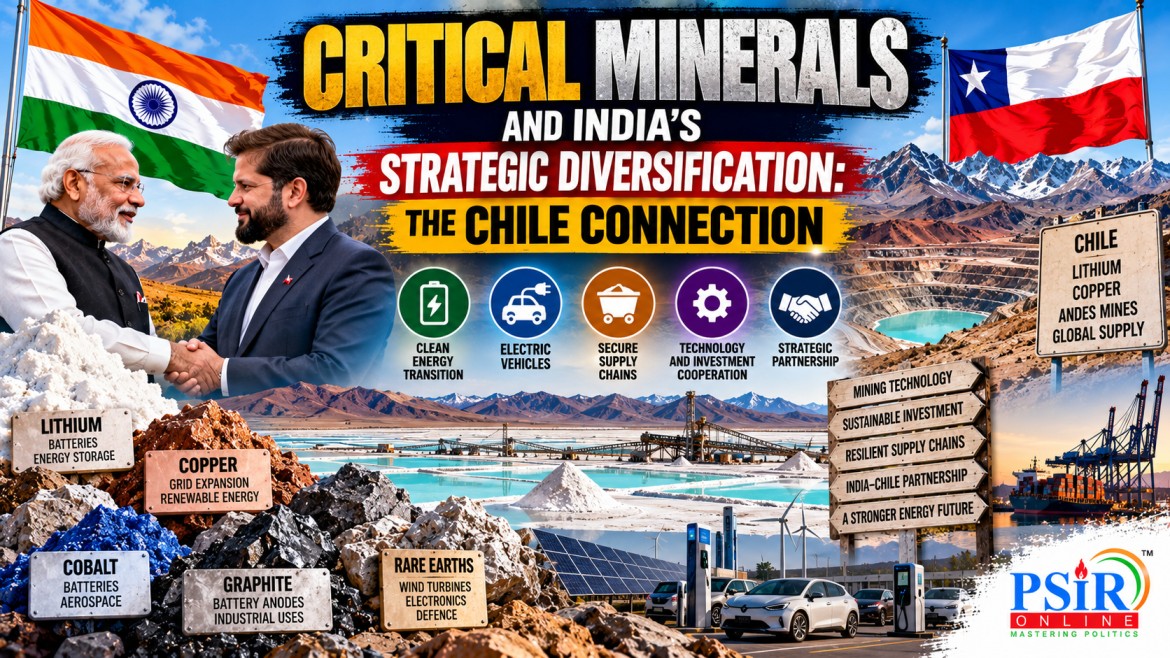
The global energy transition is transforming critical minerals into instruments of economic security and geopolitical influence. Lithium, cobalt, nickel, graphite, copper and rare earth elements are essential to electric vehicles, battery storage, renewable-energy infrastructure, electronics, telecommunications and defence technologies. Their strategic significance arises not simply from geological scarcity, but from the geographical concentration of mining, refining and advanced manufacturing.
For India, this creates a major policy challenge. The country is expanding its renewable-energy capacity, electric-mobility ecosystem, electronics manufacturing and domestic industrial base. Yet its dependence on imported critical minerals and processed materials exposes these sectors to supply disruptions, export restrictions, price volatility and geopolitical competition.
Against this background, engagement with Chile has acquired strategic importance. During June 2026, India’s diplomatic and commercial engagement with Chile included discussions on lithium and other critical minerals, investment opportunities, sustainable mining and industrial innovation. On 2 June, a delegation from Coal India Limited met Chilean authorities to explore cooperation in strategic mineral sectors. India also participated in EXPONOR 2026, a major mining and energy exhibition in Antofagasta, from 8 to 11 June. The engagement included discussions on mining technology, industrial partnerships and financial cooperation.
The central issue is how India can use partnerships with resource-rich countries to diversify supply without creating new dependencies. Strategic mineral security requires more than access to raw materials: it requires diversified suppliers, processing capabilities, technological capacity and long-term institutional cooperation.
WHY CRITICAL MINERALS MATTER TO INDIA’S ECONOMIC SECURITY
Critical minerals are materials whose supply disruptions could significantly affect important economic or strategic sectors. Their importance varies according to industrial requirements, technological alternatives, import dependence and the availability of substitutes.
Lithium is used in rechargeable batteries, while cobalt and nickel are important inputs for several battery chemistries. Graphite is used in battery anodes, and copper is indispensable for electricity networks, electric vehicles, renewable-energy systems and industrial equipment. Rare earth elements are important in permanent magnets used in wind turbines, electric motors, electronics and certain defence applications.
Three features make these minerals strategically sensitive.
First, geographical concentration creates exposure to political instability, export restrictions and logistical disruptions. A mineral may be available in several countries, yet its commercially viable production may remain concentrated in a few locations.
Second, mining and processing are different stages of the value chain. Possessing mineral deposits does not automatically provide the capacity to refine them into battery-grade chemicals, manufacture components or produce finished technologies. Processing technology, capital investment, environmental clearances and industrial infrastructure are crucial.
Third, critical-mineral demand is connected to India’s wider developmental objectives. The energy transition, advanced manufacturing, grid expansion and digital infrastructure will require reliable access to specialised materials over the coming decades.
India’s National Critical Mineral Mission, approved in January 2025, adopts a value-chain approach covering exploration, mining, beneficiation, processing, recycling and overseas asset acquisition. The mission has a proposed expenditure of ₹16,300 crore and envisages an additional ₹18,000 crore in investment by public-sector enterprises and other stakeholders.
The policy challenge is therefore not merely to reduce imports. It is to reduce strategic vulnerability while building domestic industrial capacity.
INDIA’S CRITICAL-MINERAL POSITION: RESOURCES, IMPORT DEPENDENCE AND EXTERNAL CONCENTRATION
India’s geological potential and its ability to meet domestic demand are not the same. The Geological Survey of India has reported cumulative resources of several critical minerals, but resource estimates do not establish that deposits are commercially recoverable or currently producing.
The following table draws on Government of India and NITI Aayog assessments. Import-dependence estimates refer to the assessment period used by the cited reports, principally 2025, and should not be interpreted as a measure of current-month imports.
|
Critical mineral |
India’s position and major external dependence |
|
Lithium |
India has reported 12.3 million tonnes of lithium resources in the Geological Survey of India’s cumulative resource assessment; this is not equivalent to proven, economically recoverable reserves or current production. Import dependence was assessed at 100%. China is a major lithium-chemical processor; India’s 2025 lithium-carbonate imports included China (34.3%) and Chile (13.6%), while lithium oxide and hydroxide imports included Argentina (32.5%), Belgium (25.6%) and China (22.6%). |
|
Cobalt |
India has reported limited geological occurrences, but commercial domestic supply remains inadequate and import dependence was assessed at 100%. The Democratic Republic of the Congo (DRC) dominated mined cobalt production in 2025, while China is a leading refiner. Belgium and South Africa together accounted for 85.7% of India’s reported cobalt imports in 2025, partly reflecting processing and trading hubs rather than the original mining locations. |
|
Nickel |
India has reported approximately 4.8 million tonnes of resources in the Government’s cumulative assessment, but domestic commercial supply remains inadequate; import dependence was assessed at 100%. Indonesia dominated global mined nickel production in 2025. China supplied 26.2% of India’s nickel imports, followed by Japan (13.5%) and the United States (9.0%). |
|
Graphite |
India has reported 72.91 million tonnes of graphite resources, but resource estimates do not indicate how much can be economically mined and processed. The NITI Aayog assessment estimated import dependence at 28% for the relevant category. Natural graphite imports were led by Madagascar (36.1%) and Tanzania (30.5%), whereas China supplied 52.3% of India’s synthetic graphite imports. China also dominates important downstream graphite-processing and anode-manufacturing segments. |
|
Copper |
India has substantial domestic copper resources but remains dependent on imports for a significant share of demand. NITI Aayog assessed import dependence at 57%. India’s copper-ore import market is exposed to major mining suppliers such as Chile, while refined copper and other copper products come from a more diversified set of countries. Japan, Tanzania and the UAE together supplied 45% of India’s reported copper imports in 2025. |
|
Rare earth elements (REEs) |
India has reported 310.94 million tonnes of rare-earth-bearing mineral resources, including monazite-bearing deposits; this figure refers to mineral resources and is not equivalent to recoverable rare-earth oxide reserves. Commercial extraction, separation and magnet manufacturing remain important constraints. China dominates several stages of global rare-earth separation, refining and permanent-magnet production, creating a strategic vulnerability even where alternative geological resources exist. |
Sources: Ministry of Mines and Press Information Bureau, March 2025; NITI Aayog, Trade Watch, April–June 2026; NITI Aayog critical-mineral assessments. The figures use different reporting categories and should not be compared as if they were all measured in the same way.
The table reveals three distinct challenges. India remains highly import-dependent for lithium, cobalt and nickel; graphite shows different vulnerabilities across natural and synthetic forms; and copper presents a combination of domestic production, imported raw materials and rising industrial demand. Rare earth security depends not only on deposits but also on processing and magnet manufacturing.
Import dependence and supplier concentration are separate risks. India may import a mineral from several countries while still depending on a small number of countries for refining, conversion into battery-grade materials or the manufacture of essential components.
This distinction explains why strategic diversification must cover the entire value chain rather than merely the geographical origin of imported ore.
WHY CHILE MATTERS: LITHIUM, COPPER AND SUSTAINABLE MINING
Chile occupies an important position in global mineral supply chains, particularly in copper and lithium. Its mineral sector offers India opportunities to diversify sourcing, build commercial partnerships and learn from established mining and processing ecosystems.
The lithium connection is especially relevant. Chile possesses major lithium resources associated with salt-flat brines and has an established industry supplying international markets. India’s growing demand for batteries creates an incentive to pursue long-term supply arrangements and partnerships with Chilean producers. However, access to Chilean lithium should complement other suppliers, including Argentina and Australia, rather than become a new single-source dependency.
Copper is another important dimension. The expansion of renewable-energy systems, electricity transmission, charging infrastructure and industrial manufacturing is likely to sustain India’s demand for copper. Chile is a major global copper producer, and closer cooperation could support mineral sourcing, investment and technical collaboration.
The June 2026 engagement reflected these broader possibilities. On 2 June, Coal India Limited representatives met Chile’s Ministry of Mining to discuss lithium, other critical minerals and investment opportunities. During EXPONOR 2026, Indian officials engaged with Chilean mining stakeholders, including industry representatives, and explored opportunities in mining technology and industrial innovation. Separate discussions with Chilean financial authorities on 16 June covered financial markets, sustainable finance, investment promotion and regulatory exchanges.
These activities should be understood as opportunities for cooperation, not evidence that India has already secured a comprehensive supply arrangement. Exploration, commercial negotiations, investment decisions and long-term supply contracts are distinct stages.
The value of the Chile partnership will depend on whether dialogue produces commercially viable agreements, reliable deliveries, technology cooperation and greater resilience across the supply chain.
FROM MINERAL DIPLOMACY TO INDUSTRIAL CAPABILITY
Access to minerals is only the beginning of the strategic process. Countries that control processing technologies, battery materials, components and manufacturing ecosystems can capture a greater share of the economic value generated by mineral resources.
India therefore needs to pursue a broader strategy that links overseas partnerships with domestic industrial development.
First, secure diversified supply. Long-term offtake agreements, equity participation in overseas mining projects and cooperation with resource-rich countries can improve access to essential minerals. Partnerships with Chile should be complemented by engagement with Argentina, Australia, African producers and other reliable suppliers.
Second, develop processing and refining capacity. Imported concentrates and raw materials do not automatically translate into domestic battery production. Investment is needed in chemical conversion, mineral separation, specialised refining, quality certification and advanced materials. Environmental safeguards and reliable access to energy and water will be essential.
Third, strengthen technology partnerships. Chile’s mining sector offers opportunities in exploration technology, automation, water-efficient mining, mineral recovery and environmental management. Indian engineering, digital and industrial firms can contribute to these activities while acquiring expertise relevant to domestic mineral projects.
Fourth, expand recycling and secondary recovery. Used batteries, electronic waste, industrial residues and end-of-life equipment can provide secondary sources of lithium, cobalt, nickel and other materials. Recycling cannot immediately replace primary mining, but it can reduce exposure to external disruptions over time.
Fifth, improve the domestic investment environment. Mineral exploration and mine development require long lead times, geological data, predictable regulation, environmental clearances and infrastructure. India’s domestic resource potential will remain underutilised if exploration and processing are commercially unviable or administrative processes are uncertain.
The strategic objective is to move from a model based mainly on importing materials towards participation in higher-value segments of the critical-mineral economy.
ECONOMIC SECURITY, GEOECONOMICS AND THE RISK OF NEW DEPENDENCIES
Critical-mineral diplomacy is an example of geoeconomics: the use of economic relationships, trade, investment and control over strategic resources to advance national interests.
Minerals can become instruments of leverage when supply is concentrated or when processing capacity is difficult to replace. Export restrictions, production quotas, sanctions, logistical disruptions and sudden changes in global prices can affect industrial production far beyond the mining sector.
India’s exposure is particularly significant where domestic production is limited and processing capacity is concentrated abroad. China’s role in graphite processing, lithium chemicals and rare-earth supply chains illustrates how industrial concentration can create strategic influence even when the underlying mineral is mined elsewhere.
Yet replacing dependence on one supplier with dependence on another would not provide durable security. Chile may offer diversification in lithium and copper, but a resilient strategy must account for commercial risk, environmental regulation, infrastructure constraints, changes in global prices and the possibility of political or logistical disruption.
Economic security therefore requires a portfolio approach: several reliable suppliers, strategic stocks where appropriate, domestic processing, recycling, research into substitutes and transparent commercial arrangements.
India must also balance resource security with environmental and social concerns. Lithium extraction can create pressures on water resources and local ecosystems; copper mining can generate waste and land-use conflicts. Partnerships that disregard environmental standards or local communities may face delays and undermine their long-term viability.
A sustainable approach should incorporate environmental assessment, water management, local consultation and responsible supply-chain practices. Economic security is not simply the ability to obtain raw materials at the lowest price; it is the ability to maintain dependable access without creating unacceptable environmental, social or strategic costs.
POLICY PRIORITIES: BUILDING A DIVERSIFIED CRITICAL-MINERAL PARTNERSHIP
India’s cooperation with Chile can contribute to a wider critical-mineral strategy through several practical measures.
· Establish long-term commercial arrangements: Explore bankable offtake agreements for lithium, copper and relevant processed products, with transparent pricing and delivery provisions.
· Promote joint investment: Encourage Indian public- and private-sector participation in viable mining, processing and infrastructure projects, subject to commercial and environmental due diligence.
· Build technology cooperation: Develop joint work in mineral exploration, efficient extraction, water management, automation, mineral recovery and sustainable mining.
· Link overseas access to domestic value addition: Ensure that supply arrangements support Indian capabilities in refining, battery materials, components and recycling rather than only raw-material imports.
· Diversify beyond Chile: Maintain complementary partnerships across Latin America, Australia, Africa and other regions to reduce concentration risk.
· Strengthen strategic monitoring: Track import dependence, supplier concentration, processing bottlenecks, price volatility and exposure to export restrictions. Strategic stockpiles may be appropriate for selected minerals and materials with high disruption risks.
· Expand recycling and research: Support battery recycling, recovery from industrial residues, alternative battery chemistries and research into material efficiency.
Progress should be evaluated through measurable outcomes: the number and reliability of supply arrangements, the diversification of import sources, domestic processing capacity, recycling volumes, technology transfer and the share of higher-value production undertaken in India.
The key test is whether external partnerships improve India’s resilience across the entire supply chain. A successful mineral partnership should expand India’s choices, not simply change the country from which it imports.
THEORETICAL ANGLES
|
Theory or concept |
Application to India’s critical-mineral diplomacy |
|
Geoeconomics |
Minerals, investment and supply contracts become instruments through which states pursue economic security and strategic influence. |
|
Economic statecraft |
Overseas investment, long-term offtake agreements and technology partnerships help secure resources required for strategic industries. |
|
Complex interdependence |
India and Chile can develop mutually beneficial links in mining, finance, technology and industrial supply chains, although these links may also create vulnerabilities. |
|
Strategic autonomy |
Diversifying mineral suppliers and building domestic processing capacity can widen India’s policy choices and reduce exposure to external pressure. |
|
Dependency theory |
Countries that export raw materials while importing higher-value processed products may capture a limited share of the value chain. India must therefore pursue domestic processing and technological upgrading. |
|
Resource diplomacy |
Bilateral engagement with mineral-rich states can support access to resources, investment, expertise and long-term supply arrangements. |
|
Liberal institutionalism |
Transparent contracts, stable rules, investment frameworks and technical cooperation can reduce uncertainty and support sustained cross-border partnerships. |
|
Sustainable development |
Mineral security must be reconciled with water use, biodiversity, local livelihoods, environmental safeguards and responsible mining practices. |
CONCLUSION
Critical minerals have become central to the relationship between economic development and national security. India’s growing demand for batteries, renewable-energy systems, electronics and advanced manufacturing makes dependable mineral supply an important strategic priority. Yet geological resources alone cannot guarantee security when domestic extraction, processing and value addition remain limited.
Chile offers India opportunities to diversify lithium and copper sourcing, cooperate in sustainable mining and develop commercial and technological partnerships. The June 2026 engagement demonstrates the potential for deeper cooperation, but its strategic value will depend on whether discussions lead to viable projects, dependable supply and industrial capability.
India’s long-term objective should be to combine overseas access with domestic exploration, processing, recycling and research. It must also diversify across countries and technologies rather than substitute one concentrated dependency for another.
Ultimately, critical-mineral security is achieved not by controlling every resource, but by ensuring that no single external vulnerability can seriously constrain national development.
RELATED READING
PRACTICE QUESTIONS FOR GS2 MAINS
PRACTICE QUESTIONS FOR PSIR PAPER II
