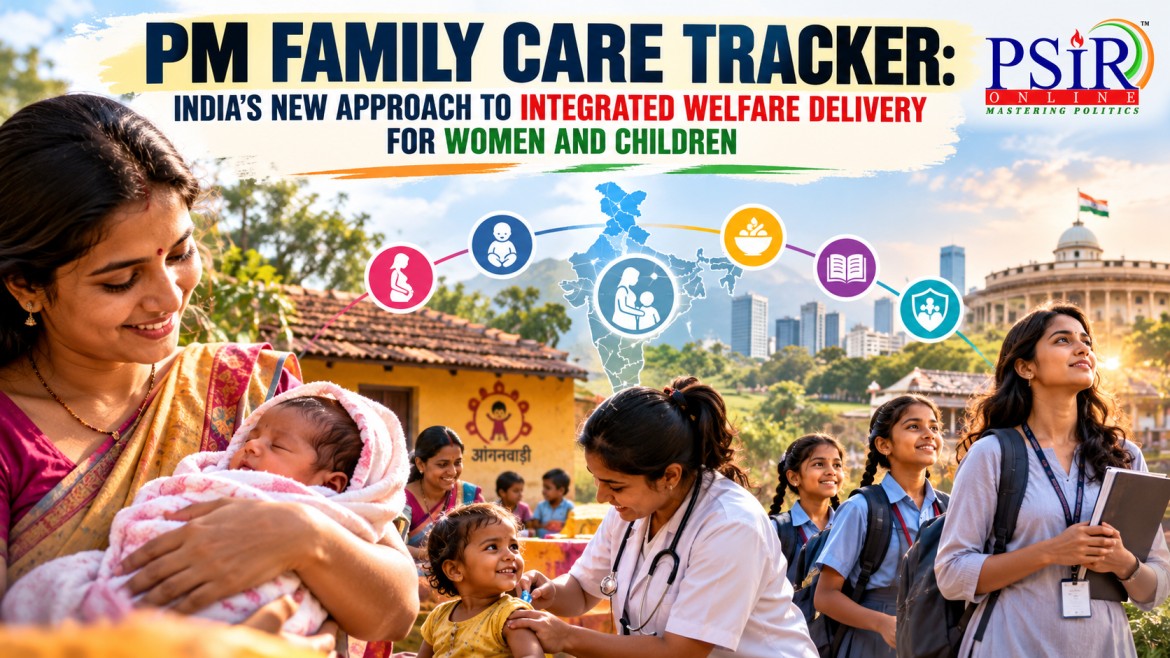
India has a large network of welfare programmes for women and children covering maternal healthcare, immunisation, nutrition, education and social protection. However, these programmes are generally administered through different departments and delivery systems. A family may therefore interact with the health system during pregnancy, the Anganwadi system for nutrition, the education system when the child enters school and several other government agencies at different stages.
The PM Family Care Tracker (PM-FCT) seeks to address this fragmentation by creating an integrated system for tracking the welfare journey of women and children.
THE 2026 DEVELOPMENT: WHAT IS PM-FCT?
On 28 June 2026, Union Home Minister and Minister of Cooperation Amit Shah launched the pilot project of the PM Family Care Tracker in Gandhinagar, Gujarat. The pilot brings together information relating to pregnancy, birth, health, nutrition and education with the objective of improving beneficiary identification and ensuring timely delivery of government services.
The programme is designed to follow beneficiaries from pregnancy through childhood and adolescence, up to 18 years of age. The system uses a unique identification mechanism linked with the Birth Registration Number (BRN) or ABHA ID, allowing information relating to different stages of a beneficiary's life to be connected.
The initial pilot is being implemented in Gandhinagar and brings together departments dealing with health, women and child development and education. At the launch, Health Passports were also issued to children, while polio vaccination and nutrition kits were provided to children, pregnant women and lactating mothers.
The government describes PM-FCT as a mechanism to strengthen beneficiary identification, government outreach and last-mile delivery of welfare services. Rather than creating one more standalone welfare benefit, the programme attempts to improve the way existing services reach beneficiaries.
HOW DOES THE PM FAMILY CARE TRACKER WORK?
The basic idea behind PM-FCT is to create a continuing record around the beneficiary. A pregnancy can become the starting point of the tracking process. After birth, the child's information can be connected with the relevant health and welfare systems. As the child grows, the system can continue monitoring areas such as immunisation, nutrition and education.
The intended process can therefore be represented simply as:
Pregnancy → Birth → Health & Nutrition → Immunisation → School Enrolment → School Continuation → Adolescence
The platform is expected to monitor indicators such as vaccination, nutrition, school enrolment and school dropout and generate alerts where intervention may be required.
For example, if a child appears to have missed a scheduled vaccination, the system can potentially flag the case for follow-up. Similarly, if a child is not enrolled in school or subsequently drops out, the information can potentially trigger intervention by the relevant authorities.
The purpose is therefore to move from a system in which government waits for citizens to approach different offices towards a system in which government can identify certain gaps in service delivery and initiate follow-up.
PM-FCT also incorporates the idea of a Health Passport, which was highlighted during the launch. A continuing health record can make it easier to maintain information about a child's health and interventions over time rather than treating every health interaction as an isolated event.
However, the Health Passport should not be confused with ABHA. ABHA is part of the digital health architecture created under the Ayushman Bharat Digital Mission, while PM-FCT is a broader welfare-tracking initiative that can use ABHA as one of its identification mechanisms.
FROM SEPARATE WELFARE SYSTEMS TO AN INTEGRATED TRACKER
PM-FCT builds upon several digital systems that already exist in India. The country already has separate mechanisms for birth registration, digital health records, nutrition monitoring, school education and welfare delivery. The problem is that information generated by one department may not always be automatically available to another department dealing with the same family. A child may therefore appear in one database as a beneficiary of a health programme, in another as an Anganwadi beneficiary and in another as a school student. PM-FCT attempts to connect these different stages.
Consider a simple example. A pregnant woman receives maternal healthcare. Her child is subsequently born and registered. The child receives immunisation and nutrition services. The child enters school. If the child subsequently drops out, the education system needs to know. Instead of treating these as completely separate government interactions, PM-FCT attempts to create a continuous beneficiary journey.
The programme therefore complements existing schemes rather than replacing them. Its purpose is to help government identify whether the appropriate service has reached the appropriate beneficiary. This approach is particularly relevant because India already has a large number of programmes for women and children. The challenge is often not simply creating another scheme but ensuring that eligible beneficiaries do not remain outside the delivery system.
WHAT CAN PM-FCT ACHIEVE?
The first potential benefit is better identification of beneficiaries. Families who are entitled to government services may sometimes remain outside welfare systems because they are unaware of a programme, fail to complete an application or encounter documentation and administrative difficulties. An integrated tracking system can potentially identify such gaps more quickly.
The second is early intervention. Health and education problems become more difficult to address when they are detected late. Monitoring vaccination, nutrition, school enrolment and dropout can allow government agencies to respond earlier.
The third is better coordination between departments. Women and children often require services from several departments at the same time. Maternal health, child nutrition, immunisation and education are interconnected at the level of the beneficiary even though they may be administered separately by government departments. A common tracking mechanism can make coordination easier.
The fourth is the possibility of reducing the burden on citizens to understand the entire welfare system. A poor family may not know every scheme for which it is eligible. If government systems can identify the family and its requirements, welfare delivery can become more proactive.
The fifth is continuity of information. A child moves through several stages of life, but government records can often remain fragmented. Connecting information from pregnancy to childhood and adolescence can provide a more complete picture of the beneficiary.
For social-justice programmes, this can be particularly useful for families that face several disadvantages simultaneously.
A child may experience poor nutrition, inadequate healthcare and interrupted education at the same time. An integrated system can potentially identify these overlapping problems instead of addressing each one separately.
CHALLENGES AND THE WAY FORWARD
The effectiveness of PM-FCT will depend heavily on the quality of the information entering the system. Incorrect birth records, duplicate entries, outdated addresses or inaccurate school information can lead to incorrect identification or missed interventions. Regular updating and mechanisms for correcting errors will therefore be essential.
There is also the question of digital exclusion. A digital welfare system should not become another barrier for families with poor internet connectivity, limited digital literacy or difficulty accessing smartphones and online services. Beneficiaries should continue to have assisted and offline mechanisms for accessing government services.
Data privacy and security will also require careful attention because the platform involves sensitive information relating to pregnancy, maternal health, children's health, nutrition and education. Access to such information needs to be properly controlled, with clear safeguards against unauthorised use or disclosure.
Another important issue is the role of frontline workers. Technology can identify that a child has missed a vaccination, but the technology cannot vaccinate the child. An alert about school dropout is useful only if a teacher, education official or local authority follows up with the family. Similarly, identification of nutritional vulnerability must lead to actual intervention.
Therefore, the delivery chain has to work as:
Digital identification → Alert → Human follow-up → Government service → Outcome
The programme will also require effective coordination between the Union Government, state governments, district administrations and frontline workers. The Gandhinagar pilot can provide an opportunity to identify administrative and technical problems before any wider expansion.
The success of PM-FCT should eventually be measured through actual outcomes rather than simply the number of records created. Important indicators could include:
· Reduction in missed vaccinations.
· Improvement in child nutrition.
· Increase in school enrolment.
· Reduction in school dropout.
· Faster delivery of eligible welfare benefits.
· Reduction in exclusion of vulnerable beneficiaries.
· Better coordination between departments.
The pilot stage therefore provides an opportunity to test whether digital integration actually produces better welfare outcomes on the ground.
CONCLUSION
The PM Family Care Tracker, launched as a pilot in Gandhinagar on 28 June 2026, represents an attempt to improve the delivery of welfare programmes for women and children by connecting information across pregnancy, birth, health, nutrition and education. The system is designed to track beneficiaries up to 18 years of age and monitor indicators including vaccination, nutrition, school enrolment and dropout.
Its central idea is relatively straightforward:
Identify the beneficiary → Know what services are required → Track whether they are received → Detect gaps → Trigger intervention.
The significance of PM-FCT will ultimately depend on what happens after the digital record is created. A database cannot replace an Anganwadi worker, a health worker, a teacher or a district official. Technology can identify a problem, but the welfare system must still act upon it. The real test of PM-FCT will therefore be whether it can convert integrated data into integrated action and, ultimately, ensure that women and children who are entitled to government support are less likely to be missed by the welfare system.
RELATED AREAS OF STUDY
For comprehensive UPSC preparation, students should connect the PM Family Care Tracker (PM-FCT) with the following areas:
PRACTISE QUESTIONS FOR GS2 MAINS
1. The PM Family Care Tracker seeks to move welfare delivery from fragmented schemes to integrated beneficiary tracking. Examine its potential to improve the last-mile delivery of welfare services to women and children. (15 Marks, 250 Words)
2. Digital integration of health, nutrition and education data can improve welfare delivery, but may also create challenges of exclusion, privacy and data security. Discuss in the context of the PM Family Care Tracker. (10 Marks, 150 Words)
3. “Technology can identify welfare gaps, but effective social welfare ultimately depends on institutional coordination and frontline implementation.” Discuss with reference to the PM Family Care Tracker. (10 Marks, 150 Words)
4. India has numerous welfare schemes for women and children, yet ensuring that eligible beneficiaries receive the appropriate services remains a challenge. How can the PM Family Care Tracker address this implementation gap? (15 Marks, 250 Words)
